



Toronto’s Leslie Feist isn’t interested in following convention. She’s an artist and goes where the music takes her, so when her latest album, Pleasure, was released in the spring, no one was surprised by the gloriously subtle and sparse backdrop for her emotionally wrought and introspective lyrics, and it soon garnered significant critical acclaim. So has it always been with Feist from her 1999 solo debut, Monarch, to Let It Die and, of course, The Reminder, which launched her to international stardom with her hit “1234.” Since the big hit days, she’s dialed back the soundscape, first with the brilliant Metals in 2011 and now Pleasure. She is bold and disarmingly honest with a beautiful and arresting voice. Seeing her at Massey on Sept. 24 is as good as it gets.
Three fashion month finds all from local sources

There seems to be a frenzy of Fashion Week fever in Toronto this month with events ranging from Toronto Fashion Week (TFW) in Yorkville, to Toronto Men’s Fashion Week (TOM), Sept. 26 to Oct. 1 downtown, and ReSet Fashion at the Great Hall on Queen West. Here’s a guide to some of the designers who will be showing and where to get your hands on the perfect Fashion Week outfit.
Fun and fresh streetwear
Get Fresh is getting a fresh start with an opening night TOM runway show on Sept. 29 at 5 p.m. Owner Jebril Jalloh launched his first ever spring collection earlier this year, and says this 2018 spring collection he will be showing at TOM will focus both on menswear and streetwear. Jalloh’s take on more polished streetwear includes embroidered hoodies and coach jackets with a focus on high-quality fabrics, unique fits and suave cuts. Get Fresh is also working on a collaboration with Puma to put out two pairs of sneakers on Nov. 24, working off a body that The Weeknd is introducing in September but adding its own unique twist.
Get Fresh Company, 498 Queen St. W.
Androgyny meets feminity
Your Choice has been a purveyor of high-end women’s fashion since 1975. Designers featured at Your Choice often push the boundaries of what is socially acceptable. This season, look no further than TFW featured Unttld’s Fall 2017 collection. The Montreal-based brand is a luxury line that leans strongly toward androgyny but with cuts that seem to accent a woman’s features, giving her a bold look from head to toe. Unttld favours shades of black and white rather than stark colour schemes, lending an edge to each fantastic piece. Catch Unttld’s runway show in Yorkville on Sept. 6 at 6:30 p.m.
Your Choice, Bayview Village
Where art and fashion collide
There are very few Canadian boutiques that base their esthetic on contemporary Canadian art, yet All About Eve embraces it. Paintings by the Canadian artist John Scott and light installations by Sakis fit along seamlessly with eclectic designers like Casa Como, It Fitz Me and Hilary MacMillan. MacMillan is also showing her spring/summer 2018 collection Sept. 5 to 6 at ReSet. Her collection has a tropical Spanish feel with green palm prints and blue-and-white striped bird and floral motifs. For more of a fall vibe, pick up the oversized knit with tie closure sweater and silky duster.
All About Eve Boutique, 602 Danforth Ave.
Taste Test: Victor Barry helps pick the best options for pint-sized, plant-based eaters
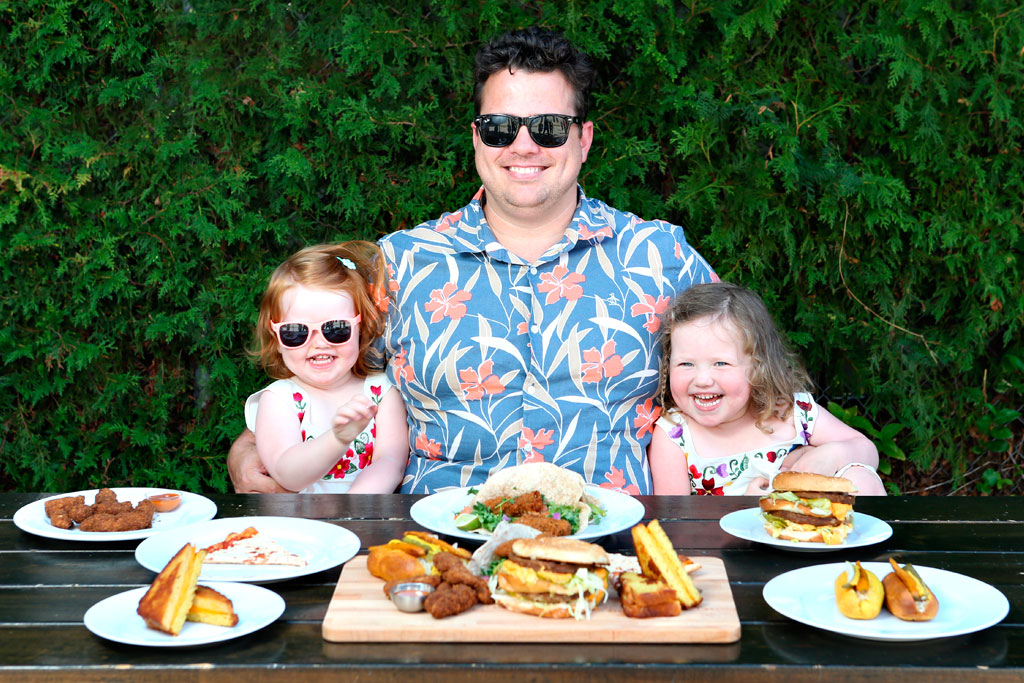
Are you and your family ready to go meat-free? We had chef Victor Barry of Piano Piano and the new restaurant Cancan — along with his two daughters, Sofie, age two, (left) and Charlotte, age three — sample the best kid-friendly vegan food from around Toronto. Which one tickled the toddlers’ taste buds? Read on.
Mac attack
Doomie’s, 1263 Queen St. W., $16
“OK, that’s trashy and delicious,” Victor says, slightly embarrassed at how much he enjoys this vegan burger. “It’s better than a Big Mac.” After declaring this option his favourite, his daughters follow suit. “But I can’t eat a whole one,” Charlotte laments.
It’s been a slice
Pizza Del Arte, 1480 Bathurst St., $9 for medium
“I want pizza!” Charlotte says, excited to tuck into this vegan slice. Charlotte laughs after biting into it, but Victor is skeptical. “With a vegan pizza, why use cheese?” he wonders. “There are so many things you can put on pizza.”
Hot diggity dog
Planta, 1221 Bay St., $17.50
“This is a really cool idea,” Victor says of Planta’s vegan hot dog, which uses a baby carrot in the place of a frankfurter. “It’s very reminiscent of a ballpark hot dog.” Charlotte holds out a piece of the pickle to share with her dad. “It’s good, right?” she says.
Flour power
Fresh, 90 Eglinton Ave. E., $10
“I like a good flour tortilla,” Victor says. “But why is the squash deep-fried? Why is the kale not dressed?” He’s disappointed that this vegan taco with jalapeno and lime taco sauce does not make better use of seasonal summer vegetables.
Golden opportunity
Sorelle & Co., 1050 Rutherford Rd., $8.50
Victor appreciates the golden-brown crust on this gluten-free, vegan grilled cheese sandwich. “This is something I’d make for my kids at home,” he says, “but I couldn’t make gluten-free bread better than this.” The sandwich is done with a gold and brown challah bread and vegan cheese.
Playing chicken
Grasshopper, 310 College St., $5.50
The girls can’t wait to dig into these meat-free “chick-un” nuggets. “Can we eat yet?” Sofie asks before digging in. “It reminds me of a grocery store chicken finger,” Victor says, nodding in approval, while Sofie keeps going back for more.
Raising vegetarians: Do your kids really need meat?
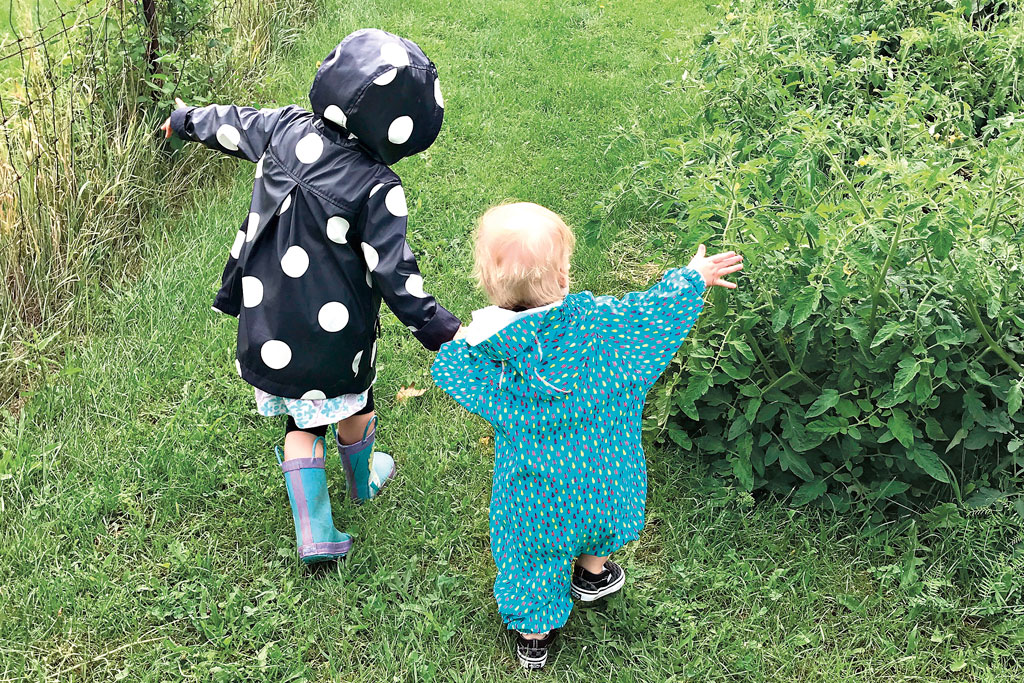
Shortly after the birth of her daughter Isabelle a few years ago, Toronto vegan Laila Upeslacis found a pediatrician and indicated that she planned on raising her child on a plant-based diet.
At first, the pediatrician was concerned. It would be best to keep Isabelle on a non-vegan diet for her first five years of life, the pediatrician said, to ensure that her nutritional needs were adequately met.
But Upeslacis consulted a nutritionist and did her research. She wanted her daughter to grow up without depending on animal products, so she stood firm in her decision.
Today, three-year-old Isabelle and her one-year-old brother Ben are happy and healthy on their vegan diets. They eat lots of wholesome, home-cooked food, and nutrients that are hard to come by from vegetables only — such as vitamin B12 — are carefully supplemented. As a result, the once-skeptical pediatrician is now fully on board.
“It’s just adjusting your way of thinking,” Upeslacis says. “Instead of just having meat, starch and vegetables, it’s a new way of looking at how to cook.”
As more and more parents choose to raise their children on vegan or vegetarian diets, concerns are on the rise. International newspaper headlines have warned of the potential health risks, and last year, a one-year-old boy from Milan who was on a strictly vegan diet was removed from his parents’ care after doctors discovered he was severely malnourished.
Meredith Deasley, a GTA-based pediatric nutritionist, says she has seen first-hand the effects of poorly executed vegan diets in children. She recalls consulting with the parents of a 13-year-old girl who was not reacting well to her plant-based nutritional intake.
“She was so pale, so emaciated,” Deasley says. “I told them to try eggs and fish just to see what would happen. Three weeks later, she was thriving.”
The problem, Deasley says, is that it can be difficult to anticipate nutritional deficiencies that can occur when removing certain food items that are considered staples in Western diets. Vitamin B12, she says, is available only through non-vegan sources, so it needs to be supplemented. Protein and healthy fats, too, need to be rigorously sought out from sources such as legumes, nuts and seeds.
“These kids are growing. It’s like a bodybuilder — if they want to build muscle, they have protein shakes. The protein helps them grow.”
Nutrition can be a complicated topic, and relying solely on plants adds extra layers of nuance. But any diet — vegan, vegetarian or omnivorous — can be unhealthy if a lackadaisical approach is taken.
“Nowadays we have to earn our health,” Deasley says. “Not caring about the diet at all is probably the biggest challenge.”
Andrea Carpenter, a registered dietician from Toronto, says that, if the proper precautionary steps are taken, a vegan diet can be just as healthy as an omnivorous diet — possibly even healthier. But the task shouldn’t be taken lightly.
“You not only have to make sure you’re getting all the nutrients, you’ll also have the child’s preferences and picky eating tendencies that you’ll have to work through,” she says. “It can be done, but it doesn’t come without challenges.”
Education, she says, is crucial. It’s not simply about avoiding meat, eggs and dairy. It’s about understanding important nutrients — such as calcium, iron and vitamin D — and how to ensure they are all sufficiently present.
“Vegetarian or vegan diets can have a healthy role in a growing child,” Carpenter says, “but we have to be careful that the diet in its entirety is looked at.”
As for Upeslacis, she has no regrets with her decision to keep animal products off the family dinner table not only from a nutritional standpoint, but also from an ethical one.
“Even as a child, you understand: why would you kill a cow and eat it?”
Thornhill mom-and-pop shop fights back

A new campaign initiated by the Ontario Korean Businessmen’s Association (OKBA) kicked off at Bros. Convenience store in Thornhill last month. The Save Our Stores campaign is hoping to rally support for independent convenience stores while protesting several concerns in time for the 2018 provincial elections.
The OKBA hopes to send a message to the Liberal, NDP and PC parties to consider amending current policies it believes are detrimental to the association’s businesses, including the spread of contraband tobacco, skyrocketing electricity bills and increased minimum wage.
According to Don Cha, the general manager of the OKBA, over 500 convenience stores in the OKBA have closed down since 2009.
“I’ve been lobbying [the province] for the last four to five years,” said Cha. “They seem to be listening, but they’re not doing anything.”
Bros. Convenience store has been running for the last 15 years. Hak Yong Kim, who owns the store with his wife, Rusia Seo, said that his main challenge has been with contraband tobacco.
“My cigarette sales went down more than 40 per cent compared to seven years ago because people are buying illegal contraband tobacco,” he wrote in an email to Post City. “When customers stop coming to stores like mine to buy cigarettes, we also lose sales on other products.”
Hak Yong and his wife work 12 to 14 hours every day and don’t have any other employees. According to him, he may not be able to hold on for much longer.
“We have put our life savings in this business, and we are about to lose everything,” he wrote.
A statement from the Ontario Ministry of Finance issued to Post City indicated that they are taking measures to tackle the OKBA’s concerns.
“When it comes to small businesses, such as convenience stores, we have taken a number of steps to improve economic opportunity and competitiveness,” wrote Jessica Martin, a spokesperson for the ministry, “To combat contraband tobacco, our government, along with the OPP, established a dedicated enforcement team to tackle organized crime.”
However, Cha doesn’t feel these are sufficient long-term solutions.
“I know there is a bill to control contraband tobacco, but they’re not moving fast enough,” said Cha. “Whoever comes into power next year, I want them to pay attention to us.”
How to have a happy relationship

If you want a happy, lasting relationship, it’s time to dispense with romanticized notions of happily ever after and instead turn to science for a reality check. Here’s what researchers have reported you can do to have the best relationship:
1. Respond to your partner’s “bids” by turning toward them when they seek your attention. Dr. John Gottman’s research with thousands of couples suggests that the happy ones recognize and respond positively to even the slightest bid for attention. For example, when your partner points out a news story, the sunset or a work incident, what he or she is really seeking is a shared emotional response. Showing enthusiasm as opposed to ambivalence is confirmation of your attentiveness to your partner’s interests. Ambivalence will erode intimate connection.
2. Be more physically affectionate. Physical affection is positively correlated with happier relationships, greater life satisfaction, improved health, deeper trust and lower stress levels. German researchers report that men who kiss their partners goodbye live an average of five years longer, and another study concluded that people can still experience intense love if they remain physically affectionate, although they may be dissatisfied with their relationship.
Unfortunately, Torontonians don’t make affection a priority, with 80 per cent reaching for their phones instead of their partners before bed and first thing in the morning. All you have to do is reach out to touch your partner.
3. Overcome psychological challenges to deepen connection. Engaging in challenging activities (e.g., a dance class or skydiving) helps intimacy, but it’s important that new experiences also challenge your emotional comfort zone. Consider a meditation session (there are free sessions across Toronto), a spiritual retreat or any experience that makes you feel emotionally vulnerable.
4. Hang out with other happy couples (and singles!). Happiness is contagious, and so is divorce, according to the most recent data. Seek the company of those who inspire you to be loving, affectionate and speak positively about your partner. How you think about your partner also affects your relationship, so make an effort to admire your partner in your mind.
5. Get more sleep. Couples who sleep well resolve conflict more effectively and have more sex. Toronto-based expert Amanda Albert of Sleep Envie suggests these simple fixes to catch more shut-eye: invest in an eye mask, skip bedtime snacks (digestion causes your body temperature to rise, which impedes sleep) and bring lavender into the bedroom to calm the nervous system.
Of sonic avatars and planetary orbits

As the front person for Metric, Emily Haines has toured the world, playing the band’s big rock tunes in big rock venues. But there are many facets to this multi-dimensional artist, and once in a while, like a solar eclipse, we get a chance to get a look at another side through her Soft Skeleton project.
On Sept. 15, the Toronto artist releases Choir of the Mind, her second solo album on Last Gang Records, the follow-up to 2006’s critically acclaimed Knives Don’t Have Your Back.
It does appear that her solo projects tend to follow an intense period of work with Metric — in this case, at the tail end of a long album cycle for their 2015 release Pagans in Vegas in addition to her work on the latest Broken Social Scene record Hug of Thunder — when Haines has the opportunity to take stock and look back at the path taken.
As she explains, it’s never that simple.
“I wish that it could be as concrete and sound like I had control of it,” she says, on the phone while strolling through Trinity Bellwoods Park in the city’s west end.
“But it really did feel like all these things lined up like a planetary orbit to have me back in Toronto.”
Choir of the Mind has lyrical similarities to her previous work with themes around empowering women and exploring her own place in the world by revisiting the past. But it is far from Haines just using songwriting as a vehicle to work out her stuff, so to speak. There is intent.
“The songs have to be of value to whomever might listen to them, you know?” she says. “It’s not just for me to hash through stuff and slap a ‘deal with it’ sticker on it. I’m looking for where the threads are that will actually resonate with the people that have come along with us through time.”
Sonically, Haines was interested in pursuing something a bit more abstract — the ideal expression of herself as a sound.
“Because this album is so non-commercial, there is absolutely no pressure to accomplish anything in that spectrum, so I can just play around with being that sound,” she explains.
“In the studio, normally I’d hear things like countermelodies, arrangements, things to develop a song, like, ‘OK, that’s the guitar, that’s going to be the string section or the horn section.’ But I was, like, ‘Fuck it, I’m just going to sing this right now.’ And that was the best risk.”
The result is this ethereal blend of vocal layers that provides texture to her poetic songs and combines to provide a beautiful and emotional wallop.
In the studio, the songs were composed by Haines on a grand piano that dates back to 1850, gifted to the musician by the folks at Paul Hahn Pianos in Rosedale.
“Our control room at the studio was just transformed by the engineer, me and this gorgeous piano,” she says.
“It was like, how could this thing even be standing, it should have deteriorated from that time, like as old as Canada, give or take a few years.”
Haines will embark on a tour kicking off at a festival in Joshua Tree, Calif., including a Dec. 5 date at the venerable Massey Hall that will surely sell out if it hasn’t already.
In the meantime, she is already set to return to the studio to work on the next Metric album. And the cycle continues.
Fall in love with new fiction
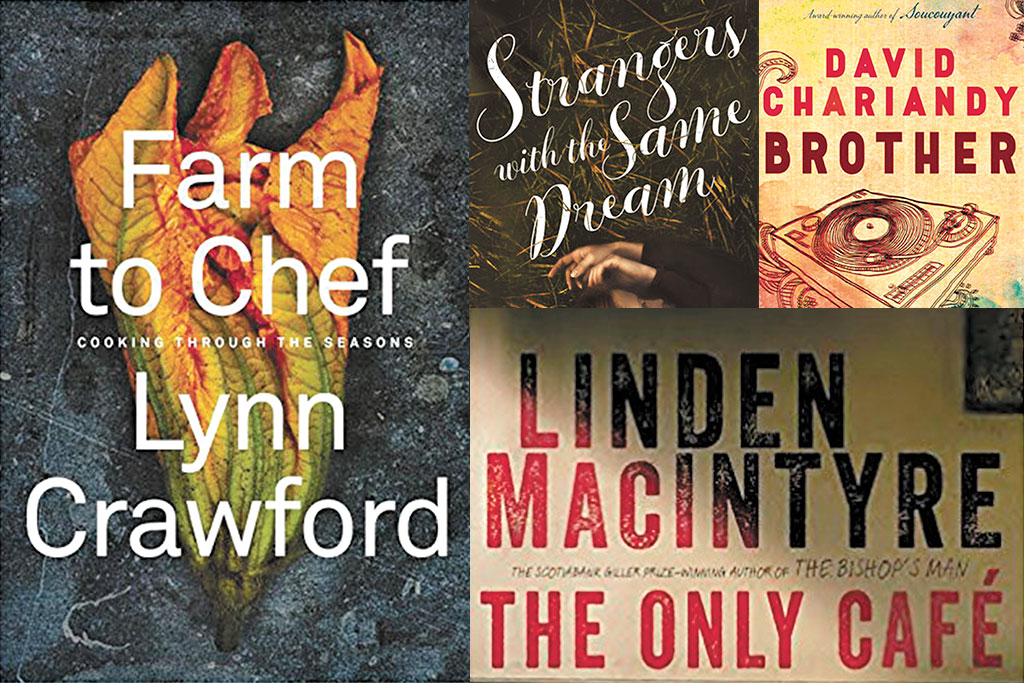
When September rolls around, as the kids head off to school and the cool fall breezes start to blow, many reach for a warm cup of tea and a good book and wait it out. To that end, here are a few choice reads that should be on your radar.
There is no shortage of intriguing works of fiction this season, and more than one set in Toronto. The Only Café is the latest mystery from former journalist and Giller Prize winner Linden MacIntyre. As the title suggests, the book makes mention of Danforth Avenue’s venerable watering hole, where a son goes in search of answers surrounding the death of his father. And moving west, local novelist Michael Redhill’s Bellevue Square is billed as a darkly comic thriller set in Kensington Market where, apparently, lead character Jean Mason’s doppelganger resides. Curiosity kills the cat, as they say, and in Jean’s case, it also involves drug addictions, scam artists, philosophers and vagrants. So totally Kensington. And one of the country’s most exciting writers, David Chariandy, author of Soucouyant, is back with Brother, which is also set in and around the city and tells the story of coming of age in “The Park” on the outskirts of town.
Toronto novelist Wayne Johnston returns to the shelves this month with his latest piece of sweeping historial fiction, First Snow, Last Light. And Annex writer Alison Pick, former Man Booker Prize nominee, returns with Strangers with the Same Dream.
For those interested in a little fact-based reading, there is a growing buzz around the book Maximum Canada: Why 35 Million Canadians Aren’t Enough by Toronto journalist Doug Saunders. Obviously very timely with events unfolding south of the border as well as just to the east in Quebec regarding Haitian refugees, in the book Saunders questions Canada and its current immigration policies, arguing that we need many more people to ensure a bright future for all. In addition, local celebrity chef Lynn Crawford is set to release her latest cookbook, Farm to Chef, which features 140 original recipes organized by season. From spring onions and ramps to winter cabbage, she has the Canadian culinary canon covered in this colourful new book.
Of course, there is no shortage of tomes dedicated to the sport of hockey. Gare Joyce can always be counted on to provide good and insightful reading, and his latest, Young Leafs: The Making of a New Hockey History, is on point and out in October, as is Killer: My Life in Hockey by scrappy Leafs icon Doug Gilmour alongside Dan Robson with the book assist.
Fashion: Jeanne wrangles up 14 selections from the current western wear trend
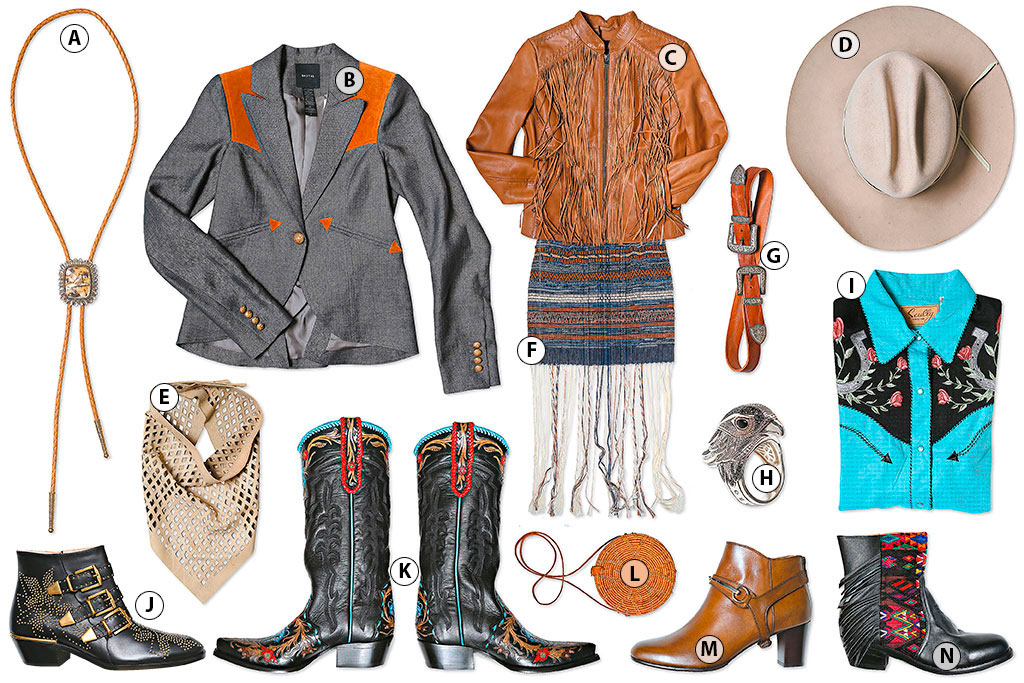
Yee-haw! It’s hard to resist the allure of the cowgirl look — especially since it’s so on-trend. Whether you want to go full on western or just get your boots wet, we got Jeanne to lasso the city’s coolest pieces to giddy-up in.
A) Rope it in
Gypsy Found Objects, 762 St. Clair Ave. W., $46
“I love a bolo! This one is in perfect condition, and it’s such a great motif here with the cowgirl Stetson hat. If you want a hit of that western feel, a bolo goes a long way.”
B) Ranch ready
Holt Renfrew, 50 Bloor St. W., $695
“Smythe! I love what they do; they’re always pushing it. Very figure flattering. A strong western statement for fall.”
C) Gaucho gear
JoshuaDavid, 2525 Yonge St., $695
“I’m a huge, huge fan of LaMarque, a Canadian label out of Montreal. The fringes are just sublime; the leather feels fabulous.”
D) Stampede situation
Gypsy Found Objects, 762 St. Clair Ave. W., $98
“An absolutely classic western hat with a feminine vibe. It’s a real find.”
E) Ready to wrangle
Uncuffed Leather, UncuffedLeather.com $255
“We all love our kerchiefs. The leather here is so butter-soft it gives a great feeling of luxury to this accessory.”
F) Tassle tussle
Peggy Sue Collection, peggysuecollection.com, $650
“Peggy Sue, I have so much respect for her; she’s upcycling denim in the most artful way. Truly art-to-wear.”
G) Saddle style
Brave Leather, BraveLeather.com, $110
“Wow! This belt is fantastic and made here in Toronto. The buckles and the colour.… It truly looks vintage, but it’s brand new.”
H) Bird’s-eye bling
Thomas Sabo, Yorkdale Shopping Centre, $529
“This ring is superb. Dazzling. A man’s ring that can be worn by any sex. It’s mesmerizing.”
I) Wild western
Bootmaster, 609 Yonge St., $149.95
“This looks like a ’50s western shirt! It’s got everything you’d want in a great western shirt. It looks like something Patsy Cline would have worn.”
J) Davids, Bayview Village, $1,795;
“Love the baby studs. It’s a cross between a western and a motorcycle boot.”
K) Bootmaster, 609 Yonge St., $1,999.95;
“Liberty boots! I love the company. It was started by my old friend Tony Benattar, who has a great feel for what makes a cowboy boot outstanding. The embossing, the detailing … just exquisite.”
L) Prairie approach
Boro, boroclothing.ca, $39/RENTAL
“This is a beautiful bag. I guess you’d carry your bullets and an apple for your horse!”
M) Ron White, 1553 Bayview Ave., $895;
“Kudos to Ron ’cause he does booties that are very comfortable. Very sleek with the stirrups.”
N) Soul woven, Soulwoven.ca, $325;
“What’s a cowgirl without her fringes? And the woven part is upcycled fabric.”
How to raise an emotionally intelligent child

This column has been paying attention to curriculum since it’s the school year. But not to school curriculum. To parenting curriculum. This is the stuff we need to teach our children because they don’t learn it in school, and it’s important. Maybe even more important than history and geography. That they can Google 24/7. But you can’t Google emotional intelligence, sometimes dubbed EQ. You can’t fake it, you can’t cram for it, and it’s pretty hard to learn once you’re grown up. All of which make the stakes pretty high on raising a child with EQ.
So how to?
The easy part is knowing what not to do. This will seem pathetically obvious to most readers. The first not-do is parenting that does not engage with children’s feelings. Many of us were raised that way. I’m not sure that either of my parents ever knew I had feelings, and if that awkward situation presented itself, they were sure to run the other way. Perhaps because their own feelings were so appalling to them. And each other. But that’s a story for another day, kiddies. You can love your kids to bits, but not attending to their feelings denies them the opportunity to learn to navigate their feelings. The kicker here is research has linked fathers’ involvement in the EQ curriculum with kids’ emotional maturity. In some families mom does the heavy lifting in this department — which can work. But kids whose dads coach them about how to deal with feelings are kids who grow up resilient and emotionally flexible.

The second not-do is the mirror image of the first. This sounds like: “My daughter is my best friend.… She tells me everything.…” “My son doesn’t open up to anyone but me….” When talking to one’s child who is in distress, it includes offers that sound like this:
“I’ll call the teacher/principal and sort this out.”
“I’ll call the camp and make sure that kid isn’t in your cabin.… Isn’t allowed to:
“I’ll call his/her mother and.…”
The problem with these offers is they don’t grow children’s capacity. They do the opposite. They express doubt in the child’s capacity.
We all want to run protection for our kids because we’re Mama Bear. Look at me: A friend had to stop me from calling the School of Graduate Studies at Columbia University when my (then) 25-year-old daughter wasn’t having the experience I thought she should have there. Argh! It was awful. For me. I hated not being able to fix it for her.
And that is the core lesson of raising a child with EQ. Don’t fix it. Teach them to fix it. Step One is being an empathic listener. When kids are sad or angry or frustrated, it sounds like: “That’s hard.… You sound sad.… I feel for you.” It’s about taking time to listen empathically without offering judgment or solutions. Caring listening. Empathy. For kids who have trouble knowing their feelings, sometimes a “fishing” expedition helps: “It sounds like you might be feeling mad … sad … frustrated.…” Oftentimes when we’re talking with a child who doesn’t know his feelings, if we give him words and make an accurate guess, he is then able to acknowledge the feeling and label it himself. So Step One is teaching our kids to name their feelings, to bring them into awareness. Being able to talk about their feelings is foundational for EQ.
Step Two is coaching your child to solve her problem. Like any other kind of coaching, coaching for EQ takes time and commitment. Quicker to do it yourself than sit with your child and ask: “How do you think you might solve that problem?” Sports coaches don’t get on the field. They plan strategy and teach skills to their players before the game and then debrief afterwards.
And sometimes it comes down to how we set limits. As parents, many of us are fond of the moving target. We set a limit and our junior litigator is so convincing, and so persistent, we fade at the finish line. When we give in on limits, our kids learn to be emotionally inflexible. We moved, they didn’t. They failed to accept a limit. That’s what they learned to do. Instead, when we set a limit, and they push back, we need to go back to Step One: listening empathically. Encourage them to vent all their ugly feelings about this terrible limit. Help them label their feelings. Acknowledge them. And then move on. This grows resilience, which is core to EQ. They know their feelings, they’re mad, they move on. Shazam! You did it!
The future is STEM
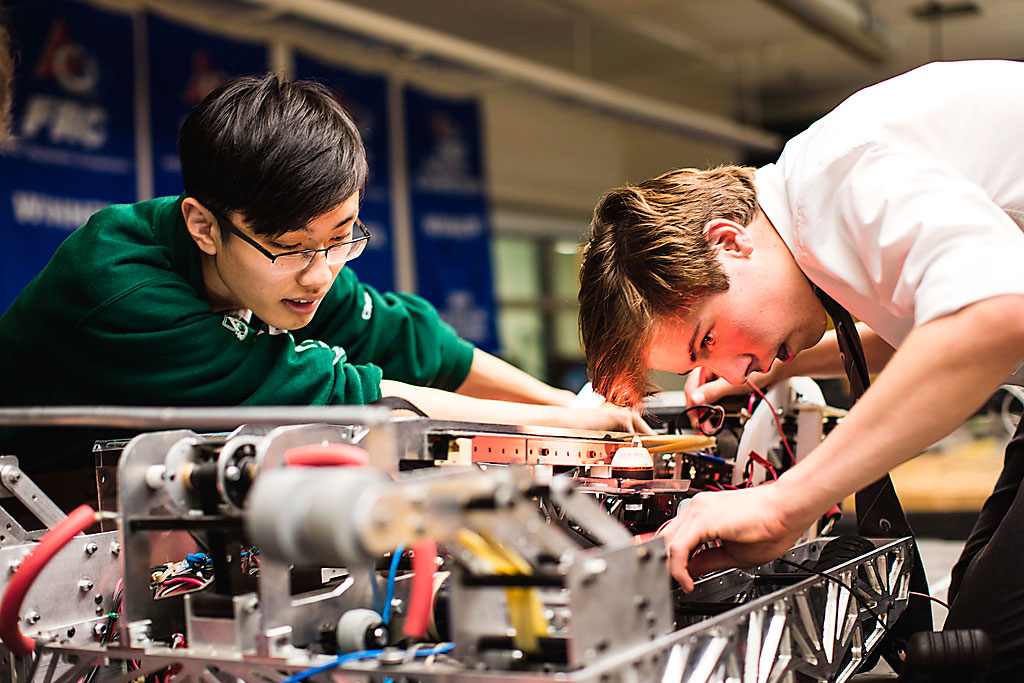
New findings suggest that 65 per cent of the current population of elementary school students will be employed in careers that don’t yet exist! That means schools must embrace the challenge of providing students with the skills that will help them excel in an exciting, unknown future.
The federal government intends to grow “the number of Canadians equipped with science, technology, engineering and mathematics (STEM) coding and digital skills,” with plans to fund $50 million for digital skills training for students and $10.8 million to support STEM learning activities.
Science and tech programming can help students develop the foundational skills that tomorrow’s young leaders will require, and schools are revamping their programs to include these initiatives in ways that excite and engage students.
Some of the more cutting-edge programming is already in Toronto’s private schools, with innovative programs and activities, and the integration of new technologies. This new approach, coupled with a classic education, students can become big thinkers and creative problem solvers.
Here are just a few of the schools advancing these programs.
TanenbaumCHAT has launched an Engineering Academy, a program that provides an understanding of engineering fundamentals, hands-on learning, coding and complex problem solving. Enrolment doubled after its first year, and principal Renee Cohen says, “Students are excited to come to school each and every day to create, innovate and build.”
UTS (University of Toronto Schools) has invested in state-of-the-art 3D printers and interactive touch screen monitors to facilitate tech-forward learning. STEM initiatives include a 3D design club, developing apps, building robots and tackling complex topics with some game-based learning.
The York School opened the Schad Art and Design Lab, a space that integrates STEM disciplines. Students test their skills in engineering challenges like Bridge Busters and the Pinewood Derby, requiring them to understand the principles of design.
innovate and build.”
Crescent School boys engage with robotics in science courses and participate in competitive teams. It’s not just about the ’bots, though.
“The lessons learned … go beyond the mechanics and coding skills,” says Don Morrison, director of robotics. “The boys learn the value of collaboration, complex problem solving, critical thinking and communication.”
Don’t forget the girls! There is a dearth of females in university science and engineering programs, as women comprise only about 20 per cent of undergrad enrolment in those areas. More girls’ schools are hoping to change that.
At Linden School, lessons in coding, engineering, robotics, electronics and science are taught in the new CERES lab. Events like the Social Justice Data Fair showcase projects centred on math and data while also exploring issues that synthesize some of the social sciences. Curriculum leader Beth Alexander says her goal is for girls to discover they are creators of technology, not just the users of it, and to develop skills so they can consider the opportunities in these under-representated fields.
Havergal College has also committed to science and math initiatives, breaking ground on a building for STEM applications, ready in 2019. Students have taken field trips to Google Canada, tested airfoil prototypes in the school’s wind tunnel and participated in coding hackathons. Clubs include Lego engineering, crafty science, mind benders and science design.
If your child isn’t considering a career in the sciences, STEM programming is still beneficial.
It can open the minds of students, allowing them to brainstorm creative ways to approach a problem. It encourages them to experiment, learn from mistakes and work with peers to find solutions: all skills essential to any career.
North York football star comes home to play for Argos

For some people, it can take years of schooling and soul-searching to figure out what direction they want their life to go in. But in the case of J’Micheal Deane, offensive lineman for the Toronto Argonauts, he knew from an early age that football was his calling.
Deane began his career in Toronto at Newtonbrook Secondary School in North York where he was a four-year starter and a member of the Ontario Varsity Football League’s Metro Toronto Wildcats.
Deane then played football at Michigan State before being drafted to the CFL, first playing for the Calgary Stampeders, then the Ottawa Redblacks and eventually being signed to the Argos this year.
Although he recalls playing football in middle school, it wasn’t until his time at Newtonbrook that his ultimate path began to take shape. He not only attributes that time with helping to shape his overall career trajectory, but also to strengthening his resolve and getting his priorities straight — namely, improving his grades.
“In high school, I wasn’t the best student, so I had to go to summer school. I had tutors. I had to do everything I could to get my grades up,” he says, adding that you can have all the talent in the world, but if you don’t have the grades to go with it, achieving your goals becomes that much more difficult. He had help on that front, however.
“During my time in high school I had great mentors,” he says, citing his principal at the time as someone who was particularly encouraging.
“Basically, in my 10th grade, the principal at that time, Mr. Jim Spyropoulos, he saw me and would not let me get away with anything because he knew that if I just kept my head on straight that I could get a scholarship.”
And he did, eventually earning a scholarship with Michigan State.
Deane is currently enjoying being part of the Toronto Argonauts as an offensive lineman.
“We have a really good team here and finally got ourselves a new home in the former Don Bosco Catholic Secondary School. Everything on the up and up with the Argos,” he says.
“When I meet people on the street, and someone asks if I’m an Argo and they’re impressed, that feels great,” says Deane who has played seven games with the Argos this year. Playing football hasn’t only been a career for Deane, but also a significant learning experience. He notes that the game has had a huge impact on his life and who he is today.
“In a 60-minute game, you’re dealing with adversity the whole time, and that makes other things in life seem more miniscule,” he explains. “Sometimes I’m having a hard time, and then I think back to really tough times on the field or particularly tough practices and draw on those moments to get through other times that feel difficult. Football teaches you perseverance.”
When he’s not playing or practising, Deane likes to read and also dabbles in cooking. Although he doesn’t have any signature dishes, he is comfortable in the kitchen. “I like to say I can cook everything. If you give me a recipe I can cook anything.”
He does have some words of wisdom for anyone eyeing a career in professional sports.
“For anyone passionate about a career in sports, you’re going to sacrifice a lot and miss a lot. Being a football player is a life of sacrifice, but at the end of the day, it’s all worth it,” he says.
“I wouldn’t want to start all over. I’ve learned so much.”
