
Home Blog Page 889

Putting the big ‘O’ in the 905

0

I will admit that, when I first started dating my now boyfriend, I was a bit of a snob.

I used to go on dates pretty much in the four-block radius around my house: south of Eglinton, west of Avenue Road, east of Bathurst, north of Bloor. Perhaps this is because I’m a lazy dater or I thought that everything good — restaurants, galleries, theatre — happens here, so why bother? But something has changed. These days I’ve been feeling less like “Ecks and the City” and more “Ecks north of Steeles.” And, I’ll admit, it just doesn’t have the same sexy ring to it.

My Rebound Guy has managed to shake free of that particular albatross around his neck and is sticking around. I can’t help it: I’m hooked, and nobody is more surprised than I that it is actually working out.

Now here’s the problem: I’m in what I consider a long-distance relationship: having to take to the highway and drive for at least 30 minutes due north to see my man who is, don’t judge me, a 905er!

Yes, after dating a Bay Street banker (and secret cross-dresser), a depressed writer living in the Annex and a King Street lawyer who was great but a workaholic, I decided to expand my dating horizons.

You could go as far as saying I am expanding my dating real estate. And, so far, so good. Sort of. I’ve learned a lot about dating someone north of Steeles. And it is not just that traffic is awful! (But seriously, why are there so many people on the highway at 3 p.m., 4 p.m., even 11 p.m. or a.m.? Where are all these people going?)

Culture is culture, sure, but this might have more to do with the men than the night life. And the men “up north” are unlike any I’ve dated in the city. These are a guy’s guys. I’m not used to it, and I’ll be frank, it turns me on.

The men up there have their own man-caves — basements with pool tables, bars, dartboards and, of course, a beer fridge. They have La-Z-Boy recliners, and, not only that, they enjoy them without a hint of irony. They have boys’ nights out. They know how to fix things around the house. They crack jokes about “their ball and chains.” (Only someone as modern as I am can laugh at this because it is so out of my realm and no one has ever referred to me as their “ball and chain.”) My downtown guys wouldn’t have known how to change a light bulb if their lives depended on it. They’d call in the contractor! And they seemed to act more like women: moaning about their jobs and wondering if their shoes matched their outfits before going to an event.

The men up north own snowplows and don’t pay people to shovel their snow. And they do things for their wives, like drop them off outside the restaurant before they park the car. The women treat their men kind of like children. They seem to nag a lot but in a way that their husbands find cute.

Downtown men do not find naggy women cute.

And, between me and you, the men up north, well, this one at least, is better in bed than anyone I’ve dated downtown. Who cares about culture when you’re getting the best orgasm of your life! I’ve been to a couple parties with my north-of-Steeles man, and I noticed two things: One, everyone’s house seemed to be decorated out of a Pottery Barn catalogue. That’s fine, but I did wonder if anyone had any personal aesthetic. And, two, everyone talked about soccer all the time. They live for soccer — driving their children to soccer games and talking about soccer practices. I have nothing to say about soccer except that professional soccer players are HOT. But I don’t think that’s what these people wanted to hear.

And people who live way north of Steeles Avenue love where they live. At parties I would hear, “I could never live in the city” and “I like the city but not with children.” It was as if Toronto were a foreign country to them, and I felt defensive because they were being snobby about downtown.

The more time I spend in suburbia, the more I’ve started to see the appeal. They have drive-through pharmacies! I mean, seriously, how cool is that?

I’m not saying I’ll move to the suburbs any time soon. But, thanks to my change in dating real estate, I’ve definitely learned that the suburbs have some pretty positive qualities. But I do think there should be a designated lane on the highway for us women dating men up north. Forget about the minimum “two people in the car lane.” Think about us who have opened our eyes to the beauty of men and life in the 905!

I’m going to call the mayor right now to see what can be done about this.

Post City Magazines’ columnist Rebecca Eckler is the author of Knocked Up, Wiped! and her latest books, How to Raise a Boyfriend and The Lucky Sperm Club.

Toronto's Best Shawarma

0

GRAND PRIZE WINNER
LE GOURMET SHAWARMA CAFE 

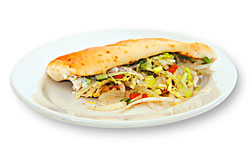
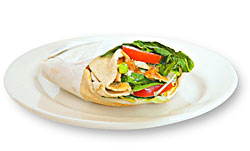
Chicken shawarmas, popular Middle Eastern pita-wrapped sandwiches, are ubiquitous “street food” options in Egypt where Tawfik Shehata spent the first four years of his life. But the shawarmas Shehata consumed in Ottawa, where he learned culinary craft, remain the most memorable: “I ate shawarmas almost nightly,” the Ballroom (and former Vertical) chef explains. Biting into Le Gourmet Shawarma Café’s waxed paper–wrapped offering, Shehata reveals that he has finally found a “good, messy sandwich” with “really, really moist chicken and lots of tomato” — much better, he says, than the ones he used to consume when he was still in school.

Price: $4.99

WATCH VIDEO: Tawfik Shehata Picks T.O.'s Tastiest Shawarma

FIRST RUNNER-UP

Ghazale, 504 Bloor St. W.

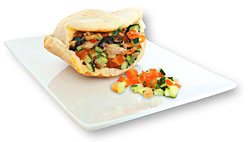
“The chicken looks really good in this one,” says Shehata. “The marinade on the chicken really comes through.” The only drawback to this generous sandwich? “There’s actually not a lot of garlic in the
garlic sauce.”

Price: $4.39

HOT STUFF

Me Va Me, 330 Steeles Ave. W.

“This one’s quite good,” says Shehata, after some consideration. “There’s lots of garlic sauce, and it’s very ‘Middle Eastern’ tasting.” Although Shehata says the toppings are a little “lacking,” he likes that the shawarma is “nice and spicy.”

Price: $6.73

THE BREAD WINNER

Shoom Shoom, 7355 Bayview Ave.

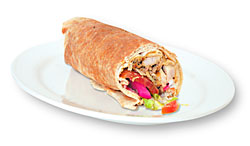
While Shehata finds the chicken a bit dry (“but flavourful”) in this shawarma, he’s a fan of the pita: “This bread is really, really fresh,” he says. He also notes that this is one of the “fullest” shawarmas. This sandwich definitely requires two hands.

Price: $7.33

LE CORDON BLAH

Ali Baba’s, 24 Wellesley St. W.

“This is quite dry,” says Shehata, “and there’s really not enough chicken in there.” Despite its shortcomings, our taste tester says this shawarma is most like the ones he frequently consumed when he was at culinary school.

Price: $4.99

  WATCH VIDEO: Tawfik Shehata Picks T.O.'s Tastiest Shawarma

Red hot and blue!

0

I DREAM OF JEAN

BURBERRY DENIM SHIRT $290

“The hottest trend this season is denim, and there’s been so much experimentation with fabrication. I love a denim shirt, and there are all kinds out there. This is a lovely one with details like plaid in the collar and cuffs, metal buttons and nice stitching that gives a rugged feel to it. It’s a great, basic denim shirt.”

Where to get it: Holt Renfrew, 50 Bloor St. W., 416-922-2333

BOYFRIEND BUILT

BEN SHERMAN DENIM SHIRT $128

“A simple denim shirt. This is a good men’s shirt if you are going for the boyfriend look.” For bigger shirts, Beker suggests cinching the waist with a belt.

Where to get it: Carbon
2581 Yonge St., 416-487-0795

BLUE LIGHT

FRANK & EILEEN BARRY SHIRT $210

“Linen isn’t for everyone, but if you like the wrinkled look of it, this is a nice lightweight shirt for the season that’s a little different from the heavier denim.”

Where to get it: TNT Blu
392 Eglinton Ave. W., 416-544-8544

BLUES TRAVELLER

TOMMY DENIM SHIRT $69

“This pullover is good for something a bit different. I like the sleeves, but you might want to wear something underneath because it’ll show on the sides.”

Where to get it: Tommy Hilfiger
4 Aggie Hogg Gardens, 416-384-0916

CLASSIC COWBOY

LEVI’S WESTERN SHIRT $70

“This is a strong, no-nonsense, functional shirt. It’s simple and not fussed over. It’s the real McCoy. I prefer something classic like this over a distressed look.”

Where to get it: TNT Blu
392 Eglinton Ave. W., 416-544-8544


Jeanne Beker is the host and segment producer of Canada’s leading fashion series FashionTelevision. Catch her Sunday nights at 5:30 p.m. ET on CTV or visit www.FashionTelevision.com

Q&A: Swami Shree Yogi Satyam, coming to Toronto’s Body, Soul and Spirit Expo this Friday

0

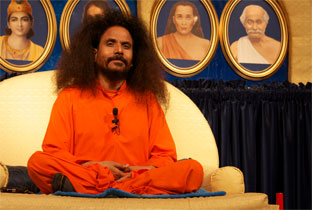
Toronto is about to get a taste of enlightenment this Friday with The Body, Soul and Spirit Expo at Exhibition Place. Among the list of special guests is Swami Shree Yogi Satyam, an advocate of spirituality and a practice called Kriyayoga. What is Kriyayoga? It’s generally passed down from Guru to disciple, so anyone who’s curious may want to hit up the Expo. We asked the Swami about meditation, living spiritually in a smart phone-obsessed world and what he thinks of yoga’s popularity in North America.

Yoga is very popular as a form of exercise in North America. What do you make of the type of yoga being taught at most North American yoga studios?
Yoga taught in North America is like a kindergarten education in spirituality. It is practiced as physical exercise in the form of bodily postures and breathing. In fact, yoga is the state of realization of truth that there is no distance and space in between any two creations of the cosmos. Any distance and space that we perceive is called ‘limited perception’ of existence of various creations, which is known as illusion or Maya.

The yoga state is the realization of the ultimate truth behind all names and forms that each and every creation is an immortal, omnipresent and omniscient consciousness. Practicing scientific lessons in spirituality – Kriyayoga meditation – makes a person experience the state of yoga. Thus, yoga is not exercise as practiced by the general public of North America. Yoga is a state that has to be attained by learning and practicing a spiritual science.

In 1920, Paramahansa Yogananda brought true spirituality — kriyayoga meditation —  for the first time to North America. He came with one aim: to charge the air, land and people of North America with the science of Kriyayoga meditation so that they could experience the state of yoga.

Many people today are distracted by technologies like smart phones, laptops and televisions. What kind of effect is technology having on spirituality today?
If anyone practices Kriyayoga meditation, they use modern technology, cell phones and computers in the best way and achieve a high grade of success in all walks of life. They never get distracted because they know how to use it for the welfare of self and all creations of the cosmos.

How should those who are very busy – with families, careers and other obligations – incorporate spirituality into their lives?
If any person is really busy with their family, careers and other things, then they can practice Kriyayoga in the best way. For example, Mahatma Gandhi, who was always a very busy person, practiced Kriyayoga successfully with open eyes in the walking, working, sleeping and dreaming states.

You left medical school to fully devote yourself to the practice of yoga. Why did you feel yoga was a better path for yourself than medicine?
I had the consciousness of spirituality and medical science from childhood and I treated patients also with the help of natural diet, water, natural clay and sunlight. Because of this, surrounding people called me a medical doctor from childhood, though I did not have any formal medical degree. However, I was able to heal persons of acute and chronic diseases. I wanted to study formal medical education and, therefore, I graduated in biological sciences. I then entered into medical school and very soon I realized in meditation that I could get many medical doctors in my life to support me in my spiritual work, knowing very clearly that spiritual healing will be the leading healing process for humanity. Therefore, I left medical school and opened a non-profit, non-sectarian, spiritual organization, Kriyayoga Satsang Samiti (Kriyayoga Fellowship) and Yog Satsang Samiti (Yog Fellowship), to help all people who are ready to realize the state of yoga – oneness with truth and non-violence – which removes all kinds of illness and sickness of body and mind permanently.

Plan to develop Midtown church sparks speculation

0

A community meeting will be held this month to discuss a development proposal for the now-empty St. Margaret’s Anglican Church near Avenue Road and Eglinton Avenue. Some locals are concerned that the lack of details could mean the current plan for 20 three-storey townhouse units on the site is just the tip of the iceberg.

“Is this really a viable design or is this just somebody trying to do the mathematics to get a rezoning on the property?” said Terry Mills, a local resident and planner, who said he is particularly concerned about the “unrealistic” density of the project.

According to John Andreevski, the city planner assigned to the project, plans are still in a preliminary form. A staff report states that several issues need to be resolved such as “the design of the proposal” and “the scale, massing and intensity of the proposed development.”

Andreevski said it is important to determine whether the Eglinton LRT proposal will go through, as there are plans to build an Avenue Road station next to the development site.

Alex Boros Design Inc. was unavailable to comment.

Local councillor Karen Stintz said she is aware of some issues, such as density and parking concerns. Currently just 20 parking spots are proposed for the 20 townhouses. She said the issues will be discussed at the upcoming meeting scheduled for April 11.

Olive my love: how to find outstanding olives

0

Mehmet Uzel is as close as it comes to an olive evangelist. From a town in northern Turkey that prides itself on growing the world’s best, he moved to Toronto to expand his family’s olive empire, believing the city’s diverse population would help him tap into an olive-loving culture.

He appears to have been right. When his quite literally-named Olive and Olive Oil store on Jones Avenue proved successful, Uzel opened a second location mere blocks away on Danforth Avenue. Brazenly called The Best Olives in the World, the store sells about a dozen varieties of Gemlik olives, Turkish olive oil and Iranian pistachios.

“All of Europe knows, everybody knows, that Gemlik olives are best,” he tells us, brushing off suggestions that moving to Canada to open an olive store was a bold move. “I didn’t listen to anyone, I knew it would be fine. I am an olive expert.”

To be fair, Uzel’s not far off when he gloats about his wares’ supremacy. His olives are meaty, delicious and uniquely seasoned.

But how to tell? Uzel admits it can be hard to tell a good olive from its sheen and offers these tips for choosing the best batch of cocktail companions.

1. Ask how the olives have been marinated. Olives made in the traditional method sit in salt water for many months, while lesser olives are treated with chemicals to hasten the process. Uzel says chemical preservatives can damage the olive’s flavour.

2. Seek out flat spots on the sides of the olives. These show the olives have spent a lengthy period being pressed inside a brine barrel.

3. Steer clear of bruises. While the flat spots are good signs, avoid any olives that appear visibly bruised or discoloured. Bruising increases acidity in olives, which makes them less pleasant to eat, says Uzel.

4. If choosing black olives, find out if they’ve ripened on the tree. If so, they will have will have more flavour than those picked while still green.

5. Choose olives that have been stored in glass. Avoid metal or plastic, which can transfer unwanted flavours to food contained inside.

Plans for neighbourhood church hotly contested

0

A development proposal meant to help a Mount Pleasant Road and Lawrence Avenue church resolve money problems is causing a rift in the neighbourhood. Nearly 150 people attended a community consultation last month at Sunny View Public School with most expressing strong support or concern for a plan to transform Bedford Park United Church into a five-storey mixed-use seniors’ home and community hub.

“We realized there was an irreversible decline in numbers and that we had to make some kind of change,” said Rick Coombs, representing Bedford Park United Church — the developer. Coombs said the decline in membership has made it more difficult to pay the maintenance costs for the church. If the site is expanded to include a 57-unit seniors’ home, the residence would bring in just enough money for the church to continue operating. The building would house a new place of worship, in addition to other services.

At the meeting, many agreed with the proposal and said there is demand for a seniors’ home in the area. Those protesting the development said they feared the building would be too high, too dense and its presence could mean traffic and safety problems. Cim Nunn and other local residents are concerned enough to have formed a local residents’ group in the hopes of providing a stronger voice on the issue. He said they are not opposed to the idea of a seniors’ home, but to the size of the proposed building.

“Imposing a really large institutional building in the middle of a residential street, it’s just inappropriate,” said Nunn. With Bedford Park Junior Public School across the street from the church, Nunn also said increased traffic could pose a threat to schoolchildren. According to Coun. Jaye Robinson, local residents will have plenty of opportunity to voice concerns and give input. She said it is important to remember that the proposal is in the very early stages of the evaluation process. Next, city planning will create a report on the potential impact of the building.

We’d like to start with the reclaimed wood

0

Take a look at a few design elements in Toronto’s restaurants these days. They are bordering on the ubiquitous: open kitchens, chef ’s tables and, the powerhouse, reclaimed wood.
All of it is indicative of a new shift in the city’s restaurant interiors, says Robert Walshaw, a project leader at Yabu Pushelberg. “A lot of restaurants, over the past five or six years, have tried to adopt a more residential feel as opposed to a restaurant feel,” he says. “There’s a lot of crossover between the two.”
What better time, then, to start finding decor inspiration from some of the city’s hottest restaurants? We spoke with several lead designers to find out how to bring restaurant charm into the home.

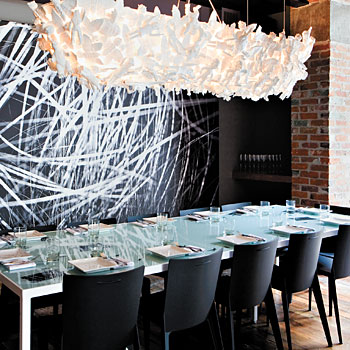
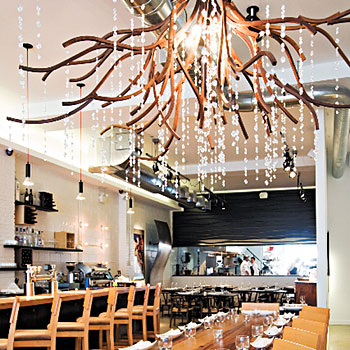
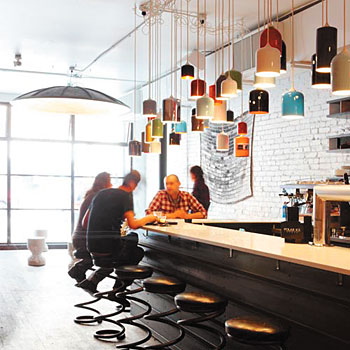
From left to right, unique lighting at Origin on Church Street, sustainable style at Böhmer on Ossington Avenue and stools with spring at Parkdale’s Parts and Labour

Origin’s design anything but ordinary
Jason Stroud admits he shot from the hip while designing Origin Restaurant (107 King St. E.),but he knew he wanted to do something out of the ordinary while still paying tribute to the building’s history. He and his team at Stroudfoot Inc. made use of found items, including some burned wood that was still sitting around from a long-ago building fire. That wood now comprises the hostess stand, while the DJ booth is made up of support columns taken from the basement. The lesson here is that derelict house relics should be thrown away with caution — they could be useful.
For a more direct emulation of Origin’s look, there’s a giant light fixture in the private dining room, affectionately known as the kaiju (that’s Japanese for “strange beast,” roughly). Stroud put it together by making moulds of some of his favourite toys — including Godzilla and Mothra — and surreptitiously zip-tying those moulds to a powder-coated metal frame (the decorative power of action figures, it seems, should never be underestimated).
Most of the furniture here has been custom-made, but the dining chairs have not. Look for Alfa chairs ($550) from Italinteriors. To capture the molten metal look of Origin’s dining tables, try seeking out some “illusion” metal, which has a lavalike, bubbly quality. Origin’s floors are made of reclaimed barnboard (those from Revival Flooring in Woodstock should do the trick). And we wouldn’t recommend recreating Origin’s aggressive barbed wire light fixture (painted pink, for effect), unless one has an aesthetic affinity for gulags.

Simplicity and Swarovski at Böhmer
To achieve the look at Böhmer (93 Ossington Ave.), go with a simple shell. Designer Roy Banse stuck with polished concrete floors and white walls (“decorator white,” from Benjamin Moore) retaining a hint of minimalism that allows other design elements to shine.
“A big mistake some people make is jumping on trendy colours,” he says, “and then they get tired of it.” The space’s clean exoskeleton allows for the warmth of reclaimed wood, as seen in the benches and the large communal dining table, to really stand out.
Indirect lighting, too, can make a space jump. Böhmer’s eye-catching chandelier, a Brothers Dressler creation rife with Swarovski crystals,certainly steals the show, but the real unsung heroes of Böhmer’s lighting are LED strips. Placed behind banquettes and at other strategic areas, they spill light upwards onto the walls, creating an especially dramatic nighttime atmosphere. Banse is currently using LED strips at a condo he’s working on, under the overhang of an island.
Other Böhmer characteristics speak to the benefits of being a pack rat. A “wall” that separates the private dining room from the main dining room is comprised of a hodgepodge of old windowpanes. And, sometimes, treating a design element like an abstract work of art can pay off. The shelves behind Böhmer’s bar are staggered, with no repeat to the pattern, for a more interesting look.

Hair-on-hide creates One’s signature look
Designers of Mark McEwan’s Hazelton Lanes restaurant One (116 Yorkville Ave.) had to adhere to a high standard of opulence, so those seeking to emulate the look at home probably have glamour in mind. Walls in the dining room are decked out with hair-on-hide panels (that’s cow skin, to the layperson) framed with mirrored bronze. The characteristic chandelier was custom-made by Unit 5 in Toronto. Ask the team there for something with metal rods that explode out into space. Such pendantic design elements are not uncommon in residences, says Robert Walshaw, who was part of One’s Yabu Pushelberg design team.
Part of the fun of getting One’s design together was in making transitions — from hotel to restaurant to lounge — seamless, Walshaw says. The hotel does that, in part, with the use of metal “screens,” steel framing with a hairline bronze finish. That framing might be a bit imposing for a residence, but screens are a great way to ease the shift between rooms. “It’s much lighter than putting up a solid wall.”
One’s lounge area has decor elements that are residence-friendly, particularly the floor lamps ($4280) from Baker Furniture, the posts of which resemble knotted tree branches. The floors throughout are wood planks made of white oak with a custom ebony stain, and for something practical and lavish, the translucent sheer net drapes in the dining room allow natural light to flow inside while providing a veil from prying eyes.

Post-punk chic at Parts and Labour
The industrial, post-punk elegance of Parkdale’s Parts and Labour (1566 Queen St. W.) shouldn’t be hard to mimic at home, since the restaurant is essentially a showcase for Castor Design (co-owner Brian Richer is part of the Castor team). A more challenging task would be infusing Parts and Labour’s too-cool-for-school vibe into the home, which probably can’t be done with design elements alone. To start, we recommend gaining a better appreciation for the Stooges.
For a superficial re-creation, the barrel- like florescent tube fixtures above Parts and Labour’s communal tables are tried-and- true Castor stalwarts. Composed of burnt- out florescent tubes, they’re lit from inside with incandescent bulbs. The mishmash of lights made from repurposed fire extinguishers above the bar, as well as the bar stools that resemble industrial springs, are also readily available from Castor.
Emulating the floors could present a problem, since the team stuck with the old, worn floor from the hardware store that previously occupied the place. To complete the transition, a rooftop garden would be in order.

Wonder lust: Robert J. Sawyer launches his latest novel

0

Robert J. Sawyer, one of Canada’s most successful authors and winner of just about every science fiction award out there, will be launching Wonder, his 20th novel, next week. It’s the conclusion of his trilogy about the increasingly complex World Wide Web becoming, in the very near future, conscious and self-aware. We spoke to him by phone at his Mississauga home.

What prompted you to write your WWW trilogy, Wake, Watch and Wonder?
I wanted to do something that was a response to what was already out there, which is that “the singularity” – that is, when something exceeds human intelligence on this planet – that we were inevitably going to be rapidly left in the dust, either destroyed or marginalized.

Twenty years and twenty novels ago, you wrote your first novel, Golden Fleece (1990), which is about artificial intelligence going terribly wrong. What has changed since then?
Golden Fleece came out of, more than anything, Ronald Reagan’s Strategic Defense Initiative and the notion that computer-controlled weapons systems would be able to function flawlessly the first time they were put in use. Putting the fate of humanity in the hands of machines, because you think machines have god-like perfection and we do not, is folly … but in the 20 years that intervened between that novel and today, I saw very little exploration of a positive future for human beings in the face of really advanced computing. There were three standard scenarios out there: we’ll be subjugated [by] the Matrix, eliminated [by] Terminator, or assimilated [by] the Borg. But there was nowhere in that idea space where people were saying, “No, actually it’s going to be a very positive experience for humanity,” and I felt that there was a real lack of that.

Have there been any great leaps forward in attempts to develop an AI that is self-aware?
There has been zero progress towards artificial consciousness. Nobody has made any progress at all. Not a whit of progress towards having artificial consciousness in that sense.

If some form of AI could spontaneously become self-aware, why do you think that might happen specifically in the World Wide Web?
We are conscious because primate brains reached a critical threshold of complexity about 40,000 years ago. At some point [our brains] got sufficiently big and complex, with sufficient interconnections, that is, sufficient synapses and neural nets, that consciousness emerged. Consciousness is dispersed through the entirety of the brain, no central spot you can point to …. and the Internet is this dispersed network that is very much analogous to the structure of the brain.

Wonder, like your writing generally, is as much about philosophy and morality as it is about cutting-edge science and technology. What will be the moral distinction between humans and a self-aware AI, and will that turn our world upside down?
I’m all about the notion that there is nothing special about being genetically Homo sapiens. There is a lot special about being self-aware. We’re not going to have a fundamental phase change in the human condition simply because we cease to be the most intelligent thing on the planet, any more than we had a fundamental phase change in the human condition when we ceased to be the strongest … when we started to build machines that could do work that used to have to be done by human beings. And I want to say, “Hey [the future] could be really positive if we take these steps and get these lucky breaks, or it could be really negative if we take those steps and get those bad breaks," but let’s have all the ideas out there instead of having ideologues pressing a single vision towards us without looking at the potential downsides, or conversely the potential upsides, of whatever scenario they’re wedded to.

The launch party for Wonder will be held on Tuesday, March 29, at Dominion on Queen.

Illyria Design: T.O. style at Ottawa Fashion Week

0

First there was New York, then London and Paris, and now — Ottawa? That’s right. Our cousin to the east celebrated its third annual fashion week over the past weekend (so, it’s technically not a week, but who’s counting?). According to the Ottawa Citizen, over 2,000 Ottawans watched the show, which featured 18 international designers, both established and emerging, including Toronto’s Illyria Pestich, a graduate of Sheridan College. We break down Illyria Design’s Fall/Winter looks from the runway and where you can buy her feminine-mod clothing.

The trends: Sophisticated, bondage, silk, cut-outs, monochrome. It’s ultra-feminine but with an edge.

The colours: black, navy blue, purple. Think jewel-tones.

The looks: Pencil skirts, sweetheart necklines, dresses with hoods and pockets, back silhouettes. It’s like what the ladies of Mad Men would wear but even sexier.

Who would wear: Elegant women who don’t mind showing a little skin.

Where to buy: Pho Pa, 698 Queen Street, 416-979-9444; Shopgirls, 1342 Queen Street West, 416-534-7467

Canadian wins Iron Chef with a little help from poutine

0

What does it take for a Canadian to win Iron Chef America? Apparently, a little bit of Canada’s national food doesn’t hurt. With a menu that included lobster poutine, Quebec chef Chuck Hughes won an Iron Chef battle against Bobby Flay in an episode that aired last night, making Hughes the youngest chef – and the second Canadian ever – to have won the title.

Other Canadians had failed to topple Flay in the past: in 2006, Toronto’s own Susur Lee had to settle for a tie, while chef Michael Smith was trounced, essentially, last year. That particular battle was not without a bit of controversy, as the secret ingredient was avocado — suspiciously convenient, some said, for a Southwestern chef like Flay. This time around, the secret ingredient was Canadian lobster.

Hughes told the Canadian Press that he simply couldn’t go on the show and not cook up some poutine. Still, he had to rely on the only cheese curds he could find, which ended up being from New York (not nearly as good – or as squeaky – as the curds from Quebec, apparently).

The first Canadian chef to have won the distinction was Vancouver’s Rob Feenie in 2005, but Hughes is playing it cool. “I am not special,” he told CBC. “I worked in restaurants. I cut an unbelievable amount of potatoes."

[CTV, CBC]

Coming Soon: Terroni Bar Centrale, Italian hustle and bustle in Rosedale

0

It wasn’t so long ago that popular Italian chain Terroni closed its Balmoral location, but a new one is opening up just down the street in a three-storey space at Rosedale’s Scrivener Square. Terroni Bar Centrale will occupy the ground floor and should open by April 1 at the latest, owners say, as a café/wine bar/restaurant. The upper floors will house a full-fledged restaurant, Terroni Price Street, expected to open this summer.

Bar Centrale will be different things at different times: it will open early, around 8 a.m., as a place to grab an espresso; it becomes a meeting place, perhaps, at lunch and a wine bar at night. Two Italian chefs are on board for a lunch and dinner menu of small sharing plates unlike any other Terroni menu. Breakfast and pastries will be served as well. Owners didn’t comment on specific dishes or price points just yet, but expect salumi, pasta and meat dishes.

In addition to food, the bar will offer a wide selection of exclusively Italian wines (150-200 selections by the bottle, 20-25 by the glass), a list of Italian-inspired cocktails and local and Italian beers by the bottle and on tap.

The 1000-square foot Bar Centrale will seat around 50 people, not including the patio, and draws its inspiration from bustling Italian train stations. The idea is to capture the life of an Italian piazza where people meet and interact at all times of the day. We’ll update with more details about Terroni Price Street as they become available.

Terroni Bar Centrale, 1095 Yonge Street