Home Blog Page 880

Give props to urban culture this weekend at the In Transit festival (bring your bag of tricks)

0

In Transit is Toronto’s first urban cultural festival, bringing together the city’s talented (if sometimes volatile) skateboarding, urban music, break-dancing and graffiti-art communities.

The two-day event at Toronto’s 99 Sudbury kicks off at noon tomorrow with a graffiti expo: Toronto’s best graffiti artists go to work inside and outside the venue. At 3 p.m., the festival’s break dancing throw-down will be hosted by Toronto’s BBoy Zen, with a top prize of $1,200 awarded to the day’s best breaker.

Quality urban music will remain a constant throughout the festival, but Saturday night is when you’ll find the weekend’s best. The concert starts off at 8:30 with local DJs Team Canada, followed by hip hop/soul artists Tanika Charles, Tre Leji and Double X (it’s understandable if you haven’t heard of any of these people, but this is the perfect opportunity to get acquainted).

Day two continues the urban counter-cultural theme with an open skateboarding competition ($1,000 for the best trick of the day). Even if you don’t “got your deck” or your “bag of tricks,” as the competition’s description suggests, this festival has something for everyone remotely interested in urban subcultures, and music and art in general.

In Transit Urban Culture Festival, 99 Sudbury, April 30 – May 1

Coming Soon: a “beer boutique” in Liberty Village

0

For those of you tired of staring at a wall of logos in a glorified walk-in refrigerator (better known as The Beer Store), you’re in luck. The beer-distributing mainstay is thinking outside the barrel and opening a beer boutique in Toronto’s Liberty Village. Store-goers will be able to enjoy in-house samples while browsing through their favorite beers, much like at the LCBO (or most grocery stores in the States).

Don’t be fooled by the layout makeover though. The Beer Boutique will feature the same selection of beers — there’s just a better chance you’ll stumble on something you didn’t know was there.

The boutique is set to open some time in June at 120 Lynn Williams St. in Liberty Village. If the branch is a success, The Beer Store hopes to open up similar branches around the city, in the Distillery District and in downtown Oakville.

The Beer Boutique, 120 Lynn Williams St.

[Canadian Beer News]

[Torontoist]

T.O. sales roundup: borrow Kate’s style without a royal budget (our last mention of the royal wedding, we promise)

0

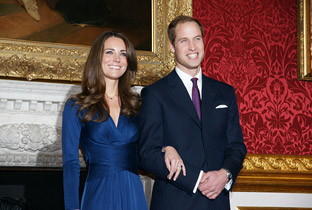
When Kate Middleton was crowned duchess this morning (we’re allowed to mention it one last time), she joined the style ranks reserved for a special class of VIPs. If her simple, elegant look at the engagement announcement was any indication, we certainly have a style icon in the making. Today’s sales round-up helps you borrow Kate’s high-class look — without the ring or the tiara.


Urban Outfitters

Of course, it all starts with the dress, and this Sparkle & Fade knit dress (on sale for $25) is both chic and form-fitting.
Various locations, check website for your nearest store.

Anthropologie

It might not be a sapphire ring, but this delicate blue beaded snowflower necklace definitely makes a statement. It’s a steal at $30.
78 Yorkville Avenue, 416-964-9700

Nine West

It seems like Kate knows that a pair of classic black pumps is a must-have for every woman’s closet. The Melaina pair is on sale for $95.
93 Bloor Street, 416-920-3519

La Senza

It’s a mystery to everyone, including the Prince, what the new Duchess will wear on their honeymoon, but she could go the patriotic way with something like this cozy London tee (on sale for $13), or for something tastefully sexy like this lace chemise, on sale for $20.
Various locations, check website for your nearest store.

Hermes

Hermes is hosting a sale next week featuring scarves and ties at 50% off, with all proceeds going towards St. Michael’s Multiple Sclerosis Clinic. We’re not entirely sure if Kate’s a fan of the Paris luxury brand, but we do know that she and Wills are big fans of supporting charities.

Triple threat: three designers, three rooms

0

Often when designing the rooms in our own homes, we are unsure how we can achieve the effects we see on glossy magazine pages — or on home reno TV shows. It can be a challenge, to say the least. So we sat down with three of the most talented interior designers out there — Debbie Travis, Candice Olson and Sarah Richardson — and asked them to tell us about their favourite projects to date.

Our trio of designers talked to us about inspiration, functionality and design challenges. And each interviewee focused on something slightly different and used the smallest of details to create the most dramatic effects. Be it colour, lighting or fabric choices, you need a space that is comfortable and livable, something that accommodates your needs but also achieves a balanced design aesthetic. Although much comes down to personal taste, it is always fun to get out of your comfort zone. You never know what might work until you try.

From left: Debbie Travis’s pistachio-hued bedroom banishes the blahs; Candice Olson adds modern touches to a classic kitchen; Sarah Richardson returns to basics with primary colours in this factory-turned-loft

Debbie Travis finds inspiration for a GTA home abroad
Debbie Travis designed this funky bedroom (pictured in the top right corner) for CBC’s All Four One in the fall. Inspired by the Firmdale group of hotels in London and New York, Travis focused on a mixture of fabric and colours and using it to drive the design of the room.

The oversized headboard, an obvious focal point, also serves as a piece of art. “It makes it grand, it makes it important, it makes it comfortable,” says Travis. The walls can be used to impact the sense of space. “One of the things people often have a problem with in small rooms is how to make them less boxy,” says Travis. “The way to do that is chop up the walls a bit.” The white wall behind the headboard is paintable embossed wall covering, which makes the room appear to extend further than it does, while a dark wall would have closed off the room. The pistachio accent walls add cheerfulness and a pop of colour, but to do this on all walls would have made it overwhelming. Mouldings serve to cover inconsistencies, finish the room and make it easier to paint. The chestnut flooring grounds the space, without making it appear too dark.

Although there is a great deal of detail incorporated, the overall effect is subtle. Travis has managed to juxtapose different patterns and fabrics that don’t match but hold together seamlessly and elegantly. This is a shift from earlier design sensibility: “In the ’80s and ’90s everyone was matching,” she says. “Modern today isn’t necessarily just sleek smooth furniture. Modern today is mixing stuff.” The principles for putting together patterns: “As opposite as you possibly can,” says Travis. Two different stripes would have clashed — but to complement the red undertones in the stripes with pistachio green walls works. Words of advice from Travis? Use hotels as your inspiration for new trends and design elements.

Candice Olson balances classic elements and modern touches
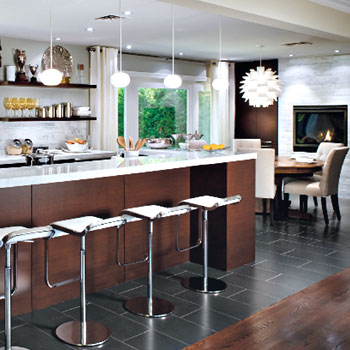
The aim with this mid-century modern house (pictured centre right) was twofold. “In that era, the idea of cooking and the preparation of meals was a solo experience,” says designer Candice Olson of W Network’s Candice Tells All (8 p.m. EST, Thursdays). “This kitchen was no different. It was completely separate from any of the other spaces.” They wanted to create a more open concept communal design but maintain the vintage of the home.

This was easier said than done. “When you open up your kitchen to the world, you open up all the sins that happen in a kitchen,” says Olson, who planted what she refers to as visual bunkers, including an 11- to 12-foot-long kitchen island. This way the “shrapnel” of meal preparation is hidden from view.

Olson positioned lighting to bring out the wood tones in the cabinetry and avoid having them appear too dark or flat. Feature lighting, such as the pendants that drop down over the island, create intimacy (and in this case a certain rhythm). The artichoke light fixture above the dining room is also a nice focal point. “I think people underestimate the power of lighting across the board,” says Olson, who feels that this could make or break the design of a room.

Lifestyle and usage are key factors in making design choices. This family entertained heavily for both business and personal reasons, so they needed the sleek elegant open concept format, coupled with storage for all the paraphernalia and room for the original appliances. “Modern kitchens are a whole lot harder to design because there is this element of precision,” says Olson. Crooked ceilings and flaws are much harder to hide, and clutter must be kept to a minimum. A custom panel wine fridge, dishwasher and the fridge are all integrated seamlessly into the kitchen and, along with careful storage planning, give the space subtlety but also accommodate how they use the room.

Sarah Richardson puts the country back into city living
Sarah Richardson designed this baseball- factory-turned-loft for her new TV series Sarah 101 (9 p.m. EST, Tuesdays, HGTV Canada). Richardson notes that designing a space for a single guy is a challenge because you want something that’s cool but not too masculine (as it could evolve into a space shared by two people). “I think the common challenge for guys decorating is if a girl enters the picture and everything he did before ends up going out the door,” says Richardson. The trick is to balance the various elements in the room (pictured below right): masculine and feminine, traditional and contemporary, light and dark, and hard and soft. The floral dragon Schumacher fabric on the head and foot of the bed balances the distressed leather side rails. Rugs and window coverings add softness to offset the grittiness of concrete flooring and sandblasted beams. “It’s a line that can be difficult to tread for a novice,” she says, “but when you can bring it together, it’s what ends up creating interest in the room.”

Richardson quotes William Morris’s approach to functionality: “Have nothing in your house that you do not know to be useful or believe to be beautiful.” The Persian rug adds softness and aesthetic appeal yet has to be a certain size so your feet land on it — instead of the bare floor. The blue vintage stools add character but serve as surface areas for bags or clothes. The side tables have personality, but need to have enough space to store water, books and other common nightstand items.

As a self-proclaimed lover of colour, Richardson always starts with the fabric. “I allow a room to grow out of that,” she says of the patterns she picks. Colour can drive the energy in a space, and her one piece of counsel for clients is not to be afraid of it. The most important thing, of course, is to have fun with the design.

Coming Soon: Ironhead, bringing “the world’s toughest clothes” to Queen West

0

Its friends? Athletes like Brad May and Mike Tyson and rock stars like Bif Naked. Its clientele? “Discerning individuals with unique tastes…no sheep.” Its location? Coming soon to Queen Street West. The brainchild of brothers Mike and Danny Regan, Ironhead enjoyed nearly two decades of success out of its Vancouver store and it’s finally setting up shop here in Toronto.

Ironhead, the “world’s toughest clothes,” specializes in limited edition Canadian vintage-wear: anything from hockey jerseys to loungewear to corporate leather-wear. (Yes, that exists). “We like nice, clean, timeless, vintage looks,” says Danny Regan, Ironhead’s head of retail. “We draw our inspiration from almost anything—50s lowbrow, old fashioned movies, old Hot Rod ads, vintage hockey, the Day of the Dead, 60s psychedelia—but everything we do has a very clean classic line to it.”

Each clothing item is designed with only about 25 others like it, effectively making everything in the store a “limited edition” item. (We can hear you hipsters salivating.) Ironhead has already established itself as a local rock-crowd favorite, often seen gracing the sweaty, rocked-out bodies of Queen Street bands like Rattlesnake Choir, The Ugly, The Screwed, as well as the sweaty, knocked-out bodies of professional boxers and hockey players, showcased here. (Even Halle Berry’s been known to don some Ironhead.)

The new store is expected to combine “sleek industrial materials, clean lines and punches of intense colour with a nod to the neighborhood’s rich history.”

The Toronto store doors will swing open some time in May, with a grand opening slated for some time in June.

Ironhead, 555 Queen Street West

Q&A: Mark Hominick, fighting for the UFC featherweight title tomorrow

0

Just in case you didn’t know, there’s a little event called UFC 129 going down at the Rogers Centre tomorrow. Venturing into the ring will be a significant Canadian contingent in addition to the top draw, Georges St-Pierre. One of those fighters, Mark “The Machine” Hominick, of Thamesford, Ontario, is gunning for the featherweight championship against Jose Aldo. We tracked down “The Machine” at the gym and asked him a few questions.

Why do they call you The Machine?
My coach gave me the nickname. When he first trained with me, he said “you’re like a machine” after he noticed I don’t get tired and I don’t show emotion. Which is a good thing for fighting, I guess.

How does it feel to be fighting in Toronto’s first UFC event?
It’s a dream come true. This is the 10th year in my career and I feel honoured to be a part of this historic event in my hometown province. It’s a historic event for UFC and the city of Toronto.

How did you get into MMA?
In grade nine gym class, we had an orientation at a martial arts class and I was immediately drawn towards it. I knew right away this was something I wanted to get into. I had a natural ability for it. Within two weeks of starting, I was fighting in local events.

Who is your mentor?
Shawn Tompkins, my coach. He started training me four or five years after I started. He channeled my work ethic and ability and made me a better fighter, and really led by example. He was the best man at my wedding, so he’s a great mentor and friend.

What’s been your favourite event so far?
It was in 2006, my first UFC event, UFC 58. It was Canada vs. USA. It was my first fight on pay-per-view, first fight in Las Vegas. The magnitude of it was incredible. I was the 5-1 underdog and I beat him in the second round.

Coming Soon: Hardys, an homage to pork and barbecue on St. Clair West

0

It’s only been a week since we reported on the opening of Barque Smokehouse, and already we’ve caught wind of a new barbecue-oriented spot set to open this June on St. Clair West. Hardys: a Hogtown Brasserie seeks to make sure that Toronto’s longstanding nickname is well deserved.

Owner John Hardy, a recent U of T graduate and longtime charcuterie enthusiast, has enlisted the help of B.C. chef Laird Gordon (Sooke Harbour House, The Edge Restaurant) for an upcoming 60-seat carnivore’s paradise. On offer will be some of Toronto’s latest meat obsessions: pulled pork, porchetta, beef brisket (by the sandwich or by the plate), along with steak, poultry and a large selection of house-made charcuterie. “I’ve been to The Drake and I’ve been to The Stockyards,” he says, “and I know what they’re doing wrong.”

Like any good barbecue joint, this new spot is equipped with a smoker, but Hardy has an affinity for “cold smoking,” in which the fire is contained separately from the food, leaving the smoke to do most of the cooking. “It takes more time and more wood,” he says, “but you get much more flavour.” For pulled pork, a piece of pork shoulder is seasoned and then marinated overnight; it’s then cooked at a very low temperature for 10 hours, during which time it’s consistently rotated and “mopped” with sauce to keep it moist.

While he’s not completely dishing on the beef brisket preparation, it’s a multi-day process involving seasoning and injecting with brine. The beef is grass-fed, organic, free-range Belted Galloway; Hardy hasn’t settled on a pork supplier just yet but he says it will be local and free-range.

Prices are still in the works, but a pulled pork or beef brisket sandwich (takeout or eat-in) could run for $8; plates of those meats could go for $15. Sides could include coleslaw, corn bread, potato salad or fries. Keep an eye out for a pork-centric brunch, too.

Hardys will also offer house-made charcuterie, like prosciutto, capicollo or salami, for indulgence in the restaurant or at home. The beer list hasn’t been finalized yet, but Hardy says he’s getting help on a matched beer list that focuses on craft beers, including at least one from the States.

Hardys: a Hogtown Brasserie, 992 St. Clair West

How to ease David Chang’s transition to Toronto

0

Remember when everyone was going crazy at the prospect of David Chang opening a restaurant in Toronto? Surely, the one thought lurking in the back of everyone’s mind was: “How can I eat my pork bun without pissing off David Chang?” After all, not making the kitchen staff mad should be the top priority for any restaurant-goer. Well, Chang has made it a lot easier for everyone by providing a “top five most annoying things customers do” list to Details magazine. The full list is below.

David Chang’s Top 5 Most Annoying Things Customers Do

5. Saying they’re right when they’re wrong. Like when they ask for a steak to be medium-rare and it’s medium-rare and they say it’s not medium-rare.

4. Special food requests.

3. Fake allergies.

2. Being fucking drunk. It’s just so annoying.

1. Bloggers who don’t know shit. The top one is to say you’re a blogger, right off the bat. That always gets a good laugh from the chefs.

We recommend hanging on to this list until 2012 to make sure Chang’s transition to Toronto goes as smoothly as possible. Though something tells us we won’t be seeing that much of him anyway.

[Details]

Feathers, frills and fascinators: where to get swanky hats for the royal wedding

0

For female royal wedding guests, nothing matters more than deciding which colourful bird feathers to strap atop their heads for the big day. Those of us watching the ceremony on the telly — at a venue that encourages showy hats, perhaps — can sympathize with the plight. We found the best places to find your own wedding hat, because nothing says “elegant spring wedding” quite like a peacock feather strapped to your temple.

Lilliput Hats

This store hosts stunning collections of hats for women, and owner Karyn Gingras even has a Kate Middleton model on display. For the daring, we love the feather bucket in the Couture Collection; for the sweet romantic, we like the large May in the Romantic Collection.
Where to buy: Lilliput Hats, 462 College Street, 416-536-5933

KC’s Hats

Not to be outdone by Lilliput’s “Kate” hat, KC’s Hats actually has an entire collection dedicated to the royal wedding, including many exquisite pieces of Kate’s favourite millinery — the fascinator.
Where to buy: Belle Boutique, 998 Bathurst Steet, 416-538-0998

Biltmore Hats

"Canada’s Master Hatters since 1917" (according to itself), this company creates hats for both men and women. Any of the hats shown on their online catalogue are sure to make heads turn.
Where to buy: The Hatter, 1794 Avenue Road, 416-783-8233

Toronto Hats and Wedding Bridal Millinery Service

You can’t go wrong when the official milliner of the company is simply called the Hat Lady. We dig the flirty spring pillbox hat.
Where to buy: The Hats Shop at Edith’s Fashions, 1113 Finch Avenue West, 416-445-9170

Big It Up

If you’re more downtown than uptown, then you might consider this store and its Monte ribbon floppy hat for a classic, not-trying-so-hard-but-still-looking-good look.
Where to buy: Big It Up, 58 Spadina Avenue, 416-591-0864

Science superstars

0

Hedy Lamarr was once regarded as the most beautiful woman in Hollywood. Through the 1930s ’40s, and ’50s, she starred in some of Hollywood’s biggest hits. She was also a part-time rocket scientist. In fact, we have her to thank for some of the technology used in cellphones and the Internet.

In 1940, Ms. Lamarr and avant-garde music composer George Antheil devised and patented a communications system based on “frequency hopping” for use in radio-guided torpedoes. Their invention was inspired by player piano rolls — spools of paper with holes that “told” automatic pianos which notes to play. Frequency hopping is now used in much of our wireless communications technology.

Because the invention was long classified as top secret, her contribution wasn’t recognized for years, and many people were surprised to learn that a glamorous star could also have a brilliant scientific mind.

Why should we be surprised? Are you surprised to learn that, during high school, Oscar winner Natalie Portman was a semifinalist in the Intel Science Talent Search for her investigation into an environmentally friendly way to convert waste into energy and that she went on to study neuroscience and the evolution of the mind at Harvard?

This isn’t about overachieving stars. Rather, it’s a way of pointing out that science isn’t just for geeky nerds — and it isn’t just for guys. But it also says something about Western society’s obsession with celebrity and its lack of interest in science. We pay far more attention to these people for their movie roles and stardom than for their intellectual accomplishments.

The lesson we should take from people like Ms. Portman is that it’s fine to be entertained and to entertain, but that shouldn’t preclude us from taking an interest in the world around us and in the science that shapes so much of our place in that world.

We can’t all be scientists, just as we can’t all be movie stars, but we can take the time to learn more about science and its application in understanding and solving some of the challenges we face. I’ve only had one small role in a short fictional film, and I can tell you, it’s tedious work. I’d much rather be a scientist. But I’m glad there are movie stars who are interested in science. With so many poor role models in the movie business and in politics, it’s refreshing to see some who are setting good examples.

Post City Magazines’ environmental columnist, David Suzuki, is the host of the CBC’s The Nature of Things. David is also the author of more than 30 books on ecology.

Canada’s boldest playwright shines; Mirvish’s latest … not so much

0

One of the great pleasures — or is it agonies? — of being a theatre critic is to try to find a link between several shows being reviewed in the same column. Linking two Shakespeares or two Chekhovs is easy. But try a wild, unruly, challenging modern tragedy at one of our most important Canadian theatres (the Tarragon) and a poorly written and directed, not-very-funny time-waster at Mirvish’s Royal Alex? Now, that’s a toughie.

The far more interesting work is Forests by Wajdi Mouawad. This Lebanese-born Quebec director and Governor General’s Literary Award for Drama winner has written plays performed around the world. The brilliant and devastating film Incendies is based on his play Scorched, which was recently nominated for an Academy Award for Best Foreign Language Film.

This phenomenally daring play is similar to Eugene O’Neill (at his best) crossed with the detective-story nature of Oedipus Rex or Citizen Kane. The audience is forced to piece together dozens of strands of familial and national horrors from several countries around the world. Some of Canada’s most respected performers (David Fox, Alon Nashman, Liisa Repo-Martell, RH Thomson and others) play many parts each, not always successfully. But they do their best to present a modern tragedy, one that struggles to capture over a dozen decades of wars, genocide and ugly secrets.

I can’t say that I found Forests to be a complete success, but it gave me much to think about. To be moved by a dozen scenes of such beauty and power, my head is still spinning.

It’s at the Tarragon Theatre until May 29 and, unlike 95 per cent of live theatre today, it raises questions, fears and concerns that deserve airing.

What a writer this Wajdi Mouawad is! And, when Tarragon’s artistic director Richard Rose is at the top of his game, as he is here, what a thrill to see so many flashes of greatness.

For more information, go to www.tarragontheatre.com.

Calendar Girls at the Royal Alex misses the mark
Theatre critics must often pull back and put the rocket launcher away when a fly swatter will do. Calendar Girls, at the Royal Alexandra Theatre until May 28, is a stage adaptation of a minor, quickly forgotten movie from 2003 starring the wonderful Helen Mirren and Julie Walters.

The plot revolves around a ladies’ group in Yorkshire, England, that chooses to pose “strategically nude” for a wall calendar to raise money for a neighbourhood hospital when one of the woman’s husbands dies from leukemia. Fine. But does it make for an enjoyable evening of theatre?

It’s nice that David Mirvish has chosen to cast most of the play with some of our best-known (Fiona Reid) and most-talented (Barbara Gordon) Canadian actresses. But the script, direction and downright-ugly set are not up to snuff.

The Yorkshire accents are dreadfully forced, making many of the big laughs unintelligible to most of the audience.

Lines like “We’re not posing naked; we’re nude!” are not funny or insightful, and the image of middle-aged women having to get drunk in order to pose without their clothes did nothing for this obviously humourless reviewer.

The second act suffers greatly after the “tension” of the struggling-to-maintain-some-dignity-in-posing-nude scene at the end of the first act, and that’s a shame.

For more information, go to www.mirvish.com.

The tale of Green Beard

0

Captain Paul Watson knows what people are calling him.

“Eco terrorist.”

The Toronto-born activist casually throws out the term, referring to the name his critics have called him and members of the Sea Shepherd Conservation Society, the organization Watson founded that is devoted to conserving marine wildlife.

“People call us a lot of things,” he says.

But it obviously hasn’t deterred Watson, who spends half of each year at the helm of the Steve Irwin — one of the Sea Shepherd’s fleet of three ships — chasing down whalers on the international seas.

“We are an anti-poaching group,” Watson says. “We’ve never injured anyone and we’ve never been convicted of felonies.

“But we’ve shut down a lot of illegal operations,” he adds.

A new documentary directed by Canadian filmmaker Trish Dolman, Eco Pirate: The Story of Paul Watson, premieres at Toronto’s documentary film festival Hot Docs this month. The film looks at Watson’s controversial life in and out of the environmental movement he helped create, including the founding of Greenpeace and Sea Shepherd.

“It’s kind of embarrassing,” Watson says, sounding surprisingly subdued for a man who is used to attracting media attention. “I don’t really like documentaries about myself.” (Eco Pirate is the second documentary about Watson’s life to date. The first, Pirate for the Sea, was released in 2008).

The films are a testament both to the high-profile nature of Sea Shepherd (both Sean Penn and Martin Sheen sit on its advisory board) and to Watson’s effectiveness. But it becomes obvious Watson would rather the attention be placed on his campaigns to save the oceans — on the whales, the blue fin tuna and the sharks he has said he would give his life to save — rather than on himself.

He is quick to divert discussion away from the documentary to his most recent success on the international seas.

Sea Shepherd recently drove a Japanese whaling fleet off the coast of Antarctica after a seven-year struggle. Watson says the victory is one of his finest accomplishments to date. “The knowledge that whales are swimming free that would otherwise be dead gives me a lot of satisfaction,” he says.

“Protesting doesn’t really accomplish much in the long run.”

Most of the “battle” was captured for the upcoming fourth season of reality TV show Whale Wars, set to air this June on Animal Planet. The popular series follows Watson and his volunteer crew as they chase and harass Japanese whalers.

Watson’s reputation as an “eco warrior” stems from a belief that direct action is the only approach to environmentalism.

“Sea Shepherd was set up to intervene,” says Watson. “What we do is called aggressive non-violence.”

Watson says this is in contrast to the Greenpeace Foundation — the organization he helped found at the tender age of 18 but from which he is now disassociated.

His involvement with Greenpeace began in 1969 when he helped organize a mission to the United States–Canada border to protest nuclear testing at Amchitka Island.

Watson says he felt motivated to take part in the voyage out of concern for the marine wildlife at the planned testing site.

During Watson’s time at Greenpeace, he led anti-whaling campaigns, and their first voyage to protect seals from hunters on Canada’s east coast.

While he takes a measure of pride in his involvement with the world’s most recognizable environmental group, he now calls Greenpeace, with its focus on protests, “the world’s biggest feel-good organization.”

Watson broke ties with the group in 1977, the same year he founded Sea Shepherd. “Protesting doesn’t really accomplish much in the long run,” says Watson. “Sea Shepherd’s approach is economic. We bankrupt them by preventing them from getting their quotas and interfering with their operations.

“I don’t think you can appeal to people ethically or morally, but you can appeal to their bank accounts,” he adds.

It’s no surprise the seemingly fearless Watson found his calling when he was just nine years old.

While living in New Brunswick with his parents and six siblings, Watson felt kinship with a beaver he swam with in a pond near his home. When Watson found his furry friend had been killed by a trapper, so began his first campaign to save the beavers. He eventually joined a local environmental group called the Kindness Club.

After returning to Toronto with his family at 13, Watson continued to foster his interest in wildlife.

“My grandfather used to take me to the Riverdale Zoo all the time,” says Watson. The first article Watson ever wrote was an interview with the curator at the zoo when he was a Grade 7 student.

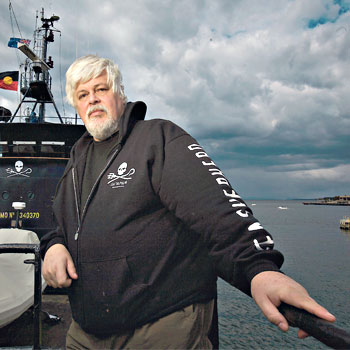
In his late teens Watson went off to sea with the Canadian Coast Guard, a move he says provided him with the skills to carry out campaigns in treacherous weather as a first officer on voyages with Greenpeace and now at the helm of his Sea Shepherd ships. With his shock of white, wavy hair and serious goatee, Watson looks like a man on a mission and indeed he is. In the past year he has spent only two weeks at home in Friday Harbor in the San Juan Islands, Washington.

When not at sea, he’s on the university circuit, lecturing about the laws of ecology and “getting people to understand how important it is to protect our oceans.” Watson, 60, has been married three times and says relationships for him have been difficult. “I’m never around,” he says. “But I can’t imagine doing anything else.” Aside from an adult daughter in Seattle with whom he is close, Watson quite obviously feels his greatest affinity for animals.

“My passion has always been animals,” says Watson.

Sparked by the success of Whale Wars, the unrelenting Watson is set on expanding his participation in reality TV. In May he’s Mediterranean bound to begin shooting Tuna Wars, with a Seal Wars and Shark Wars in the works.

While films and TV shows help to bring some of Watson’s work to a broader audience, Watson is unequivocal in summing up the sense of urgency he feels as he carries out his mission.

“Forget about cancer and heart disease,” he says. “If we destroy diversity on the planet, we destroy ourselves.”