Home Blog Page 859

Wind power sound backlash is overblown

0

A backlash has been growing in many places where wind power is being developed.

In Ontario, one of the main criticisms has been its impact on human health, mostly because of the noise that wind turbines produce. Yet, the peer-reviewed scientific research indicates that the sound from windmills has little to no impact on human health.

This is especially true if windmills are built far enough away from residences. The required setback in Ontario is 550 metres. At this distance, the audible sound from windmills has been found to be below 40 decibels, which is around the level of sound you’d find in most bedrooms.

Critics have also pointed to low frequency sound and infrasound as the source of health impacts from wind turbines. These are sounds that are either difficult to hear or inaudible to humans.

However, Ontario’s chief medical officer of health did a review of the scientific literature and found no evidence that low frequency sound from wind turbines causes adverse health effects.

Though we should always remain open-minded about new and emerging research on any issue, the evidence seems clear that wind turbines built with appropriate setbacks do not constitute a health hazard. And wind becomes a more attractive energy source when you consider the health impacts of the main energy alternative, burning coal and other fossil fuels.

The Canadian Medical Association estimated that in 2008 Canada’s air pollution was responsible for 21,000 premature deaths, 92,000 emergency room visits and 620,000 visits to a doctor’s office. Even if you look only at the health impacts of Ontario coal-fired power plants, the numbers are startling.

It’s never easy to find energy technologies that satisfy everyone, but with the world facing ever-growing negative consequences of burning fossil fuels, we must weigh our options. In doing so, wind power comes out ahead.

If we ensure that care is taken to use technologies with minimal environmental impact and to locate turbines in areas where effects on humans and animals are also minimal, there is no good reason to oppose wind power.

Post City Magazines’ environmental columnist, David Suzuki, is the host of the CBC’s The Nature of Things. David is also the author of more than 30 books on ecology.

A little couch time

0

With a comedy series set to premiere on CBC next month and his award-winning Broadway musical The Drowsy Chaperone about to be turned into a movie, it seems unlikely Canadian comic, performer and writer Bob Martin has much to feel anxious about.

But watch his new show, Michael, Tuesdays and Thursdays, and, according to Martin, you’ll learn a lot about his fears.

The series, says Martin, is based on his co-star Matt Watts’s experiences trying to overcome his neuroses with his therapist but hits upon some of Martin’s anxieties as well.

“I’m not crazy about being in confined spaces,” Martin says, “and height,” he adds. “Height plays prominently.”

Martin’s character, David, is the therapist to Watts’s neurotic Michael. The show, directed by Toronto’s Don McKellar, follows Michael’s therapy sessions in which David tries to tame his fears by gradually introducing him to what he’s afraid of. Unbeknownst to his patient, David’s got his own mess of problems.

“The situations make for a lot of anxiety,” Martin says. “The comedy is in the characters’ dealing with their absurd situations.”

Having forged a path writing and performing his own material, Martin has found success drawing upon his own observations and experiences and reproducing them for the stage or screen. “Writing is extremely personal for me,” he says.

Having grown up in a household with two brothers and three sisters in a two-bedroom house in North York, it would seem Martin, the youngest, would have a lot of colourful material to draw from.

Born in England, Martin moved with his family to Toronto when he was four. His mother was a waitress and his father a carpenter.

His first foray into the world of performing was at the age of 12 when his mother put him in acting classes as a way to combat his intense shyness.

“It worked,” he says. “It [acting] became my thing.”

Martin says his interest in acting and writing was heightened at his high school, Lawrence Park Collegiate Institute. It was there where he met McKellar, who became a long-time friend and collaborator.

“Don was into theatre and writing,” Martin says. “I was competitive, so I was always trying to compete with him.”

“Writing is extremely personal for me,”

Although Martin studied English and cinema at the University of Toronto, he continued acting and writing in fringe theatre. But once he graduated and found his creative pursuits weren’t earning him money, Martin took a job as an editor with a children’s book company. Although short-lived, it seems the stint benefited Martin in the long run.

“I quickly realized I would be absolutely miserable if I didn’t do what I love.”

He quit the job, returned to performing and took “a vow of poverty.”

Shortly after taking his “vow,” Martin auditioned for The Second City in Toronto, a move he made following a bad breakup that proved to be a turning point in his career.

“I wanted to change my life,” he says. “So I surrounded myself with interesting, creative people.” At Second City, Martin says he thrived in the collaborative environment. He overcame any fears he had of acting in front of an audience by performing improv.

“When you go out [onstage] with nothing and end up entertaining people night after night, it means no stage fright,” Martin says.

He went on to direct Second City’s mainstage company and was artistic director for a year.

But the real turn of events happened when Martin became engaged to actress and Second City performer Janet van de Graaff — with whom he now has a four-year-old son, Harrison.

It was at his stag where the first version of The Drowsy Chaperone — a spoof of jazz age musicals — was performed as a gift from Martin’s circle of friends in the Toronto comedy community.

Martin and McKellar took the original script and rewrote it, adding the central character Man in Chair, played by Martin throughout the show’s transformative years.

After premiering at the Fringe Festival and with financial backing from producer David Mirvish, it moved on to Theatre Pass Muraille and the Winter Garden Theatre.

New York producers took interest, and after The Drowsy Chaperone played at a theatre in Los Angeles and a festival in New York City, it landed on Broadway, all within a span of eight years.

After its initial 2006 Broadway run in which Martin was the only performer left from the original cast, The Drowsy Chaperone won five Tony Awards including Best Book and Best Original Score. Martin earned a Best Actor Tony Award nomination and later an Olivier nod after performing Man in Chair in London’s West End.

The musical is being performed in theatres all over the world.

“It’s got a life of its own,” Martin says. A film adaptation is set to shoot within the next year, starring Oscar Award-winning actor Geoffrey Rush (The King’s Speech), who recently played Man in Chair in an Australian production.

As a writer, Martin also figured prominently in creating Slings and Arrows (2003 to 2006), a comical Canadian TV series starring a who’s who of Canadian actors, including Paul Gross, Rachel McAdams and Martha Burns. He recently co-wrote the Broadway musical Elf, the stage adaptation of the Will Ferrell movie, with American writer Tom Meehan (Annie, The Producers) and has several musicals in the works.

But as much as his career takes him elsewhere, Martin says Toronto will remain home for him and his family, and he says he wants his son to grow up here. Plus, he says, he loves living in the Beach neighbourhood where, in his time off, he can walk by the lake.

With so much working in his favour, can Martin really relate to feeling anxiety?

“Every time I get slammed by a bad review, I question it all,” Martin says. “It’s just I’ve had more victories than failures to keep me going.”

Made In Toronto

0

North Toronto trail-blazers

Smythe | www.smythelesvestes.com

North Toronto residents Andrea Lenczner and Christie Smythe landed a major coup when the Duchess of Cambridge sported their signature tailored jacket during her recent Canadian voyage. Launching their fashion label Smythe in 2004, it wasn’t long before they saw their business skyrocket worldwide, counting the U.S., Japan and Hong Kong as just a few of the countries that have fallen in love with the duo’s stylish-yet-practical pieces.

History buff

Cabinet | 10 birch ave. | 416.923.9234 
A third-generation woodworker, Ronald Briand crafts Cabinet’s acclaimed dining tables locally, producing seven unique lines that range from modern minimal to traditional styles. The Historic Collection is made from century-old planks salvaged from weathered whiskey barrels and antique flooring from Toronto’s Distillery District, resulting in one-of-a-kind pieces cherished by the city’s top designers and most notable families.

Bayview’s furnishing magnate

Keilhauer | 1450 Birchmount Rd. | 800.724.5665

One of Toronto’s biggest success stories, Keilhauer manufactures high-end commercial furniture, found globally in Fortune 500 companies and high-level government offices, including the White House. Helmed by Bayview resident Michael Keilhauer, they’re at the cutting edge of environmental responsibility, using closed-loop manufacturing in Toronto to create products that have minimal waste and a lighter footprint.

Skater boy

Boz Boards | www.bozboards.com 
Mike Boz’s college pastime quickly became a full-fledged business opportunity when people took notice of his beautifully crafted and brightly designed longboards. For Boz, manufacturing locally means a better board: “Canadian maple is the most durable because of our short growing season.” That insistence on quality has garnered him some impressive fans, including star skater Steven Sanchez, who recently placed third out of 400 competitors in New York’s annual Broadway Bomb race — on a Boz Board, of course.

Midtown’s vintage virtuoso

Preloved | 881 Queen St. W. | 416.504.8704

Julia Grieve has been reworking vintage threads into modern clothing since 1995. With her innate sense of style and passion for sustainability, the Midtown resident quickly elevated her line, preloved, from cult favourite of eco-enthusiasts to a major player in the fashion world, attracting fans like Anne Hathaway and Kate Hudson and teaming with Anthropologie and Holt Renfrew for their fall 2011 collection. Grieve says that, despite their worldwide success, continuing to create clothes in the GTA “just makes so much sense. It’s a hands-on product.”

Canine designs

Aviva Designs | www.avivadesigns.com 
The world’s top dogs (and cats) can’t sleep on any old bed. Enter Nadine Tyshynski and Aviva Designs, which makes “kitty kouches and doggy divans” using the same high-quality materials as human beds. Pet owners love that the items can be custom designed to complement any home decor. Canadian flag mats are the newest products launched to great success: it’s rumoured that the Canadian Consulate in New York City has one for their dog in residence.

North York’s Can-con champion

Canada Goose | www.canada-goose.com 
For most Torontonians, wearing a Canada Goose jacket is de rigueur come wintertime. Founded in 1957 by the grandfather of CEO Dani Reiss, the company has grown into an internationally touted brand of quality and functionality with an all-around coolness factor. Reiss, a North York resident, decided to keep the company in Canada 10 years ago, in spite of a struggling economy, because “a move would have devalued” the iconic Canadian product.

Chic chapeaus

Lilliput Hats | 462 college st. | 416.536.5933 
Though mainstream fashionistas have only recently become fascinated with fascinators, Karyn Gingras has been designing ultra-couture hats for the past 18 years. All are meticulously made in her College Street shop, Lilliput, drawing celebrities such as Celine Dion and Whoopi Goldberg. The art of millinery may be expanding globally, but Gingras is proud to keep her goods local. “I live and work and am inspired by the city. My work reflects that.”

From our Village to the global village

Fluf | www.fluf-design.com
In 2005, on little more than a whim, Nathalie Butterfield and Terra Kushner decided to give up their respective careers in law and interior design to create decorative pillows and bags. The duo have been making Fluf from their Village-area studio ever since. “We’re proud Torontonians,” says Butterfield, which explains why the partnership is determined to produce its unique eco-friendly products locally, and countries like Japan, Italy and the U.S. (home decor mecca CB2 is now carrying their goods) keep their pillows and bags in constant demand.

Toy story

Cate & Levi | www.cateandlevi.com 
As he awaited the birth of his first child in 2008, Josh Title discovered a lack of responsibly made toys. His concern led him to create Cate & Levi, a line of handmade puppets and stuffed animals, which quickly became an international sensation, selling in stores across North America and Europe, and attracting the likes of Martha Stewart and Sir Elton John. Meanwhile the eco-friendly products remain inherently Canadian: everything is designed and manufactured at Title’s studio in Toronto.

Thornhill’s Foxy ladies

Foxy Originals | www.foxyoriginals.com
What began as a hobby for college friends Suzie Chemel and Jennifer Ger soon developed into a career when the duo launched their jewellery line, Foxy Originals, as a full-time operation in 2003. Since then, the Thornhill and North York natives have attracted international attention from fashion editors, stylists and famous trendsetters like Sienna Miller and Paris Hilton. The jewellery is sold in the U.K., Japan, Australia and North America, but despite the global fanfare, Chemel and Ger are steadfast in keeping their homegrown line just that: homegrown.

Bright idea

Shana Anderson | www.shanaanderson.ca
A recent OCAD graduate, Shana Anderson has already won over many fans with her funky lampshades painted with Toronto landscapes. All of her designs are created by hand and on computer from her downtown condo, and Anderson has the fabric handmade into light shades locally. Inspired by her surroundings, including local architecture, Anderson says, “My products are a reflection of my environment. I make my products in Toronto because they are inspired by Toronto.”

Richmond Hill award-winner
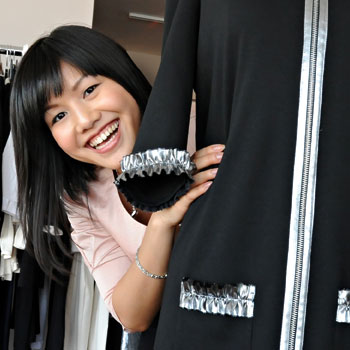
AIME Luxury | www.aimeluxury.com 
Richmond Hill native Monica Mei keeps her clothing line, Aime Luxury, timeless and simple, using all-natural and organic fabrics. Despite achieving almost-instant success after graduating from Ryerson’s School of Fashion in 2007, Mei is adamant her garments remain Toronto produced. A proponent of “slow fashion,” she wants to reduce her carbon footprint and support the local economy. It’s no surprise then that Aime Luxury’s clothing labels read: Made in Canada — with Love.

The rescuers

Brothers Dressler | www.brothersdressler.com 
The Brothers Dressler might be better known as Toronto’s favourite salvage junkies. Twins Jason and Lars have been crafting furniture from rescued materials and repurposed objects since they began their business nearly eight years ago. All of their custom-made sustainable furniture is designed and assembled in their downtown studio. Jason says it’s important to his customers that they are buying furniture made by people who live in the same city: “Our idea of sustainability extends to sustaining a community.”

Experi-metalsmith

Anne Sportun | 742 Queen St. W. | 416.363.4114 
Anne Sportun lives and works within a small radius in downtown Toronto, but her “Experimetal” jewellery travels the world, selling in the U.K. and Japan and across North America. Sported by stars such as Julianne Moore, her unique pieces have made cameos in movies, on TV and were even featured on a Canadian stamp. For Anne, making jewellery isn’t just a business, it’s a creative outlet, which is why she’s been crafting locally for almost 30 years: “I dont want to do it any other way.

Bag lady

Ela Handbags | www.elahandbags.com 
Though Toronto-based Ela Handbags is new to the fashion industry, its designer, Ela Kowalewska, is not. Having worked in public relations at Hermès and as a handbag creator at Roots, she brings a high level of sophistication and expertise that is evident in her cleverly crafted bags. With such attention to design, it’s not surprising that, in its first season, the company is already selling to retailers across Canada, the U.S. and Sweden. Kowalewska says that though producing locally is costlier, it gives her quality control.

Haute dogs

Rufhaus k9 Couture | www.rufhaus.ca 
“Who is your dog wearing?” is not your typical fashion query, but Serge and Katina Constantinou, the husband-and-wife team behind Rufhaus K9 Couture, is changing that with their stylish and sophisticated doggy duds. The entire line is Toronto made, from drafting patterns to manufacturing. Though their garments are in high demand throughout North America and in Europe, they don’t use mass production, so their canine coat bearers can feel special that they’re part of such exclusivity.

Prints charming

Julie Jenkinson | 33 Hepbourne St. | 416-537-9660
British-born Torontonian Julie Jenkinson is a prolific designer whose work covers many mediums. Best recognized for her textiles, Jenkinson’s wallcoverings and fabrics are getting a lot of attention lately and for good reason: her Animaze print is an intricate fusion of surrealist animal theme with vintage pattern style. The result is fresh, unique and would complement any home with room for ingenuity. Jenkinson’s talent is a highlight of the city’s contemporary design landscape.

Child’s play

Thingeeys | 692 QUEEN ST. W. | 416-594-1313
What began as a schoolyard game for Grade 4 friends Noah Cameron and Jack Burton became a booming business idea when Noah’s mom, fashion industry insider Sherri Cameron, started making their imaginary characters into stuffed toys and matching T-shirts. Available at Fresh Collective on Queen Street, Thingeeys are flying off the shelves. Encouraged, the boys have big plans. “Their ideas never stop!” says Sherri. “They’ve got designs for action figures, sleeping bags … they see a whole Thingeey empire.”

Outside the box

Maiwenn Castellan | www.madedesign.ca 
An industrial designer by trade, up-and-comer Maiwenn Castellan launched the Liam Mailbox last February and is quickly achieving widespread acclaim. Available exclusively at Made on Dundas, the quirky postbox is a fresh take on a classic. Every element is produced locally: the round body is spun in a small shop in Newmarket, while Castellan crafts the door and welds the metal herself in her studio. This month, she’ll be celebrated at the Design Exchange’s Capacity show, featuring Toronto’s top female industrial, graphic and textile designers.


New miniseries brings culinary gems from Spain to the Food Network, with love (and sheep's brains)

0

Toronto’s Annie Sibonney brings her love affair with Spain to the Food Network in a new 13-episode miniseries, From Spain With Love. Airing on Thursdays, the show profiles different traditions, recipes and restaurants from all across Spain. From brains to balls, Sibonney shares with us the details of her Spanish inquisition.

How did you choose the restaurants, chefs and families that you wanted to showcase?
It was a collaborative process. A lot of the guests and families, people that you can see I have an authentic relationship with, are people I’ve known for years. They’re people I collaborate with in Spain. We had a research team as well. We reached out to as many people as possible. We shot this grandmother in our Preserves episode and she’s the mother of a good friend of mine from the ‘A Pig’s Tail’ episode, so it’s really one huge family.

What was your favorite meal?
I ate so much food it’s a mystery where it’s all gone. By the end of the day you’re at 60 courses. If I had to pick some of the most memorable meals it would be the kokotxa that I had in a restaurant called Mugaritz in the Basque country. This kokotxa is the lower muscle of the jaw of a cod or a hake fish and it’s a very special product and unique thing. It has a very luxurious texture. It’s an incredible product and I miss it every time I’m not in Spain, but I think there’s a beauty in that, missing dishes that you can’t have all the time.

Were you surprised by any of the cooking or the ingredients?
Absolutely. I have a rule that I never say no when something is offered to me. There is a moment in the ‘Granada’ episode that airs this Thursday where I get offered, as a surprise, this tortilla de Sacromonte. It has a ton of folklore. It is basically a tortilla, which is an omelette, but inside the omelet are some beautiful vegetables and also some balls and brain from the lamb. There is the traditional version and a modern version which has just the vegetables. I enjoyed it. What I loved more was when we started to put together the episode, I saw the amazing reaction by my guest. He was staring at me to see my first reaction to the dish, it reminds me that that’s the power that food has. There was such a magical moment and he was so honored that I enjoyed it and would try it.

What did you learn about Spanish cooking that you didn’t already know?
I would say the pork carpaccio for me was eye-opening. I also had never been to a Cacoltada, which is like an onion roast. It’s these long onions between the vines in Catalonia. I’m amazed every day at the passion and the way people relate to their food. We also visited this street called Calle De Laurel in a town called Logrono in Rioja wine country. I go there for tapas and it’s one of the only remaining places in Spain where each bar has it’s own specialty. We visit a bar where they have a potato and egg omelette, and another bar that just does mushrooms. Just to experience that was totally new. It had the most lively night life that I have ever seen in any city because it was just a jam packed street of tapas bars and restaurants where everyone is just piling in and out.

Favorite episode?
I love our ‘Seafood To Die For’ episode. It’s really action packed. I go on this boat to get this crustacean that grows on rocks. The guys that get them are aquatic superheros and jump from jagged rock to jagged rock. We were in 13-meter swells and I am very afraid of the water. It was murder to get through but one of the best things that I’ve ever done in my life. This week’s episode, ‘Granada,’ is for sure up there as one of my favorites.

From Spain, With Love, The Food Network, Thursdays, 10:00 a.m, 3:00 p.m, 7:00 p.m.

Chef & Me: cottage cookery 101

0

In these times of extreme heat and humidity, we all have our own coping methods. My survival strategy revolves around building a water work station with my newly purchased kiddie pool and lady bug sprinkler. Currently, I’m still in the process of figuring out how not to get electrocuted should my large and hyperactive dog accidentally knock the umbrella taped to the side of the pool into my computer, knocking it off the stool and into the water.

Chef, on the other hand, refuses to wade in my pool, and instead has chosen to play the martyr and sacrifice himself to the sun in order to preserve the well-being of his beloved vegetable garden: meticulously watering at dusk and dawn, pruning and weeding in peak hours with beads of sunscreen running down his face. This is less than surprising behaviour from someone who picks up scolding hot items with his fingers so often that he may no longer have finger prints. He calls it conditioning.

Luckily for us, before electrocution or heat stroke had a chance to strike, we received an invite to a friend’s cottage in Muskoka. Relaxation was to be ours, or so it seemed before I found myself witnessing a one man Top Chef competition.

It all starts off normally. We grab some ham and cheese croissants from Clafouti before starting off, which staves off hunger until we reach Webers Hamburgers off Highway 11, north of Orillia. Every northern-bound camper/cottager out of Toronto is sure to make the stop at this roadside grill for a charbroiled burger – everyone except for Chef and me. I watched with sadness and hunger as the Weber sign became a small speck in the sky, listening to Chef go on about the importance of the cut of meat used in burgers and the ideal fattiness and collagen found in brisket and short ribs.

This leads into a verbal essay on the staggering difference between pre-packaged ground meat and self-ground meat: the former tends to be finely ground, while the at-home-butcher can opt for a larger dye to achieve loosely-packed strains of meat, which allow the collagen room to breathe when sandwiched between the protein; which then gives it air to melt when on the grill, creating a silken chewiness, unattainable without the gelatinous texture of the collagen.

By the time he gets to how he likes to grill his burger (sear both sides on high heat, then close lid and cook for two minutes on low heat, flip and cook another two minutes ), I am pale with hunger and on the lookout for grocery stores where we can stop. We need to shop for supplies for the lunch we’re meant to be preparing upon arrival, and I need the sustenance of fried chicken immediately.

It’s quickly approaching our lunch date and we’re low on time due to a stop at a farmers’ market, where Chef refused to buy produce because they were selling tomatoes (not in season until August and categorized as “devil’s food” until then). We stop at a grocery store and I leave Chef to shop, giving him a budget, 25 minutes to meet me at the cash register and a list of the dietary restrictions of the guests: one vegetarian, one lactose intolerant and one professional food critic. Call it a hunch, but I think it was the last item on that list that gave him the Top Chef sweats.

Chef refused to buy produce because they were selling tomatoes — not in season until August and categorized as “devil’s food” until then

Adamant about never making grocery lists or planning dishes ahead, Chef prepares even meals at home based upon the best available ingredients. Unfortunately, on this particular day, in this particular big-box grocery store, Chef found himself surrounded by tomatoes and corn (also to be listed under “devil’s food” until the end of this month), and ultimately in the middle of a culinary breakdown.

Back on the road and 30 minutes away from the cottage, it was obvious that Chef was in a state. He was making some sort of seafood dish and he was positive he did not have the right quality of ingredients, particularly in regards to the mussels, which were pre-packaged in a plastic container that Chef was convinced would suffocate them. He begins lamenting for Hooked, the latest supplier he’s signed on for his pop-up restaurant, Boxed.

Run by husband-wife chef duo Dan and Kristin Donovan, Hooked is one of the city’s best sustainable seafood suppliers and the current apple of Chef’s eye. He’s taken to sharing with me the joy of learning the daily specials via email; on this day, it’s the fresh Pacific herring from Vancouver that he’s pining for. But with the Leslieville fish store miles behind us, all there is left to do is hear out Chef’s anxiety about his supermarket aqua farm purchases until we reach the cottage.

Once there, the competition continues: the judges are sipping on sangria on the dock, Chef is alone on the deck before the barbecue battling hothouse tomatoes and possibly asphyxiated mussels. Lunch arrives on the table in individual bowls carrying steamed mussels, grilled whitefish and scallops in a roasted tomato consommé, garnished with dill, basil, oregano and olive oil-brushed crostini. The judges make their decisions: shells are emptied, soup is sopped up with bread – it’s a happy ending for Chef.

Something tells me, though, that despite the praise of the judges, Chef’s totalitarian view on the importance of seasonality has not been compromised by this recent cottage experience. Given the fact that the devil’s corn was tossed out that night, while the husks were spared to wrap and steam potatoes on the grill, I think it would be safe to assume that no one in our house will be enjoying any corn salsa until the late summer harvest.

Cottage Bouillabaisse

Ingredients
1 cup of Ontario cherry tomatoes
2 garlic cloves
1 medium sized shallot
1 lbs of mussels (washed and beards removed)
1/2 cup dry white wine
6 large scallops
3 fillets of whitefish, skin and all bones removed
1 Tbsp each of; dill, mint, basil, oregano (chopped finely)
1 sour dough loaf

Staples
Salt
Pepper
Extra virgin olive oil

(Serves 6)

1. Pre-heat grill, high on one side and med-high on the other.

2. Warm a healthy splash of good olive oil in pan on med-high side. Add 2 cups of cherry tomatoes, cook until blistered and browned.

3. Add 1 tbsp of minced garlic and half cup of brunoise shallots. Cook until shallots are translucent.

4. Add mussels and sautés for approximately 30 seconds. (*If you have it, a couple splashes of fish sauce here will bump up umami and bring out the mussel flavour.)

5. Deglaze pan with half a cup of white wine (best to use a wine that would be worth drinking). Cover for 2 minutes.

6. While the contents in the pan stew, season your scallops and tilapia with salt and pepper and grill on high heat side.

7. Grill until 50 per cent cooked, approximately two minutes on one side only. Remove from grill and place one scallop and half a fish fillet (grilled side up) into individual serving bowls.

8. Remove lid from pan and use slotted spoon to move roughly 10 mussels into each bowl.

9. Move pan to high heat side and allow remaining sauce to reduce for two minutes. Turn med-high side to low and grill sliced bread while sauce reduces; flip after one minute.

10. Spoon approximately a half cup of boiling sauce (be sure to catch tomatoes and shallot) over seafood. The residual heat from broth will cook through the fish and scallop.

11. Add a squeeze of lemon and a splash more of extra virgin olive oil before garnishing with fresh dill, mint, oregano and basil. Stick 2 slices of grilled bread upward in the bowl.

*Chef’s tip: Continually taste everything for seasoning purposes. Adding small amounts of butter at any time throughout this recipe will only help.

Toronto-based writer Jennifer Lee is the editorial director of FILLER magazine, an online fashion and culture journal. She is also the co-editor of Hardly magazine, an arts-centric online teen publication for Canadian girls. Her column, Chef & Me, appears biweekly.

What’s minty, boozy and not a mojito? The mint julep, and Toronto’s digging it

0

Toronto’s mean midsummer heat wave bares sparse semblance to the first, sweet-breezed weekend in May that heralds the arrival of spring and, south of the border, gives way to the famous Kentucky Derby. But there’s no reason why we can’t inwardly escape to the Bluegrass State by wrapping our sweaty paws around a tall, frosty cup of minted bourbon.

Sound questionably appealing? Let me persuade you to reconsider: the mint julep may just be one of the simplest, and most surprisingly delectable, drinks you’ve never tried.

According to Tales of the Cocktail, New Orleans’ annual drink symposium which took place last weekend, the skeletal origins of the mint julep date back to the Persian Empire, where health tonics called gulabs were distilled from rose petals. As the popularity of herbal distillations spread to Mediterranean regions, rose-based tinctures were replaced with indigenous and plentiful mint.

By the 1800s, mint and spirit combinations were being downed in the Americas as breakfast pick-me-ups, rousing groggy southeastern farmers in the wee morning hours and making their arduous days that much more bearable. And seriously, who needs caffeine when a spot of mint and whisky does the trick?

Around 1875, fine Kentucky bourbon was solidified as the spirit of choice for juleps, and the accelerated popularity of this Southern classic established it as the official drink of the Churchill Downs by 1938. Originally sold in souvenir cups for seventy-five cents a pop — yes, those were the days — the Kentucky Derby continues to cater to a parched crowd of julep enthusiasts, now mixing over eighty thousand of its signature cocktails over a single weekend.

Mixing a mint julep isn’t difficult by any means: in fact, it demands an adherence to simplicity. The traditional Southern recipe, according to Mittie Hellmich’s Ultimate Bar Book, calls for four ounces of good-quality bourbon, a teaspoon of simple syrup and six mint sprigs over crushed ice, served in a silver (or pewter, if you’re feeling decadent) julep cup. Exactly how mint assimilates into the cocktail is still a subject of debate, with purists insisting that it be used only as an aromatic garnish, while others prefer to marry the caramelized woodiness of American whisky with the soft bite of fresh mint by carefully bruising the leaves with sugar.

When mixing a julep, don’t shirk on bourbon — as with any stiff cocktail, a premium brand of spirit makes all the difference. Try Maker’s Mark 46 ($49.95), Woodford Reserve Distiller’s Select ($46.95), or Elijah Craig 12 Year Old Kentucky Straight Bourbon ($39.95), all available at the LCBO, for a stellar whisky slushy. If you want to get authentic about it, abandon high ball glasses for your very own julep cup, soon to be available at Queen West’s Cocktail Emporium ($50 for a set of four). Alternatively, sip a julep at Ossington’s The Dakota Tavern ($8), or tackle a Mint Julep Martini ($9) at Southern Accent in the Annex.

Cocktail Emporium, 972 Queen Street West, 647-727-3600; The Dakota Tavern, 249 Ossington Ave., 416-850-4579; Southern Accent,595 Markham St., 416-536-3548

Band of the Week: Rattlesnake Choir

0

Toronto’s Rattlesnake Choir looks like a band with more than a few stories to tell. Fortunately the band makes good on its anecdotal potential, backing it all up with a strong country music foundation that takes as much influence from Tom Waits as it does Hank Williams. Watching the group live is an experience in and of itself, with percussive Slinkys and the musical saw making regular appearances throughout the band’s set.

The band has been host to a rotating cast of musicians, but mainstays John Borra and Sam Ferrara have been with the band since its inception. We pulled the guys away from their busy weekend at the inaugural Wawapalooza Music Festival to ask them a few questions about their new album, their weekly residency at The Communist’s Daughter and what it’s like to play in a women’s prison.

How did you guys get together?
SF: Who knows? [laughs]

JB: Around 15 years ago or so I just started writing and singing my own songs. I played in a band as the bass player for years and Sam also had been playing bass for a number of years. He sort of dissolved his group and started playing these odd percussion things. Me and Frank Nevada had a night at the El Mocambo where we did a songwriter’s showcase and Sam would come down and play. We’ve just been playing together ever since.

Have you had a lot of members go through the band?
JB: We started as a four-piece with Tony Benattar on bass and a woman named Treasa Levasseur who played accordion and piano. The very night she told us she couldn’t play in the band anymore — because she had her own project — Miranda Mulholland happened to be at that gig and told Treasa she’d love to play with us. So as Treasa’s telling us she can’t be in the band, she introduces us to Miranda, who we invited to come play. And it turned out she was amazing.

SF: I’d played with her before when she dropped in a bit and played some fiddle with some other bands.

JB: She’s played for a lot of bands. So after we’d been playing for a while Michael Boguski, who’d been playing with The Beauties, said he’d love to play with us and at the time Miranda was away a lot, and Tony had to go away a lot for his boot business, so we started to think maybe another member would be a good thing. Then we asked Dani Nash, because with Miranda being away we needed someone to cover the harmonies.

You use some pretty creative percussion instruments. How do you come up with those? Do you make them yourself?
SF: The Slinkys I made myself, yeah. The cheese grater, I’m the only one I know who plays it with sandpaper. I’ve seen one guy play it once with spoons.

JB: You had other things you used to play too. He used to play a Zippo lighter.

SF: There was two-clothes-pegs-on-a-block-of-wood too.

JB: Back in the early days he used to play the plastic bags. He’d take a white grocery bag and stuff a bunch more inside.

SF: It was a really cool sound, but my doctor told me I had to stop doing that.

JB: I tell you, you’ve never lived until you’ve asked for more bag in the monitor. Then there were the files — we actually got files into a women’s prison one time.

Can you tell the story about the women’s prison?
JB: It was a Christmas thing. Y’know, you have to fill out this thing and they give you a background check to make sure you don’t have a criminal record. So I asked the woman from the charitable organization arranging it if we should tell the prison about Sam’s instruments … and she said no, because the prison would definitely say no. So we arrived at the prison, and we’re standing there with all our stuff and the organization was bringing in all these pizzas, so they just stuck all the instruments in these pizza boxes. We played our set and after, as we were coming out, we were just carrying them all and the guards had these confused looks on their faces, but it was already too late so they just let us go.

How many albums do you guys have out?
JB: Two. We released our newest one [Walkin’ The Wire] in April.

And you’re still playing the Communist’s Daughter?
JB: Sam and I have had a residency at the Commie for six-and-a-half years; Sundays between 5 and 8 p.m. That was sort of the genesis of the Rattlesnake Choir with the two of us playing together.

Any thing else coming up?
JB: We’re just trying to lay low, but we’re doing things like this Wawa thing and we do the Cameron House one Saturday a month. We’re trying to do less gigs but make them a little more special.

Recommended track: “You Play the Thunder”

Rattlesnake Choir are:
John Borra: Vocals, guitar, harmonica
Sam Ferrara: Cheese grater, slinky, saw, tambourine, vocals
Tony Benattar: Upright bass, dobro, vocals
Miranda Mulholland: Violin, vocals
Michael Boguski: Piano, accordion
Dani Nash: Mandolin, vocals

Spent puts on a limited-run show before heading abroad

0

Spent, a comical play about the 2008 financial crisis, made its debut two years ago to a fair bit of critical acclaim (it won a Dora award). It’ll  be appearing at the Edinburg Fringe Festival next month, but a "final" series of fundraiser shows are taking place in Toronto over the next few days to raise money for festival costs. We caught up with writer and actor Ravi Jain to talk about the play.

Why a play about the 2008 financial crisis?
Well, me and my collaborator Adam had done a clown show [Tools] in 2008. It was about clowns building Ikea furniture. We wanted to find a different style that was comedic but more in depth. The crisis hit in 2008 and we said, that’s our show. It shows an international impact through a Toronto lens. It focuses on two Bay Street bankers who lose all their money and jump off a building. They dream of heaven with lots of food and money, and they get greedy. They are sent to hell because of their greed, then wake up and realize they are falling. It spoofs the media; BBC world news is a big part of it.

How does Spent show the financial crisis and its aftermath?
Through a BBC lens we show different reactions. We go to Afghanistan, for example, and show people laughing at America and their demise. We show real people who have to change everything while people like Richard Fuld keep everything. One part shows an average Joe who lost everything and there’s no one helping him. You hear the numbers of money that this guy (Richard Fuld) made and it’s absurd. American people had to bail him out.

Why use humour?
Comedy provokes us to think in a different way, uses a different part of the brain. Movies like Inside Job, which was a great documentary, have the ability to capture an audience’s attention. Theatre allows people to experience it in a different way. In 2010 there was a school trip of Detroit students who were laughing so hard. We asked them after the show and turns out they were all hit so hard by the crisis, people they know lost everything. They said it was the first time they could laugh at it. It pokes fun at the bastards who got away with murder.

What were people’s initial responses?
People were excited. It was the only show that directly talked about it. In 2009 there was an excitement for the way it was performed by two actors. We won the Dora award for best performance. We did a 2010 re-edit. Added that a year and a half after the crisis, when Wall Street made record profits. It felt like the crisis was over, but there was disparity between the rich and the poor. There was an idea of recovery, but we didn’t trust it.

How many characters do you and Adam Paolozza play?
There’s a total of about 34 characters. So about 16 or 17 each. At one part there’s a panel and we play about six characters at once. We use accents to differentiate. The two Bay Street characters are completely silent, they never actually speak. BBC world news explains what is happening.

How did you get involved with the Edinburg Fringe Festival?
Friends have performed there in the past. They said it would be a good fit for the Pleasance Theatre. We sent them a package and they took us.

Spent, Tank House Theatre July 27-29.

Q&A with Jann Arden: Juno Award winner, author and celebrity judge on Canada Sings

0

With a new live album, a new book and a weekend radio show, multiple Juno Award winner Jann Arden is having a busy year. Next month, she’ll appear on Global’s Canada Sings, a six-part series in which teams of ordinary Canadian co-workers form singing groups to compete for a $10,000 donation to their chosen charity. The judges are Pierre Bouvier of Simple Plan, Robert “Vanilla Ice” Van Winkle and, of course, Jann Arden.

We caught up with her to chat about philanthropy, work versus luck and what it’s like being a judge.

On Canada Sings [Arden playfully sings an A natural], did you want to be the mean judge with the accent?
Yeah, wouldn’t that have been easy. You know, when they made me the offer I thought, “I don’t want to do this.” But my manager said, “It’s not what you think. It’s not 100 kids that want to be flown to Vegas to be famous and get a record deal.” These are people that want to earn money for their charity. These are people that don’t typically sing and dance. These are firemen, teachers, zookeepers, truck drivers. What a cool concept! Everybody wins. Not a record contract, but a nice chunk of money for the charity of their choice. Plus, they have this experience that takes them over the course of a few weeks, working with vocal coaches and choreographers, and they get to be in the spotlight on a national TV show, singing and dancing in a production that is as good as anything I’ve seen on Broadway. And I am not kidding you; nobody sucks! Nobody!

Are you concerned one of these groups of ordinary working Canadians might do so well that they quit their day jobs and leave a hospital or something without a staff?
I would be thrilled if that happened. If someone says, “There was such a demand for it, they’re releasing a single,” cool! But I know that’s not what’s motivating them.

Apart from the charity element, what are the merits of competitions in performing arts?
Well, I think in this show, for the most part, people are competing against themselves. Does that make any sense? There were people who hadn’t sung a day in their lives. Some people hadn’t danced since junior high school. So there is competitiveness to win money for a charity. Yeah, that’ll light a fire under anybody. And the fact that it’s motivated by selflessness, you know? But once they get a taste of it – it’s funny watching as this stuff unfolds. They get a taste of what attention feels like, what accolades feel like, it’s very intoxicating. So you definitely see people developing that hunger, which is great to see! I think all these people left this show inspired, feeling “I can do anything now! Why was I so afraid of trying things my whole life?”

You have said you are always surprised by what you have accomplished.
Careers generally don’t last this long. A huge percentage of acts have a shelf life of about 36 months. After three years you’re like, “Whatever happened to those guys that did that?” So I’m grateful to be in that small percentage who survived that.

And is that luck or hard work?
It’s work. Because art’s subjective, it doesn’t mean what I do is great; nine people could hate me and one could like me. So it’s really up to the individual [artist] how far you can push things. It’s not one thing, and I always tell that to parents who tell me about their kids who are singing. Yeah, your kid can sing okay, but if you think that’s where it begins and ends you’re wrong. My life has very little to do with singing. The actual time I spend singing is minute. I enjoy it, but there are so many things I have to do.

Canada Sings airs Wednesdays at 9 p.m. on Global starting Aug. 3.

Wilfred’s first standalone boutique opening in Toronto this summer

0

For those ladylike trendsetters who clamour to Aritzia for its ultra-feminine Wilfred line, here’s some very good news: Wilfred will open its first-ever boutique this summer at Toronto’s ever-evolving Eaton Centre.

Though faithful Aritzia customers may frown upon the label’s new digs (let’s face it, malls don’t have quite the same cache as they did in the Clueless era), the ‘grand apartment’ concept of the new store promises its clientele the cozy boutique aesthetic they’re used to, along with a contemporary edge.

The store will house all three of Wilfred’s labels: Wilfred Free (for casually chic looks), Le Fou (for more luxurious and high-end statement pieces) and the original Wilfred (for classic feminine essentials).

Despite Wilfred striking out on its own, die-hard Aritzia fans can relax: the label will continue to be sold at Aritzia stores, meaning there will just be a lot more breezy blouses and romantic skirts available this fall, which isn’t a bad thing at all.

The new Wilfred is scheduled for an Aug. 25 opening.

The Dressing Room: a men’s summer wardrobe guide

0

When barometer meter readings are on the rise, collared shirts and slacks are no man’s friend. And though none should be denied the right to cool down in a pair of Bermuda shorts, there is a clear distinction between a breezy summer wardrobe and a sailor’s closet (circa 1930s/Popeye era) that should not be ignored. It’s the simple difference between a tailored short-sleeved button-up and a cuffed cap-sleeved plaid shirt buttoned to the top.

But, with the scorchers piling one on top of the other, and the city’s men finding themselves in toe-to-toe combat with the notorious sleeve monster (who prefers his victims to be nautical striped, in baby T sizes), the task of finding a happy medium between beach bum Slater’s flip flops and board shorts and upper class Brad’s Sperry’s and seersucker shorts appears increasingly daunting.

Or so I learned while shopping the summer sales with my brother and boyfriend last week — my 30-something year-old brother being the type who would never wear a grandpa cardigan because he doesn’t get the irony in looking like the dad from Growing Pains, and my boyfriend being the sort of guy who would wear a Boston Red Sox cap every day for two weeks to hide a side part fade he inadvertently got from one of our neighbourhood hipster barbershops. Both men were on the hunt for staples and wanting to find items to help transition their fall/winter fashion sensibilities — pea coats; solid-coloured crew neck sweaters; straight leg jeans (not to be confused with skinny cut) and slip on ankle boots — into practical and stylist summer wear.

The first item on their wish list: shorts. For a few seasons now, the men’s runways have been showing slim shorts. Every year, they seem to get slimmer and shorter, bringing us to this year’s favoured above-the-knee variety, seen modeled around town in chambray incarnations and colourful twills alike, worn so tight that when a man sits and rises, the shorts must be yanked down back into place. Such short shorts, though, would not do for either of these two men. What they were looking for was a tailored short with versatility: a pair of shorts that they could wear camping as comfortably as to a nice dinner out — shorts for the fashionable man’s man. Funnily enough, it was a pair of swim trunks that ended up fitting the bill best for both gentlemen.

Found at Sydney’s menswear store on Queen Street West and designed by Carl Cunow of New York’s Onia label, the boys’ dream shorts (pictured below) were happily discovered at the back of the store on the sales rack. Measuring 10” in length, these zip-front shorts fall above the knee and are made from high quality cotton/nylon fabric sourced from Japan and tailored in NYC’s Garment District. Aside from the durable net lining and the whole hi-tech waterproof fabric thing, Cunow has taken his background in fashion — including five years working production at Steven Alan doing fabric-buying and sample-making — so these shorts look every bit as ready-to-wear (made of 60 per cent cotton, they’re soft enough to wear as a walking short) as they are ready-to-swim (at 40 per cent nylon yarn, they dry quickly). During our visit to Sydney’s, there were still at least a handful of shorts waiting to be snatched up, but should you miss the sale, try ordering online at onia.com.

Next on the list was a breezy top of some sort — something suitable for city strolls and park lounging. This we would end up buying at Little Portugal’s Lost & Found. One of the many clothing shops popping up on Dundas West specializing in smaller labels that one might find at Opening Ceremony, this particular shop offers the distinguishing perk of being reasonably priced.

Amongst the brands on offer here is Unis, a contemporary men’s sportswear line produced and manufactured out of New York and Los Angeles. Designed by Eunice Lee, the line is at the head of urbane menswear’s appropriation of the office nerd-preferred short-sleeved button-up. While the bulk of designers have re-imagined the shirt for the malnourished man with a boyish figure (i.e. arms smaller than mine), Lee has stayed on trend with narrow bicep cut sleeves whilst managing to keep in mind that some men might actually have something bigger than joggers arms, and would rather not wear a shirt that makes them look like they’re going to lift weights on the pier. Unis’s “Owen” shirt — woven out of cotton and available in striped, checkered, purple and pink — is a good choice for a low-key guy in need of an honest summer button-up that can be worn in both casual and semi-formal settings — best worn not buttoned to the top — and doesn’t look like it’s been shrunk in the wash.

For the last item on the boys’ summer wish list, shoes, it was as easy as a pair of Vans. For my brother, the woven leather slip-ons; for my boyfriend, the classic canvas low-top sneakers — both in all-black, both an ideal balance of coast and street and both available at Get Outside.

Top-siders dodged and sleeve monster averted, the boys had their summer staples, and I had a new appreciation for menswear. Never would I have known how challenging it is for a man to avoid looking like a caricature unless I had gone shopping for summer essentials with someone who already looks like a sailor from the shoulders up: the fade, like layers of clothing in the summer, is no man’s friend.

Toronto-based writer Jennifer Lee is the editorial director of FILLER magazine, an online fashion and culture journal. She is also the co-editor of Hardly magazine, an arts-centric online teen publication for Canadian girls. Her column, The Dressing Room, appears weekly. 

This Week in Sound: Death Cab for Cutie, Frightened Rabbit, The Weeknd and more

0

Indie flagship band Death Cab for Cutie (July 29 @ The Molson Amphitheatre) are indie only in name and don’t need to be introduced. Their electronics-heavy new album Codes and Keys has bewildered critics, and, well, Narrow Stairs wasn’t exactly their finest 45 minutes either — but it’s easy to forget that Death Cab are still among the sturdiest acts in indie rock, with a huge stable of quality material reaching back to 1998. How much of it they’ll play, mind you, is anyone’s guess.

I like them so much I gave them their own paragraph, even though it’s the same show: Frightened Rabbit (July 29 @ The Molson Amphitheatre) will be warming the crowd for Death Cab. Singer Scott Hutchison must have been bedridden with the measles the day they taught positive self-image in social studies class, but his angst makes for very engaging narrative-based folk-rock songs, and his band delivers plenty of dopamine-rush climaxes. If you’re not down with Death Cab’s new material, go to see Frightened Rabbit and just hope Death Cab plays "Transatlanticism."

Out of the Box Music Festival (July 29 – 31 @ various venues) lives up to its name. Toss a space-themed prom (“You have just graduated from the Intergalactic School of Debauchery…”), a 3D rock concert and a lineup of mostly Toronto and Ontario-based acts ranging from folk to psychedelia into a blender, and you’ve got two whole weeks worth of weird in one easy-to-drink, three-day milkshake.

This is not a generic hip-hop drop-in from a rock music listener: I actually find Kid Cudi (July 30 @ The Molson Amphitheatre) charming. His "Pursuit of Happiness" vid was so disarmingly emo and self-loathing that I watched it ten or twenty times. The big strike against him is that he was a little mean to Canada’s finest bipedal napkin, Narduwar the Human Serviette. Not cool, Kid Cudi, not cool at all.

My weekends usually involve beer and reading Wikipedia for six hours at a time, but if yours are more along the lines of flash strobe lights and sweaty, gyrating bodies, you might want to check Toronto’s own The Weeknd (July 31 @ The Molson Amphitheatre). At twenty years young, singer Abel Tesfaye is offers disturbingly mature R&B fables with ultra-NSFW lyrics (re women, sex and altered states) over moody, sputtering beats.

This is a generic hip-hop drop-in from a rock music listener: big names Rick Ross and Drake (July 31 @ The Molson Amphitheatre) will be getting the party started this weekend. Young girls will scream, hands will be thrown in the air like their owners just don’t care, etc.

And, of course, this week’s dose of nostalgia: remember when you thought that Third Eye Blind (July 28 @ Echo Beach) was so, so cool—along with pogs, baggy shorts and wallet-chains? Um, yeah. Anyway, those with an underdeveloped sense of shame can shout along to “Jumper” on Thursday.