

Home Blog Page 715

Nelly Furtado’s still got it

0

“Gangnam Style” is the biggest Korean export since Samsung. The pop video, by South Korean rapper Psy, has been viewed almost 500 million times and gotten more “likes” than any in the history of YouTube — 4.1 million and counting. Psy’s quasi-sensical and entirely infectious tune has everybody groovin’, from Katy Perry to Tom Cruise.

It’s inspired countless imitations, mashups and parodies. Usually austere CBC news anchor Peter Mansbridge can be seen replicating the original’s cowboy dance moves in one video, and another features Toronto Mayor Rob Ford barely tolerating a tuxedoed Psy wannabe as he dances around him during a high school football game.

So it comes as little surprise that if you punch “Nelly Furtado” into Google the first result the all-seeing search engine spits back — after the obligatory Wikipedia, Facebook and Twitter pages devoted to the pop star — is a shaky smartphone video of Furtado showing off her “Gangnam Style” during a recent concert in Manila.

“I was on tour in Asia, and during the second stop, in Singapore, my driver showed me the video and thought it was spectacular. I fell in love with the music and the dancing,” she says. “I often do covers, like J.Lo’s “On the Floor,” so I immediately grabbed everybody I could wrangle to rehearse “Gangnam Style” with me, and we performed it at the Araneta Coliseum where Muhammad Ali and Joe Frazier fought the Thrilla in Manila. It’s a fun, high-octane song that gets everybody moving.”

Indeed, Furtado does possess a certain “Gangnam Style,” which the song describes as a “girl with that kind of twist” and “who looks quiet but plays when she plays, a girl who puts her hair down when the right time comes.”

“I’ve been listening to K-pop for years,” says Furtado. “I was at an event at Mel Lastman Square three years ago, and they had these great Korean rappers. And I remember when I was younger hanging out at Pacific Mall and at Yonge and Finch and eating Korean BBQ and going to karaoke. Now hearing Korean pop on the radio is delightful.”

The 33-year-old B.C. native has just flown from her home in Miami to Toronto to promote her new album, The Spirit Indestructible.

“Songs are like babies, precious little things that are born.”

“I’m still getting used to the fall weather,” she says with a laugh. “But it’s nice to be back where it all started.”

Furtado moved to Toronto after high school to live with her sister, and it’s where she launched her singing career with the Grammy-winning album Whoa, Nelly! in 2000 that spawned the infectious, ubiquitous chart-topper “I’m Like a Bird”.

It’s been six years since Furtado’s multi-platinum album Loose, which featured the smash hit “Maneater” and collaborations with Justin Timberlake and Chris Martin. Motherhood has taken up much of her time. But she hasn’t been completely absent from the music scene. She started her own record label, Nelstar Records, and recorded a Spanish-language album, Mi Plan, which sold well internationally, spawned a South American tour and earned her a Latin Grammy. Still, her return to the more commercial pop cocktail of her roots is not without some trepidation.

“It’s taken three years to make this album, trucking along up a big mountain wondering when I would get to the top,” says Furtado, who enlisted producers Salaam Remi (Nas, Amy Winehouse, Fergie) and Rodney “Darkchild” Jerkins (Michael Jackson, Beyoncé, Mariah Carey, Kanye West) to help recapture just the right sound.

“We wrote something like 50 songs to get to the 20 that became the album. And choosing them was difficult —while I find that songs are therapeutic, I kept wondering whether others are going to like the songs or am I just being selfish by including the songs that I like?“The songs are mostly uplifting and positive and make you move, but then something like ‘Enemy’ is so melancholy — does it belong? Ultimately, though, it was a creative pressure that I felt, not pressure, in terms of how the album will perform with sales and things. It’s pressure I put on myself.” 

In fact, Furtado devoted so much time to getting each song on the album just right that Remi accused her of being “three years pregnant” with it, Furtado jokes. “Songs are like babies, precious little things that are born.” Some, like the title track, took only a couple of days to write.

“Rodney and I had such a spiritual connection between our musical inner children,” she says of the collaboration.
In some ways, Furtado credits her Spanish album with her current record’s success.

Mi Plan forced me to look at songwriting differently. Now my lyrics are more cohesive, and I think about metaphor more, not so esoteric,” she says.

“At the same time, it’s a totally different-sounding album, with lots of urban sounds. It’s a pop record, with a bit of hip hop and dance and rock and folk, a bit of everything but still very much my sound, my voice.”

The album’s first single, “Big Hoops (Bigger the Better),” sees Furtado channelling her 14-year-old self and hanging at the mall and discovering hip hop, which explains the lyrical quotes from Salt-N-Pepa, A Tribe Called Quest and Blackstreet — bands the teenage Furtado listened to in the burbs of Victoria, B.C.

Likewise, “Parking Lot” and “Waiting for the Night,” inspired by a diary she kept as a lovestruck teenager, have a similar nostalgic bent.

But much of the album was inspired by Furtado’s more recent experiences. Furtado is an ambassador for charity Free The Children, which supports education and development projects around the world. Last year, she donated $1 million to the organization to assist in the building of a girls’ school in Kenya (it was same amount she was paid in 2007 for performing for Libya’s Gadhafi family).

“I’ve been to Kenya several times — it’s the most beautiful place in the world. Going there and meeting the people there, the women and young girls who are fighting to make a better community for themselves and a better world, it’s changed my life,” she says.

She’s also working closely with Me to We (www.metowe.com), a charitable organization that sells fashion accessories made by the Maasai women in Kenya.

“In addition to the beaded jewellery, they have a special “Spirit Indestructible” tank top I designed that they’re selling to raise money for a new high school in rural Kenya,” she says.

“I experienced real communal joy for the first time. In Africa, I experienced people celebrating and being joyful together for the first time, and it reaffirmed my belief in humanity.”

The unlikely rise of Jian Ghomeshi

0

Sitting with him on the upper level of the Rivoli on Queen Street West, it’s hard to believe Jian Ghomeshi was once the awkward, paranoid, David Bowie–wannabe 14-year-old kid he describes in his book 1982.

Moving between appointments with media outlets to promote his first novel, Canada’s cool guy of radio is, well, cool.

Dressed casually in black jeans and a black shirt, Ghomeshi engaged and connected with his interviewers just as easily as when he’s interviewing a subject on his own radio show.

As the well-known host and co-creator of CBC Radio’s Q, it’s hard for most Canadians to picture him as anything other than the soothing voice on the airwaves. Since launching in 2007, Q has grown to air twice daily across the country, as well as becoming a multi-platform entity that has moved into television, satellite radio, YouTube shows and podcasts. This year, it’s also airing on 140 stations in the United States. Oh, and the New York Times also wrote an article this summer on the former Thornhiller.

Given all this hype, it’s hard to wrap one’s head around the image of Ghomeshi as a scrawny, purple eyeliner–wearing teen that wanted nothing more than to fit in. But throughout 1982 he draws quite the picture of his teenaged life for his readers.

The Thornlea Secondary School graduate was born to Iranian parents in London, England, and moved with his family to Canada when he was seven. As a first-generation immigrant in a suburb north of the city, all he wanted to do was blend in. And it was hard.

“Some of it is just sort of the reality of Grade 9 and high school and all of the confusion and pressure and worry and desire and all those things clashing together,” he says. “But the other part of it, for sure, was really feeling like I didn’t fit in, like really feeling like an outsider, being reminded about that in different ways.”

His dad didn’t play hockey, while other dads were out on the ice, he says. He reveals in the book that his house was lit with a red light at night and not the standard white bulbs the other homes shone with. It wasn’t until a neighbour alerted his father to the brothel-red-light connotation that the Ghomeshi household adopted the usual bulb.

Growing up during the Iranian Revolution of 1979 added another layer of yearning to be different for the teen.

“As a way of wanting to escape that and aspire to more or something else, Bowie was my hero and my idol, and I figured that if I could just be Bowie, then I would be accepted and liked and girls would like me,” he says. “So Thornhill all played into that because Thornhill was both who I was and also my greatest obstacle to becoming cool. And all of this was based on this misled notion that if I was cool I wouldn’t feel left out anymore, I wouldn’t feel different, I wouldn’t get picked on or whatever.”

His obstacles became his fuel, and it was that longing to assume Bowie that helped him join and form high school bands, leading to the formation of Moxy Früvous, the Thornhill folk band that toured for more than a decade.

The tumultuous relationship he had with his hometown has played out in different ways throughout his life, but as he got older, he’s paid homage to his old neighbourhood.

“I figured that if I could just be Bowie, then I would be accepted and liked and girls would like me.”

“One of the biggest laughs we ever had was to be on the Late Night with Conan O'Brien and have him announce Moxy Früvous, as a name we had just made up as a joke, ‘and their new record Thornhill,’ in front of a national network audience,” he says, laughing.

Music has provided a soundtrack for Ghomeshi throughout his life, and he continues to make music a centerpiece of his show with Friday Live, the weekly thematic show that weaves in music throughout the segment.

“By my early teens my life was music. The soundtrack that accompanied my life was my life, to a certain extent,” he says. “It really defines those years.”

Though he always had an inkling he would become something great, he was convinced at 12 years old that his name and looks would hold him back because he was too different. Looking back from his time as a kid through to now, the made media man has a hard time grasping it all. Even compared to a few years ago, there has been a huge surge in popularity and validity for Q and its host.

“I will say that it wasn’t that long ago, two or three years ago, it was a challenge for us to get, say at TIFF, a lot of big name guests, ’cause they were like, ‘Oh, it’s a radio show,’ ” he says. “And now we don’t have that at all.”

The most rewarding part is that Q is his brainchild. He wanted to produce a radio variety show that also combined long-form journalism. Though the suits told him the genre doesn’t fit today’s ADD-filled world, Ghomeshi had a vision.

After much convincing, he was given a shot. The show hit two target audiences, the first being the older generation of CBC fans, which he maintained to the CBC’s delight. Yet the variety aspect of the show also attracted a younger generation of new listeners. The surge in a new fan base, combined with the musician’s ability to connect with his guests in a way the audience relates to, have made the show untouchable.

“I think it has to do with the fact that I genuinely am interested and curious. I am genuinely interested in people. I am genuinely curious about things I’m asking about on the show,” he says of his success with his subjects.
He strives to be as prepared and confident as possible, when it comes time to air, admitting that a live format adds a difficulty factor.

“It’s a daily show and it’s live. There is no break from the pressure cooker,” he says. “I don’t want to have a crappy show, and there’s no editing, there’s no do-overs … so it’s definitely a grind.”

He attributes his work ethic and determination not just to the desire to fit in as a teenager in Thornhill, but  also to his family values.

“I also come from first-generation immigrants whose father I joke about saying, ‘Please work harder,’ ” he says. “But I was brought up to really work hard and to not take things for granted and to never sort of coast and to prove myself to others. So it’s in my DNA.”

His book 1982 provides an inside peek into one year of his life, helping readers to understand the current Ghomeshi through the younger one. For the radio star, writing a creative book was rewarding.

“It’s a document that will live on as a moment in my life. So in that sense, it’s gratifying,” he says. “It feels like I used a lot of my Lego pieces. And instead of building little blocks, it’s like a house and hopefully an entertaining and interesting house.”

The musical genius of Chilly Gonzales

0
Chilly Gonzalez
Chilly Gonzalez

A 40-year-old man with a disorderly shock of brown hair, wearing a bathrobe and plush slippers walks onstage and seats himself at a grand piano. His name is Chilly Gonzales.

His name and getup might be pageantry, but Gonzales’ music is, simply put, the real deal. And with his piano playing he even lives up to his preferred moniker “musical genius.”

Over the past decade, the eclectic, underground Canadian performer has fronted an alt-rock band, released three rap electro-pop albums (which garnered him a loyal European following), collaborated with artists from Feist and Peaches to Jane Birkin and Charles Aznavour and has now released a second mesmerizing album of original compositions for piano. And the flourish: Gonzales holds the Guinness World Record for longest continuous piano concert (27 hours).

He’s a hard one to pin down, this rapping piano virtuoso, but as Gonzales — speaking from Europe where he has been based since 1998 — discusses his musical career, two things become clear: First, a lot of structured, deliberate thinking underpins his multifarious creative experimentation. Second, behind the alias and the showmanship, Gonzales (born Jason Charles Beck) is ultimately a musician in a lifelong partnership with the piano.

“My grandfather showed me the piano at around age three, and I was pretty much stuck on it since then,” Gonzales says, which conjures up the image of a toddler in a silk robe tickling the ivories. For the young player, though, there was no need for costume or character — the instrument was cover enough.

“I think it helped me escape from a lot of things I didn’t like, and so it became a reliable place for me to go and get lost in the music.”

As his skills improved, Gonzales’ form of escape came to mean even more.

“I would go and retreat into this world, and then later on I realized that people would essentially reward me for it and, you know, applaud,” he says. “It helped me earn my place in my family and in society.”

Though his home shifted from Montreal to Calgary to Toronto during his childhood, Gonzales retained a fixed residence at the piano bench. After completing his final three years of high school at Crescent School in North Toronto, Gonzales studied music at McGill and then returned to Toronto to forge ahead with his career. The early to mid ’90s Toronto music scene offered him one of those learning experiences that are memorable but not entirely successful.

“I consider my Toronto time really formative,” Gonzales says, “and it really played a huge role in my leaving Canada because I was very frustrated with the Toronto music scene then.”

On paper, things weren’t going badly. His alternative band, Son, signed a three-album deal with Warner Music Canada, and Gonzales slipped seamlessly into the local community, developing strong, lasting ties to fellow up-and-comers Feist, Peaches and Howie Beck — just a few members of his “musical family.”

As a practising artist, though, he felt neither appreciated nor encouraged.

“In the mid-’90s period it was very much the era of indie-rock, and the idea of being an entertainer was really verboten,” explains Gonzales. “You were supposed to be an accidental musician, and deep down I knew I wasn’t an accidental musician. I was a very purposeful musician and had been preparing for it my whole life, so it was hard for me to be in a world where the accidental musicians seemed to have a leg up.”

“My grandfather showed me the piano at around age three, and I was pretty much stuck on it since then.”

By the time Son parted ways with its label, Gonzales was ready to overhaul his whole approach to music.

“My time in Toronto signed to Warner was traumatic but very instructive,” he muses. “I was in denial about many of the superficial elements that make up a music career.”

What he needed to do, he figured, was move to Europe and become a rapper — not only in substance, but in style.

“I moved to Berlin in 1998, and I said, ‘OK, it’s about having an image and having a message and standing out from the crowd, and if music itself isn’t enough to differentiate me then I’m going to run headlong into this gig and decide to become larger than life.’ ”

Goodbye Jason Beck; hello Chilly Gonzales.

Back at the turn of the millennium, Canada’s loss was Europe’s gain. Gonzales signed with the independent German label Kitty-Yo (which also signed Peaches, who had transplanted to Berlin as well), and he thrived in the local avant-garde music scene, releasing low-fi hip hop and rap albums. After a few years spent establishing “the Chilly Gonzales brand,” he invited Feist across the pond.

“I brought her over to tour with me as Chilly Gonzales’ foil onstage. In that period, we began to sew the seeds of what became her album Let It Die, which was recorded in Paris around 2002 and 2003.”

The breakout 2004 Feist album was just one of many big-name writing, producing and recording credits that Gonzales has racked up. He calls them his “Where’s Waldo moments — where I end up rubbing up against the mainstream.”

It was during one such mainstream foray that Gonzales brought the piano into his works, which has now become the focal point of his career to date.

“I was in a phase where I was retired from touring, and I was learning about how music was produced in studios in Paris, working with all kinds of French artists like Jane Birkin and Charles Aznavour,” he says. “As a way to have creative venting, I would go off into a different room in the studio, while everyone was having lunch, and noodle on the piano.”

In 2004, that noodling became Solo Piano, an album of ethereal, minimal compositions that outsold all his previous works and earned him frequent comparisons to Erik Satie.

Now, Gonzales is on the road promoting his follow-up work, Solo Piano II, a set of neoclassical pop pieces, that is drawing praise and attention in equal measure. Although his current tour has him playing the part of Chilly Gonzales piano maestro, he is quick to reassure that he is as much a rapper as ever.

“The only way to make something like the piano survive is to approach it as a rapper. Without putting too fine a point on it, I’m sampling the feeling you would get from a chord progression in a Ravel piece, using the feeling of Erik Satie here, the feeling of Chopin there, the flourish that would be in a baroque piece. So I approach everything as a rapper, and that’s how my piano music ends up coming off a bit more acceptable than your average New Age tinkler or your jazz pianist or a classical guy.”

Stephen Amell’s career takes off

0

Sometimes finding a path to success can be a long, winding road. For Torontonian Stephen Amell, his acting career almost ended before it even began.

Having first tasted acting in high school at St. Andrew’s College in Aurora, he became drawn to the art. But at 19 years old, he decided to go out west to pursue an education in California.

TV’s newest heartthrob and star of CTV’s show Arrow almost became a professional career man, but the threat of a permanent job put things into perspective, Amell says, and he realized acting was what he wanted to devote himself to.

Yet even after that initial wake-up call, it would take several years of on-again, off-again acting gigs, moving around Toronto’s Yonge and St. Clair and Eglinton areas, ending a long-term relationship and wanting to leave his formerly shared apartment on Merton Street to shake things up a bit.

“I had a little personal, professional upheaval in 2009, and I just decided that I was 28 and it was just time to go to L.A. and give it a proper try, so that’s what I did,” he says.

The period forced Amell to re-examine his life. “I asked myself an honest question, which was, ‘What is it in my life that makes me happy?’ And my friends make me happy, and my family makes me happy, and acting really made me happy.”

On the cusp of his career erupting and even with an already impressive Hollywood resumé — such as winning a Gemini Award for his guest role on ReGenesis, another Gemini nomination for Rent-A-Goalie, working alongside Mischa Barton and other notable career highlights — it doesn’t take much time to recognize that Amell is a true friends and family man.

He relies on his inner circle for grounding and support, helping the 31-year-old maintain a sense of realism in his life. There are also new additions to his crew, ready to squash signs of arrogance. He jokes about his co-star Katie Cassidy, who keeps him in line.

“She threatened to beat me up,” he says, and laughs. “She said to me, ‘If this goes out and it does really well and you turn into a d*ck, I will kick your ass.’ Those were her exact words to me.”

“It was just time to go to L.A. and give it a proper try.”

The Arrow premiere doubled the audience of The Middle and Modern Family on CTV, and it became The CW network’s highest-rated premiere since The Vampire Diaries.

Amell remains calm and collected, though, even on a day when he’s doing back-to-back press meetings to promote his new show. With a hectic schedule of working nearly every day, running through scenes and learning lines, hitting the gym to maintain the chiseled abs of his burly character and finding time to sleep and appease the press, the Toronto native hasn’t had much time to think about what his future may hold.

“It’s really hard to know what this experience is going to be like if it keeps going in this direction, if the viewership stays where it is, if people continue to be excited about it. I don’t know how my life is going to change,” he says, “but I do know that I am pretty comfortable being myself, and I have a pretty good network of friends.… If I ever tried to pull some of the stuff that other actors pull, they’d just look at me like, ‘Hey dude, come on.’ ”

He hadn’t even checked the ratings on Arrow’s premiere, despite the fact that critics (and swooning females) had rave reviews. 

“I haven’t stopped to think about what I would want the ratings to be, but that’s because, when I used to audition … and I wasn’t totally prepared for it, I would bug my agent for feedback because I wasn’t totally confident with what I did in the room,” he says. “Once I started being confident with what I did in the room, I never phoned my agent for feedback. If I got the job, I got it. If I didn’t, I didn’t.”

He admits that confidence is a necessity for a successful actor, but it wasn’t until he re-entered the acting world post-breakup that he had a new air of confidence about him.

“When I went to L.A. in the beginning of 2010, I was very comfortable in my own skin. And I think that that’s 95 per cent of the battle when it comes to embodying someone else on the television screen or the movie screen,” he says. “I immediately saw the results in the audition room. That didn’t immediately turn into jobs, but by late summer of 2010, I started booking jobs, and it just escalated all the way up to Arrow.”

He has also used his celebrity status to rally for a cause he and his family are close to. His mother was diagnosed with breast cancer 25 years ago and survived. But this past December, she was rediagnosed.

“As I work in this acting world, there are opportunities through social media to bring awareness to things that I am passionate about,” Amell says, who is also working to encourage F*ck Cancer Foundation to hold a fundraiser out in Vancouver. “And it just seemed to make sense to align myself with breast cancer.”

The same week that Arrow premiered, Amell was in Toronto to attend the Boobyball, an annual event launched in 2002 in honour of a 23-year-old who battled aggressive breast cancer.

“Most importantly, it’s thrown for a girl that is a survivor, and it’s done really well,” he says. “So if I can lend any profile to it whatsoever, that’s great. I’m happy about that.”

Whatever the root cause of Amell’s positive outlook on life, it’s refreshing to see a good-looking boy from Toronto make it big onscreen and remain real.

“One of my big things is I never, ever, ever want people to think I’m taking myself too seriously,” he says, referring to comedic commentary on Twitter.

Like all of us, he admits to sometimes unloading his daily frustrations on his close friends, but he’s quick to catch himself when doing so.

“We’re talking about this because we’re friends,” he says of those conversations, “but in reality, I don’t have any problems right now. My life is perfect. And it is. It’s just that it’s a demanding schedule, so every once in a while, I get a little testy, but you can either laugh or cry.”

And laugh it is. Even when talking about his hometown, he throws in a good zinger.

“Toronto will always be home. I don’t know if I’ll ever live here again, but it will always be home,” he says. “I just wish the sports teams were better.”

El Almacen is bringing its yerba mate and empanadas to the Junction

0

El Almacen, the Queen West café known for its authentic yerba mate and empanadas, is expanding soon with a new location in the Junction.

“It’s going to be a little mix of coffee, tea and retail,” says co-owner Silvio Rodriguez. He’s partnering with a friend to open the new café at 1642 Dupont Street. The new location’s name has yet to be decided, but it will incorporate its El Almacen roots.

Aiming to open before Christmas, the café will be an intimate space, maxing out at 200-square feet, so it will be more of a grab-and-go shop.

“We’re still trying to find out how we’re going to function in that space and where we’re going to put everything,” Rodriguez says.

Since the new café will be unable to house cooking equipment, food items will be prepared at the original El Almacen by Rodriguez’s wife, then transported over. Empanadas, sandwiches, baked treats and soups will be available, along with an array of house-cured meats.

Despite the small size, Rodriguez is planning to incorporate a bar area for customers to sit and enjoy their goods. The café will parallel the warmth of Queen West’s El Almacen, but mixed with the homey feel of a general store.

As for the new retail aspect: “That’s going to be a little secret until we open,” Rodriguez says.

[h/t @helenspitzer]

10,000 residents sign Station K petition

0

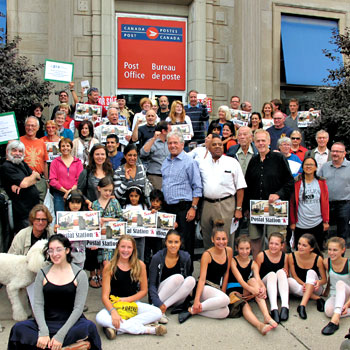
Residents concerned about Canada Post Station K’s fate have collected 10,000 signatures on a petition to save the storied building and have twice rallied in front of the post office. The national historic site was once home to Montgomery’s Tavern, William Lyon Mackenzie’s headquarters in the Upper Canada Rebellion. The current art deco building bears the rare royal cypher of King Edward VIII. Eglinton-Lawrence MPP Mike Colle was worried last month that time was running out, as Canada Post began to solicit written feedback from customers, which it is required to do one month prior to closing, moving or amalgamating locations.

“It’s not just about the history,” he said. “It’s the last public space we’ve got at Yonge and Eglinton, and if we can’t protect this 175-year-old site from becoming a condo, what can we protect?”

Colle is now looking for a member of federal Parliament to present the petition to Parliament. Local MP Joe Oliver, who has approached federal Minister of State for Transport Steven Fletcher to convey residents’ concerns, was told that the city and province have tools at their disposal to protect the building once it’s sold. Toronto City Council has already signalled its intent to designate the building as heritage.

Tom Cohen of the Eglinton Park Residents Association said the best-case scenario would be to persuade Canada Post to stay put.

“If we can’t  protect this site, what can we protect?”

“Bugaboo one is demolition. Bugaboo two is the Air Canada Centre, where you take the skin of an old building and you paste pieces of it here and there. Bugaboo three is privatization is such a way that the building is transformed into the lobby for a condo,” Cohen said.

Jon Hamilton, a Canada Post spokesperson, said he couldn’t speak to timelines or potential outcomes because it would be unfair to those participating in the request-for-proposal process it has undertaken. 

“While we appreciate the concern [from residents], the building no longer fits our needs,” said Hamilton. “Our focus is on providing postal service and staying financially viable.”

Local school’s expansion plans put on hold

0

The provincial government’s recent freeze on all new major capital projects at the Toronto District School Board (TDSB) has put the planned expansion of Avondale Public School on ice. The Ministry of Education is citing the board’s capital deficit and cost overruns as the impetus for the freeze. But the local trustee, Mari Rutka, said her ward continues to be treated unfairly.

“We’re the threat for the rest of the board to behave itself,” Rutka said. “There is no other area in the city that has over-enrolment to the degree that Willowdale does.”

McKee Public School is at the root of the problem. New residents from the surrounding condos have filled it to capacity, even after the TDSB added to the existing building and put a portable on the property. The explosion in the student population has forced the board to bus kids out of their immediate neighbourhoods.

The planned expansion would allow Avondale to absorb overflow from three nearby schools, and for the board to redraw Willowdale’s boundaries to better assign students to schools according to their neighbourhoods. While the project was in the planning stages when the province issued the freeze, it had not yet gone to the board for approval.

“We’re the threat for the rest of the board to behave itself.”

According to the Ministry of Education’s letter to the TDSB, its freeze will be lifted when the TDSB produces an “acceptable” capital deficit recovery plan and ensures it has checks in place to stop costs from spiralling out of control.

“It’s important that education spending stays in the classroom,” Minister of Education Laurel Broten said. “Every dollar overspent on capital is a dollar we can’t use to support children in our schools, so we want to work closely and quickly with the TDSB to help them through these challenges.” It’s unclear as to how long this will take, and with the Avondale expansion originally slated to be completed by 2014, the trustee doesn’t know what will happen.

Jewellery shines a light on children in need

0

Kazuri is Swahili for “small and beautiful.” It’s also the name of a non-profit fair trade company based in Kenya that employs disadvantaged women —and the perfect way to describe the ceramic, hand-painted, clay jewellery it produces.

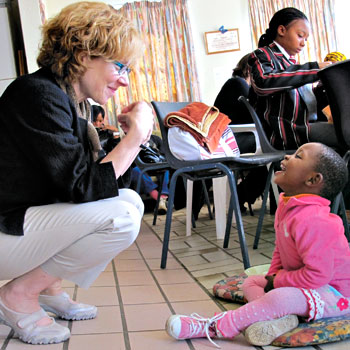
On Nov. 25, between 2 and 5 p.m., local resident Leslie Starkman and other members of Toronto Grandmothers Embrace will host a Kazuri jewellery sale at Body Harmonics Studio on Eglinton Avenue West. Approximately half of the proceeds will go to Kazuri and half of the proceeds will go toward the Stephen Lewis Foundation’s Grandmothers to Grandmothers campaign, which provides such essentials as food, housing and school uniforms to grandmothers who are caring for kids left orphaned as a result of the AIDS epidemic in Africa.

“I found the whole issue of what was going on with AIDS in Africa, the notion that these older women were now taking care of children who were devastated by having lost their parents, and what that must mean, to be inspiring,” Starkman said.

Flamenco queen

0

Flamenco is a proud Spanish dance, and Earl Haig graduate Yana Maizel is bringing her unique take on the tradition to the St. Lawrence Centre for the Arts on Nov. 8 and 9.

Maizel’s flair for the dramatic began when she was a theatre major at the Claude Watson School for the Arts. She performed in plays throughout high school, and in her last year, along with friend Evan Brooker, founded the one-act play festival that is still an annual event at Claude Watson.

“Students submitted one-act plays, and we chose four or five of them,” she explains. “We had auditions, we chose directors, then the directors chose actors. We tried to do something professional even though we were in school,” Maizel says.

Acting was her passion, but the program also opened her up to other artistic mediums, particularly dance. But it wasn’t until years later that she fell in love with flamenco.

After high school, she attended the University of Toronto, which took her on a third-year study abroad program to Spain. Once there, a fellow student took her to her first flamenco concert.

“I fell off my chair. It was really powerful,” she says. “That was the moment where I thought that if I had one dream it would be to be able to do this.”

So she did. She signed up for flamenco classes right away. Her strong sense of rhythm helped her master the dance quickly, and before long she was performing for audiences in Spain and France.

Then, one day, an old acquaintance called her and asked her to do a 20-minute piece for an international dance festival she was starting in Paris. As Maizel started to choreograph the piece, it began to take on a life of its own, and soon she realized it couldn’t be contained in 20 minutes. The result is My Name Is Not Carmen!, a fusion of theatre, dance, poetry and music that tells the story of her journey from Russia (Maizel was born in St. Petersburg) to Canada, to Spain and ultimately to France.

The show deals with the issue of identity — Maizel has experienced and adopted so many different nationalities and cultures.

When news of the successful show travelled back to Toronto, she was invited home to showcase My Name Is Not Carmen!

“I’m totally nervous and excited to bring it to Toronto,” she says.

Ice cream house in jeopardy of demolition

0

Local residents are scrambling to save a more-than-100-year-old home in the Casa Loma neighbourhood after Toronto and East York Community Council issued its purchaser a demolition permit last month. While City of Toronto: Heritage Preservation Services conducts a heritage review, there is little stopping the purchaser of 72 Wells Hill Ave. from moving ahead with demolition.

The Ontario Heritage Act requires that one of three criteria be met in order for a home to be designated with architectural, associative or contextual significance. Residents believe this home possesses all three. The architect who built the home, W. R. Gregg, worked on other important local projects from this period, such as the Timothy Eaton Memorial Church. Charles Neilson, son of the founder of the Neilson ice cream and chocolate empire, and president of the company for a period, lived in the home, which is believed to be one of the oldest on the street and in the area.

Coun. Joe Mihevc said Toronto and East York Community Council was bound by provincial law to approve the demolition permit, as the building permit was already in place. He added that because the purchaser can’t simply toss out the tenants now living there, heritage preservation services staff will likely have time to report back in January before the home is demolished.

“To lose the house would be a serious blow to heritage.”

Joel Farber, a lawyer for the purchaser, said his client disagrees with the contention that the home has associative value. If anything, the founder of Neilon’s Gladstone Avenue home and original factory does. The purchaser is currently trying to address any concerns residents may have.

But, Farber said, “He’s not willing to forgo any legal rights that he has.”

Brian Barron, a member of the Casa Loma Residents Association, said his group would be sympathetic if the owner wanted to repair and update the home, but it does not want to see the home demolished.

“To lose the house would be a serious blow to the heritage characteristics of the neighbourhood,” Barron said.

Babies and beverages

0

Back in high school, presentation days were usually skip days, but when it was Lyranda Martin Evans and Fiona Stevenson’s turn to take the “stage,” it was a must-see event. Their projects were like no other — they were musical comedy shows. They wrote songs, drew programs and choreographed dance numbers, all in the pursuit of the A+.

The best friends shared a passion for comedy, so after graduating from North Toronto Secondary School and getting day jobs (Martin Evans is a creative director at an ad agency and Stevenson works in marketing), they took classes at Second City. In 2006, they launched the comedy troupe Math is Hard, performing with them for three years.

When they found themselves pregnant and on maternity leave at the same time, they needed something else to do. “So we brainstormed, and we landed on this really winning idea of [a blog about] the reasons why mommy drinks,” says Martin Evans.

Martin Evans, a bartender in college, comes up with the drink recipes (such as “day care defence,” a cognac and rum concoction) that accompany each post, and the stories themselves stem from real life: “The simplest things, like trying to make a frozen pizza with a baby in your arms, can just be so hard, frustrating and upsetting, and then the comedic mind says ‘Wow, there’s some comedy here,’ ” says Stevenson. “I think these real insights, these true moments of parenthood, were what inspired the blog, and then each post becomes almost a release where you can write about this moment that you’ve had.”

The response to the blog has been enormous. The duo receives comments from as far away as Australia. “When someone across the world says, ‘I thought I was the only person in the universe who has had this experience and thank you so much for validating what I’ve been feeling,’ it’s so cool,” says Stevenson.

Reasons Mommy Drinks was  named best Mommy Blog 2012 by Toronto Mom Now and has been picked up by Metronews.ca. In August, the bloggers signed a book deal with Crown, a division of Random House, and are already busy working on the content.

With a successful blog and a book deal already in the bag, who knows, there may soon be a Reasons Mommy Drinks stage show coming to a theatre near you.

Live-edge tables act as a great focal point for your home

0

Renovating an entire home can be daunting. Whether you’re looking for a slight change or a complete overhaul, the mere thought of tearing apart the space you live in is enough to put plans on the back burner.

Focusing on one room, either as a full-scale renovation or just a facelift, can bring a breath of fresh air into a home, minus the panic.

With the holiday season around the corner, your dining room is likely to see its fair share of visitors. According to Glen Peloso, principal designer and owner of Glen Peloso Interiors, current trends suggest an open concept kitchen is the way to go — combining it with a living room, where most entertaining is done, leaves the dining area behind.

Take advantage of this time before the holidays to spruce up the elegant room in your house. By implementing a few savvy interior design tips, you can recreate the look and feel of this room without the construction crew.

Changing the colour or texturing of the walls in the dining room is a great place to start.

Peloso recommends painting them a dark shade to change the feel of the space.

“I also like the idea of wallpapering the walls in a large-scale pattern and painting the ceiling in a darker colour to maintain the intimate feeling,” says Peloso.

If going for a more modern look, switching up the chairs in colour or style creates an interesting feel and adds character to the room. “In more avant-garde dining spaces, there is a trend to mix and match different dining chairs and either painting them all one colour or in several different colours for a more eclectic feel,” he says, also noting a trend in alternating seating, such as using chairs on one side of the table and a bench on the opposing side.

Incorporating new furniture and accessories is another way to change the look of the room without doing too much work. Live-edge tables, a style of table based on Japanese woodwork, have increased in popularity over the last few years.

Robert Akroyd, owner of Akroyd Furniture in Toronto’s Distillery District, is an expert craftsman and fan of live-edge tables, having created his first one in 1995.

This type of table boasts the natural, organic grain of the wood while retaining a “live edge” on one or all sides of the piece. Instead of squaring off all planks of wood, the natural curvature and character of the wood is maintained on at least one edge of the table.

He recommends this furniture as a focal point in a modern space, such as a loft, to warm up the room. “I have a live-edge dining room table and I absolutely love it,” Akroyd says. “They have a material character that can’t be faked, they can’t be artificially reproduced. The way that … the annular rings follow the outside edge, it’s so obviously and unmistakably a part of an enormous plant growing outside, which we then turn into usable domestic objects. I just love it.”

Though he admires this style of table for its natural appeal, he admits fashion has played a part in the popularity surge. “Where fashions come and go, as fashion does, I hope that this is something that doesn’t follow that same cycle, because these tables should have good long lives well beyond the temporal fashion cycle,” he says.

If replacing your table is out of budget or commitment, changing simple accents in the room can have a strong effect. Whether it is by reupholstering the chairs, switching the lighting to pot lights or adding in a new chandelier, as Peloso suggests, your dining room will be a fresh and inviting place for guests to be entertained.

As Peloso says, “Combine a few of these ideas, and it won’t feel like your old dining room at all!”