Home Blog Page 714

First Draught: Cannery Brewing’s Blackberry Porter

0

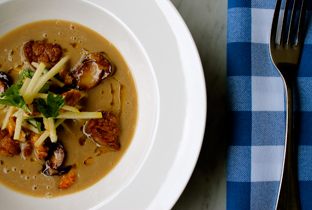
Good fruit beers can go in one of two directions. The special ingredient is either buried deep in the background, faintly whistling a quiet but distinctive tune, or the flavour is unmistakable and right at the front, like the horns section of an orchestra. Spearhead's Hawaiian Pale Ale, with its gentle hint of pineapple, is a good example of the former, while this week's beer, Cannery Brewing Company’s Blackberry Porter, is definitely the latter.

Porters are dark, often above-average-strength ales. Stouts (like Guiness) are a significant branch of the porter family tree. Traditionally, they were popular with outdoor labourers along London's stretch of the Thames River, so it makes sense that the drink has become a beer of choice for hat-and-scarf months today.

Like many in its class, this porter pours a very dark brown that, if given a wide enough glass and the right light, can look almost black. The blackberry aroma wafts up as soon as it leaves the bottle, making it easy to imagine that you're in the middle of a thorny patch in the peak of August.

With the first sip, the blackberry flavour hits at a pleasing volume, backed by malty sweetness. A second sip, swished around a bit, brings out a faint roasted-malt bitterness, like toasted pumpernickel bread, which matches well to the fruit jam flavours.

Cannery Brewing is a small-ish operation from Penticton, B.C. Given how difficult it is to get out-of-province beer in Ontario, it makes sense to grab a bottle of the Blackberry Porter while the LCBO supply lasts.

Cannery Brewing Blackberry Porter, $5.80 for a 650 ml bottle, LCBO #174581

The Jezabels deliver a mesmerizing performance at The Mod Club

0

Aussie foursome The Jezabels were in town last night at The Mod Club, and they delivered a theatrical and mesmerizing performance. For those of you that missed it, the band combined their maudlin balladry with their gritty metal-infused rock, making for one powerfully loud gig. Think of it as opera for punks.

Sanctified rock god trinity Eight and a Half kicked things off with tracks from their self-titled debut record. Comprised of former Broken Social Scene’s Justin Peroff and former members of The Stills (Dave Hamelin and Liam O’Neil), their thrumming synth machines, droning electric riffs and thumping drum beats washed over us in waves. Simply spellbinding. And, if nothing else, the half-hour set showed us that they are probably the most polite and endearing band in the city; they were gushing with “thank yous” directed at us, The Jezabels and each other after every song.

Then it came time for The Jezabels to take the stage. Lead singer Hayley Mary is unrivalled in stage charisma. Her bombastic yowling is what we were there to see — so much so that we’ll forgive her dorky dance moves (and her, ahem, serious case of Elvis pelvis). To be fair, it was obvious that Mary lives and breathes the music and feels it from head-to-toe, so her Emily Haines-esque writhing and snaking across the stage was rather infectious. Everyone in attendance had their eyes locked on her, and her quivering wail resonated up to the balcony like that of an old-school opera singer — or a grunge-y Debbie Harry or Cyndi Lauper

Although they’ve only released one full-length (Prisoner, on local label Dine Alone Records), their three EPs — which hooked their cult following — provided plenty of songs from which to choose. Where previous studio records have failed to capture the booming essence of the music, the live set showcases the band’s ear-splitting capabilities. Even ivory tickler Heather Shannon’s delicacy radiated throughout the venue.

After seeing them live, it’s not surprising that the wonders from down under are quickly gaining traction on the international stage. Earlier this year, they took home the lauded Australian Music Prize for best local talent, (shockingly) beating out fellow Aussie, Gotye. In 2011, Prisoner was awarded album of the year at the Australian Rolling Stone Awards.

Boxing The Jezabels into a single genre is beyond challenging. Their studio album has an incredibly sweeping range, from sentimental love songs to heavy-metal-tinged rock numbers to glittering and paranoid dark tunes. If steampunk opera were such a thing, that might come close.

The Fashion Week Diaries: Lucian Matis, Korhani Home, Mackage, Joe Fresh

0

Day three got up and running with Matis, the secondary line from designer Lucian Matis. Shown in the studio space, the collection began on a strong note with a floor-length stunner done in a multihued floral pattern on a white backdrop.

Looks progressed into peplumed numbers with spider lace acting as an accent. A coral peplum top paired with a slim pant was a standout, although it didn’t fit quite as snugly as we would have liked. Overall there were a number of winning looks, but when a lower-priced line is print-heavy, we feel like it’s being done to mask subpar fabrics.

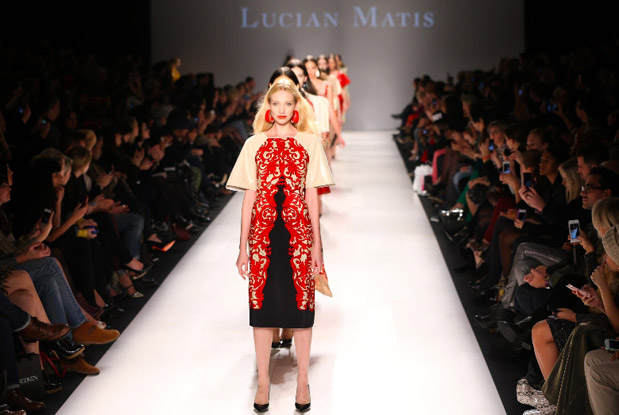
The same cannot be said for the designer’s namesake line, Lucian Matis. We spotted Zaib Shaikh with Kirstine Stewart, artist Andrea Bolley and Suzanne Rogers — resplendent in Prada — taking in the show, along with plenty of attendees in a certain H&M floral. Investing in more prints, Matis drew inspiration from Morocco this time around. Many of the garments were done in a blown-up tile print, which took on a kaleidoscopic quality. More peplums were noted, but volume also made its way into shoulders and into boxier jackets. We loved a look matching a printed pant with a bustier and blazer, while a series of mock-croc looks done in sheer plastic were both futuristic and feminine. Again, fit seemed to be a bit of an issue, but overall the collection was beautifully done and the crowd went wild during Matis’s bow.

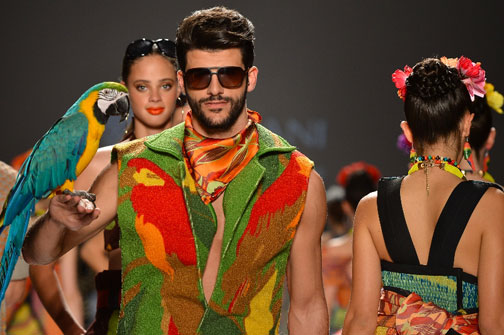
Although Korhani Home does not qualify as a fashion label, the home and décor company does put on a good show, which would explain the number of attendees, each of whom was presented with a large gingerbread cookie (Suzanne Rogers and Glenn Dixon dug in immediately). Models made their way down the runway, strapped into carpets that had been whittled into lingerie, flapper dresses, boxy jackets and a series of Frida Kahlo-worthy looks, which came complete with a live parrot. Orthinophobes winced, but everyone else oohed and aahed over the stunning specimen.


Korhani Home

Mackage was strong from start to finish, drawing the likes of Stacey McKenzie in straight-off-the-runway Evan Biddell, an impeccably dressed Sarah Magwood and Matt Austin Sadowski (his wife and PR maven Debra Goldblatt-Sadowski ran around tying up loose ends). The Montreal-based leather line paraded out endless covetable looks for leather aficionados. A dusky rose trench with contrasting black sleeves was a great women’s look, as was a minty green jacket with an overextended collar. For men, we loved the leather shorts and the button downs with leather collars and plackets. All in all, there was something for everyone.

The grand finale of the night was Joe Fresh. Always a hot ticket, this time around was no different, with attendees squeezing themselves into every last corner of the room. Liz Cabral, Lisa Tant, the Nugents and Bruce C. Bailey all made their way to the front row, although Bruce removed his ostentatious hat — complete with a feather — allowing those sitting further back to catch a glimpse of the runway action. Kimberley Newport-Mimran sat grinning throughout the entirety of the show.

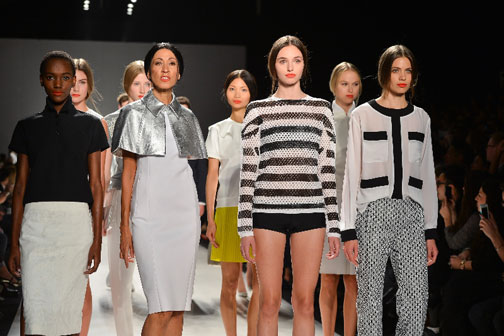
Unsurprisingly, the collection was inspired by the Mimran’s favourite decade: the ’60s. A black and white montage opened the show before legendary model Pat Cleveland sashayed down the runway in diamond checkers with attitude for miles. The black and white bombardment continued, with various interpretations done in graphic prints. With 42 looks in total, the collection was far more extensive than your usual one, progressing into retro looks in blue, silver and white combos and ending on a golden note. Much of it played off Pink Tartan’s collection from earlier in the week. The best looks were a men’s thin black and white checkered suit, a matching capelet and high-waisted pencil skirt and a silver and gold laser-cut dress.


Joe Fresh

And with that, the day was done.

Up next:  Rachel Sin and Arthur Mendonça

EnRoute’s best new restaurants list gives serious props to Toronto; probably won’t irk Anthony Bourdain

0

With enRoute’s 2012 edition of Canada’s best new restaurants list, the magazine has confirmed what Torontonians already knew: “The city’s dining scene is on fire.” Six of the 10 restaurants on the list are from Toronto, including Niagara Street’s Edulis, which snagged the number one spot.

Other well-deserved Toronto mentions went to Keriwa Cafe, Acadia and Ursa, along with two offspring of The Black Hoof (number two on enRoute’s 2009 list): Grand Electric and Hopgood’s Foodliner. Now for the important question: who’s going to be the first Twitter personality to raise a stink over this list?

[enRoute]

Morning Throwback: in ’50s, NHL players actually made their fans happy

0

Like Barack Obama said, “Get this done,” NHL players and owners, because we’d really like to see hockey fans smile like this again (especially the George McFly look-alike on the right). 

TOCA relaunches with a new chef and a new menu

0

Back in May, we told you about the departure of chef Tom Brodi from TOCA at the Ritz-Carlton in Toronto. At the end of this month, TOCA will relaunch with a new chef who’s looking to add some excitement to Toronto’s dining scene.

The restaurant’s interior remains as sophisticated as before, and its cheese cave is looking happier than ever; the wine list is still curated and poured by sommelier Taylor Thompson; and pastry chef Yusuke Aoki continues to take care of the breads and desserts.

But what has changed is the menu. And the inspiration behind TOCA’s revival is chef de cuisine Gihen Zitouni, a Montreal-native who trained professionally in France and worked most recently in Portugal, in one of the kitchens of Spanish chef Sergi Arola.

The food is influenced by her career abroad, and she describes the concept as “Mediterranean-Canadian with a focus on local ingredients.” The menu will offer items such as B.C. octopus salad, smoked Nova Scotia trout and succulent Niagara black pork rib eye.

The new menu and concept at TOCA will officially launch on Oct. 29. Below, our sneak peek from a recent tasting.

Album Review: Luke Lalonde’s Rhythymnals

0

It started with a beat. Then it was fleshed out with the odd droning of synth machines, violin, piano, steel drums and the trademarked smooth wail of Born Ruffians frontman Luke Lalonde. The result is Rhythymnals, Lalonde’s debut solo album, which brings music back to its elemental roots — and serves as an ode to the appreciation of sound itself. Yes, electro-pop can do that.

We got our first listen of Rhythymnals — to be released on Oct. 30 — and boy, has this Toronto-based ruffian taken a turn towards breezy, mellow shores. 

As I uncased the album, from the Paper Bag Records team, I must confess that I was mentally bracing myself. I would have to do my utmost to steel against any comparison to Lalonde’s day band, Born Ruffians, which pretty much serve as the soundtrack to my summers. But as soon as the first song, “Grand (Rhythymnals),” began, I knew that I need not have worried. Instantly, it was obvious that Rhythymnals is more than just a side vanity project; it’s a venture into exotic auditory territory.

For fans of Vampire Weekend and Grizzly Bear, you’ll be happy to know that there are still elements of Born Ruffian goodness: melodic, hooky, synth-heavy electro-pop that ties in influences spanning R&B, electronica, pop and reggae.

These 10 tracks are devoted to sonic exploration. The first track is an indication that Lalonde is playfully toying with his instruments — and it could probably stand alone as a single. The actual single, “Undone,” is a dreamy R&B-fused ballad, and will likely have even of the most rigid listeners shamelessly grooving to it on the streetcar or waiting in line at the grocery store. Deeper into it, “Shove Off” is a ditty in which the galloping guitar riffs and jaunty hooks of Born Ruffians come out, but with a muffled laxness that is heard across the album. 

According to the presser, the record was “originally centred around the notion of sound existing whether we do or do not and our unique ability to interpret it and manipulate it,” then it branched out into songs about gender-confused couples, a boy who is unhappy with his feminine features (so he cuts his face up) and long distance love.

If Rhythymnals has a downfall, it is its lack of cohesiveness: it’s a compilation of a range of emotions and sounds from almost every genre. Think of Lalonde as a mad scientist, conducting crazed sonic experiments in his beat laboratory.

And don’t worry, Born Ruffians aren’t going anywhere — they’re dotting the I’s and crossing the T’s on their third full-length, slated to drop in 2013.

Rhythymnals will be officially released on Paper Bag Records on Oct. 30.

Beauty is in the eye of the beholder

0

I can, for the first time in my life, bat my eyelashes. Finally. That’s because I now have eyelashes, 45 new ones, in fact, on each eye, thanks to Lauren Kurtz, the founder of Good Gosh Beauty. As I continue on my tour of non-alcoholic bars across the city (first the wax bar, then the ponytail bar and now the eyelash bar), I have to admit this is my favourite new spot.

Located on College Street near Dovercourt, it’s definitely a destination upkeep spot. Which is fine because to get natural-looking eyelashes made out of premium synthetic mink, for the first time, takes almost two hours.

“Who doesn’t want to enhance their eyes?” asks Kurtz when asked why the trend of eyelash extensions, which started in Korea and now can be seen on every celebrity in every tabloid, is so popular. Kurtz (who looks remarkably like Alexis Bledel from Gilmour Girls) says she does between five and seven eyelash extensions a week, which isn’t a lot, but is understandable considering the focus it takes to apply the extensions with the special “bonding agent” (otherwise known as glue) and create a look of naturally longer, fuller eyelashes.

I have to ask “Are you ambidextrous?” as she tells me how she applies the eyelashes — with one tweezer in one hand, separating my natural eyelashes, and with another set of tweezers in the other hand, to glue the fake ones on.

“No, but I have really steady hands.” As well, she definitely has patience. (As one would need to, to apply up to 75 eyelashes on each eye, which is one reason she only does one of these appointments a day.)

Everything about Kurtz and her lash bar is cute, from the pink painted walls to the vintage posters with sayings like “Beauty Is in the Eye of the Beholder.” What’s especially cute is Kurtz’s menu. Those wanting thicker and longer eyelashes can choose from the MacGraw (30 eyelashes on each eye), the Audrey (45), the Bardot (60) or the Kardashian (75). Kurtz will help you choose which best suits your features. We choose the Audrey for me, since I want my eyelashes to be noticeable but don’t want questions like “What did you do to your face?!”

Kurtz says eyelash extensions are not for everybody. “If you can believe it, there are some women who really like the routine of putting on mascara, so it’s not for them. But even though mascara may only take two minutes to put on in the morning, you’ll be so surprised at how liberating it is to wake up and just be ready to go.”

Kurtz opened Good Gosh Beauty last year and only focuses on eyelash extensions and permanent makeup. She studied permanent cosmetics and has worked for some of the most well-known plastic surgeons in Toronto, doing permanent cosmetics before branching out on her own.

The eyelash extensions last anywhere from four to six weeks before falling out, depending on your natural eyelash growth cycle, which is generally 60 to 90 days. Most people come in about three days before a big event or vacation. Not only do the extensions come in different lengths, but different curls as well.

I’m worried about the falling out part, wondering if I’ll have big gaps in my eyelashes. She explains that during the falling out phase, most women simply apply mascara (which you don’t need to — actually aren’t supposed to — apply on these extensions) or book another appointment for fill-ins.

“This is why I’m booked well into the next few weeks. People book their next appointments when they come in because they know their cycle or they know they have a big event.”

After just over an hour of relaxation (yes, it is relaxing: you’re lying down, your eyes are taped lightly shut, and Kurtz’s voice is gentle), my eyelashes are ready to bat.

I can’t believe what I see in the mirror. My eyes look bigger and I actually have lashes! I tell Kurtz I’m thrilled with the results and can’t help but ask if anyone has not liked them.

“It hasn’t happened yet,” she chirps. “But I guess there’s a first time for everything.”

The after-care is pretty simple. No water or steam on or around the eye area for 24 hours. (In her brochure, she adds, “Do not watch Beaches, Love Story or Life Is Beautiful”). She also gives me a pair of goggles (in case I want to shower), a special non-oil-based eye cleanser and an eyelash comb. But, pretty much, when I get up, I’m ready to go. For the first visit, it’s $150 for the Audrey, and fill-ins will be anywhere from $30 to $60 a visit.

When I get home, my fiancé says, “I can’t believe the difference. It’s incredible.” He says this for the next few days, giving me a serious complex about what I looked like before. But, this batting-your-eyelash thing works serious wonders in a relationship, definitely worth the time and cost. It’s one bar I’ll be sure to frequent regularly.

Post City Magazines’ columnist Rebecca Eckler is the author of Knocked Up, Wiped!, and her latest books, How to Raise a Boyfriend and The Lucky Sperm Club.

The Fashion Week Diaries: Adrian Wu, Ashtiani, Evan Biddell, Duy Nguyen, Bustle

0

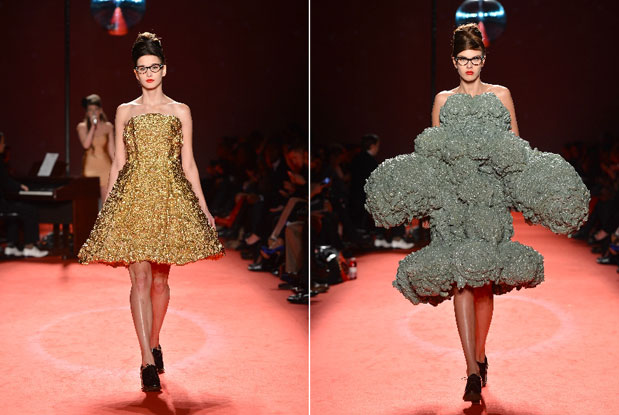
As the longest day of Fashion Week, day two got off to a relatively early start with Adrian Wu’s latest collection. In the past, the young designer has shown in the smaller studio space; this time, he presented in the main runway room, relinquishing some of the intimacy. There, beneath a spinning disco ball, a pianist and a female soloist readied themselves for the show, starting on the Marilyn Monroe number “I Wanna Be Loved By You” as the first model appeared.

Wu tends to polarize people with his work; this collection was no different. Citing the idea of dystopia as his inspiration, Wu crafted a series of dresses out of polyurethane, a foam-like material that he moulded and painted after it had hardened. The resulting texture was akin to hardened chewing gum. Staying true to his aesthetic, Wu’s pieces became increasingly distorted as the show wore on; a gold mini dress transformed into more violent configurations, with the final model appearing to have been engulfed by a sage-coloured shrub. What it comes down to is that Wu is a boundary-pushing artist — he just works with the human form.

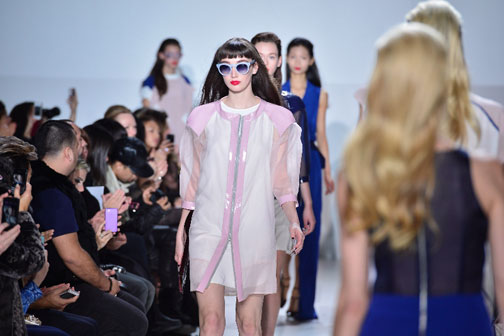
Next up, Ashtiani drew the likes of boutique owner Glenna Weddle and PR maven Christine Faulhaber to her spring collection. The up-and-coming designer showed a series of sporty, pastel-hued looks that played around with geometrical forms. The best pieces included refined takes on the sweatshirt — done through the interplay of shapes, fabrics and textures — and a sheer jacket with bubblegum pink patent leather accents.


Ashtiani

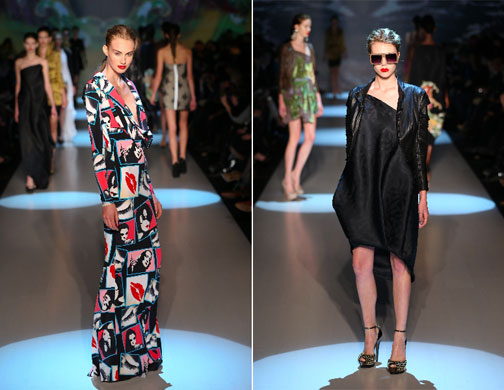
Evan Biddell made his return to Fashion Week, following a two-year hiatus. Refusing to play by the rules, Biddell’s collection seemed a tad disjointed — which is exactly how he wanted it to be. Showing a series of dresses in an array of fabrics — a kaleidoscopic leopard made way for Chinoiserie followed by a pop art print — the models looped repeatedly down the runway, ensuring that each garment got more than its fair share of time in the sun. Our favourite was the opening look: a floor length gown done in the aforementioned leopard print with a leather neckline. As the show drew to a close, Biddell appeared hunched over his smartphone — a hilarious reference to the stooped position spotted on just about everyone — before taking his bow.


Evan Biddell

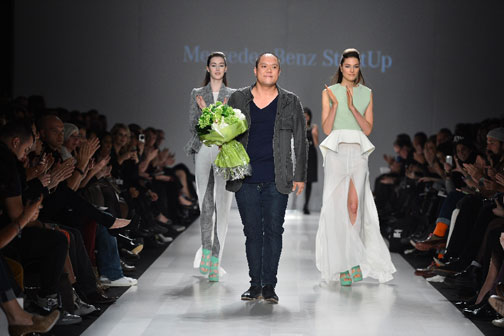
A major draw of the day was the Mercedez-Benz StartUp final, in which eight design teams from across Canada presented capsule collections while vying for the prize. Competitors included Lauren Bagliore, Malorie Urbanovitch, DUY and Dreamboat Lucy. Our hopes were pinned on Toronto-based Caitlin Power, although we felt that she didn’t push herself enough as a designer since last season. Following a brief interlude, Bernadette Morra announced the winner: Duy Nguyen’s line DUY. His collection of separates was the most wearable, and, having been on the Canadian scene for quite some time, he undoubtedly deserved the prize.


Duy Nguyen

Day two ended with Bustle, the menswear line designed by Ruth Promislow and Shawn Hewson. Known for elaborate staging, the duo opted to fix up the runway with trunks of clothing and faux elephant tusks this time around. The vision for spring was a bold one: tropical safari. Bright looks were marched out in colour combos that would turn wallflowers on their heels: a head-to-toe coral and tangerine floral print; a vertically colour-blocked button-down paired with striped salmon pants. Just like the presentation, the collection itself was lighthearted and fun, and we hope to see men embrace its joie de vivre for spring.

Up next: Lucian Matis and Joe Fresh

Gerry Dee gets straight A’s for comedy

0

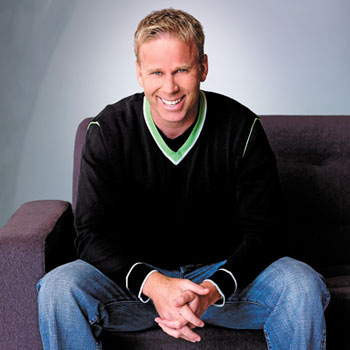
Growing up in Willowdale, when he wasn’t delivering newspapers on Hollywood Avenue, Gerry Dee focused most of his energy on sports: from playing tennis at Bayview Village Tennis Club to excelling on many teams during his high school years at De La Salle College in Rosedale.

Dee even went on to study kinesiology at York University. Later, after receiving his teaching degree from St. Francis Xavier University in Nova Scotia, he would return to De La Salle to teach phys. ed. and coach hockey.

It comes as no surprise, then, that Dee would be able to segue his career from stand-up comedian to humorous reporter on The Score.

In 2007, after placing third overall in season five of Last Comic Standing, the sports network came knocking.

“They wanted to try something different,” says Dee, noting Charles Barkley as the funniest athlete interviewed on his recurring segment Gerry Dee: Sports Reporter.

“We’re going to get back into it when things settle down,” he adds.

Right now, Dee’s schedule is pretty busy. Every year he plays more than 150 sold-out stand-up shows across Canada and internationally. His Life After Teaching 2012 tour has him performing across Canada from October until the end of the year.

And then there are the summers spent in Halifax taping the CBC comedy Mr. D, in which Dee plays the lead.

The television show, in which he stars as underqualified high school teacher Gerry Duncan, is based on his previous comedic performances referencing his 10-year career in education. Picked up for a second season, new episodes start airing in January.

“Every stand-up in the country has aspirations to have a sitcom,” he admits.

If you’re wondering which of his former teachers Dee looks to when developing his character’s substandard habits in the classroom, he’s quick to admit he has few memories of the bad ones.

“You tend to focus on the good ones,” he says. “I was very fortunate.”

Mr. D pays homage to quite a few of Dee’s positive experiences growing up. His character teaches at Xavier Academy, in honour of Dee’s alma mater. And Principal Callaghan was inspired by his former coach at De La Salle.

“Not the character,” he explains, “but that’s how I got the name.”

With over 800,000 weekly viewers, the show’s been a runaway hit, joining together other local stars like Jonathan Torrens and Wes Williams (otherwise known as Maestro Fresh Wes). The entire cast is scheduled to perform a live show on New Year’s Eve at Toronto Centre for the Arts.

The biggest difference for Dee between being a stand-up comedian and an actor?

“Stand-up is doing your own thing, by yourself,” he says. “But at the end of day, you still have to be funny.”

“Every stand-up in the country has aspirations to have a sitcom.”

And being funny is something that has come naturally to Willowdale’s prodigal performer.

“Once I started getting some laughs and making a little bit of money and could feel a positive response, I kept pursuing it,” he recalls.

Kicking off on the local Yuk Yuk’s stage — just like many comedians before him, such as Norm Macdonald — Dee first performed there in the early ’90s. Mark Breslin, the comedy club’s Torontonian creator and a fellow York University alumnus, remembers a young Gerry Dee as “a white Bill Cosby.”

“He was very smooth,” Breslin says. “He was clean, squeaky clean — in a way that a lot of the comics aren’t. That gave him a very different vibe.”

Breslin goes on to say, “Besides being funny, because there’s a lot of funny people out there, Gerry has a very respectful tone toward the audience, and that’s rare.”

Dee’s career cannonballed from there. In 2002 he was the first Canadian in 27 years to win the San Francisco International Comedy Competition, a platform that launched the careers of such notable comedians as Robin Williams, Dana Carvey and Ellen DeGeneres. He also won the Canadian Comedy Award for Best Male Stand-Up in 2008.

Dee’s been at it full-time ever since, attracting legions of loyal fans and accolades both in Canada and internationally. 

His latest foray is a book that takes a hilarious behind-the-scenes look at life inside the classroom: Teaching: It’s Harder Than It Looks hit bookshelves Oct. 23.

“A lot of people think teaching is a walk in the park. Yeah, yeah. You have no idea! You think teachers just stand up there and lecture on and on — and get paid for it. Here’s the truth: there are only two good reasons to become a teacher. The first is July; the second is August,” he writes.

This hilarious tell-all shares the trials and tribulations of Dee’s teaching days, including exams, smart kids, the cafeteria, school dances, the staff room, cheating, teen romance and parent meetings.

“This is my tribute to school life,” reads the book jacket, “from the point of view of a teacher who, like many other teachers out there, occasionally taught hungover (and lied about it), sometimes lost his students’ exams (and lied about it) and enjoyed staging impromptu baseball games in the middle of history class just to kill some time.”

Dee speaks of what every teacher has been thinking: the job isn’t always easy. (He admits that “a lot of teachers go home every night complaining about preparing lessons. I went home every night to learn the lesson.”)

But although they may be one spontaneous ball game away from a nervous breakdown, teachers continue to make a difference in the lives of boys and girls everywhere … even if the road to success gets a little bumpy along the way.

For Dee, his secret of survival in front of the chalkboard is his modus operandi on the stand-up stage: “I learned how to put on a performance,” he says.

And the two acts are not dissimilar: performing for applause from a late-night Yuk Yuk’s audience takes prowess similar to holding the attention of teenagers who would rather be anywhere but at their desks.

“There’s not a teacher out there who hasn’t bent the rules a little in order to win that much-sought-after prize: respect in the classroom,” Dee admits in his signature candid way.

With a comedy career stretching from the stage to the screen, Dee has not only earned that respect — he’s getting straight A’s across the board.

Gordon Lightfoot keeps getting better

0

It’s hard to believe Gordon Lightfoot has been playing Massey Hall for 45 years.

“I can’t believe it myself,” he exclaims over the phone from his Bayview home. “I performed there when I was 12 after winning a contest, and didn’t see the inside again for 15 years.”

It was in March 1967 that Lightfoot’s first two sold-out concerts took place at the Grand Ol’ Lady of Shuter Street. And now, over 150 performances later, he will celebrate his 74th birthday there with four more shows on November 14, 15, 16 and 17. 

Not bad for a man who’s had more than one serious health scare.

He keeps up his stamina by hitting the gym four days a week. After his abdominal aneurism in 2002, he was back at the gym after just 19 months.

“It had me worried for about six months,” says Lightfoot, of his health issue. So close to the edge was Lightfoot during that time, he had visions of his own demise.

“I had a hallucination of my funeral one day,” he says. “There was an odour of flowers in the air, and [I heard] people speaking in hushed conversations.”

Luckily for Lightfoot, his family and hordes of fans, this experience —along with a Twitter-based death hoax that sprang up in 2010 — was a false alarm.

Right after he recovered from the aneurism, Lightfoot was made a companion of the Order of Canada, the highest honour for a civilian, by then–Governor General Adrienne Clarkson.

“I wanted to get to the point where I could do all my songs like Bob Dylan does.”

He is also a member of the Order of Ontario.

Born in Orillia in 1938, Lightfoot started working in his dad’s dry cleaning plant when he was 14.

“I wanted to go to work,” he says. “When I turned 16, I started driving a truck and worked all through high school.”

It was around this time that he “started to get the bug” to write songs. His first song was about the Hula Hoop fad. He took the song to BMI Music.

“[It] was the place to go here in Toronto, down on Gould Street,” Lightfoot recalls. “William Harold Moon and Bailey Bird said, ‘Leave your name with the receptionist and we’ll call you.’ They were interested because it was a topical song.”

Many of his songs that would follow adhered to a topical style, and his music was often influenced by actual events.

In 1967, he was commissioned by the CBC to write “Canadian Railroad Trilogy” for their Centennial celebrations.

“I learned songs like a sponge at the beginning,” he says. “I wanted to get to the point where I could do all my songs like Bob Dylan does.” (Dylan would also later cite Lightfoot as one of his favourite artists.)

Part of Toronto’s fabled folk scene of the 1960s, Lightfoot began performing at the Riverboat, a coffee shop in Yorkville.

He held his own beside other musical greats, including Ian and Sylvia, who first heard him play at Steele’s Tavern on Yonge Street, as well as Joni Mitchell, Neil Young, Al Cromwell and the Sparrows (later Steppenwolf).

Lightfoot remembers them all: “A lot of those people disappeared, and they were really good,” he says, solemnly.

Did he realize how influential he and his contemporaries would become?

“You really wonder, but you can’t take the dream away. Keep plugging, keep trying, see if something gives. I was lucky.”

Since his debut, Lightfoot has received 16 Juno Awards and has been nominated for five Grammys. He was inducted into the Canadian Music Hall of Fame in 1986 and the Canadian Country Music Hall of Fame in 2001. This past June, he was also inducted the Songwriters’ Hall of Fame in New York City.

In 1998 he received a star on Canada’s Walk of Fame.

That same year, his song “If You Could Read My Mind” was covered in the film 54, starring fellow Torontonian Mike Myers.

“One day we got a call from [Myers], and he told Barry, our manager at the time, that he would like to use [the song], but he wanted to use it as disco,” explains Lightfoot.

“Barry asked me how I would feel. I knew I would like it — Viola Wills did it in disco 25 years earlier when disco was just starting. I still own the 45. Every once in a while I put it on.”

It would seem an odd pairing: a 1970s folk-rock song, redone for disco. But that didn’t bother Lightfoot.

“Of course,” he adds, “I like everything that anybody does [with my music]. I really appreciate it.”

Disco or rock, the ’70s era was a big party for Lightfoot, but that stopped in 1982 when he gave up alcohol. A relationship ended at the same time, and with the help of a doctor, he cleaned house.

“It was miraculous,” he admits. “Well, one day I had a couple of beers with Stompin’ Tom Connors. Sometimes you have to! They call it a bonus.” He’s been on the wagon ever since. 

Parties today may be sober for Lightfoot, but they’re exciting nonetheless.

In addition to his November concerts at Massey Hall, he’s just released a new album: Massey Hall Moments — All Live. Recorded between 1998 and 2001, the disc celebrates his legacy at the hall: he’s performed at Massey more in its 117-year history than any other individual artist. 

“One of the great things about Massey Hall is that we can get all the families together,” says Lightfoot. “Mostly it’s in the [private] meet and greet, which occurs after each performance — sometimes with over 100 people. It’s a great time for family participation with members of the band.

What’s next for this local legend?

“I just see what life has to offer,” he says. “The rest of the time, it’s all family.”

Despite his fully packed schedule, Lightfoot still finds time to support causes near to his heart. He has a scholarship fund for the Great Lakes Maritime Academy at Northwestern Michigan College — something that came about through his relationship with the families of Edmund Fitzgerald survivors.

“I get involved in doing small stuff, helpful things,” he says, adding, “I keep a low profile about it, too.”

When asked what role his music ultimately plays in the shaping of a Canadian identity, he replies in that same modest manner.

“The best things I can do is just stay here, in Canada, and be a part of this country and represent it well whenever I go abroad. And be proud.”


Steve Patterson yuks it up

0

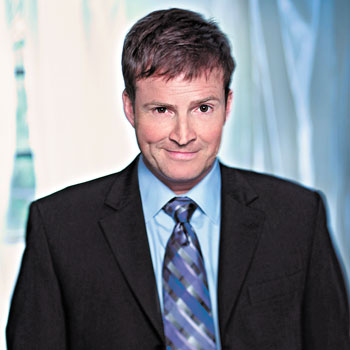
The prodding that finally pushed Steve Patterson into a full-time comedy career came from an unlikely source: his boss at an advertising firm.

Back in the mid-’90s, the host of CBC Radio’s The Debaters was toiling away in the ad world, and though his work may have been above par, his heart was seriously not in it. To wit: in a particularly tough meeting with his boss and a client, Patterson became so frustrated that he more or less pink-slipped the client.

“I believe the exact line I used was, ‘If you guys are going to suck all the creativity out of this, why don’t you just write the ads yourselves!’ ” Patterson recalls.

After the meeting, his boss countered with a surprisingly empathic response.

“He said, ‘Look, I know what you want to do, and this isn’t it, so.…’ ”

So Patterson was fired, but he was also liberated to step in to the successful comedy career that he was made for.

Born in Richmond Hill and raised in Thornhill, the young Patterson used his sense of humour as a defence mechanism against his scrappy older brothers.

“I figured if I could make them laugh then I wouldn’t be put into wrestling submission holds and punched as much,” he says.

But as he grew up, Patterson’s comedy aspirations didn’t extend much beyond the aim of self-preservation. His father’s model of professionalism made a big impact on him, and he reasoned that an adult career equaled a desk job.

“I used to think very traditionally,” Patterson says. “My dad always would come home from work wearing a tie, and I would think, ‘Ah that’s what you’re supposed to do.’ ”

In keeping with his tie-based definition of a job, he first considered law (and entered York University’s pre-law program on scholarship) before deciding he’d prefer to do business school at Western. Armed with his business degree, he then jumped over to advertising, and we all know how that turned out.

“I went from law to business to advertising to stand-up comedy, which is certainly not a traditional path,” says Patterson of his roundabout career trajectory. “But I think everyone who does stand-up finds it in a different way.”

Of course, even during his button-down university days, comedy seemed to find its way into Patterson’s life. In first year, his peers found him funny enough to sign him up (unbeknownst to Patterson) for amateur night at Yuk Yuk’s. Thinking he and his friends were just there to scope out the scene and never having done stand-up before, Patterson had absolutely no material ready.

“The first time I did stand-up I literally stood up and walked on the stage not knowing a word of what I was going to say. They just called my name and I went onstage,” he says.

“I think everyone who does stand-up finds it in a different way.”

Though he dismisses his inaugural performance as “probably not stellar,” he’s just being modest. Yuk Yuk’s invited him back to perform based on his set, which he did occasionally throughout his university and advertising days.

Years later, when he transitioned from advertising to comedy, Patterson didn’t intend on being caught unprepared again. In the months before his job ended, he began to focus steadfastly on writing material and planning his act.

Then he strategically planned a tour of western Canada to build his onstage chops.

“Toronto has almost as many comedians as they do condos,” he explains, “so the thing in Toronto is that you can do stand-up, but it’s obviously very competitive and you might not get paid — not just as in you might not get paid a lot — you might not get paid at all. So I decided to go out west where there was less stand-up.”

His Yuk Yuk’s comedy tour helped him hone his skills, especially since it forced him to develop new, location-specific material to cater to his non-Toronto audiences.

Or as he puts it, “When you’re in Toronto you tend to do stand-up about Toronto, but if you happen to be going to Moosejaw to do a show they don’t give a crap about Toronto, so you better find material that can make them laugh.”

Beyond expanding his repertoire and helping him connect with his audiences, Patterson’s first tour offered him a sense of validation.

“I felt for the first time ever like I was doing what I was supposed to be doing,” he says. “And when it feels right, you honestly don’t care about the money. As long as you can live, you’re happy.”

Patterson has eked out a comedy career for himself that has him doing more than just making ends meet. In 2007 he was chosen to succeed Shaun Majumder as host of The Debaters, a role that he has made his own and which utilizes his stand-up skills in a novel way. In every show, a pair of stand-up comics are invited to debate a topic in front of a live audience that also serves as the debate’s judge.

“I think the host needs to have a stand-up comic’s mentality because we’re working with stand-up comedians,” says Patterson. “The show has a rare format that allows stand-ups to work off of each other on the same stage. It’s a playful environment, and it’s nice to have other people to fill in the blanks sometimes in comedy.”

His reign on the show has actually been so popular that the CBC decided to try out The Debaters in television format this past year, but unfortunately, after filming 26 episodes, it’s back to the radio waves for the show. Patterson acknowledges that The Debaters may, indeed, be better suited for radio anyhow.

“The live feeling wasn’t really translated as well as it could have been to television,” he says. “You know, on TV they want everything to look sort of perfect, so if you flub a line, they want you to go back and deliver it again, but this show is supposed to include mistakes.”

Hosting duties aside, Patterson also had a huge year in 2011 when he was nominated for a Gemini Award, for a Just For Laughs appearance, and named Best Stand-Up Male at the Canadian Comedy Awards. Now he’s hoping to match his past successes by embarking on a one-man tour with his first-ever solo theatre show, This Is Not Debatable.

“I hosted the Just For Laughs tour last year, and it was great,” he says, “but it was all hosting, so now I’m really getting back out there with my material. I’m looking forward to seeing how it goes on the road this time around.”