
Home Blog Page 1000

Rob Stefaniuk

0
Screenshot2009 09 01at5.31.37PM

ROB STEFANIUK IS living the dream. Your dream, in fact. Seriously, what’s your dream? To star in a movie, write it, direct it? Done. Are you a music fan? Would you love to work with Alice Cooper, Iggy Pop, Henry Rollins? Write your own music and perform it in a movie that all those rock icons are also in? He’s done that, too. Wanna walk down the red carpet at a Toronto International Film Festival premiere with your gorgeous girlfriend on your arm, crowds cheering, cameras flashing, reporters calling out your name? Well, he’s about to live your dream for the second time.

Thing is, dreaming and living the dream are totally different. In order to get there, you have to go through a lot of fire, which the writer, director, actor and musician — a very gracious and funny young man — defines as “not making a living and not giving up.”

The 37-year-old North York native is starring in his second feature film, Suck, which he wrote and directed here in Toronto and which premieres at TIFF on Sept. 11. It’s a comedy about a loser rock band called the Winners, led by Stefaniuk’s character, Joey. They’re getting older and going nowhere until their female bassist, the superhot Jessica Paré, is turned into a vampire. All of a sudden they’ve got the sexy rock-chic appeal they were missing (think Stefaniuk’s all-time favourite album cover: Lou Reed’s Transformer), and they finally start getting noticed.

As their road tour leads them into vampirism, superstardom and the pitfalls of both, they encounter a number of interesting characters from the music industry–supernatural world. The casting feat alone is surreal: Malcolm McDowell as Eddie Van Helsing, a vampire hunter who’s afraid of the dark; Alice Cooper and his daughter, Calico, as a creepy bartender- waitress duo; Henry Rollins as Rockin’ Roger, a popular radio show host whose mysterious on- air disappearance during an interview with the Winners really sends the band’s star into orbit; Iggy Pop; Dave Foley; Moby; Carole Pope; and more.

Twilight fans may be disappointed — these vampires don’t glitter in the sun — but they definitely know how to rock ’n’ roll.

“I say rock ’n’ roll too much,” Stefaniuk chuckles, as he describes the movie. “It’s not a vampire movie that has rock ’n’ roll. It’s a rock ’n’ roll movie that has vampires in it, and instead of someone in the band having a drug problem and mixing up with a druggie crowd, I made the drug addicts vampires instead.” The sex, blood and rock ’n’ roll metaphor takes its cue from Stefaniuk’s real-life experience performing in bands, being on the road and seeing musician friends go to “the dark side,” he says.

“That was the genesis of what I wanted to write about — getting older and people self-destructing. And the vampire seemed like the perfect fit for that: what if you didn’t get older? And dead people sell more records.”

Iggy Pop, who plays a rock star turned producer, and Dave Foley, who plays their seedy manager, were the first to sign onto the film. Stefaniuk already knew Foley but only got the guts to e- mail the script to Iggy Pop, his ultimate musical hero, after going to a Stooges show at Massey Hall.  “I always wanted Iggy, but never thought we’d ever get him…. I didn’t even believe we had him when he showed up!”

Once those two were in, the film had the credibility to lure the other musicians and film greats that make up the star-studded cast. “It was a bit nerve-racking at first,” Stefaniuk says about directing them. “But they were all so generous and so supportive. Like, Iggy worked on it, and Alice [Cooper] worked on it, and they delivered subtle performances. And it was great to see Henry [Rollins] and Moby played against type.” Moby, known for his strict veganism, plays Beef Bellows, the lead singer of a band called the Secretaries of Steak.

Stefaniuk knows a lot about playing against type — he’s been doing it for a long time. He doesn’t look like a rocker, even though he wears a leather jacket. The boyish charm and good looks are hard to cover. In fact, early on in his acting career, when he was fresh out of high school and living in L.A. and had landed a role on the show Catwalk, that charm and those looks might have garnered him the fame and career of the Coreys (Haim and Feldman), whom he acted alongside in a TV movie. Indeed, the temptation to sign that Hollywood deal that promises immediate fame, cash and TeenBeat covers — but offers no warranty on meaningful life’s work — was definitely there. “If you go down to Los Angeles, it costs money,” he explains. “So you end up taking jobs that you wouldn’t normally take — not always cool ones. And like, next thing you know, you’re Screech from Saved by the Bell.”

He didn’t want any of it. He was a punk rock kid, recently graduated from the Earl Haig theatre program, who would just as well go up to Yonge and Eglinton with a buddy to play music and busk “for the yuppie patio crowd” if he needed cash. He didn’t care about the money, and he certainly didn’t want to be Corey Haim. “I got jaded fast,” he says. “I wanted to do cool stuff, especially then. Then I took it very seriously — what was cool and what wasn’t cool. So, doing a bunch of bad stuff didn’t feel good, you know?”

At the same time, Woody Allen wasn’t on the phone. So he opted for the road less taken — the long hard road to making his own movies. “I had to create my own work and do my own thing,” says Stefaniuk. “And once I wrote my first script, The Size of Watermelons, and got it made, that was it: I was hooked. I was, like, this is what I want to do with the rest of my life.”

Persistence and ingenuity ensued. He learned to direct, edit and produce. For his directorial debut, Phil the Alien, which premiered at TIFF in 2004, he featured an alien and a beaver because his brother, a special effects pro, already had those two things in his shop.

Now he’s back, with another hilarious film, full of his friends, heroes and his own music. (Rob co-wrote seven songs on Suck’s soundtrack).

His advice to current Earl Haigers (parents cover your ears): “Everyone always said, ‘Have a fallback plan, go get your BA or do something to fall back on,’ and it’s like, no, I’m gonna do this or I’m gonna have a bad life,” he says and laughs. “If you just accomplish enough to get some wind in your sails, it gets you to that next thing. Just don’t quit.”

Lanes, trains and automobiles

0
cohnScreenshot2009 09 01at7.00.40PM

THIS PAST JULY, Dalton McGuinty pledged a rebate of $10,000 to buyers of plug-in hybrid vehicles as the next step of his plan to make five per cent of cars on Canada’s roads electric by 2020. But should we be putting money into consumer vehicles rather than public transit?

After all, in York Region, our roads aren’t spacious enough to properly accommodate cars. Metrolinx, the Ontario-run GTA transit authority, has accepted suggestions from each region and approved provincial spending projects spanning up to 2017. One project was the expansion of the University subway line to York University, continuing up to Jane Street and Highway. 7.

Metrolinx agreed to pay for bus transit systems with separate lanes for buses. These buses were to stop at traffic lights and in certain instances, mix with traffic. All-day GO train service was not included. Nor was the Finch subway to Richmond Hill.

My understanding is that the dedicated Viva bus lanes are not being built in Thornhill. Where do buses go when they leave Richmond Hill?

Take the case of Vancouver — which replaced its system with an efficient rapid transit scheme that connects to Richmond, B.C.– and Manhattan, where subways give passengers almost unlimited access to the city and buses don’t congest traffic!

I present these instances because York Region and the City of Toronto have received not a train service that will efficiently take us where we need to go, but a bus service that is rendered inadequate by having to stop at red lights. How would this be more time or cost effective than taking my own car? How could this serve to turn around ever- increasing gridlock?

Stop wasting money on our bus system and start investing in a rapid transit system for York Region and the GTA!

You told us, and we listened

0
Screenshot2009 09 01at7.00.46PM

THROUGH THE People Plan Richmond Hill project, you have told us what you value about your community and what you wish to see in the future.

The official plan guiding principles are based on extensive consultation from People Plan Richmond Hill and provincial and regional policy directions.
The principles are rooted in five core directions reflecting the community’s vision of more complete communities, the environment, the economy, place making and improved mobility and connectivity. These principles will help ensure that the plan’s policies and decisions are based on what is best for the community over the long term.

But what is a principle? It is a basic rule that guides a thought or action by stating what direction should be taken on a matter. Through the official plan policies, a principle can be translated into more tangible goals and objectives.

Here is what we’vegathered so far:

Create a vibrant and diverse community that has a mix of land uses, including a balance of housing, employment, parks and services.

Protect and enhance natural environments, their functions and resources over the long term. Incorporate and promote sustainable development practices.

Promote economic vitality and provide for a balanced range of employment opportunities and protect employment areas over the long term.

Recognize and enhance the inherent and unique aspects of Richmond Hill and create focal points, gateways, experiences and landmarks.

Strive for design excellence in the public and private realm. Plan for transit and pedestrian oriented development.

I look forward to meeting you at one of our next sessions.

Battling baby blues

0
hero LifeWithABaby2 Sept09

Claire Zlobin knows first-hand about the challenges that new moms can face after having a baby.

“I went through the baby blues really, really badly. I think a lot of it was because I moved to a new area and I didn’t have friends there. I just didn’t have that support. I was like sinking in depression,” she says.

A mere two months after her daughter was born in 2007, Zlobin decided to reach out and connect with other moms in the Thornhill area by organizing meetings where they could share their stories and experiences.

Around the same time in Richmond Hill, first-time mom Joanna Vernik started holding very similar meetings of her own. “In the beginning, it was the social aspect. I really wanted to connect with other moms to know what they are going through,” she says.

After Vernik and Zlobin crossed paths in 2008, they decided to join forces to create Life With a Baby — a support group for new and expecting mothers. By building on their initial efforts, the not-for-profit organization, which now has 500 members across all regions and has grown to encompass free information seminars, events and an online discussion board. The group helps provide access to information and resources for mothers, a service that is also available in other languages.

Life With a Baby’s main objective is for moms to feel happier and more relaxed, which benefits not only the mom but the baby as well. Through meetings and the website, the group serves as an outlet for moms to discuss a broad range of topics, like whether or not to vaccinate, and debunks any motherhood myths.

“If you’re a mom and you’re feeling alone and isolated and sinking into depression because you have no support and no connections to other people, it’s very difficult to be a good mom because you’re not a happy mom,” Zlobin says. “There’s such a stigma, such a need to be, like, I’m the perfect mom, I can do everything, my baby is great, I look great, and everything is fine. People are nervous to say my life is normal, which is what it is.”

“I think people are very hesitant to talk about things like, ‘I let my baby cry and I feel guilty about that,’ and the balance of the husband,” Vernik adds.

New topics and discussion ideas often stem from their own experiences and from new challenges that arise as their kids grow older. For example, after she returned to work from maternity leave, Vernik began scheduling meetings for working moms. Likewise, the group has organizers that specialize in being single moms and moms with infants or toddlers.

Zlobin, who had also planned on going back to work, only recently decided to focus on Life With a Baby because she knew how much the group was needed.

“Because I went through it first-hand, maybe I see the need through a different angle. I know that if I hadn’t started this group and connected with other moms — I was actually depressed most of the time that I was doing it — nobody knows unless you talk about it,” she says.

Post City Magazines salutes Claire Zlobin and Joanna Vernik for giving new moms parenting support and education.

Pusateri’s flying south?

0
Screenshot2009 09 01at7.38.40PM

VENERABLE MIDTOWN GOURMET food shop Pusateri’s might be making a move south of the border, if reports are true.

Although John Mastroianni, general manager at Pusateri’s, wouldn’t confirm a deal has been struck, he did say negotiations are underway for a potential location in Miami, Florida.

“Our type of market, our business plan is quite unique,” says Mastroianni. “We offer some things some of the stores don’t at present.”

One would think the idea would be to follow their regular customers to their winter resting place, but Mastroianni says he gets as many requests from Florida residents spending time in Toronto, who have found out about Pusateri’s.

“The demand is not just snowbirds,” says Mastroianni, who confirms that most of the Pusateri’s team heads south during the winter, including shareholder Frank Luchetta and, of course, Ida Pusateri, herself.

“It would be a great addition to the area and could result in future growth in the U.S.,” he explains.

According to Mastroianni, if all goes well, an announcement could be made within the next two months.

Asian BBQ arrives

A new Korean BBQ restaurant has opened in Richmond Hill. Kazan Teppanyaki Barbeque is located in the former confines of the legendary Old Galley Fish and Chips, and the new dining destination getting rave reviews combines inviting decor with friendly service and tasty food.

Kazan is located at 9625 Yonge St., 905-737-9999.

Berman for Senator

Bob Berman, previously the chef and co-owner of popular bistro Boba, with his wife Barbara Gordon, has quietly taken over the legendary Senator, Toronto’s oldest restaurant and formerly housing a renowned jazz club on the second floor.

The Senator is quite a different game for Berman, who has moved from serving upscale and creative cuisine, to mixing up cozy diner fare for the masses.

Berman chose the Senator for sentimental reasons.

“It was the first restaurant I ever ate at when I came to Toronto,” he explains. But he also believes that it’s the kind of food and atmosphere that Toronto needs more of right now.

“The thing I like about it is that it’s authentic, really an original diner, unique to Toronto. Yonge- Dundas square has become so futuristic and modern, it is nice to have a link to the past.”

In terms of changes to the restaurant, Berman just wants to improve what the Senator has already got going.

“I want to make the Senator recognized as the best diner in the city, with good chicken pot pie or a great sandwich.”

He plans to team up with Cumbrae Butchers to create a special Senator burger blend, which he hopes to get ranked as one of the top in the city. In the end, Berman notes, its just about offering “a food experience that is similar to the actual space: unique, comfortable, elegant and unintimidating.”

The Senator is located at 249 Victoria St., 416-364-7517.

Little India meets Queen West

Restaurateur Hanif Harji finds inspiration in the most unlikely places around the world for his globally inspired hot spots, including Queen West’s Nyood and Kultura on King Street East, but he didn’t have to look further than his grandma’s kitchen for his latest operation, Madras Pantry.

Trendy Queen Westers now have somewhere else to drop by for their on-the-go munchies and eclectic grocery needs.

Harji and partner Ryan Fisher are the brains behind Madras Pantry, a combination restaurant and grocery that specializes in dosas, Indian crepes made from rice flour and lentils, usually filled with potatoes or vegetables.

But Madras has their own take on the dosa. “We’ve North Americanized it by doing it in a wrap form,” says Fisher. “This way people can easily walk out with it in their hand.”

In addition to dosas, Madras Pantry serves up lassis (yogourt- based smoothies) and kulfi (cubed indian ice cream made from condensed milk) and boasts a retail section stocked with Indian foods usually found only on Gerrard: spices, chutneys, pickled foods, mixes and Indian sodas.

The shop also features an exciting Indian circus theme, conceived and executed by Commute Homes (who also designed Nyood and Kultura among others) complete with massive posters and even a mini Ferris wheel.

Madras Pantry is located at 877 Queen St. W., 416-777-0026.

La-la-la-la Lola

Named after a great aunt that really knew how to throw a dinner party, Lola’s Commissary has opened on Church Street, just south of Bloor.

“The restaurant has been a true labour of love,” says Therese De Grace, who owns the restaurant with partner Karen Balcom — former owner of iconic bar Pope Joan.

Lola’s will feature whimsical food options such as blueberry cheesecake stuffed French toast for brunch and homespun fettuccine with hemp pesto for dinner.

Lola’s Commissary is located at 634 Church St., 416-966-3991.

The Abbot turns Monk

The neighbourhood favourite Abbot on the Hill, located on Yonge south of St Clair, has changed their name to the Monk’s Table.

While the loss of a partner is partially behind the change, the major reason is confusion with another Abbot on the Hill, separately owned and located at Yonge and Lawrence.

“We let our patrons choose our new name, asking that it be ecclesiastical (because of our selection of monastic ales) and have something to do with our fare,” says current owner Adam Grant. Along with their new name, the Monk’s Table is now going under the title of “gourmand house” rather than “gastropub,” as it was previously known. 

The Monk’s Table is located at 1276 Yonge St., 416-920-7037.

Scuttlebutt

Chef Christopher Palik, of North York’s popular Italian destination Paese (3829 Bathurst St., 416-631-6585) will soon be harvesting his quarter-acre test farm that will provide local produce for a new harvest menu upcoming at the restaurant.

Excitement is building for the third annual Picnic at the Brick Works event slated for early next month, Oct. 4. For this year’s event, each food station will combine a chef with a global food background, a chef specializing in local food traditions and a local farmer. Tickets are $110 per person. Go to www.evergreen.ca for further information.

Hungry for authentic Hungarian

0
Screenshot2009 09 01at7.45.34PM

“SINCERE,” “ENDEARING” AND “enthusiastic” are just three adjectives that come to mind when thinking of Schnitzel Bistro, a matchbox of a restaurant on a quaint strip of Yonge just south of the Richmond Hill Centre for the Performing Arts.

Passion about the food and the business model of making Hungarian fare accessible to the masses is evident in all aspects of the restaurant.

The lack of table service here caters to the fast-food structure — patrons place orders at one end of the service counter and collect their food at the other end when it’s ready — as does the limited seating (just 10 spaces!), the upbeat music throbbing from the speakers and the use of black plastic plates and cutlery.

But overall, this bittie room feels more spa than speedy: it’s bright, uncluttered and serenely decorated. Panels of bamboo- green paint along white walls, an ivory-coloured floor, dark woods and a leathery banquette give it a modern look.

The short menu is straightforward: soups, salads and sides; sandwiches and entrees; and desserts. As we stand contemplating our options, the owner offers, “This is a schnitzel place.” Pause. “If I were you, I’d order the schnitzel.” Smile.

“Also, you might want to share the garlic cucumber salad. It’s very garlicky. That way, you will both have garlic breath!”

And garlicky it is — awesomely so. The cucumbers are sliced thinly, and they are so fresh and crunchy that even the heavy dousing of thin, white garlic dressing doesn’t soften them.

There are six entrees to choose from — schnitzel (chicken, veal, pork), Hungarian hamburger, breaded chicken liver or lightly breaded chicken — and they can be served either in sandwich form with various toppings or as a plate rounded out with choice of side or salad.

The “patty” in the Hungarian hamburger (“fasirt”) sandwich ($5.25) more resembles lightly battered falafel pieces in a huddle, made with a combination of ground pork and veal and seasoned with spices and mint. Gussying up the protein are a thick tomato slice, lettuce, garlic mayo and creamy Dijon, and the freshest of fresh multi-grain kaisers. The assembly tastes lighter and more refreshing than it reads.

Veal schnitzel plate, otherwise known as the big schnitz ($9.95), continues the delight. The ample slice of meat is evenly flattened, expertly battered with a mixture of bread crumbs and salt and pepper, then deep-fried — not at all greasy or heavy. A single squirt of lemon adds citrusy pep.

Its recommended side dish, “roasted” potatoes ($3.75), also sweeps us off our feet. Potatoes sliced and diced as French fries are roasted then stirred with a slightly chunky, perfectly balanced mix of garlic, parsley, lemon and butter. I will remember the palate pleasure of these potatoes for years.

After the indulgence of all the plates beforehand, we are let down by dessert — served tepid. Too much cinnamon renders a couple of cinnamon-sugar crepes ($2.95) bitter and inedible, despite the rolled, yummy crepe wrapping, phhhhssst of whip cream and house-made chocolate sauce drizzle. The booziness of rum extract drowns out the other flavours of ground walnut–cream crepes, folded in quarters and similarly adorned ($3.95).

San Pellegrino and soda pops are as fancy as it gets in terms of drinks (unlicensed), but specialty coffees and teas offer something for loungers.

This neighbourhood spot, complete with sidewalk bench out front, also offers takeout and catering.

Shia community centre to open

0
Screenshot2009 09 01at7.57.35PM

FOR ALL WHO celebrate the diversity of our community, the Jaffari Community Centre will celebrate its grand opening on Oct. 8.

The stunning facility, housing the largest mosque in Canada, isn’t visible from its location on Bathurst Street but is set back on a 28-acre property. And, unlike the original Jaffari Islamic Centre on Bayview Avenue, there is enough parking at the complex.

The Shia community of the Greater Toronto Area has grown and prospered over the past three decades. More than 5,000 members of the faith are served by the Islamic Shia Ithna-Asheri Jamaat of Toronto.

The new Jaffari centre will allow the Jamaat to offer expanded religious, educational, youth and sports programs. It will also operate its own religious library, marriage bureau, media and public relations group, outreach services and a variety of specialized activities.

I’ve seen how the Jaffari slamic Centre on Bayview Avenue operates as an integral part of Thornhill, how it contributes to the quality of life of our residents — Muslim and non-Muslim alike —andhowithas become one of the most important mosques in Canada. I was proud to attend the centre’s inauguration and to see how the diversity of our community is its greatest strength.

As a cabinet minister and in my previous career as a journalist, I’ve had the chance to visit many countries around the world and meet people from all backgrounds and all faiths.

What I have found striking isn’t how people differ from one another but the myriad ways in which they are the same. We all want a better future for our children. We all want to be treated with respect and dignity. We all want our communities to be safe. And we all want the opportunity to learn, work and to build a better life for our families.

Celebrating our village’s history

0
Screenshot2009 09 01at7.57.45PM

IT IS ONCE again time for arts, crafts, music, fun, games, military re- enactments and great food. With September comes the excitement of the annual Thornhill Village Festival, this year brought to you on two Saturdays: Sept. 19 and Sept. 26.

I first attended the Thornhill Village Festival with my family 25 years ago, but it has been a successful annual event for over three decades. The 2009 Thornhill Village Festival will feature the Craftfest on Sept. 19, with the craft fair, children’s events and entertainment. Musicfest will be on Sept. 26, featuring military re-enactments, music, art and the opening of the MacDonald House and the Armstrong House.

When it comes to keeping our community spirit alive, few things are as important as making sure that residents can come together to celebrate the history and character that make Thornhill such a wonderfully unique community to live in. The Thornhill Village Festival is just such an opportunity, and that is why I am pleased that, thanks to the Society for the Preservation of Historic Thornhill, we will be able to immerse ourselves in Thornhill’s rich history at the most important community event of the year.

As a parent who raised his children in Thornhill, I know the importance of the annual festival for all those who call Thornhill home, and I hope you and your families will come out to enjoy it.

I would also like to express my appreciation to the organizers and volunteers who are once again spending countless hours getting the festivities ready. Without your commitment to our community, events like the Thornhill Village Festival would simply not be possible, and I thank each and every one of you for your dedication.

For more information, please visit www.thornhillhistoric.org.

Georgina Reilly

0
Screenshot2009 09 01at8.38.14PM

WHEN GEORGINA REILLY moved to Toronto at age 16 from her native Surrey, England, she left something behind.

Her British accent.

“I know, it’s so weird!” the 23- year-old actress says with a laugh during a recent chat. “When I came [here], it just sort of went away. But if I’m home and around English friends, I have an English accent…. It’s all very confusing!”

Dubbed Canada’s “next big thing,” by a host of media outlets, including the celebrity star- making website du jour, She Does the City, she certainly has the charisma to follow in the footsteps of other breakout stars like Nova Scotia’s Ellen Page or Vancouver’s Seth Rogen, both of whom have seen their careers take off in the past two years. (Page’s Whip It will debut this month at the Toronto International Film Festival and Rogen’s Funny People opened in July).

It doesn’t take long after meeting Reilly — who has a wonderful sense of humour — to realize that there’s something behind the buzz.

One can’t help but notice that the actress appears poised for stardom. She finds herself at TIFF again this month, starring in Dev Khanna’s short film A Hindu’s Indictment of Heaven. In the film, shot on location in Guildwood Park in Scarborough, she plays a woman standing at the gates of heaven, who refuses to enter until her soul mate can join her.

“It’s kind of a dark comedy,” Reilly explains. “She says she’s going to wait outside the gates of heaven with Saint Peter, and then she finds out that her boyfriend actually found a new soul mate. It’s kind of funny. She’s, like, ‘I’ve been waiting here for 10 years for you!’”

Heaven comes on the heels of her leading role in Bruce McDonald’s Pontypool, which debuted at last year’s TIFF.

Reilly’s got plenty to look forward to, as well, with the lead in McDonald’s latest collaboration with Don McKellar, This Movie Is Broken, which intercuts a fictional story with local Toronto indie band Broken Social Scene’s summer Harbourfront concert.

Growing up in England’s idyllic countryside, the acting bug caught the fresh-faced brunette at an early age.

Various stints in musical theatre followed.

“I’m a sucker for musical theatre!” she gushes, citing Guys and Dolls and Thoroughly Modern Millie among her favourites. “It’s always great when there are good songs to sing,” she says.

Her first foray into television came in the form of an animated character on the popular BBC children’s series — Number Time. “I was 10 at the time and loved it. I would record songs in my PJs,” she says.

While a lot of Britons take trips to Paris, Rome or the Swiss Alps on vacation, Reilly recalls her family always came to Canada.

“When I was younger, we always went to Vancouver and Victoria because we have family here in Toronto,” she recalls fondly, adding, “I just remember loving the beaches there when I was little.”

While her parents’ decision to move to Toronto was based partly on her father’s career, she’s quick to point out that the whole family fell hard for the country as well.

“I love the people here,” Reilly says. “They’re very chill and friendly.”

Like a lot of women her age, shopping is among Reilly’s hobbies. She also loves to read and keep in shape by taking classes at the local gym.

“Do you know what else I love?” she asks. “Rainbow Cinemas. On toonie Tuesday you can go to the movies for, like, four dollars.”

And, being English, a love of Indian food is a definite must.

The Reillys always order takeout from the Indian Kitchen, a local restaurant. “The butter chicken is amazing there,” she says.

The family home — which Reilly describes as being different from her home in England, what with all the open spaces and modern design — sounds like the perfect environment for a budding actress to hone her craft.

Her father, a writer and composer, spends his time these days working on screenplays. Her mother concentrates on the production side of the industry. Her older brother is a DJ, among other things.

And of course, Reilly’s two “wiener dogs,” Bodie and Alfie, serve as great sounding boards when she is reading through scripts.

Reilly has decided to postpone university indefinitely and is instead focusing on acting classes and taking up smaller TV roles in lesser-known series like Beautiful People, Runaway and MTV’s upcoming Valemont. But She attended her final two years of high school at North Toronto private school Havergal College. “It was kind of like the movies for me,” she says of her experience, “with all the lunch tables and cliques and stuff. The school uniform was like a Britney Spears outfit!” Spoken like a true actress.

And now, reflecting on the just completed shoot for  This Movie Is Broken with McDonald, famed for such cult flicks as Highway 61 and The Tracey Fragments, she says the film was a great way to flex her acting muscles, performing under the hectic conditions of a live concert.

“It was just so confusing,” she says. “Bruce was dealing with like 20 red cams on the stage to shoot the show, and we were running around with Don and a handheld camera, and he would just shout at us, ‘Now do this!’ ‘Light your cigarette!’ It was just go, go, go, and it was really funny, because we would look at him, and he’d be, like, ‘No, don’t look at me!’ It was really interesting and just kept us on our toes.”

She plays Caroline in the film, a girl visiting Toronto on break from a study abroad program in Paris, who is conflicted over starting a romantic relationship with her long-time friend on the night of the concert.

“It’s just about this couple going to the concert and also intermixed with their confusion about each other and whether she’s going to leave or stay,” she says. “It kind of works beautifully with the music of Broken, just the feel of their stuff.”

She does admit that she doesn’t fancy watching herself onscreen.

“I know some people find it very beneficial for critiquing, but I find it very difficult. I end up looking at how my face moves instead of what I’m doing. You can’t always be constructive in your criticisms.”

Regardless of her process, the future looks bright for Georgina Reilly. With a few future projects in the works (How to Be Indie and Majority Rules), she is most certainly one to watch.

Wherever the future takes her, chances are she’ll always enjoy coming home for a trip to the Indian Kitchen for her favourite butter chicken.

Danny Dichio

0
Screenshot2009 09 01at8.37.17PM

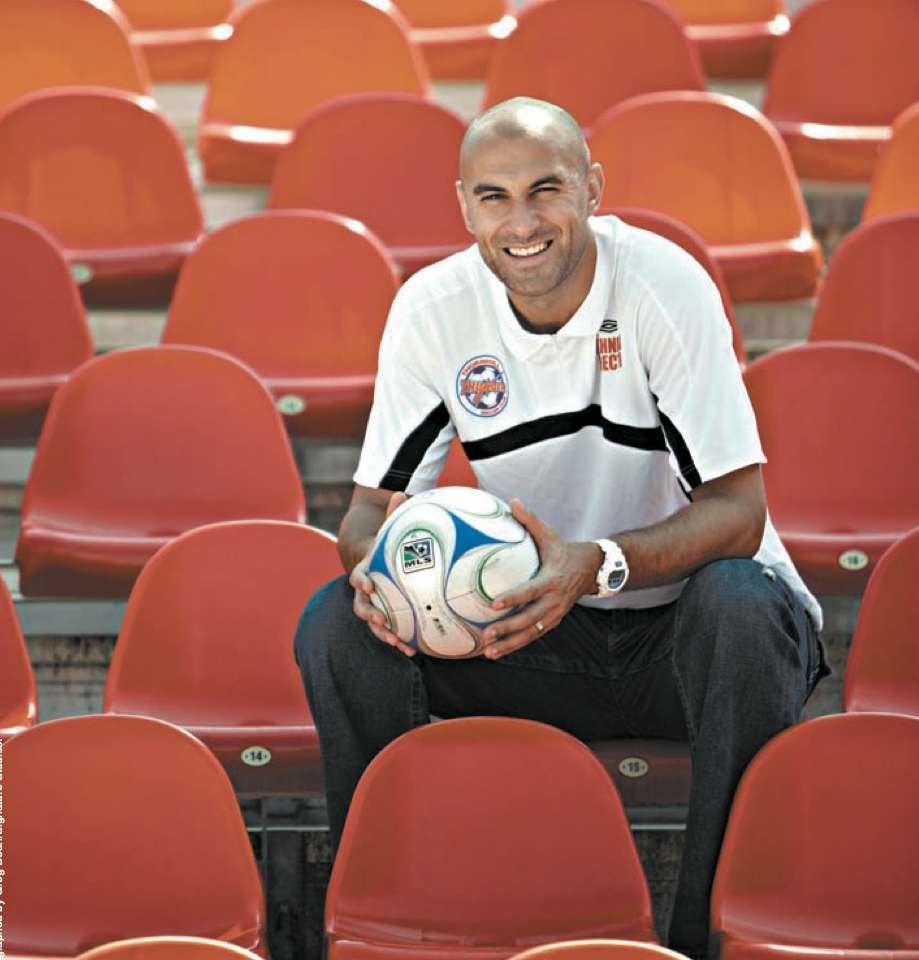
IT’S A SUNNY EVENING at a soccer park on the eastern edge of Thornhill, and Toronto FC’s star forward is planting slalom poles into the ground. Around him clamours a group of nine- and 10-year-old kids clad in soccer kits, eager to get their training started as they juggle balls with their feet. Finally, Danny Dichio blows his whistle.

Practice at the Thornhill Soccer Club has officially begun.

With military efficiency, the team falls into single file. One by one, they duck and weave between the slalom poles.

“Don’t touch them sticks!” bellows Dichio in his thick London accent.

Course completed, each kid scoops up the ball and heads it over to Dichio at the far end of the obstacle course, where they’re rewarded with a quick high five.

At 6’4” Dichio towers over the tykes, but he’s got a gentle manner that belies his tough-guy character. When a young player approaches Dichio with an untied cleat, the superstar quickly descends to one knee and fixes the problem — a gesture you might not expect from the man who strides the field like a colossus.
Training tomorrow’s stars of the pitch has become a significant part of the life Dichio leads beyond the bright lights and cheering crowds of BMO Field. In his role as technical director of Thornhill Soccer Club, Dichio puts in two to three nights every two weeks, developing new training regimens and spotting young talent for the club’s competitive squads.

“It’s fantastic,” says the veteran footballer, 34, of his job. “It’s something I definitely want to get into and this is a great experience for me, for what I want to achieve when I’m finished playing.”

Dichio is still a commanding presence on the field, notching three goals and two assists so far with TFC this season, but he confirmed in March that the current season will be his last, making now a perfect time to start the transition to coaching.

With permanent resident status here in Canada, a house in Toronto and baby number four due in October (“I’m working on a five-a- side squad,” he jokes), it looks like Dichio and his family are here to stay, which bodes well for both TFC and TSC in the years to come.

“I’m here until I get kicked out,” he says. “We’re here as a family. My kids and my wife really like it and they’re settled here. We’ve been made to feel welcome here. I’ve got a rapport with the fans and with this club, so for me and my family to be happy off the pitch is an even bigger bonus.”

Dichio’s connection to the club began informally last year, when he was introduced to the Thornhill Soccer Club through a contact at local sports apparel shop. Towards the end of the season Dichio sat in on training sessions and gave some input on how to improve the players’ technique. Then, last May, the relationship was finally made official, and the club couldn’t be happier to have him.

“He works exceptionally well with the children,” says Thornhill Soccer Club president Gerry Salvati. “He’s got the respect and the attention of the kids all the time. There are a lot of awestruck kids, there’s no question about it. But once he starts the training, the kids are attentive. They’re like sponges and they pick up everything he has to say. He speaks with authority without being domineering. It’s an all-around positive experience and that’s what we’re here to provide.”

For Dichio, it’s simply a matter of paying it forward. Dichio grew up with a love for the beautiful game with his Italian dad and English mom and sister in West London. Dad, a diehard AC Milan fan, saw talent in the boy at an early age and set out to make sure his natural prowess didn’t go to waste. Life as a kid was therefore somewhat strict (other boys were allowed to play in the street well past his bedtime), but looking back, Dichio admits his family did him a good turn, given the payoff. At 9, Dichio was signed to the Queen’s Park Rangers (or QPR) youth system.

“My father was a major mentor, very soccer-crazy as Italians are,” laughs Dichio. “It’s different over here, where you’ve got a lot of different sports to get involved in at a young age. There’s hockey, baseball, football or whatever. In England, 99 per cent of the kids want to be a soccer player. It was a dream that came true for me. I had to work hard at it,but I had a good family behind me that was very disciplined with me. Sometimes too hard, but looking back I see that they did it for a reason, and I thank them for that.”

Dichio got his big break in 1993, when the Rangers called him up to play for the senior club in the English Premiership, the top soccer league in Britain and one of the most lucrative in the world in which to play.

Along the way, Dichio played for various community clubs, including Forest United, where he first matched wits with childhood friend and soccer demi-god David Beckham. The friendly rivalry continues to this day whenever Beckham comes to town. “We go for coffees whenever we see each other,” says Dichio. “He’s not keen on all the attention he gets. He’s as shy now as he was then.”

For fans on this side of the pond, Dichio’s most notable achievement came on May 12, 2007, a moment otherwise known to fans as “23:13.” — the time on the clock at which Dichio scored TFC’s first-ever goal. The goal sent the BMO Field faithful into a roaring frenzy, prompting those in attendance to hurl their commemorative seat cushions onto the field in celebration. To this day, fans sing and chant his name when the game clock strikes 23:13.

“Yeah, the fans remind me of it. I’m surprised they do after the beers they’ve drunk,” Dichio laughs. “It was a hot day for an Englishman, and the crowd was on top of their game as usual. I remember the whole scenario happening in slow motion. The ball came across, and I caught the defender marking me napping and I put it in. Then about 2,000 seat cushions hit me on the back of the head. It could have been anyone that day. I’m a very lucky man. That’s up there with my favourite moments. It was a tremendous feeling.”

In all, then, it’s a tremendous coup for the Thornhill Soccer Club to nab a veteran of both English and Italian soccer at his most intense and competitive. He has staked his claim with authority in both, and has become one of Toronto FC’s most celebrated players.

Back at the soccer pitch, the kids are put through their paces. But Dichio’s objective, he says, is to find the balance between pointing out what can be improved while making sure players don’t get discouraged.

“A kid might hit the target seven times out of ten,” he said. “But if I can correct them a little bit so that they hit the target nine times out of ten, that works better than telling him he’s doing something wrong. They might go home not angry, but thinking they’re not the best player in the world, which many do at that age. And we don’t want that. We don’t want to just build their skills. We want to build their character.”

Pamela Wallin

0
Screenshot2009 09 01at8.36.21PM

YOU’VE JUST SAT down for dinner at a friend’s place when your cellphone rings. Embarrassing. And then you answer it. Rude. But it’s the prime minister, and he wants you to become a Canadian senator.

Oh.

So what’s next?

“I agreed,” says North Toronto’s Pamela Wallin with a laugh. “It’s amazing what happens when you say ‘yes’ to things that you hadn’t contemplated, [when] you didn’t know you were the right person or up to the job. But if someone gives you this opportunity, you just take it, just run with it and do the best you can,” she says.

As a senator, Wallin will divide her time between Ottawa, her hometown of Wadena, Sask., and her beloved Midtown neighbourhood. “I live in airports,” she says with a long exhale. “It’s insane.”

When in Toronto, Wallin will continue to call Midtown home. “One of the things that is so compelling about big cities is the energy that they just generate,” she says. “[The area] is a great neighbourhood with shops and stores and restaurants and coffee places and all the rest of it,”

It was probably that kind of Ontario-friendly comment that recently prompted one Regina academic to call into question the validity of Wallin’s connection to Saskatchewan, the province she represents as senator. It’s an argument that Wallin has little time for.

“Nobody that I’ve spoken to, save the one gentleman, has raised any concerns about whether or not I’m an appropriate representative of the province,” says Wallin. “I’ve spent most of my life as the unofficial ambassador of Saskatchewan regardless of where I’ve been and what I’ve been doing.”

The province can lay claim to another title, too: launching pad for one of Canada’s most high- profile accidental journalism careers.

The year was 1973, and Wallin had just graduated from the University of Regina with a degree in psychology and political science. She was working at a maximum security prison as a social worker when, out of the blue, a friend from CBC Radio called to see if she’d be interested in filling in as a weekend host. With zero radio experience but no shortage of ambition, 20- year-old Wallin simply said, “Yes.”

A match was struck. Within a few years, Wallin was hosting her own radio program and working the federal political beat for the CBC. By 1978, she was covering Parliament Hill for the Toronto Star and doing guest spots on CTV’s Question Period.

Wallin was clearly a natural reporter and interviewer, but she had her share of missteps. At one point in her young career, she found herself across the table from then–prime minister Pierre Trudeau, whose approval numbers were at an historic low. Live on television, and “with the arrogance of youth,” she says, she pointed out that the PM had lost the moral authority to govern and should therefore resign.

“[I remember him] looking back at me and saying, you know, ‘Interesting theory of democracy, Ms. Wallin,’ and giving me a civics lesson live on television that I never forgot. [He] taught me that very fundamental lesson in journalism, which is to think through what the answers to your questions might be. Just do your homework.”

Wallin proved to be a quick study. In 1992, she was wooed back to the CBC to become the first woman to co-anchor the nightly national news program Prime Time News, alongside Peter Mansbridge. However, the coed anchor team failed to resonate with viewers accustomed to a single (male) anchor, so Wallin was reassigned to the nightly magazine segment of the show.

Then suddenly in 1995, Wallin was fired from Prime Time News. Internal politics and Wallin’s confrontational style were said to be at the heart of the highly publicized dismissal.

Still, while the Prime Time News experiment had ended badly, Wallin had cemented her reputation for asking probing, intelligent questions without seeming salacious or muckraking.

Her next project, Pamela Wallin Live, on CBC Newsworld, mixed the celebrity cachet of Larry King Live with the intellectual angle of Charlie Rose and provided the perfect forum for Wallin to showcase those interviewing skills. The show ran for four years.

In late 2001, Wallin’s world was given a shake. As North America was dealing with the shock of 9/11, Wallin underwent surgery for colon cancer. The experience gave her pause to consider the bigger things in life. “It really does offer a perspective, you know, when 3,000 people get up in the morning and simply go to work or get on with their work and their business, and they lose their lives.”

Wallin came out of the surgery thankful to be alive and determined to make a difference. “You really do feel like you’ve been given a second chance and that you better do something that matters with that second chance.” she says. Fortuitously, opportunity came calling in the form of a new challenge. Then-prime minister Jéan Chretien asked Wallin to serve as Canada’s consul general in New York. And so, with another “Yes,” the journalist became a diplomat, a role she held from 2002 to 2006.

Wallin’s performance as consul general evidently impressed Stephen Harper, who came calling in December with a new opportunity: Canadian senator.
During this tour of duty on Parliament Hill, though, she’ll no longer be the one holding public officials’ feet to the fire, but rather the one on the receiving end of irreverent questions from brash journalists.

One question that has already been put her way: With a salary of $130,400 and a generous pension, what’s to stop her from becoming an entitled, toe-the-party-line member of our federal government?

“Well, because I think the prime minister, of sound mind, asked us to sit in the Senate,” she says. “He knew who we were when he asked us to be there. So I don’t think he went in there deliberately and found a group of shy and retiring wallflowers.”

But for all of Wallin’s good intentions, with the position’s perks and its meagre accountability (does anyone actually keep a record of senators’ accomplishments?), it mustn’t take much to lapse into a blasé state of senatorial comfort.

Hogwash, suggests Wallin.

“I’ve had the good fortune over my years in Ottawa covering Parliament Hill to know what the Senate actually does,” she says. “For those of us who have been given this opportunity, it’s an opportunity to work very, very hard if you choose to do it, and that’s what I intend I do.”

Jack Diamond

0
JDiamond
JDiamond

TALK ABOUT HISTORY repeating itself. In 1801, an innkeeper by the name of Abner Miles created the “nucleous” of what would become the village (and, later, the town) of Richmond Hill. He established an inn, an ashery and a general store on two lots at the corner of Yonge Street and Major MacKenzie Drive.

Indeed, Miles accidentally carved out a downtown core that would serve as the thriving “hub” of village life. Two centuries later, another individual — this time, an architect — is intent on changing both the structural and social landscape of Richmond Hill.

By constructing a state-of-the-art performance venue and restoring one of the town’s original 19th-century buildings (the Old Schoolhouse), Jack Diamond hopes to bring the life that works and plays in the big smoke back to Miles’s old stomping ground at Yonge and Major Mac.

“Locating the Centre for the Performing Arts at that northern end [of the town] really speaks to the foresight of the town of Richmond Hill,” says Diamond, principal in charge at Diamond and Schmitt Architects Inc. “It’s really going to help rejuvenate and enhance the downtown area.”

This isn’t the first time Diamond has contributed to the rejuvenation — and reconception — of Richmond Hill’s civic spaces.

In 1987, Diamond designed Richmond Hill’s Lois Hancey Aquatic Centre (a.k.a the wave pool) — the concept for which his firm later received one of their six Governor General’s Awards.

Then, in 1989, with the help of Gary McCluskie (at this time, a “rookie” who had just received his bachelor of architecture from the University of Waterloo), Diamond oversaw the creation of the Richmond Hill’s 60,000-square-foot central library.

Now, 20 years after their first collaboration, Diamond and McCluskie — now managing principal at the firm — are at it again. Thanks, in part, to Coun. Arnie Warner, chair of the Centre for the Performing Arts Steering Committee.

“Various members of the community for about 25 years had spoken about having an arts centre in Richmond Hill,” says Coun. Warner. “One, no, I think two councils ago, we thought we were looking at a community theatre. And we were determined to move ahead. After a series of studies, we selected the site … and eventually returned to our first principles: we came back to the idea of having a performing arts centre — one that could host touring, international shows as well as local choirs, local theatre groups, local dance troops … even graduation ceremonies. ”

After receiving applications from more than 20 architectural firms, Warner’s committee began whittling down their selections.

After several rounds of interviews, Coun. Warner and the steering committee selected Diamond and Schmitt Architects’ design. The reason?

“First of all,” says Coun. Warner, “they’re a world-class architectural firm. Mostly, though, we really liked how they found a way to transition from the architecture of today to the architecture of yesteryear. They incorporated the old [the schoolhouse] with the totally new [the performing arts centre].”

The town selected a firm that was not only acquainted with Richmond Hill’s architectural history but was also well versed in world-class performance spaces and restoration projects. Indeed, Diamond and Schmitt Architects boasts an impressive (and international) portfolio.

Among their numerous performance-related projects, the firm has designed Toronto’s Four Seasons Centre for the Performing Arts, Ireland’s Garter Lane Arts Centre and Sydney Harmon Hall in Washington, D.C.

Restoration-wise, the firm has refurbished Toronto’s Berkeley Castle and renovated the offices of the Toronto Historical Board.

Although the success of Diamond and Schmitt’s bid can be traced back to the firm’s pitch-perfect proposal, the name “Jack Diamond” also resonated with members of the steering committee.

Indeed, the 76-year-old Diamond’s resumé is as impressive as his firm’s portfolio: the Oxford University–educated founding director of the University of Toronto’s master of architecture program served as commissioner of human rights for the Province of Ontario, received the Order of Ontario in 1997 and was awarded the prestigious Gold Medal from the Royal Architecture Institute of Canada in 2001.

Perhaps, though, it is Diamond’s theoretical approach to design that has really aligned him with the town’s intentions. He understands the value of the “old,” yet sees the potential in the “new.” And he isn’t opposed to multi-purpose space — something the town, and Coun. Warner, deemed necessary for their $30 million project.

“When we were working on the opera house [the Four Seasons Centre for the Performing Arts], we had the luxury of designing for one purpose. And that was the real coup: creating something that was uncompromising yet flexible,” says Diamond.

“I think that’s a really important point,” adds McCluskie, pulling up a chair to the table in the centre of Diamond’s corner office. “The space can accommodate international touring groups, local theatre groups, all amplified events, dance performances…”

“We had three groups to satisfy,” interjects Diamond. “They are the audience, the performers and the producers.”

But both McCluskie and Diamond reveal that they have an ulterior motive — albeit one that is supported by the town.

“There was a time when Richmond Hill was a town,” says Diamond. “It had a vital, vibrant town centre. With the spread of metropolitan Toronto, the retail life got sucked out of the town. And it lost its geographical identity.”

While the town was — and still is — experiencing an identity crisis, Diamond and McCluskie both insist that their creation will address Richmond Hill’s “condition.” The Centre for the Performing Arts will keep the residents of Richmond Hill in Richmond Hill.

“We know that we’re going to provide the type of entertainment that people go elsewhere to receive — at affordable prices. We have big name performers, and, yes, the ticket structure is attractive.”

To date, the performance venue, which has yet to open to the public, has already booked a number of big name acts for their winter/spring ’09 season: RyanDan, Sophie Millman, Cynthia Dale, Chantal Kreviazuk and Arlo Guthrie are just a few of the confirmed artists. Although the grand opening of the theatre was scheduled for November 2008, Coun. Warner estimates that “February 2009 will be closer to the time of the opening.”

“You need a destination,” says Coun. Warner. “As I’ve said before, we need to make the downtown area a ‘people place.’ We want them living, working and walking on Yonge Street. You could start out by seeing Michael Burgess perform at the centre … and then you might say, ‘Oh, let’s have dinner at Rhapsody or Café en Passant,’ and then you might find something you like at the new gelato store. Really, we want people to enjoy themselves. And enjoy themselves here.”

But what about the $30-odd million that the town poured into this project? “This is something I want to stress,” says Coun. Warner. “The money is from the town’s reserves. Not from last year’s property tax.”

In essence, this project was a long time coming, not only has council — rather, several incarnations of “council” — discussed the possibility of a civic, performance-oriented space for the past decade or so, but they’ve also put aside funds for this very purpose.

Still, the questions remain: Will this “world-class” space achieve what Diamond, McCluskie and Coun. Warner have envisioned for the town? And will appealing to residents’ cultural (and historical) sensibilities help reroute weekend traffic back to the 905?

“This is all about revitalizing,” says Coun. Warner. “And when you undertake a project of such magnitude, you’re really telling people that you believe in your downtown.”

It looks as though Coun. Warner’s belief is contagious.

Although the Centre for the Performing Arts has yet to open its doors, neighbouring store owners have already started refurbishing their property fronts. Downtown Richmond Hill is already looking more like the “vibrant town” that emerged in Able Miles’s wake and a little less like the bedroom community that surfaced in the mid-’80s.