

Home Blog Page 921

Backyard bungalows not just man-caves any longer

0

WHETHER IT’S USED as a studio, office, or simply a sanctuary from a busy household, prefabricated backyard bungalows are springing up as a popular way for homeowners to add space onto their property without the expense and effort of a traditional renovation.

Available in a variety of models from rustic log cabins to modern cabanas, these little gems can offer everything from 10-by-10 squares of free space to a full guest house with all the amenities.

Easily customizable with the buyer’s choice of windows, siding, roofing and interior finishes, companies have emerged to meet the growing demand for prefab functionality, offering online purchasing as well as showroom tours for buyers looking for their ideal home (not far) away from home.

According to John Hickey a senior designer at Summerwood, one of North America’s leading sources of prefabricated buildings and sheds, the trend toward these outdoor bungalows first gained popularity in California as “granny flats” — self-contained retirement units for in-laws who wished to remain close to relatives in the main house while keeping their independence.

With state tax incentives for those who chose to work from home, outdoor home studios and offices soon became a popular project modelled on these structures. In the past five years, the trend has taken off worldwide, with more and more inquiries coming in each day from across Canada and as far away as Germany and Japan.

“This separation is really key to working in a home office,” Hickey says. “At the end of the day, you get to leave everything behind and come home instead of feeling like it’s always there with you.”

He says that units from his company come in dozens of different pre-set designs, and designers are eager to work with buyers to customize their purchase.

“What I usually do is have people send me photos of their home and property, and what we do is pull elements from the home and take into consideration the location where they are planning to build it,” says Hickey. “You don’t want to go into a yard and go ‘Oh, that’s new.’ You want something that works within the location.”

Already appealing because they are less pricey than traditional renovations, backyard bungalows are also a key way to allow homeowners to adapt to changes within their living and work situation without having to move into a new house.

Temporary guests and recent graduates returning home to save money before heading off on their own can enjoy cottage comfort while still joining in with family at their leisure.

They’ve also been touted as excellent libraries, wine cellars and children’s play rooms.

“They’re basically mini houses,” says Hickey, “And anything you do in a home you can do in one of these units as well.”

Vic Maia, of Kenex Manufacturing Ltd., says his company has units ranging from pre-cut do-it-yourself kits available for approximately $2,700 to fully installed options for $3,700.

He says that shipping takes between two and four weeks for the DIY crowd, and all of Kenex’s products are made in Canada using renewable resources and energy efficient windows and doors.

“One of our most popular units for the home office or studio is our Huron series, which has a nice balance at eight by 12 feet and a rectangular shape instead of the standard square box, and it’s still under the square footage required to get a building permit,” he says.

“And there are many customizable options to make these work for all of our buyers: like if you want to use it as a workshop, we can put in side barn doors, or for an office, we can add extra windows and things like that — it’s all up to them.”
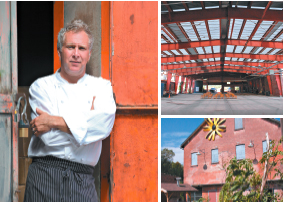
 

All hail the new king of local food

0

“WE COULD ALL be eating like kings,” says Brad Long, the gregarious Toronto celebrity chef and renaissance restaurateur. “We should be able to wallow in a great banquet of things.”

Long isn’t making a bold proclamation advocating gluttony. Quite the opposite.He’s referring to the abundance of local, organic and sustainable foods available in Ontario. “We’re in an excellent situation to be eating better than most people.”

Long is chef and owner of Veritas, on King Street East, north of the Esplanade, which he runs with his wife, Sheryl Brooks, who’s also an experienced chef. He was also the co-host of the hit Food Network series Restaurant Makeover, which gave area eateries a fashionably fresh look.

He’s cooked for captains of industry and heads of state, for NBA and NHL stars, for Andrea Bocelli and Avril Lavigne.

Now, he’s in the process of making local, organic and sustainable — the Big 3, as he calls them — the cornerstone of his boldest venture yet. As part of the Evergreen Brick Works’ ongoing multi-million-dollar envirofriendly revitalization project, his Belong Café will open its doors at the end of November.

The café, which will include a take-away counter for “quick snacks on the run,”he says, will rely exclusively on local farms, including his own 10- acre farm north of Stouffville, for all of the ingredients.That means Long will have to be remarkably flexible with his menu. “Instead of me making a menu and then going out and finding the ingredients, I will go out and find the ingredients and then create a menu around them,” he explains.

The Brick Works site will also include Belong Catering as well as a small retail grocery. “We will be bringing in whole animals and sides of beef where there are lots of little bits left over that I can make into a million things. When you break a cow, you get sirloins and tenderloins and also flank steaks, flatirons, hangers, skirt steaks, briskets, and we grind the rest and make meatballs and hamburgers, and people will be able to pick that up to cook at home.”

Long is no stranger to start-up projects. In the mid-’90s, he revamped 360, the revolving restaurant atop the CN Tower.

Then he spent a decade as executive chef with Maple Leaf Sports & Entertainment where he was responsible for feeding more than 20 million fans at the Air Canada Centre and BMO Field as well as the Platinum Club. But that doesn’t mean that the mu s i c i a n – t u r n e d – c u l i n a r y cognoscenti was a shoo-in to establish the Evergreen Brick Works’ cuisine.

“I honestly thought they’d never give it to me, not in a million years,” he says.

Nestled into the marshy wetlands of the Don River Valley, the Brick Works was once one of North America’s biggest brickyards, producing more than 43 million bricks a year at its peak, which were used to construct such buildings as Massey Hall and Old City Hall.

Abandoned and in disrepair, the site was turned over to Evergreen, an environmental non-profit, in the late ’90s, which set about the painstaking process of transforming the historic collection of factory buildings, industrial sheds and kilns into a community environmental centre with programs that celebrate the site’s unique geological, industrial and natural heritage.

In 2010, National Geographic named Evergreen Brick Works one of the world’s top 10 geotourism destinations. So there was stiff competition among restaurateurs and catering companies when it came time to accept proposals for the restaurant and catering services. It had to be just the right fit for such an ecoaware organization.

According to a Toronto Life story on the Brick Works, Jamie Kennedy was expected to run the operation until looming bankruptcy threw those plans into disarray (Long says he wasn’t privy as to why Kennedy was not enlisted by Evergreen). Still, it was Evergreen that sought Long out.

“I got a phone call last October or November asking if I’d be interested. I was overwhelmed with so many things at the time I actually said no,” he says, as if he can’t believe his own story.

“I got a call back asking if I was sure. No one ever calls back, so I thought I better do it or I’d regret it.”

Long put together a proposal that included the Belong Café, the catering company and the small grocery, unsure if Evergreen was looking to divide things up among several proprietors or not.

“I love the whole vertical integration, from quick-service windows or counters to the restaurant to catering. It’s like a cow — you can use more ingredients if you are in charge of the whole operation. They wanted everything from a food court to a quirky, beautiful restaurant to a caterer, and I swallowed the blue pill.”

He even swallowed the idea of the name of the restaurant, Belong Café, being a play on his own name, something he’d resisted in the past because of the “hokey marketing” connotations behind it.

It seems Long has gotten used to putting his name on things. He’s currently in post-production on a documentary he’s made tentatively called The Long Way Around. It’s about what it means to be local, organic and sustainable.

And as if there weren’t already enough on Long’s plate, he’s also an associate producer on a rom-com mockumentary called The Untitled Work of Paul Shepard.

Oh, and he’s also learning how to be a farmer. He and his wife and their five kids spend a lot of time taking care of the ducks, geese, chickens, turkeys and laying hens and tending the market garden on their farm.

“It’s not about becoming a farmer but about learning the pieces and processes of being a farmer so I can be a better chef,” he says. “And maybe next year we’ll get a small herd of sheep.”


Accused bomb threats mar local school trustee bid

0

Linda Pitney — charged last year and accused of sending a bomb threat to a west end school — has now been disqualified after a short run for the Eglinton-Lawrence Toronto District School Board trustee position.

Bonita Pietrangelo, the director of elections, said Pitney had written a post office address on her application, disqualifying herself. All school trustee candidates must reside in the relevant ward to qualify. Pitney, however, said she has several places she considers home and that application guidelines were not clear. “I have different spots.… I stay with people in Toronto. I have a spot in London,” she said. 

The threatening letters Pitney is accused of sending started to appear at Perth Avenue Public School in the Dundas Street and Dupont Street area in December 2008. They were allegedly motivated by Pitney’s defence of an Iranian student, who Pitney said was being treated unfairly. She said that though it was her duty to report a abuse, she maintains she did not send the letters. “It doesn’t add up…. It’s devastated my life,” she said.

Pitney is currently scheduled to appear in court on Oct. 20. She said her decision to run for trustee was an attempt to bring some attention to her case and to help clear her name. She also said she wanted to bring more transparency to the school board.

Howard Goodman, the current Eglinton-Lawrence trustee, said, though he is uncertain of all the exact requirements for trustee candidates, he does believe a person is innocent until proven guilty. “I’m taking the situation as an accused who hasn’t been tried yet,” he said.

Goodman also said, if Pitney is running to bring more transparency to the board, he agrees with her reasoning. “If somebody has issues with the way we’re doing things, it’s a really good reason to run.”

Thornhill man loses Supreme Court challenge

0

A Thornhill resident recently lost his case at the Ontario Superior Court arguing that the practice of barring men who have had sex with men from donating blood is discriminatory.

Kyle Freeman first made headlines when he anonymously emailed Canadian Blood Services, revealing that he had lied during its screening process and donated blood on multiple occasions because he disagreed with the policy.

Freeman filed his counterclaim in a response to a lawsuit launched by the non-profit organization that accused him of negligent misrepresentation. In it, he asserted that the policy infringed upon his rights to equality under the Canadian Charter of Rights and Freedoms.

At the Ontario Superior Court of Justice, judge Catherine Aitken ultimately ruled that the policy wasn’t discriminatory for a variety of reasons, including that it was designed with health and safety in mind, and was grounded in evidence. She also found that Freeman had, in fact, been negligent.

Ron Vezina, a spokesperson for Blood Services, said his agency didn’t have any plans to collect the $10,000 it was awarded in damages.

“It was never about money,” said Vezina. “When we first pursued Mr. Freeman, it was so that we could find out his identity, so that we could call back his units of blood and also defer him as a donor.”

Blood Services continues to support research and reassess its policies, but right now, the evidence doesn’t exist to support any changes to this one, he said.

Patricia LeFebour, the lawyer who represented Freeman, said she was unable to comment on the ruling at this time.

At a press conference following the judge’s ruling, Blood Services CEO Graham Sher said that the decision reaffirmed the appropriateness of his organization’s current policy.

He pointed out that men who have sex with men are only one of the groups that are not permitted to make donations because various factors put them at a higher risk for blood-borne diseases. Screening is done in the form of a questionnaire before people roll up their sleeves, but it doesn’t take the place of testing, which happens after donations have been collected.

“Our donor selection policies have always been about protecting the safety of blood recipients and the MSM [men who have sex with men] policy is no exception,” said Sher.

Efforts to contact Freeman were not returned by press time.
 

Local broadcaster gets candid about cause

0

AFTER DEFYING GRIM odds and beating pancreatic cancer last year, prominent Canadian journalist Libby Znaimer says she remembers feeling as if, suddenly, all the time in the world opened up to her: “One of the things that you find, when you’re finished treatment, is ‘I have all this time, now, what am I going to do?’”

These days, the Wychwood Park local finds herself busier than ever. In addition to helping older brother Moses Znaimer grow and strengthen the ZoomerMedia empire (which includes Classical 96.3 FM and Zoomer magazine), she is a recently appointed Pancreatic Cancer Canada spokesperson and is doing what she can to raise both awareness and money to help others outlive cancer.

Just last month, Znaimer, who finished treatment for breast cancer a couple years prior to her pancreatic cancer diagnosis, organized a Zoomer team for Princess Margaret’s Weekend to End Breast Cancer, helping raise more than $76,000.

“It was a big effort. We really gave it a lot of publicity,” says Znaimer, of the 30-person team. The walk wasn’t the first time Znaimer has been public about breast cancer. In 2007, she published a book called In Cancerland, detailing her own journey with the disease, its physical and mental toll and how she learned to cope and continue to enjoy life.

Znaimer first became aware that she might have breast cancer after finding a lump late one night, just 10 weeks after a mammogram.

When she was officially diagnosed in June 2006, her life changed rapidly. “Suddenly your life is full of doctors appointments,” she says. After nine months of treatment, followed by surgery, Znaimer found herself in remission.

However, barely a year passed when stomach pains sent Znaimer back to the doctors where she received an even more grim diagnosis: pancreatic cancer.

She said pancreatic cancer is often considered a silent killer.

There are few symptoms, and often by the time a person is diagnosed, the cancer is well advanced. After five years, the survival rate from pancreatic cancer is approximately five per cent. In addition, Znaimer says it is very difficult to decide on a treatment plan because of all the scientific information patients need to disseminate.

“We’re not in the old days where the doctor tells you what to do. It’s very, very complicated,” says Znaimer. “You have to take in and understand all this stuff that you’re not necessarily prepared for.”

However, in an odd twist of fate, her trial with breast cancer gave her a reason to hope. After the 2006 diagnosis, Znaimer was tested for a genetic mutation that, when present, puts people at greater risk for breast cancer. She came out positive.

In the face of pancreatic cancer, that same genetic mutation opened up an innovative treatment that Znaimer decided to try. It worked. Znaimer says the doctors were shocked. She herself wasn’t sure she’d survive. “You read the statistics.… I didn’t really expect to survive, but I have,” she says.

Znaimer says outliving pancreatic cancer has encouraged her to act in the now.

After treatment, she says she focused on a home renovation and was excited to get back to work, where she is now the vice-president of news and information at Classical 96.3 FM and AM740, as well as host of The Zoomer Report. She also got in touch with Pancreatic Cancer Canada to help profile the disease.

“The problem with pancreatic cancer is there are few survivors, so there aren’t a lot of people to speak for it,”says Znaimer. “I think that’s why there hasn’t been the research dollars and there hasn’t been much progress.”

Currently she is writing a pamphlet for Pancreatic Cancer Canada, which she wants to complete for this November: Pancreatic Cancer Awareness Month. Znaimer is also preparing for an office move, completing articles for Zoomer magazine and enjoying life full tilt.

“Frankly, it may come back, so I want to do everything that I want to do as quickly as I can do it because that’s just the way to be,” says Znaimer. “It’s living in the moment.”


Exclusive local golf club might be forced to pay up

0

City council recently voted to reopen a decades-old arrangement that has seen nine private golf clubs save about $33 million in deferred taxes over the years, in exchange for preserving the green space. Rosedale Golf Club is among them.

The motion, as approved, calls for the city to ask the clubs to do community outreach, to appeal their property tax assessments and to look at ways of challenging the legality of the old deal. Signed in perpetuity, it’s an arrangement that Coun. Adrian Heaps feels is outdated. The exclusive golf clubs are getting a subsidy, but there’s no public benefit, he said.

“People say, ‘You can look over the fence and see some green space, but that’s not the way the city should be working,” said Heaps.

Coun. Howard Moscoe, who has challenged the arrangement in the past, would like to see the private golf clubs pay back the deferred taxes in full. At the least, he believes, they should open themselves up to the community and, for example, give disadvantaged kids the opportunity to learn how to golf.

“I don’t think the ordinary guy, who sweeps the floor in the clubhouse, ought to be subsidizing or support the wealthy clubs,” said Moscoe.

He noted that past meetings with the private clubs have been unsuccessful.

“They have drawn into their shell and stood firm on their privilege, but it’s not the right thing to do,” he said.

What’s different this time around is that Coun. Heaps’s motion calls for legal action.

Date set for Shops on Steeles redevelopment

0

A development Proposal to transform a Thornhill shopping centre will be heard at the Ontario Municipal Board (OMB) beginning next March unless a compromise can be reached.

The revised plan, first submitted by Bayview Summit Development Ltd. in October 2007, seeks to transform the 17-acre Shops on Steeles and 404 site into a mixed-use community with retail, office and other uses as well as 1,787 residential units. The plan includes five residential point towers, ranging between 18 and 32 storeys, near Highway 404 on the eastern portion of the site.

Erin Shapero, outgoing councillor for Ward 2, said she is not surprised that the development has become a hot campaign topic for many candidates in the coming municipal election.

“It’s a huge issue,” Shapero said. “And not just for Thornhill, for the rest of the town of Markham because it’s a site that was never identified by the town as a site for major intensification.”

Fred Webber, president of the German Mills Ratepayers Association, agreed on the significance.

“It’s clearly the most important issue in this ward,” he said. “There’s nothing near it.”

Webber said his group has concerns about traffic, density and enhancement of the commercial mall. He said his group would continue to push for a six-storey height limit and one time coverage limit for the site should it ultimately go before the OMB.

Both Webber and Shapero said they were hopeful a compromise could be reached with the developer prior to the scheduled hearings.

“With the pending election, it’s been a little difficult,” said Maria Gatzios, planning consultant for Bayview Summit, regarding efforts to reach a compromise, but said that discussions would be ongoing.

Hearings are scheduled to begin on March 2 at Markham Municipal Offices. A total of 32 days over eight weeks has been set aside.

The revolution is now for TTC Bus Bay area

0

As the only Yonge Street and Eglinton Avenue corner not overwhelmed by tall buildings, locals have long wondered what will become of the old TTC Bus Bay area southwest of the intersection. However, with a 17-storey condo and townhouse complex about to break ground, the overhaul is here. 

The complex, called the Berwick, will sit next to the Canada Square building and will include a parkette that eventually will expand onto its northern neighbour, the TTC land. Andrin homes, the developer of the Berwick, this month opened the sale of its 225 condo units to the public.

“The building is very sensitive to the existing neighbourhood,” said Anne Marchildon, Andrin vice-president of sales and marketing, regarding the site which received final approval last June. “It steps back on Yonge Street. It doesn’t have the overshadowing effect on the neighbourhood.”

As for the long-anticipated plans for the TTC bus bays, several things must be accomplished before all of the site can be considered for development. The land is currently being managed by the city-owned real estate agent Build Toronto. However John Macintyre, the senior vice-president of Build Toronto, said that ownership of the land still has to be transferred to them from the TTC.

“We don’t actually have the keys, yet, or the title to the land,” said MacIntyre. “Really at this point it’s more about investigation and waiting for the TTC to get their plans finalized.”

Additionally, Macintyre said Build Toronto will not move forward with development until after the construction of the Eglinton light rail line. He also said there is no guarantee the city will either keep or sell off the land and that it will likely be a year before Build Toronto starts assessing what can be done with the property. 

As for the Berwick, Marchildon said construction will likely begin in spring 2011 and completion is slated for June 2013.

End of the world as he knows it

0

DOUGLAS COUPLAND’S latest novel, Player One, presents a doomsday scenario set in a Toronto hotel, a building resembling “the third-best restaurant in the fourth-largest city in Bulgaria.”

No, being stuck in an airport hotel is not the apocalypse of which he writes. The cataclysmic social upheaval is actually triggered by skyrocketing gas prices in the time of a severe oil shortage.

But while all hell breaks loose — there are explosions and all manner of mayhem — the story itself is remarkably subdued as Coupland focuses on four characters: the hotel’s alcoholic bartender, a pastor who stole $20,000 from his church, an autistic 17- year-old girl and a 40-year-old woman waiting to meet an Internet suitor.

Long-listed for the prestigious Giller Prize, Player One also has the honour of being the subject of the 2010 CBC Massey Lectures. Coupland will present his novel in a series of five lectures in Vancouver, Regina, Charlottetown, Ottawa and Toronto, which will take place on Oct. 29 at 8 p.m. at Convocation Hall.

The lectures will be recorded and then broadcast on the CBC Radio the week of Nov. 8.

Coupland, best-selling novelist, visual artist and popularizer of such terms as Generation X and McJob, prefers to conduct interviews via e-mail, most likely because it allows him to answer questions from his Vancouver home at 2 in the morning in his pyjamas.

Q: Congratulations on being long listed for the Giller. How did you receive the news and what was your reaction?

A: I opened my e-mail box and saw about 20 e-mails saying “congratulations,” and I thought maybe I’d won a barbecue.

Q: How did the idea for Player One come about?

A: I wanted to take everything I’ve ever done and squish it into a diamond,the way Superman can take anything and crush it into a diamond. There were a lot of persistent ideas in my work, and I really needed to once and for all put them into a final logic.

Q:What was the process and challenge of adapting the novel for the lecture format?

A: I’m a terrible teacher. I’m disciplined but I have no patience. The only students I’d ever care about would be those one or two live wires you get in any class. I’d just tell the others to go knit or play Scrabble and give them a C+. So I’m not a good lecturer, and doing a traditional lecture was pointless. So I had to figure out a new way of knitting ideas together and putting them forward.

Q: How do you feel that Player One comes across in book form versus lecture?

A: I went to see Wade Davis’s lecture last year, and he’s an astonishing lecturer — because that’s what he does for a living! And good on him! As a non-lecturer,I had to figure out what works for me and what doesn’t.

Q:According to a Quill & Quire article, you have said that Player One “presents a wide array of modes to view the mind, the soul, the body, the future, eternity, technology, and media.”

A: I did.

Q: Doug, I’m wondering if you wouldn’t mind expanding on that and explaining what that means?

A: Barrett, I think we’re at a crisis point as a species, and we need to articulate the types and depths of our crisis. It’s not just about pollution or greenhouse gases or war. It’s about how we have to somehow modify our cortical structures or our DNA as a species.There’s really no hope otherwise. I mean, are we going to be making photocopies and going to Starbucks in 500 years? 5,000 years? No.We’ll either be dead or we’ll have mutated forward, hopefully electively forward.

Q: Setting aside your “me goggles,” which you defined in the New York Times as “the inability to accurately perceive oneself as others do,” how do you think people perceive you?

A: I have no idea. I used to care. The moment I stopped caring, life got so much easier.

Q: What is your fascination with the end of the world?

A: It’s not a fascination with the end of the world. It’s a fascination with using endgame scenarios to shock us into facing how unstable our everyday reality is — not just ecologically but in all other ways.

Q:What is your favorite T.O. memory?

A: I have so many. I really love the city and it’s my second home. Probably it was a rainy day in fall of 1988, maybe 5:30, outside the Davisville subway station, and the rain had stopped and the sun was washing in red across the western horizon, and I had this moment where the larger part of myself said to all the smaller parts of myself that I was to become a full-time writer, and that if I were to do this, I’d have to write fiction because it’s a pure and crystalline form of writing. This isn’t something I was expecting at the age of 28. I knew I was going to have to give up everything I’d achieved at that point and throw it all away and start from scratch.

Q:What are your favorite places to visit and eat when you’re here?

A: I like that bar at the Hyatt where they have those fantastically out-of-date caricatures of (mostly) dead Canadian writers. It’s the skull that sits on the desk staring at you while you write.


Talk of the fashion world

0

ON THE SEASON four premiere of Gossip Girl, the popular TV series about rich kids living the high life in Manhattan, a new character named Juliet shows up wearing a fabulous light grey blazer from the New York label Alex & Eli.

At the end of the show, Juliet tries to retag the item, but her love interest interrupts, and she quickly puts the blazer back on, suggesting Juliet is trying to appear wealthier than she really is.

For a small brand that’s trying to become a major player in the fashion world, that’s the kind of exposure money can’t buy. Since launching Alex & Eli two years ago, Aja Singer, a graduate of Bishop Strachan School, and her co-owner and co-designer, Anna Zeman, have slowly built a loyal following with their small clothing label.

Out of Singer’s small Nolita apartment, the duo creates suits for women that combine classic shapes and fabrics with a more aggressive, modern style.

“When we started two years ago, there really wasn’t anything that wasn’t a pinstriped black blazer for girls to wear.We saw that was an area of the market that wasn’t being fulfilled,so that’s where it came from,”says Singer. “We use classic silhouettes and classic fabrics and add an edginess.”

The label’s fall/winter 2010 line was inspired by motocross and hunting wear. One jacket uses a fox-hunting silhouette, with a grey and black houndstooth fabric and black elbow patches.

A clothing label to call her own was a long time coming for Singer, 27. She remembers making dresses for father-daughter dances at BSS and “little outfits” for “grub” (non-uniform) days at school. After graduation in 2002, she headed to McGill to pursue math and science but eventually realized that fashion, not medicine, was where her ambitions lay. She finished her degree in anatomy and cell biology and applied to Parsons, the prestigious fashion school in New York.

Punctual by nature, Singer would show up so early that only other keeners were in the building. One of those keeners was Zeman. She and Singer hit it off, eventually agreeing to start a label together.

Today, Alex & Eli is an extension of their personalities. Singer describes her design aesthetic as more feminine, and Zeman’s as more experimental. Even the name of the label is reflective of the co-owners: the name is short for Alexandra and Elizabeth, Singer’s and Zeman’s middle names, respectively.

Alex & Eli is now available at Lileo, 55 Mill St.,Toronto.


What’s Italian for awesome?

0

Had one too many fusilli with vodka sauces? Tired of pedestrian pasta primavera? There is no reason to accept run-of-the-mill restaurants serving average fare when there is Italian cuisine in the city that tastes like it came straight out of Sicily. Buon Appetito!

Italian cuisine becomes fine art with ace team

Chef Andrew Milne-Allan of Zucca is a master of deeply authentic Italiana, which is why you see all kinds of downtown types making the unlikely pilgrimage to a desperately boring stretch of Yonge between Eglinton and Davisville.

Dinner chez Zucca starts with the best panisse (fried chickpea-flour cake) I’ve ever had, with toasted rosemary on top. Since Zucca scooped Madeline’s exec chef Dominic Amaral, when Madeline’s closed in spring ’10, it’s only gotten better. In southern Italy you see chiles everywhere, hanging to dry from roadside poles. Chiles bring zip and zing to Milne-Allan’s cooking, turning house-made noodles divine, with deep rich sausage ragu, innocent of the cliché of tomatoes, deepened with pecorino and good ricotta.He roasts fat scallops with fab guanciale, onion and grape tomatoes. Even a lowly pork sirloin gets its groove at Zucca, stuffed with snazzy mozzarella and greens. For dessert, his lacy chocolate cannoli are delicacy incarnate.

Zucca is located at 2150 Yonge St, 416-488-5774.

Food made with passion comes through on the plate

A great date restaurant, thanks to the dark candlelit room and sexy Italian food. For total privacy, reserve one of the two front tables beside the bar.

Also a very sexy place to dine thanks to big flavours. My favourite app is rich chicken and veal broth afloat with little pasta pockets of parmigiano reggiano–spiked veal stew. Mistura is a master builder of robust flavours. Under the divine decadence of pink fork-tender Kobe flatiron steak is a pile of mashed potatoes fragrant with sliced black truffles. Alongside impeccable veal loins is cream sauce loaded with porcini flavour and roasted chestnuts. You’ll want to lick the plate.

Mistura is located at 265 Davenport Rd., 416-515-0009.

New team keeps landmark restaurant humming along

New owners took it down a notch, so instead of foie gras, we have foie gras parfait — like velvet, like silk, but less ambitious, less complex, less expensive.

Chef/owner Victor Barry, who worked under chef David Lee (now of Nota Bene) when he owned Splendido, learned well. By enchanted alchemy he makes blood sausage resemble a soufflé. His gnocchi are gossamer and truffle-scented. His house-made pasta comes with soft-fleshed rabbit and tiny young artichokes.

Other than when he uses the wood-fire grill, which is sometimes too hot and causes meats to feel too charred, the chef does great justice to meat. He braises local lamb shoulder and suckling pig with finesse, assuring moist tenderness. Sometimes his mind is a culinary surprise package, as when he partners barely cooked scallops with homespun oxtail ravioli and sauces that happily marry with silky cauliflower puree and barely butter-braised Savoy cabbage. Desserts keep to the same high standards, and nobody told the waitstaff that Splendido has downscaled: they are attentive, knowledgeable and charming.

Splendido is located at 88 Harbord St., 416-929-7788.

Pasta Bar one of the best kept secrets in town

Now that the Pasta Bar takes reservations, it’s the anti-big night- out go-to resto for people of a certain class. Some tables enjoy a fab view over downtown. Let the valet take the car, and make an entrance down the grand staircase, all blonde wood and brushed stainless steel.

The service is flawlessly professional, the menu an interesting compendium of grills ’n’ pastas. We love the saffron-kissed scallops, the fish soup with subtle broth and perfectly cooked fish, the housemade filled pastas and of course pastry chef Joanne Yolles’ divine desserts.

Scaramouche is located at 1 Benvenuto Pl., 416-961-8011.

The hottest new Italian restaurant in town

If an out-of-towner asked me for a typical Toronto restaurant, I’d say Buca, for it signifies a hat trick of edible Toronto: First, our ethnic background in general and specifically our strong Italian immigrant presence. Second, how cool we’ve become.

Who needs the Big Apple when we have restaurants like this, in a reclaimed warehouse with soaring ceilings, washed brick, industrial fixtures and a multiplicity of clever little spaces, all grace and no attitude. And third, Buca is one of the reasons why Toronto is one of the great food cities of the world, for pure food quality.

That chef Rob Gentile trained under Mark McEwan shows in his impeccable technique. I love his thin-crust pizzas with clever toppings and his pasta, especially when he fills them with the likes of veal, grana padano and mortadella and makes matters even richer with a deep strong veal sauce. His charcuterie is superb, and even the desserts, not usually an Italian strong suit, are worth every calorie.

Buca is located at 604 King St. W., 416-865-1600.


Bitter sweet

0

TORONTO DOCTOR Jeremy Gilbert is on the front lines of the battle with diabetes as a physician at Sunnybrook,as well as a professor in the department of endocrinology and metabolism at the University of Toronto.

You must be a treat around Halloween — what’s your sweet indulgence?

Cookies.

What is the difference between Type 1 and Type 2 diabetes?

Type 1 diabetes, the issue is that antibodies attack the pancreas so it can no longer make insulin. Type 2 diabetes,there are two problems: the body is resistant to the insulin, and they don’t make enough of the insulin. Both, technically, can come on any time.

But Type 2 is generally something that comes along later in life, right?

Well, that is the general concept,but there are a lot more kids and adolescents getting Type 2 diabetes.

Why?

That’s because of insulin resistance that is brought on by obesity. Because there are more obese kids and adolescents, there is more Type 2. SickKids has actually opened an entire Type 2 diabetes clinic.

So why is there such a rise?

There is an obesity epidemic going on right now.

Well, how can I make sure my kid stays out of that clinic?

The most important thing would be proper diet and exercise and limiting the amount of sedentary activity and promoting exercise — hockey, running, biking, anything like that. Also proper food choices, avoiding fast food, pop.

What are some of the warning signs?

Symptoms of high blood sugar include fatigue, blurry vision, thirst and excess urine output. If you have any of the risk factors for diabetics, you should let your family doctor know so he or she can check you.

So how do I know if I’m in that high-risk group?

So there are certain patients more prone to get diabetes than others, certain ethnic groups, Aboriginals and Southeast Asians or those with a strong family history of diabetes. If you had diabetes during pregnancy.

What foods are best to avoid?

That’s a bit complicated. Obviously foods with a lot of sugar have a high-glycemic load that would contribute to higher sugar levels, and carbohydrates also contribute. Making proper choices in carbs makes a difference — whole wheat is better than white bread, for instance.

Are some forms of diabetes hereditary?

Yes, there is a very rare type of diabetes, single gene, that is inherited, but that is less than one per cent of patients with diabetes.

But with respect to Type 1 and Type 2 diabetes, if there is a parent or sibling, there is a high risk of getting it.

I’ve heard vitamin D might be helpful, true?

There is up-and-coming research about whether vitamin D affects diabetes or not, but the jury is still out.

Do you take it?

I do.

What about other natural alternatives such as cinnamon and green tea?

And chromium (another natural health option) also is on the list. My feeling on that is that they probably don’t harm, but they probably don’t have a huge sugarlowering effect.

What’s the latest research?

It’s in insulin pumps. Instead of having needles, you actually wear a pump that gives you insulin all the time. That is where all the coolest research is. It’s called “closing the loop.”

Basically, you have a loop of sugar to insulin that needs to be matched. The new technology, in theory, mimics a normal pancreas.We’re not quite there, but that is where all the big development is.

And how close are we to finding a cure?

I think there is a lot of research going on, but I don’t hear anything in current articles about a cure coming out. The main focus is on Type 1, closing the loop.