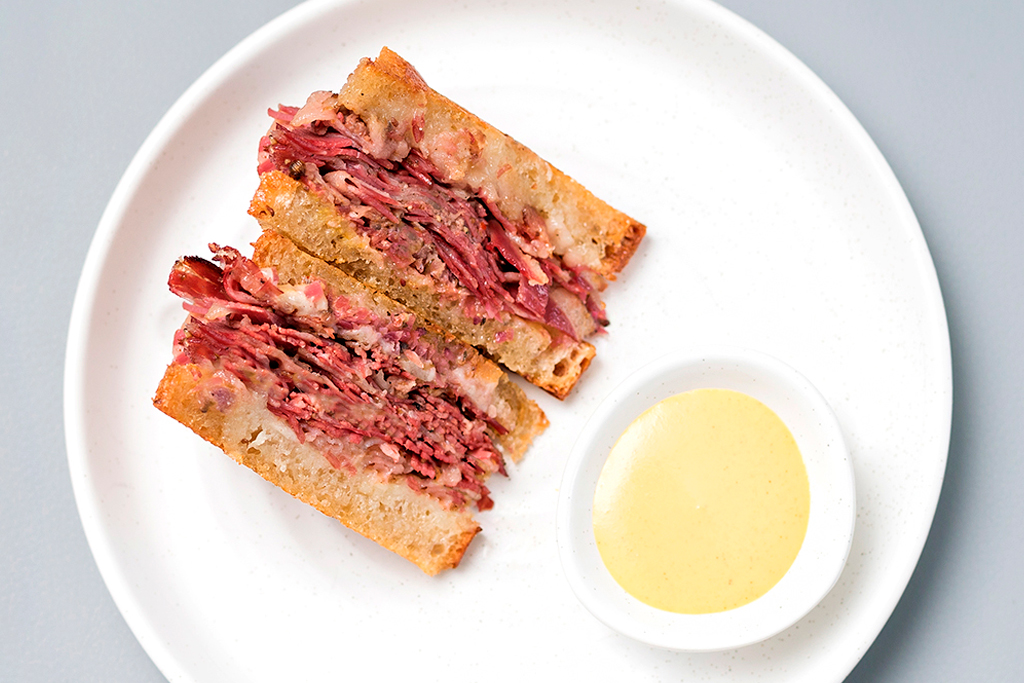
Nouveau-chic Sara, with its sleek marble table tops and delicate small plates, throws its wagyu Reuben ($18) into the ring. The house-cured wagyu beef literally melts in your mouth. Well-buttered ciabatta toast is accented with a red cabbage caraway-infused sauerkraut and an aged Gruyère cheese. Presented like a little finger sandwich, this contender is meant to be a small plate, but the meat is so decadent, two triangles is more than enough. The sandwich comes alongside a house-made truffle mayo that offers a welcome horseradish zip. All in all, this one is well worth the splurge. 98 Portland St.
THAT FUNKY TWIST
Despite Rose and Sons’ loyalty to classic deli noshes, they’ve combined two stand-alone greats into one epic sandwich. The Randy ($14), is a juicy pounded chicken thigh, battered to crispy cornflake-esque perfection, set atop two slices of caraway rye and topped with a deeply flavourful sauerkraut that isn’t afraid to be a little funky, just like Grandma used to make. This nostalgic treat is finished with a hearty slice of Swiss cheese, some Russian dressing and a pickle spear on the side for good measure. Oh, and they definitely cut the mustard with a choice of Colman’s, French’s and spicy dijon on every table. 176 Dupont St.
PALM-SIZED PASTRAMI
Many locals would tout 416 Snack Bar as Toronto’s quintessential bar. It’s casual yet elevated; cosy yet infused with an intangible hipness. The bar focuses generally on small plates, so their Reuben ($8), is deliberately pint-sized. But don’t let its two-inch stature fool you. This little number packs an enticingly diverse flavour profile. Thin and toasted slices of Dimpflmeier rye give a rich, buttery crunch. The lean smoked meat, Russian dressing and sauerkraut are all made in-house. Rightfully, this little meaty treasure is a fixture on the menu, so make it your regular order. 181 Bathurst St.
HAIL SEITAN
The Hogtown Vegan’s seitan Reuben ($13.50) is a leaning tower of thinly sliced seitan (a wheat gluten meat alternative), topped with zingy sauerkraut, earthy alfalfa sprouts and house-made Thousand Island dressing on pillowy pumpernickel rye. The seitan is seasoned with soy sauce to achieve a deep, almost gamey savouriness, then rubbed in a kicky signature spice blend and roasted before meeting the deli slicer. Although not an unclockable meat imitation, it checks all of the Reuben boxes, and, frankly, it’s just plain delicious, even if you don’t abstain from meat. 1056 Bloor St. W.
Shook, a fresh new Israeli-inspired vegetarian concept from restaurateur and Iconink CEO Hanif Harji (Byblos, Patria, Figo, Mira) will open in Toronto at 77 Portland St. this June. The new 78-seat dine-in, takeout, and retail spot is built around the concept of the traditional Israeli “shuk,” open-air markets that sell fresh ingredients and traditional eats.
“We interpret modern Israeli cuisine as a melting pot of both cultural and regional culinary traditions,” explains Harji. “We see no boundaries or borders, our intentions are simple: explore ancient spices, and understand regional food and cooking techniques while staying true to our mission [to] translate food to emotion and memory.”
With a focus on sustainability, the menu is built around high quality locally-sourced ingredients.
This flavourful veggie-based cuisine will be cooked over an open flame, rather than with a typical gas range.
“We poured our hearts and souls into developing a rich menu,” says Shook executive chef Ben Heaton (The Grove, La Société, Figo, Estia). “We’re working with amazing, locally grown ingredients and paying careful attention to every element in every dish. Cooking on an open flame is a unique opportunity to really bring out amazing flavours in a way most people don’t expect.”
At the heart of the menu is the pita, which is baked in a wood oven while you wait to provide a fresh base for the rotating sandwiches. There are also plenty of seasonal soups, such as burnt eggplant and maftoul, fresh salads, such as green cabbage, dill, and pistachio, and plates such as manouri stuffed squash blossom with matzo crust and mushroom tahdig.
The brunch menu features dishes such as buttermilk qatayef pancakes with rose cream and pistachio, chocolate babka French toast with spiced orange marmalade, as well as two variations of the classic Israeli dish shakshouka.
To accompany the food is a menu of botanical cocktails, mocktails and biodynamic wines. Sit back with a drink and enjoy the decor by Toronto-based interior design firm Model Ctzn that features a custom-made woven chandelier and an impressive art installation. Or enjoy your libations on the 48-seat patio when the glorious Toronto summer finally arrives.
A daily menu of coffee, smoothies, and baked goods, as well as salads and sandwiches are available to-go, all packaged in environmentally responsible containers. In the retail shop you’ll find everything from house-made pickles to custom clothing to handmade pottery.
Shook will be serving lunch, dinner and weekend brunch as of June 1st.
The Annex Hotel has more than gorgeous rooms and an attractive lobby café and bar to offer Torontonians and travellers: The Commons is officially open, and just like the hotel, this restaurant-meets-bar is carving out a space that’s all its own.
When partners Trevor Speis, Justin Fong and Andrew Peek got together to launch the boutique Annex Hotel, they envisioned it as someplace between an Airbnb and a hotel in order to capitalize on the best aspects of both. When it came to the dining aspect of the hotel, they wanted the Commons to combine the ambiance and curated menus of fine dining and the accessibility and immediacy of casual eateries.
“We wanted to take advantage of the increasing popularity of the fast-casual experience, without sacrificing style,” says hotel partner Trevor Speis. “People are eating out more, but they can’t do fine dining every night, so it was important to us to be an everyday spot that still offers impeccable food and beverage.”
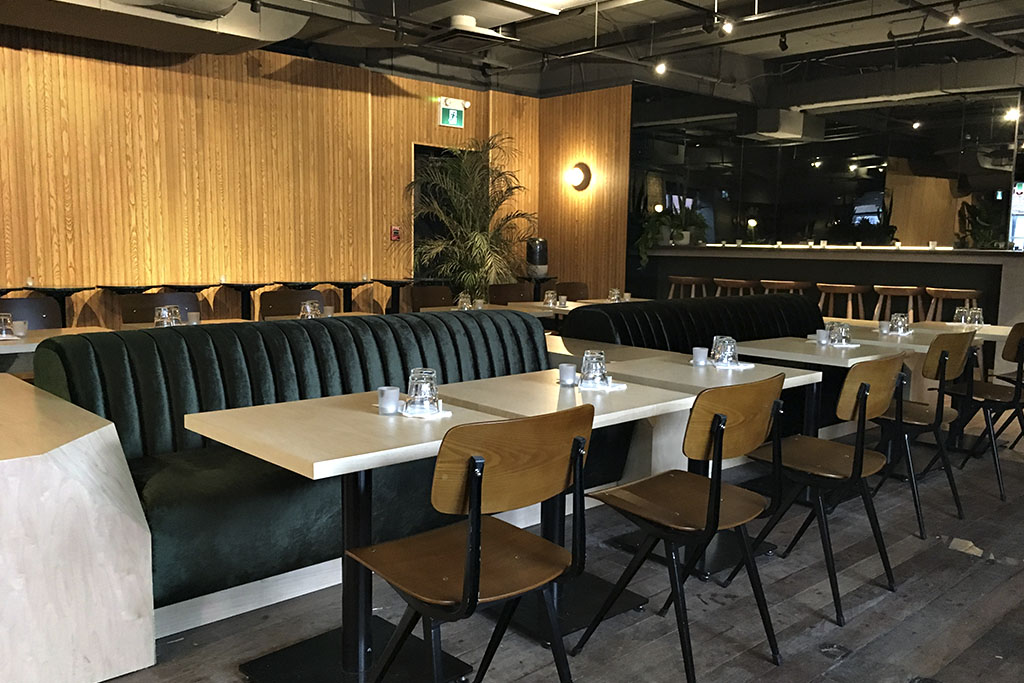
After narrowing down his favourite foods, Speis decided that tacos and pizza were the perfect fit for the fine/casual middle point. They then hunted down the best versions of each throughout Toronto. Now, they’re serving up tacos from Seven Lives, and pizzas from Big Trouble Pizza. Patrons will order at the counter before moving into the rest of the lush, well-appointed space that also has a wine and cocktail bar, and an assortment of local brews, including the beloved Bellwoods Jelly King ($5/$10).
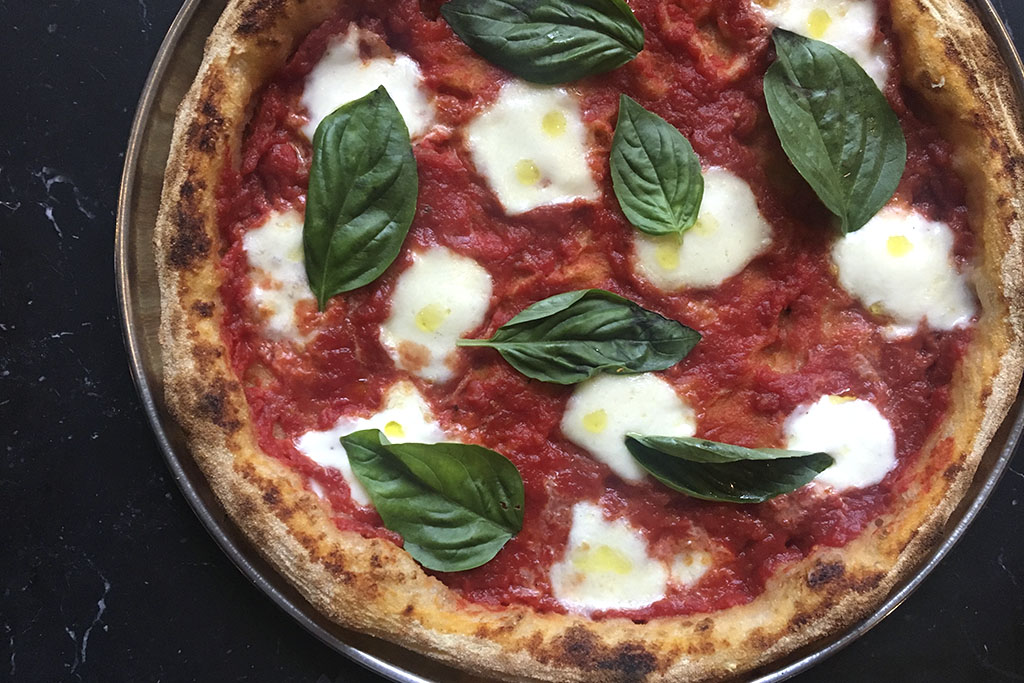
The Annex Margherita pizza ($18)
“A lot of hotels will outsource a restaurateur to run their ground floor, but everything you see here is Annex-designed, and Annex-led,” Speis explains. “Having said that, I could never put together a team like Big Trouble or Seven Lives, so what we’ve done is bring the best in class into our theme and let them focus on what they already do so well.”
The Annex Margherita pizza ($18) is exclusive to The Commons, and pairs with the Solco Lambrusco ($11), a sparkling red wine that has traditionally been considered one of Italy’s favourite accompaniments to this classic.
The Grape Gatsby pizza ($17)
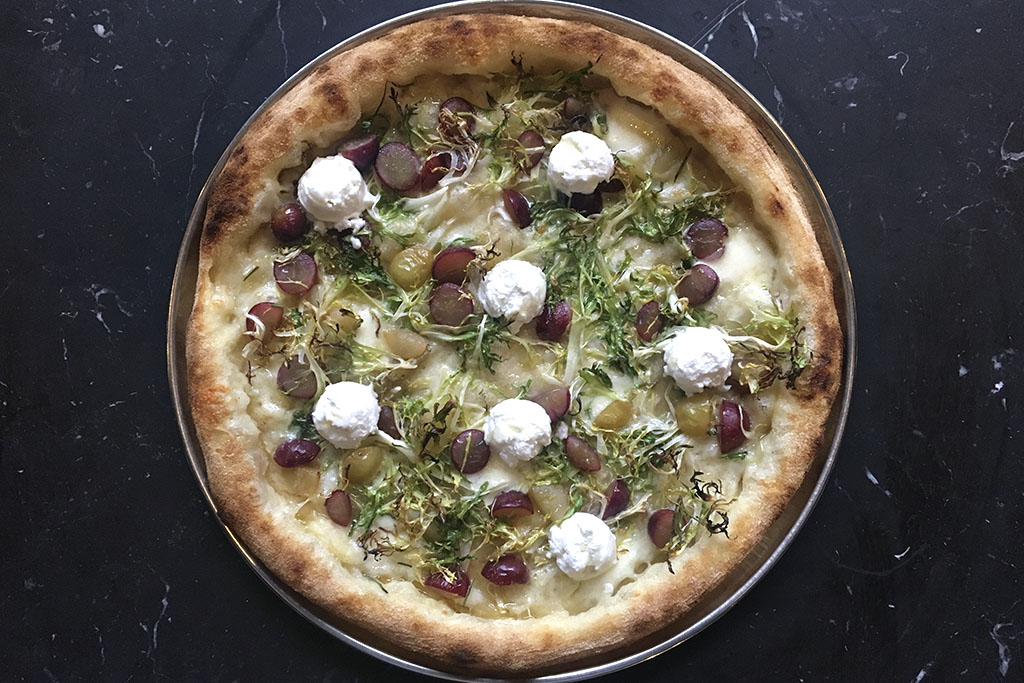
The Grape Gatsby pizza ($17) combines pickled grapes with fior di latte, frisée lettuce, goat cheese, rosemary, and honey. This unconventional mix rests on Big Trouble’s light and flavourful dough for a taste that is hard to find anywhere else.
The Kung-funghi pizza ($18)
The Kung-funghi pizza ($18) smothers portobello and enoki mushrooms with mozzarella cheese, which is then coated in a generous helping of sweet onions, chives, truffle oil, and tangy chili jelly.
The Spicy Pepperoni pizza ($18) is an artisanal twist on the classic — tomato sauce and mozzarella provide the base for a hot cacciatore that packs an impressive punch.
The Pacifica tostada ($12)
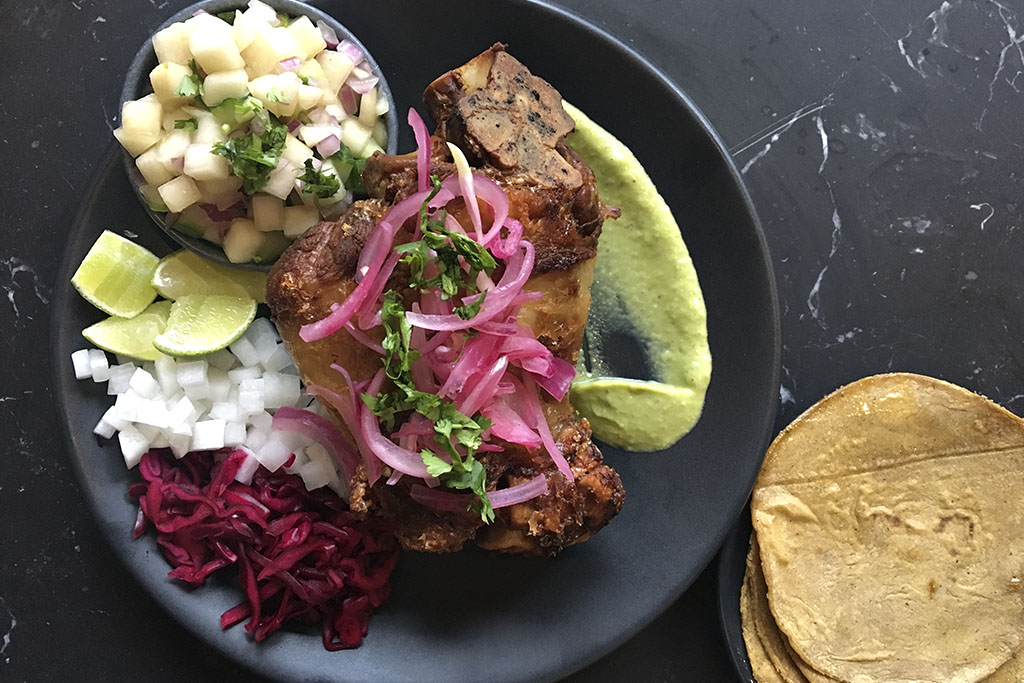
All of the most popular tacos from Seven Lives are on the menu, including the classic Gobernador ($6), the mushroom ($6), as well as the Pacifica tostada ($12), which is loaded up with a generous helping of torched raw salmon with sesame, arbol oil, avocado slices and a nest of fried leeks. The show-stopper, though, is the Chamorro platter ($24) that serves two to three people. A gorgeous cut of pork is served with seasonal salsas and corn tortillas, and the meat will fall off the bone as each member of your party dives in to create their own taco.
The Commons has struck the same exciting balance between practiced and grassroots that visitors love about the affiliated hotel, but this time, with all things delicious. They also have a dedicated interest in showcasing and serving their roots, even as they cater to tourists through the hotel. The photos that cover the walls of The Commons were taken by a team of local photographers who shot within a several-block radius, and even the illustrations and logos on uniforms and candles were hand-drawn by local tattoo artist Curt Montgomery.
“Our name, Annex, was obviously very deliberate,” says Speis. “We wanted to put our best foot forward in terms of collaborating with local establishments, and to understand our wider market while appreciating our area; what better way to do that than to literally just name yourself after the neighbourhood you opened up in?”
Although the phrase “eating your feelings” conjures rom-com images of jilted lovers crying into tubs of Ben & Jerry’s, for television personality John Catucci, it evokes a much more enduring concept of food’s relationship to our emotions, communities and personal identities.
Catucci’s childhood home is five blocks away from us as we sit at his favourite Toronto spot for cosy Italian, Marcello’s Pizzeria. He grew up surrounded by family members with impressive culinary prowess.
“My dad was a tailor by trade, but in another life, I’m sure he could have been a chef,” says Catucci. “He’d make these huge feasts, and us kids would go into the kitchen and steal fried artichokes and shrimp. Every Sunday, he’d start a beautiful slow-cooked ragu in the morning, and he’d sneak an early bowl upstairs just for me.”
Today, Catucci is well known for his five-season run as host for the popular Food Network show You Gotta Eat Here! His background as a comedian and improviser for the Second City touring company helped him take a passionate and fun-loving approach to hunting down Canada’s most comforting foods.
Catucci’s next big project for the Food Network, The Big Food Bucket List, which debuts in May, will draw on these same skills while taking Catucci and his team all over North America to cover a wider array of cuisines while telling the stories of the towns, chefs and communities behind the food.
He has a soft spot for family histories that weave their way through a city’s foodscapes. From childhood hangs at his uncle’s busy restaurant on St. Clair to splitting giant after-school baguettes from Tre Mari bakery with his cousins, being able to come back to his hometown still delights.
“We got to visit Patois, which is a Chinese Jamaican spot on Dundas,” he says. “Seeing these recipes coming from generations of Chinese immigrants coming to Jamaica and then how the food, people and stories then make their way here, I mean, how beautifully Canadian is that?”
Catucci’s impact on some of the most beloved Toronto restaurants is still palpable, years after episodes have aired.
“You Gotta Eat Here! showcased Lahori halal cuisine in a way that allowed people to really see the food and culture of Pakistan instead of just the negative stereotypes,” says owner of Lahore Tikka House, Gulshan Alibhai.
The colourful 23-year-old Pakistani restaurant in the Gerrard India Bazaar appeared on the fourth season of You Gotta Eat Here!. In this episode, Alibhai took Catucci through the recipes for butter chicken, lamb kebab rice dish and ended the segment with Pakistani kulfi with Kasmhiri tea, all the while gently ribbing Catucci on his spice intolerance.
Without a formal background in cookery, he doesn’t seem like a conventional Food Network star. But it was his affinity for unearthing the stories behind the dishes that won him the role.
“When they were looking for a host for [You Gotta Eat Here!] …” explains Catucci, “they wanted somebody who could bring stories out of people and who could have fun and connect with the emotion behind the food.”
He recounts an incident over a modest hoagie in a Calgary restaurant that really brought his emotions to the table.
“I had to stop filming because a wave of emotions hit me when I bit into this meatball sub,” he says. “It was wild. It was just like my dad’s, and he had passed away five years ago at that point. The chef had also lost his father, and he thanked me afterwards for opening up about the impact his food had on me.”
His travels so far seem to be bringing him full circle to the genre that marked the start of his career in food.
“Comfort food is just what connects everybody,” says Catucci.
“Whatever culture you’re from, whatever style of food you like to eat, there’s that one dish that reminds you of being a kid —reminds you of love. You can feel it. So in the end, we’re always eating our feelings. Doesn’t it always come back to that?”
Forget Comic Con, because Anime North is heading into Toronto this month, and it’s a big deal. Anime is a style of Japanese film and television animation, and this is Canada’s biggest anime event. It all goes down May 24 to 26 at the Toronto Congress Centre. Whether you’re a fan of anime or not, the entertainment will be sure to amaze.
Illuminair Entertainment will be on hand with its cosplay circus show — think Cirque du Soleil meets anime. Cosplay is the practice of dressing up as a character from a movie, book or video game. Illuminair combines cosplay with contemporary circus, and is choreographed by and for fans of anime. The group’s shows are based on series such as Pokémon, Sailor Moon, The Legend of Korra and Overwatch.
Wedding season is upon us, and with that in mind, we take a look at two party venues in Toronto to assist couples in their quest to find the ultimate location for their special day. Without further ado, here are a few that are sure to turn some heads.
Toronto’s premiere 20,000 square foot loft-inspired event space incorporates magnificent 30 ft. high ceilings, multi-functional space, an elegant cocktail area, full kitchen facilities and one-of-a-kind surroundings. The open concept allows clients to truly customize the look and feel of the space, giving each event its own personal touch.
FEATURED EVENT: With every rustically elegant detail captured, this was one wedding you didn’t want to miss! The couple’s jaw-dropping reception was a beautiful blend of both modern glam and traditional elegance. With a sleek neutral palette and sophisticated linens along with tons of candlelight, a mesmerizing chandelier, and fantastic florals the night was truly picture-perfect. 2-35 Carl Hall Rd. | 416-496-2112
Reception seating with dance floor can accommodate up to 500The venue can accommodate more than 1000 cocktail style
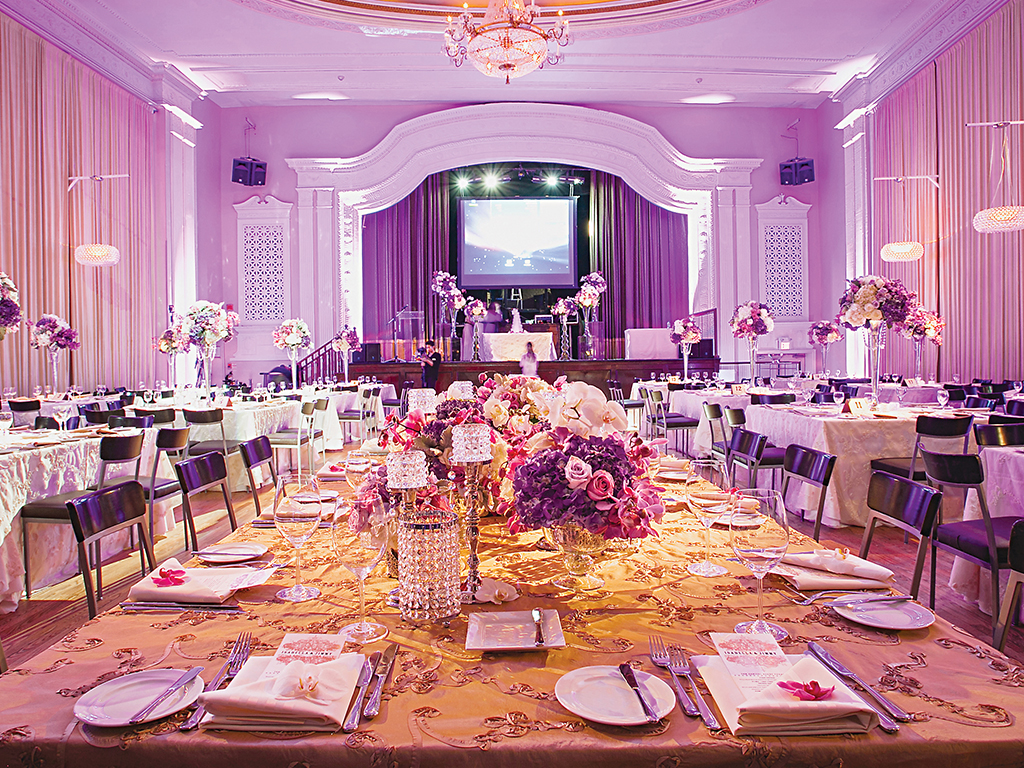
Toronto’s premiere 10,000 square foot theatre including mezzanine has been restored to its former glory and re-opened as a special event venue called THE MET. Multi-functional space, high ceilings, full kitchen facilities, elegant cocktail lounge and ornate interior detailing with several modern updates have been added for guests to enjoy this special event venue. Let your imagination soar, they have the facilities and expertise to stage truly big productions.
The met offers a complete scope of services including gourmet catering, in-house production, state-of-the-art audio and visual services, stylish décor and the ultimate in guest experiences. From the planning process to your event day their staff of experienced professionals will walk you through every detail to ensure flawless event execution. A perfect backdrop fit to host any social, private or corporate event. 2492 Yonge St. | 416-633-0888
Reception seating can accommodate 225 with a dance floorThe theatre be set up for a ceremony and/or receptionA cocktail style event can accommodate up to 500
My first real job was cooking at Three Small Rooms, then the acknowledged best resto in Toronto. I thought it was pretty cool, as jobs went: Until I went to visit my grandmother, whose first words were: “We sent you to Wellesley for this?”
People who grew up in Forest Hill (or anywhere else fancy) did not work in restaurants then. Immigrants worked in restaurants. Not the offspring of the well off. That has changed since I was young, but with the change has come another shift: Chefs don’t necessarily stay in the kitchen any more.
It’s become commonplace for a chef to open a smallish restaurant, make his name (yes, his, because it’s mostly the male chefs who do this) and then open another restaurant … and then another … and another. And then the chef isn’t a chef any more. He’s a business manager who’s teaching (he hopes) others to enact his vision. On a good day it works.
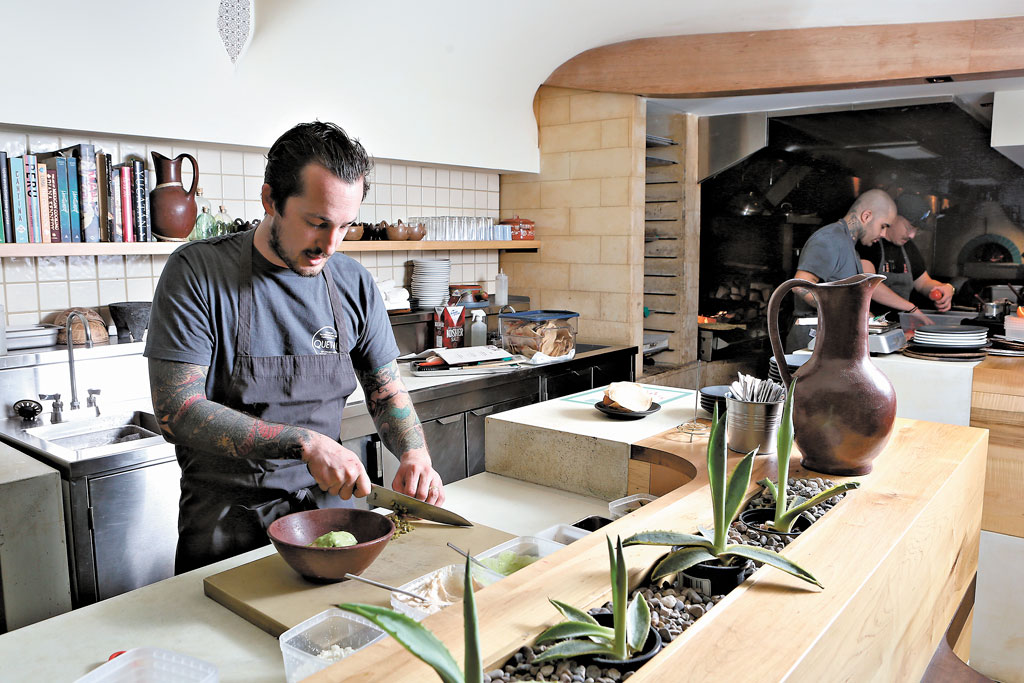
On a bad day it’s January 2019 and you’re Grant van Gameren. You already have eight restos. You sunk a reported $1.5 million into a beautiful reno and opened Quetzal in August 2018, in partnership with chefs Julio Guajardo and Kate Chomyshyn. Less than six months later it went sour.
So sour that on January 17, 2019, the Toronto Star published this: “We ended our roles as chefs/operators of Quetzal because we think the terms of our agreement were never met. We felt overworked, underpaid, undervalued and disrespected,” wrote Julio Guajardo and his wife, Kate Chomyshyn, referring to van Gameren.
Quetzal, which was then the hottest resto in town, closed.
Then Grant, likely upset about that $1.5 mil out of pocket, went back into the kitchen and reopened Quetzal on March 5.
van Gameren’s octopus
You might want to go there in a hurry before he again exits the kitchen. Because Quetzal rocks.
I just came back from a week of serious gluttony in Puerto Vallarta, including a Oaxacan cooking school day, and nothing I ate there compares to Grant’s addictive Mexican moves.
His ceviches are works of art. My fave is the delicate kanpachi tiradito. This is a superbly fresh raw white fish, its skin charred fast and crunchy (on the eight-metre-long open wood grill), sitting in a fabulous citric/spicy liquid of white soy, tomatillo juice, lime and arbol chili oil.
His masas are painstaking artisanal corn breads that redefine the genre.
When Grant makes an empanada, it’s a thin crispy blue corn wrapper holding wood-smoked chicken with super-delicate mole of almonds, guajillo pepper and a hint of chocolate. Spoon the salsa verde with tomatillo, serrano peppers and cucumber juice for sweet! Of course Grant does octopus, charred tender, with sauce of peanuts and wood-charred pasilla, ancho and guajillo chilies.
But his masterwork is the house-made chorizo. To score a half order, they make you choose red or green. Go green. It’s the tenderest, most delicate chorizo I’ve ever had, jazzed with coriander and chilies, served with two very fine salsas (red and green).
Raw vegetables at Quetzal
That’s the best Mexican dinner — by far — in this town today.
You don’t need anything else. Skip the (slightly tough) skirt steak. Don’t order the avocado leaf ice cream with caramelized crickets and guava foam. Less interesting than it sounds.
But hurry over to Quetzal. Because nobody expects Grant to stay in the kitchen forever.
Hot off the release of his new album, Both Sides, Marc Jordan will be performing across Ontario this May. Jordan is married to fellow singer-songwriter Amy Sky and they share a home in Rosedale. Here, the pair dish the details on how they met and fell in love.
How they met
Marc: John Capek, my writing partner in L.A., was having a barbecue for all his Canadian friends. Amy was working with John, and we met and talked the whole afternoon.
Amy: I was a fan of Marc’s music but never met him till that party at John’s. He walked into the backyard looking super cool in a pair of skinny black jeans, a white pirate shirt, yellow moccasins and Ray-Bans. My heart skipped a beat when I saw him, and then as we chatted I found out he was really funny and smart.
The first date
Marc: Amy wanted to go to a hippie health food place way up in Topanga Canyon called the Inn of the Seventh Ray. I had thought it was going to be weird, but it was actually a very beautiful place in the mountains.
Amy: I had seen this place in Topanga, and it was so L.A. — surrounded by trees and with twinkly lights. Nothing like it in Toronto. Marc picked me up in his ’68 Oldsmobile, and we drove out with the top down through the canyon in the twilight. The wind wrecked my hair as I recall, but it was very romantic.
Marc: They put us at the edge of the patio and there were some coyotes that had come in from the hills, and they were kind of looking at us. I wasn’t sure whether we were going to eat or get eaten.
Amy: We never had any trouble finding things to talk about, and I had a hard time chewing because I was laughing so much. Marc has such a unique take on life and a surreal sense of humour. I thought to myself that this is one person who I will never be bored with.
The courtship
Amy: Marc was working hard in the studio on his album Talking Through Pictures, so I would invite him to come by on his dinner break. He would come, eat and go back to work. One day, while he was eating these delicious twice-baked potatoes, he looked at me and said, “I like this.” I said, “Oh, you like the potatoes?” And he said, “No, I like you cooking for me.” And I suspected I would be baking his potatoes for a long time to come.
The wedding
Marc: We got married at Holy Blossom Temple and had a big family party at Amy’s parents’ house in Forest Hill. It was beautiful, and I cried all through my speech. We spent our honeymoon in London and Paris.
Amy: We got married on New Year’s Eve. We walked down the aisle to one of our duets. We were on an artist’s budget on our honeymoon, so we ate baguette sandwiches for lunch and then had a nice dinner. We both came back a few pounds lighter.
The kids
Marc: Our daughter Zoe Sky Jordan is 28, and she and her husband Liam Russell are singer-songwriters who live and work in Nashville, Tenn. Our son Ezra Jordan is 25, based in Toronto and is also a singer-songwriter who was a finalist on CTV’s The Launch.
Balancing careers and marriage
Amy: We are lucky in that we both have the same time demands — long hours spent on the music and often have to travel away from each other. That has always been part of our lifestyle. At the same time, we both get to work and create at home, so we stay in each other’s orbit and are available to listen to and weight in on each other’s work if asked. I like to make Marc’s favourite homemade meals for dinner whenever possible.
Life after retirement
Amy: Retirement means getting to keep doing music. We are excited about our musical, Fly High, that we have been developing with co-writer Steve Mckinnon and Junkyard Dog (the producers who developed Come From Away). And also … we’re excited for grandkids!
Laissez Faire, a new venture from the team behind the popular King and Portland pub, Locals Only, has ambitions of offering a new standard of dining to the regular Financial District fare of super-casual happy hour pubs and bars, and tony white tablecloth dining rooms. Their approach: Meeting both of these evening stops in the middle.
“Toronto’s always been a two-stop town,” says co-founder Jonathan Condren. “You go here for dinner, and then you go here for drinks. Whereas, in Europe, or different countries, you’ll usually go somewhere for dinner and you’ll usually stay until late.”
The porcini truffle arancini ($13)
The porcini truffle arancini ($13) is made with risotto cooked in a mushroom sauced finished with truffle paste and bound around a cube of mozzarella in a simple tomato sauce
The space, which sits above Locals Only, was designed to fit that dinner-to-late crowd. Their large King Street-facing window invites sunlight into its airy and bucolic French-inspired dining room, while comfortably dispersed table tops are brought to bar-top height to facilitate eye contact between servers and patrons.
The menu also reflects this hybrid approach. Chef Zachary Barnes, whose resume boasts time at Michelin-starred restaurants such as Restaurant Gordon Ramsay in the U.K. and New York’s DANIEL, as well as Alo, has created a menu of French and Italian-inspired dishes, each finessed to be ultra-sharable and many of them well-suited to plant-based and vegetarian diners.
“What we wanted to do was almost give people the greatest hits, and to give people as much of a well-rounded menu as possible,” says Condren.
The cauliflower steak ($18)
The cauliflower steak ($18) is steamed with kombu, finished with paprika, chimichurri and fines herbes, on a romesco sauce made with roasted red pepper
The beetroot tartare ($14), for example, is a play on classic beef tartare, on a base of horseradish crème fraîche and roasted beets, its shape and flavour reinforced with beet purée on a bed of arugula salad served alongside fat tubes of bread crisps.
“We did it in our own way, and it has really been the highlight of our menu,” says Condren.
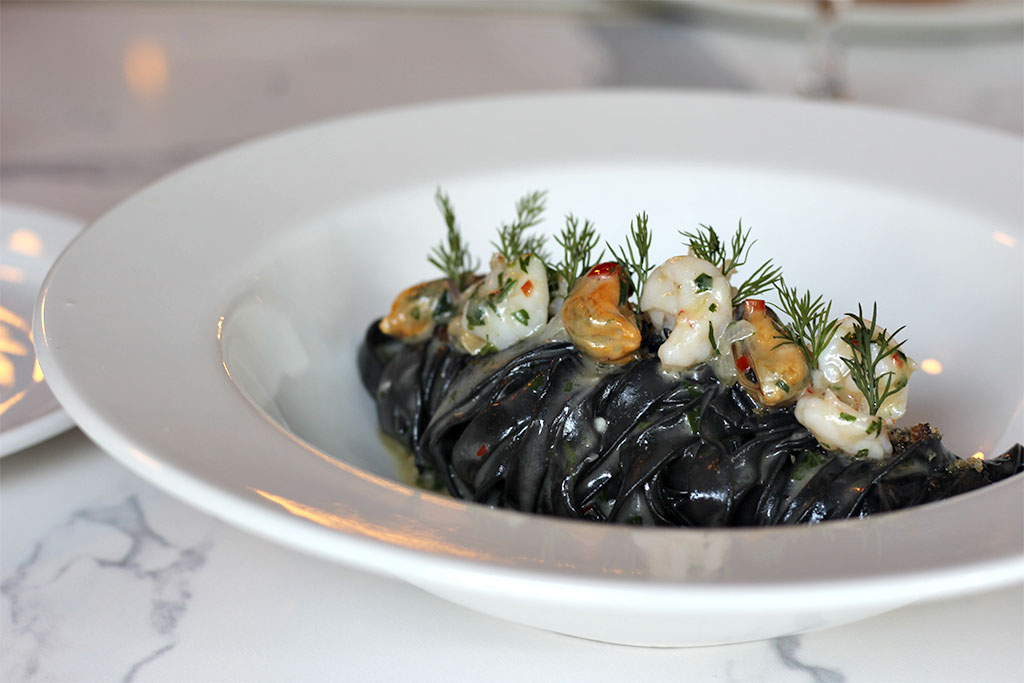
Another classic dish, tastefully executed is the squid ink tagliatelle ($21), a slick and buttery heap of obsidian black noodles that are made fresh every other day, cooked in garlic, clam juice and white wine, and studded with clams, mussels and shrimp. The result is a velvety and remarkable homey plate that you may just want to keep for yourself.
The squid ink tagliatelle ($21)
Of course, sips and small bites are encouraged, too. Their cocktail program, designed by bar manager Marko Mavra, comprises a list of barroom staples, like your classic espresso martinis and old fashioneds (each $13), as well as a tight list of refreshing house cocktails. The watermelon picanté ($14) in particular offers up a summery combination of fresh watermelon and tequila blanco, finished with a jalapeño edge.
The watermelon picanté ($14)
Rounding out the meal is the brioche panna cotta ($11), a dessert perfectly suited for spring: light and creamy, with slivers of plum and brioche crumble lending an earthy warmth, it is served alongside a light apricot sauce.
Brioche panna cotta ($11)
Another unique feature of Laissez Faire is the chef’s table in the back, where Chef will get to flex his fine dining chops three nights a week for an exclusive table of six people with an eight-course tasting menu.
But the rest of the time, Laissez Faire is true to its name: A laid back approach that encourages lingering and letting go.
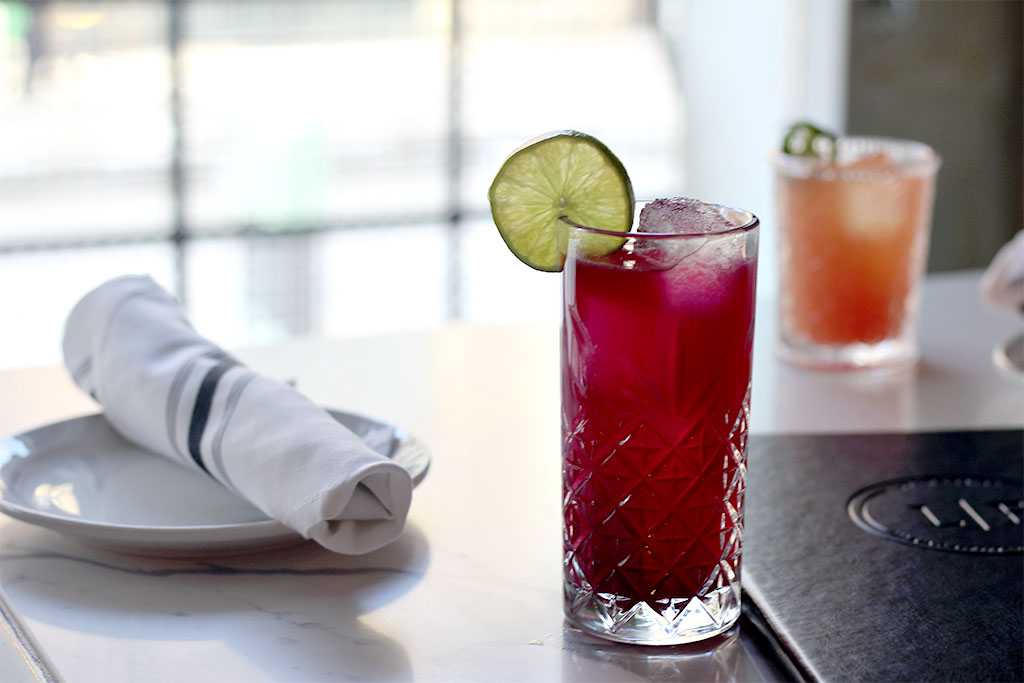
The beetroot mule ($14)
The beetroot mule ($14) punches up a traditional Moscow mule with a hit of beet and fresh ginger instead of ginger beer
The site of the former Electric Mud barbecue joint has been resurrected as Superfly (5 Brock Ave.), a snazzy new snack bar inspired by 1970s New York, led by alum of the Drake Hotel. Expect cocktails, sharing plates too pretty to eat, groovy tunes and an all-year-round patio to keep the party going into winter.
One of Yorkville’s fave all-day dining spots has gone east. The new Corktown Reyna on King (354 King St. E.) opened its doors on April 29.
Montreal deli chain Rock’n Deli (32 Clock Tower Rd.) has just opened its first Toronto location at Shops at Don Mills.
Three Monks and a Duck (811 Queen St. W.) isn’t a punchline, but a new micro-bar on Queen West that seats 20 people, with a 70 per cent plant-based menu by the team behind iHalo Krunch, last year’s well-instagrammed charcoal ice cream phenomenon.
The spread at Three Monks and a Duck
Get ready to slurp up a storm with Udon Kitanoya (513 Bloor St. W.), which draws from different regions of Japan to offer specialty elevated bowls of udon noodles. The grand opening is set for May 18, when it will be giving away 200 free bowls of noodz between noon and 2 p.m.
Animal Liberation Kitchen (717 1/2 Queen St. E.) has opened in the former Pulp Kitchen location in Riverside. Expect veganized comfort classics like mac and cheese, pulled jackfruit burgers, plus smoothies and green juices aplenty.
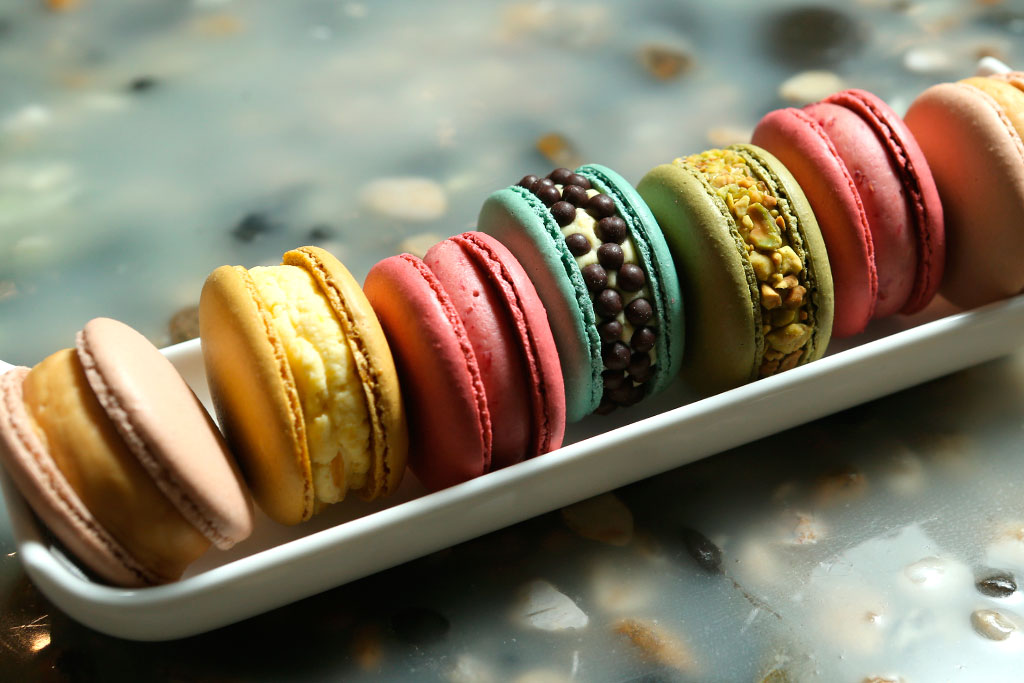
Thornhill now has a hot new hangout. Cafe Login (100 Steeles Ave. W.) is a huge new café space serving espresso drinks and cakes from Rahier Patisserie, as well as daily-changing macarons from Young’s Macarons (picture flavours like double cheese and red wine fig, which we’re already obsessed with).
Macarons from Cafe Login
Foodie finds
OneRestaurant (116 Yorkville Rd.) is getting a major glow up, with a two-part reno taking place over summer and fall, while the restaurant stays open. In the meantime, it has opened up its patio and added a new spring/summer menu to boot.
Richmond Hill’s Ruelo Patisserie (550 Hwy. 7 E.) just launched its new weekend brunch menu, which ranges from the classic (eggs benny) to the unexpected (beef bourguignon).
North of Brooklyn (511 Rogers Rd.) is taking its Neapolitan-style slices alfresco with a new pizza patio and beer garden, opening in late May. It’s clearing out the parking lot and in its place will be a lush, tree-lined 50-seat patio.
Inside North of Brooklyn
Coming soon
Spotted in Yorkville Village: boards announcing Hemant Bhagwani’s clean-eating lunch counter Good Karma and a new Zaza Espresso Bar.
The bad news: Lasa by La Mesa is no more. The good news? In its place will be its sister resto, Lamesa Filipino Kitchen (634 St. Clair Ave. W.), which will bring its more modern, elevated Filipino dishes to the nabe in early June.
As part of the large renovation of the Yonge Sheppard Centre, a new sign is up for FLOCK rotisserie + greens (4841 Yonge St.).
Cory Vitiello’s rapidly expanding health-conscious chain also plans to add a seventh location at Yonge and Eglinton.
Signs are up at the forthcoming new Summerhill Market location on the Eglinton Way and a second new location at Dupont and Bathurst, opening in late September.
Since Konjiki Ramen (5051 Yonge St.) opened its first international outpost in North York, the chain has gone on to win its first star in the Tokyo 2019 Michelin guide. It has announced that a new location will open on Elm Street.
Michelin-starred ramen at Konjiki Ramen
Sad to see you go
Fans of Craig Harding’s decade-old Italian eatery Campagnolo (832 Dundas St. W.) have one more month before the restaurant turns out its last plate on June 1. Fortunately, the spirit of Campagnolo lives on in Harding’s other restaurants, La Palma, Casa La Palma and Constantine.
At the end of last year, it was announced that Oakville Place would lose its Pusateri’s Fine Foods store after only a year and a half of operation. The location is now home to an L.L.Bean. All the five other stores will remain in operation, according to a Pusateri’s spokesperson.
After 10 years, Delica Kitchen officially closed its three sandwich and salad shops, including the flagship midtown shop at Yonge and St. Clair.
Toronto hasn’t traditionally been seen as much of a global high-end dining destination, but one little seven-seater restaurant is going to change all that.
Chef Masaki Saito has won international acclaim for his two-Michelin-starred Sushi Ginza Onodera in New York. Now, he has moved to Toronto to open a sushi restaurant specializing in his signature new Edomae-style sushi, inspired by the Edo-era (roughly the period from the mid 1600s to the 1800s) tradition of aging and preparation of fish before refrigeration and modern preservation.
Saito-san is a master in his field: He studied marine biology from the age of 13, worked his way up the chain as a sushi apprentice and then a chef, eventually leading the New York expansion of Sushi Ginza Onodera, earning two Michelin stars in as many years. This past January, he announced that he was leaving New York to join his friends Jackie Lin and Tsuyoshi Yoshinaga of Shoushin and Tachi in Toronto, making our humble city the new residence of a globally revered sushi master.
Sushi Masaki Saito, the restaurant, is an unassuming blink-and-you’ll-miss-it walk-up on Avenue Road where sidewalk turns into marble, leading to a minimalist cypress-paneled haven that seats seven comfortably across a chef’s counter (they offer two services a night). Diners are seated up front and centre, in full, enviably unobstructed view of Saito-san himself.
Saito-san is as deft a showman as he is a sushi chef, making quick and light banter with his apprentices and diners as he meticulously weighs out pea-sized morsels of freshly grated wasabi, or expertly slices paper-thin slivers of house-pickled ginger between his thumb and his forefinger, with hardly a glance at the large blade wedged between these digits.
His preparation is captivating to watch, and dizzying in its precision. He will lay out a full spread of bluefin tuna, uni, and horse mackerel, on a slab of hinoki, wiping the blade of his knife between carefully slicing each slab of fish so it gleams from the pot lights overhead. Rice has to be made fresh for each round, and eaten within seconds of serving to maintain its optimal temperature. He will hand you each piece, and watch you as you pop it in your mouth. It is all very intense. But it’s also transcendent.
Saito-san’s blue fin tunaBeautifully plated horse mackerel
With his pedigree, his eye for detail and years of training, there’s a lot to write home about over the five appetizers and 12 pieces of sushi: The creaminess of his Aori squid stamped with a dab of squid ink salt, the impossible softness of the scallop, the tangy funk of his house-fermented miso soup.
Aori squid marked with a blot of squid ink
But the purple sea urchin he serves is unlike any uni anywhere else, collapsing in a pool of buttery, creamy brine over subtly seasoned rice the moment it hits your mouth.
Sea urchin served on small bed of rice
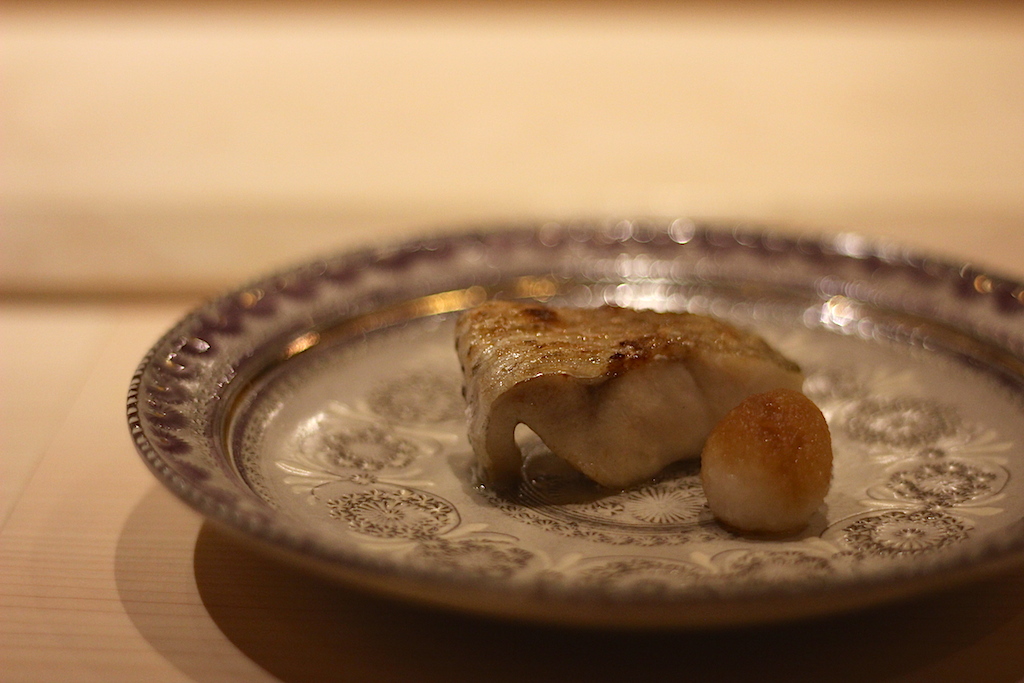
Another highlight on the menu is the black throat sea perch — it’s skewered, lightly seared over a majestic binchotan grill just behind him, carefully butterflied and served alongside a pallet-cleansing mound of grated radish lightly doused in soy sauce, resulting in a sublimely soft succulence.
Black throat sea perch paired with grated radish
Capping off this seafaring procession is a matcha blancmange — creamier than a panna cotta, lighter than a crème brûlée, with a roasted sweetness coming off the layer of emerald-coloured matcha syrup on top of this simple and delectable close-out.
Reservations for Sushi Masaki Saito are now open for July and beyond. Email [email protected] with a name, phone number, date and party size. And get in soon — you won’t want to miss out on this ticket.
$380 (gratuity included) – 3 appetizers, 12 pieces of sushi, miso soup and dessert
$500 (gratuity included) – 5 appetizers, 15 pieces of sushi, miso soup and dessert
With spring in full swing, local farmers markets are set to open in neighbourhoods across the city this month. Torontonians’ trips to the grocery store will be swapped out for weekend mornings picking up fresh produce at their local market and chatting with Ontario farmers. But what if the produce at the market is no different than what’s at the grocery store? And what if that “local farmer” isn’t a farmer at all?
After a CBC Marketplace exposé, consumers were surprised to learn that some of the produce coming to their local market hailed not from the idyllic fields of a nearby farm, but from the Ontario Food Terminal, where grocery stores buy their wholesale produce.
Some have called for strict legislation to ensure only farmers be allowed to participate in farmers markets, whereas others insist the issue is vastly more complicated.
“Each market is responsible at the end of the day for both vetting vendors, deciding on their own requirements for vendors and, most importantly, communicating this to their audience,” says Cameron Dale, the markets manager at Evergreen Brick Works.
Evergreen has a producer-first market, meaning vendors can carry up to 15 per cent of products they didn’t grow themselves, but even those products must come from a neighbouring farmer that they can trace. All products must be clearly labelled at the stall so consumers have complete transparency as to what they are buying and eating.
Public Health Ontario has a set of rules for farmers markets regarding food premises regulation.
“For Public Health, to have afarmers market designation, you must have 50 per cent plus one farmers who produce their own product,” says Carolyn Wong, co-founder and manager of the Trinity Bellwoods Farmers’ Market.
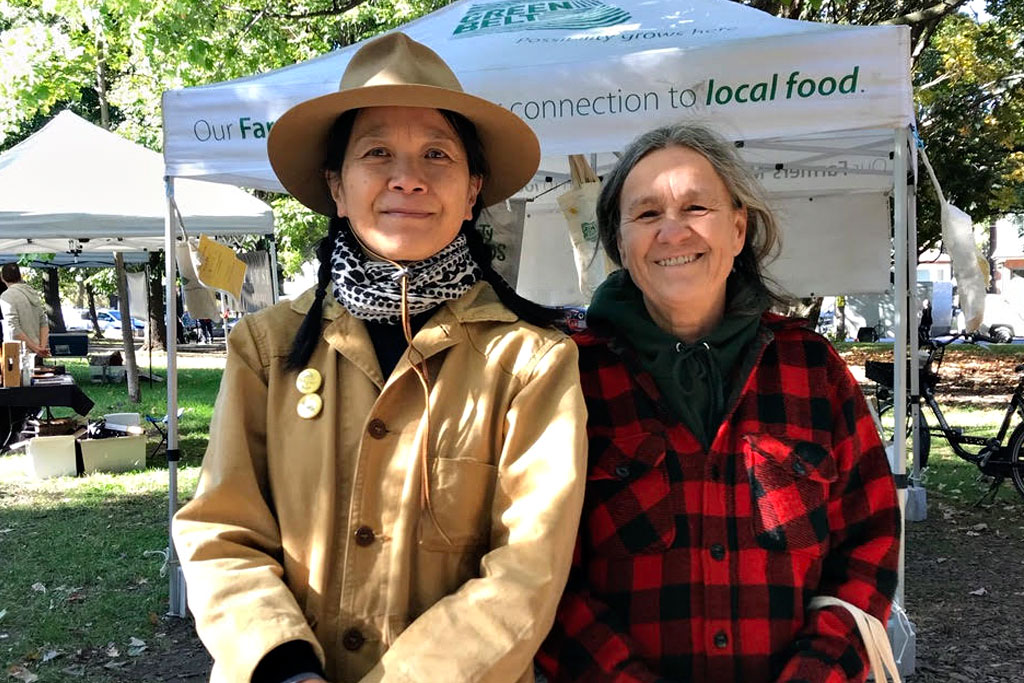
Carolyn Wong with Gay Couillard, a volunteer from the Trinity Bellwoods market
However, there aren’t any other top-down requirements for market participation.
“There’s no government regulation that enforces farmer transparency in a farmers market,” explains Catherine Clark, executive director of Farmers’ Markets Ontario (FMO).
“Frankly, I think [government regulation] would be maybe impossible or at least take a very long time to implement. California is the only state that certifies their vendors and pays for public inspectors to verify them. We don’t have that infrastructure, and so many markets exist because of the work of volunteers.”
The debate surrounding who gets to participate has some markets experimenting with certifications. One such program is the trio of GTA MyMarkets, which sell only MyPick verified produce. These markets take place in East Lynn Park, Liberty Village, Bloor Street and Borden Street in the Annex.
“We have about 250 vendors in the MyPick verification program in Ontario,” explains Clark. “[FMO] founded and developed the MyMarket and MyPick verification programs to help with transparency.”
The certification process is useful for all parties — vendors, consumers and market organizers.
“We support vendors who have certification and always encourage vendors to seek certification when possible,” says Dale. “Building on this practice last year, we supported vendors in visiting other vendors to verify that what is on their table is growing in their fields. This community-building approach to food transparency provided … valuable opportunities for farmers to network and learn from each other.”
Although Clark has found that the farmers they work with appreciate an infrastructure of authentication, she notes that FMO isn’t trying to homogenize the variety of vendors that are allowed to sell at farmers markets.
“There’s a place for resellers at a market,” says Clark. “It rounds off selection for consumers, can extend the time a market can run, and there are even farmers who supplement what they grow, and there’s nothing wrong with that. But it’s how a market manages and identifies that variety that matters.”
Wong is unsure of whether certification procedures are going to be the ultimate solution to the issue of disingenuous vendors and thinks that perhaps the solution may be more grassroots.
“Ultimately, you have to trust your market, your farmers and vendors,” says Wong. “It’s about cultivating personal relationships.”
The Bellwoods market includes some farm visits that tend to occur one year after the vendor is accepted, but not all markets have the resources or volunteer power for that level of verification.
“The last 13 years has seen a surge in farmers markets,” says Wong. “But before, farmers markets were something almost fair-like. Historically, that included resellers, who’ve possibly been doing what they do for 30 years now.”
Wong touches on a crucial distinction in the debate about “fake farmers” that many organizers and farmers believe must nuance the “who belongs at markets” argument.
It’s a debate that needs to be more clear-cut than conflating reseller with “fake farmer.” A fake farmer could undercut farmers’ ability to get a fair price on their homegrown produce as well as mislead the customer into paying higher prices for produce available at their neighbourhood Longo’s, but a reseller is not as problematic to many long-standing local farmers.
The Chesney family of Thames River Melons who participate in the MyMarket farmers markets
“I’ve been a vendor at the North York farmers market since it started 26 years ago,” says vegetable and herb farmer Ron Thiessen of Thiessen Farms. “One of the other vendors who has been there since day one is a reseller, and he’s our only one. I think it’s extremely important that the market is open and honest about who’s there, and I do think it should mostly be farmers, but this guy can get stuff the rest of us aren’t growing, and it rounds out our market’s selection for the customers.”
So what about consumers who visit farmers markets specifically for the opportunity to buy fresh, locally grown produce from the person they’re handing their cash over to?
“Step one is talking to your vendor,” says Clark. “Ask about their farm. See if you can visit. Ask for a business card or take a look at the boxes behind their table. I know that some vendors know the tricks on how to seem like they’re real farmers, but it’s a starting point.”