Inspired by the 1920s prohibition era, speakeasy-style “secret” bars have been gaining popularity in Toronto’s nightlife scene for years. Whether fronted by a completely different kind of business like a barber shop or just reminiscent of the romantic, dimly lit bars of the flapper’s decade, speakeasy bars have all the appeal of an anonymous secret hideaway from the rest of the world.
Although the beginning of 2020 was meant to be a glowing resurgence of the roaring twenties, instead the world was hit with a global pandemic of epic proportions. Unfortunately, speakeasy style bars weren’t shielded from the blow, despite all the cloak and dagger ambiance they had worked so hard to create.
Gift Shop, one of Toronto’s most beloved speakeasies hidden behind a barber shop on Ossington Avenue, has closed with no immediate plans to reopen. Others have been operating at a reduced capacity or making use of Toronto’s CaféTO Program, which was introduced this year in an effort to support restaurants with expanded patio space in light of social distancing regulations.
Here are some of the secret bars that have been getting creative to make the best of the situation:
Located behind an art gallery on Dundas Street West, Cry Baby Gallery is one secret bar in Toronto that has made lemonade out of lemons this year, despite a dramatically reduced capacity. Co-owner Rob Granicolo said some of the changes they’ve made in light of the pandemic include the hosting of socially distanced paint nights and art exhibitions, the installation of plexiglass shields at the bar made out of vintage picture frames, and coming up this fall, the unveiling of their harvest patio outside complete with heat lamps and warm cocktails.
“We’re converting our patio into a harvest patio, so it’s basically going to look like a pumpkin spice latte commercial. We’ll have a bunch of warm cocktails, so Mexican hot chocolate, our take on a hot toddy, Irish coffee, and we’re probably going to rotate between mulled wine and hot apple cider,” he says. “We’re going to push that as late as we can. We’re in this landscape now where I’m not afraid to tell people to bring a blanket, bring a toque. Christmas markets go until Christmas day so I don’t see why this can’t work.”
For Prohibition Social House in the east end, the pandemic didn’t stop them from doing a full rebrand, renovation and re-opening in late August. Operations Manager Afron Miftari said that although it’s a “bit of a different ball game” in the business these days, they’re making it work through various measures on a rolling basis.
“We’ve spread out all the tables, we’re constantly keeping the garage doors open, which we’re very fortunate to have because they make people feel really safe. This year we’ve been so fortunate with the CaféTO Program because we were able to get seven to eight tables out on the patio,” he says.
According to Miftari, the Riverside area where the bar is located is extremely tight knit and supportive, and they feel fortunate that the patrons are community minded.
“Everyone is just excited that we’re open and it’s been really great feedback and response, no one has given us any problems with the masks or contact tracing, guests have been very responsive,” he says.
One challenge Prohibition Social House is working through now? Securing heaters for the cooler weather.
“We’re going to keep the patio open until the ice falls off our chins, but heaters have been a nightmare to get a hold of,” Miftari says. “They usually cost $200 and now they’re going for $500 to $600, and they’re saying you have to order a minimum of 20 or you can only get one per week. That’s what I’m working on right now, but we’ll have some in time for sure.”
Prohibition Social House, 696 Queen St. E., 416-792-4499
Another secret bar located in the Dundas West area, Suite 114 has also been operating at a reduced capacity and complying with new rules and regulations surrounding sanitization, mask wearing and contract tracing with the use of an app for guest sign-in. The bar also built a patio from scratch to comply with Stage 2 regulations and have been using it as overflow space given the reduced capacity indoors.
“We’re in the hospitality industry and we’re used to cleaning anyway, so we’re just doing what we have to do to keep our doors open and our customers happy,” says Elijah Stevens, a bartender at Suite 114. “We sort of noticed there was a decline in clientele but considering the situation it’s not that bad. We still have a steady enough flow of clientele, which is a silver lining in all of this.”
Stevens says the bar is taking the situation day by day and waiting for any new guidelines from the premier to see if they will be able to keep operating on a Stage 3 basis.
“We’re just waiting to see what the new situation is going to be because according to Premier Doug Ford they may shut down the industry again but we basically pulled out all the stops so people felt safe and comfortable when coming for a drink,” he says. “If the weather holds we’ll keep our patio open as long as possible but if the weather turns and then we go back to Stage 2 we might have a bit of a problem. We’re just rolling with the punches.”
Near the top of the CN Tower — Canada’s tallest and arguably most iconic structure — 360 Restaurant offers guests a dining experience like few others. Everyone who knows there’s a restaurant perched in the tower’s main pod knows that it promises majestic views of Toronto, but there’s more to the CN Tower’s dining establishment than the dazzling skyline.
Here are seven things you didn’t know about 360:
1. The revolving restaurant is located 351 metres above ground, and it takes 72 minutes to complete one rotation, offering — you guessed it — a 360-degree view of Toronto and Lake Ontario.
2. 360 boasts the world’s highest wine cellar, which holds 9,000 bottles, featuring more than 500 wines from around the world. Looking to splurge? It doesn’t get much better than uncorking a bottle of 1975 Château Haut-Brion as dusk descends over the city.
3. For those looking for a more locally driven experience, 360 has a mandate to feature local, artisanal, limited-supply, and hard-to-find Ontario wines. For every dish they suggest a VQA Ontario wine pairing, like their P.E.I. mussels and Quebec escargot matched with Wismer Vineyard, 2017 Chardonnay from 2027 Cellars, located in Four Mile Creek.
4. The CN Tower actually has its own beer. In keeping with the craft beer focus at 360, the Tower Lager was created in partnership with Railway City Brewing from St. Thomas, Ont. Available on-site at 360 as well as VUE Bistros located on the main observation level, it’s a must-try for beer lovers.
5. Each season the team at 360 comes up with a list of signature cocktails made with a Canadian spirit and served in a glass with the skyline, which customers get to take home with them. This past summer patrons could sip on their Save the Bees cocktail, which was mixed with Elevation gin, Beattie’s potato vodka and Rosewood spiced mead.
6. Believe it or not, 360 is one of the most sustainability driven restaurants in Toronto. By being Feast On certified, Ocean Wise certified and LEAF certified, 360 is hoping to lead the industry by example, proving that restaurants — even the biggest among them — can make sustainable choices and be part of the solution.
7. Guests receive complimentary access to the LookOut and Glass Floor, following lunch or dinner with the purchase of a prix-fixe meal by each guest.
Make sure to check out 360’s fall menu by making a reservation — and remember to bring a face mask!
Those hoping to catch one last meal at Gusto 101 before the chilly autumn nights sweep Toronto’s patio scene will have to wait just a little while longer.
The cozy Italian eatery, popular for its tempting $1/oz. house wines and savoury, wood-fired pizzas with just the right amount of char, has closed its doors until further notice after an employee tested positive for COVID-19.
“While we have taken every step possible to ensure your second home here at 101 Portland St. is one where you feel safe to eat, even during the most uncertain of times, it’s on days like today where we are reminded that the world is a hard one for restaurants, the awesome hospitality workers that keep us going, and our wonderful guests that continue to support us when we need it most,” Gusto 101 wrote on Instagram, Sept. 28th.
The employee who tested positive for the virus worked their last shift on Sept. 26th, and is currently quarantining at home.
Though not mandatory, Gusto 101 made the decision to close up shop immediately as a precaution for remaining staff members, and says it will not reopen until it is safe to do so.
As an extra precaution, all Gusto 101 staff are currently in self-isolation, and will not be permitted to return to work until they present proof of a negative COVID-19 test.
The restaurant will also undergo professional sanitization to eradicate the possibility of any surface contamination. Contact tracing details have been shared with Toronto Public Health, and those deemed at-risk will be contacted.
After closing its doors on March 17th amid the pandemic, Gusto 101 opened its outdoor patio on June 26th, and reopened its indoor dining room on July 31st, both with limited seating to accommodate proper social distancing measures.
Prior to both reopenings, Gusto 101 kept a steady stream of customers by finding innovative ways to sell its products, like launching Gusto Marketplace, an online, one-stop-shop for grocery delivery, to those wary of long lines, or crowded grocery stores.
Back in June, the restaurant also announced a partnership with Feed the Frontlines. Made up of several dedicated restaurants and volunteers, Feed the Frontlines saw more than 15,000 meals delivered to healthcare workers, social services staff, and Torontonians facing food insecurity as a result of the COVID-19 pandemic.
As of now, all food items have been removed from the Marketplace, and customers will not be able to order takeout from popular app services until both the kitchen and establishment get a clean bill of health to reopen.
As COVID-19 cases continue to climb in the city, Toronto has seen several restaurants confirm cases amongst staff and guests in recent weeks, including four additional popular eateries in the King West neighbourhood, which Gusto 101 calls home.
Chubby’s Jamaican Kitchen, which is owned by the Gusto 54 Restaurant Group (the same company that owns Gusto 101), also made the decision to temporarily shut down on Sept. 21st after one of their employees tested positive for COVID-19.
Chubby’s reopened on Sept. 26th, just five days after closing, after receiving confirmation that all remaining team members tested negative for COVID-19, and had not been in close contact with the individual who had tested positive.
While there is no word yet on when Gusto 101 will be up and running again, the staff remains positive that Torontonians will be able to raise a glass of prosecco sooner rather than later.
“We are optimistic that this is an isolated case, as no other team members are experiencing symptoms and rigorous sanitation, social distancing, and mask-wearing procedures were followed,” Gusto 101 concluded.
In our first Post City Restaurant Roundtable in partnership with the Rotman School of Management, we sit down with 10 dining industry veterans from Toronto and New York to talk about how the pandemic has impacted restaurants, what’s trending with food lovers, and what the future of dining out might look like.
PANELLISTS
Chef Victor Barry: Piano Piano, Cafe Cancan Chef Hemant Bhagwani:Popa, GOA Indian Farm Kitchen, Amaya Restaurant, Egg Bird Chef Massimo Capra: Capra’s Kitchen Chef Amanda Cohen: Dirt Candy NYC Lisa Kramer: Professor of Finance at the University of Toronto Nicki Laborie:Bar Reyna, Reyna on King Chef David Lee:Planta Restaurants Chef Roger Mooking:Twist by Roger Mooking Chef Ivana Raca:Ufficio Chef Nuit Regular:Pai, Sabai Sabai, Kiin, By Nuit
POST: How has the pandemic changed the way we eat? What types of food are diners ordering right now?
HEMANT BHAGWANI: Everybody wants to sit at home and enjoy their alcohol. They don’t want to come out. People need comfort food, like Indian or Thai or pizza. That’s what’s selling.
NUIT REGULAR: People want comfort food right now because we are in such weird times and the pandemic is something that’s unpredictable. Comfort food is also something that’s not so expensive. A lot of people have to worry about their finances right now. We did a pop-up at Kiin, because it’s a fine dining restaurant, and there’s no way that we can open fine dining at this point. I just decided to do something fun with the pop-up. We do a sandwich, we do a burger. That’s something that we would never sell at Pai or any other restaurant of ours. It’s just some comfort food with a Thai tweak on it. With all the sad times, I just feel like bringing some colour,bringing some fun and bringing some joy to the industry. I’m also finding people like to cook more at home. Meal kits are something we’ve never done before, and we did it at Pai.
VICTOR BARRY: I think there’s a chemical reaction that happens in your brain with comfort food. A lot of comfort food has white carbohydrates that light up your brain like a Christmas tree, and it gives you pleasure and instant gratification. Comfort food also stems a lot from your childhood and the nostalgia of being safe. Right now, I think it’s truly all about bringing back the feeling of being safe. That’s why I believe people are gravitating toward more comfort foods these days.
IVANA RACA: People are definitely ordering a lot of pastas. They’re looking for comfort. Anything that’s going to make us feel like it’s going to be OK at the end.
Comfort food—such as the Detroit-style pizza at Gianna’s—is the big trend of 2020
POST: What trends are you noticing in how diners are spending?
MASSIMO CAPRA: My cheque average is very low. There are no groups of people coming in and spending time at the table, drinking an extra bottle of wine or sitting around having a little cheese while they finish their wine. They just finish the meal, cap the wine and take it home.
VICTOR: I would say our cheque average is up a little bit. I’ve tried to figure out a reason as to why it is. The only thing I can come up with is maybe they’re going out a little bit less, and since they’re going out a little bit less, maybe they’re OK to spend a little bit more money while they are out. The gratuity percentage has been up. People have been happily leaving north of 20 per cent for gratuities.
ROGER MOOKING: The generosity of our customers has been just incredible. Tips are up significantly. The few staff that we have are greatly appreciative of it because they’ve just been on hiatus for so long. In a time where people are really in need, they’re more generous than ever. That gives me hope for humanity.
We’ve been seeing a movement towards eliminating tipping. Do you think we’ll see more restaurants adopting this model?
IVANA: It’s such a weird time. I wouldn’t say yes, but I wouldn’t say no. When we started takeout, our clients were so generous with the tipping, leaving $40 or $60 on a bill, which is not a small amount of change.
VICTOR: I don’t think it’s very positive for the guest experience. As a chef and growing up in the industry, the abolishing of tips, it sounds great. But what happens on the back end is the most important part in that conversation. How is that money that’s now being included in the food — that $20 or $30 hamburger — how is that money being distributed equally between everybody?I don’t think it’s going be us or myself that’s the first person to do that. If someone like Danny Meyer — who is arguably one of the best restaurateurs in the world presently and one of the smartest men in the hospitality industry — he’s backed away from doing the abolishing of tips thing, that kind of says something to me right there.
ROGER: I think unless people globally do it or it’s mandated or legislated, it’s an unrealistic precedent because this is a market-driven industry. If my restaurant abolishes tips, and then the one across the street does not abolish tips, and we’re doing similar food at a similar price point, the customer will move to that other place, right? The market has to move simultaneously, or it just will not be able to stick. Or it has to be a cultural precedent. In many parts of the world, Japan, for example, they’re insulted if you tip. There’s no expectation to tip, and it’s frowned upon to tip. Without it being cultural or legislated, I don’t think that it will happen.
MASSIMO: Everybody wants to abolish tipping, but then they don’t want to assume the cost of having the tips abolished. Our waiters make good living because they make tips. Our cooks, finally, they’re starting to share tips. But there is a cost involved. I’m OK to take away the tips. Pay the waiters $30 an hour. Let’s make fair pay for everybody. I don’t know if we can. It’s a big issue. I don’t think we’re able, as a community, to actually absorb no tipping. I don’t think it’s going to work. I mean, we have an unnaturally low price of food per plate. The price of food is going up, and yet, the food cost in the restaurant is still the same. There is a cost involved in producing food. You want to pay the real price? Then there is a real price to be paid by everybody.
DAVID LEE: I came to Canada in 1994, and a caesar salad was around $12.95. A caesar salad today, in 2020, is still at $12.95, but the minimum wage was $5.75 when I first came to Canada.I remember when the minimum wage went up $0.50, and I’m thinking in my mind, “Oh my God, my food cost is going to go up. What shall I do?” But now, minimum wage in Canada, the way I look at it, is $16. It’s not $14, because no one works for that. I think it is a big issue. I agree with you, Victor, that Danny Meyers is an incredible restaurateur. I think that, because of the size of his organization, abolishing tips didn’t work. I do believe that it may work for a smaller organization if you have one restaurant. Maybe. But I think it’s very challenging, it’s very difficult, and it is cultural.
HEMANT: My inspiration for doing no tipping in Canada was Amanda. I ate in her restaurant, and I came back to Canada, and I started doing it. But I got nailed big time by CRA [Canada Revenue Agency]. I ended up paying so much to the government that I had to stop. I ended up fighting with the CRA to be able to leave me alone with it, but it wasn’t the case. When I started doing no tipping in the restaurant, I used to get phone calls. People were swearing at me on the phone. So I ended up leaving it. Unless this comes from the government, we won’t be able to make it work.
AMANDA COHEN: My answer back is: if you believe in the system, you all have a voice. Use your voice together. In the States, there are 11 million workers who work for independent restaurants. We have 500,000 restaurants that are small, independent restaurants. That’s a huge voice. We put so much money back into this economy, and the ripple effect is insane. I think that, as an industry, we need to start using that and doing the right thing. I stopped doing tipping because it’s a really sexist, dangerous, misogynistic, racist system, and it’s time it ends because everybody who does it is putting their staff at risk. No matter how good you think your customers are, no matter how good you think your staff is, you’re setting up a two-tiered system that is not worth it in the long run.
POST: How are you planning to transition to fall-winter service and do you think diners will be willing to sit on patios in the late fall?
VICTOR: Not November. There’s no chance. November’s pretty cold. People aren’t going to be wearing their Canada Goose jackets and sitting out and crushing slices of pizza because the food will get cold, and they’ll be uncomfortable. The patio heaters will only extend it a little bit.Sales are going to go down, and there’s nothing we can do about that. We just have to make sure that we’re running our business appropriately, in order to mitigate the loss of the patios.
NICKI LABORIE: Like Victor, I don’t think people will be sitting out there in November. We are getting patio heaters. Our inside is quite small, so my sales will go down. We’re planning different revenue streams to compensate for the loss. Plexiglas will be very important so that I can use as many seats as I can inside.
IVANA: Ufficio was built to be this cosy little place, and now that’s kind of backfiring because people aren’t looking for anything cosy right now. Thank God for the continuance of the takeout. We’ve noticed on Thursdays, Fridays and Saturdays we get a lot of takeout before service, which helps us a good amount. Having a patio, which we’ve never had before, has been great for us, but, again, in the winter, nobody is going to want to sit out there. Everybody wants to sit inside. But people won’t want to be in a tiny, little indoor space because they want to feel safe. I think that’s the biggest challenge for a space like ours that’s small.
HEMANT: We’re lucky that Indian food carries really well for takeout and delivery. Our sales are way up in takeout and delivery, but dine in has not been happening, even up in midtown. We’re very slow. Takeout and delivery is so huge that we’re almost doing similar numbers to what we were doing with dine in before the pandemic. The biggest struggle for us are the food courts. We’re down by 90 per cent, so that’s where the challenging part for us is.
NUIT: We’re lucky to have a bigger dining room, but the numbers are still not there. We’re putting more energy into our takeout now. Before this whole pandemic happened, we’d do about 35 per cent takeout, but now it’s almost 80 per cent of our revenue.
MASSIMO: I’m looking at putting up a tent to cover our patio and putting heaters in it to make it last as long as possible. There are people that will not come inside to eat. There are people that only want to sit on the patio. Victor is right: it’s very difficult because, whether there are a swarm of bees coming around or mosquitoes in the summer or if the food is cold because of the weather, they blame the restaurant for it. If you’re sending a pizza out, and it’s 15 degrees outside, it’s only going to stay warm for five minutes. When winter comes here, it’s very fierce. You’re not going to sit outside in November. You’re going to have to be in an enclosed space with a lot of heat. So we will do our best to make it happen.
AMANDA: New York is pretty unique. We’re the last city to get indoor dining, basically. Takeout has been OK. I have outdoor dining, but it’s basically on the side of a highway. We’ll maybe start at 25 per cent indoor capacity at the end of September. I’m at 25 per cent of my sales, and even if we move to indoor dining, it won’t probably go up that much more. You guys have more federal aid in Canada. There’s no landlord relief whatsoever [in New York], so with our rent, I’m in the exact same boat as every other restaurant in New York City, in New York state, everywhere. You’re going to see a mass closure of restaurants in the States in somewhere between the next two to four months.
Restaurants around the world are finding creative ways to support physically distanced dining. Mediamatic Eten in Amsterdam debuted a series of dining pods reminiscent of tiny greenhouses.
POST: What role will new technology play in the future of restaurants and how is it helping restaurants to provide physically-distanced service?
HEMANT:I feel that’s where we’re going to be moving. Having artificial intelligence now and CRMS [customer relationship management software] in your restaurants are going to be very important. I’ve actually ended up spending money on not just online ordering or website, but also how the people will order inside the restaurant. I’m probably two weeks away from finishing it up, the whole technology part, and we’re going to roll it out in all 29 restaurants and see how it goes. Then I want to open it up for all the restaurants in the city. What COVID has basically done, it’s accelerated where we were going to be in the next two years when it comes to technology. I think the restaurant industry is going to be a technology-based business now. That’s where we’re going.
ROGER: At Twist, we implemented paperless menus, upon reopening, and QR codes. So it’s scan a QR code for the menu, you order direct, boom, direct sales transaction. The whole thing is touchless, paperless, contactless. There’s minimal interaction with the servers for safety without sacrificing the integrity of the service. Our customers primarily are an older demographic because they’re mainly travelling for business. They tend to be educated and sophisticated. Although they may be hesitant because their sensibility is still wanting to be able to interact and touch and talk and all that, they’re also mindful that they’re in a challenging environment. The safety overrides their general proclivity to want to interact and talk and touch a menu and all that stuff.
DAVID: We did that same thing, too, with all of our restaurants. I do feel that the menu, there’s nothing better for me. This is me speaking personally, but there’s something about holding a menu and falling in love with a dish on that menu that you want to order. The technology is a very different experience. Maybe I’m a little old-fashioned.
MASSIMO: It’s a new world. I have a lot of regulars, and there’s nothing they love more than to actually bond with the maître d’, with the bartender, with the waiters, with the chef, with me. Then there are the younger generations that are coming in, and they barely look at you in the eyes. For them, you might as well be a computer. That’s what they’re used to. So the technology is going to be great for the younger generation, but the older people are still going to want to touch the menu. They want to talk to the maître d’. They want to know about the bottle of wine. They want to know about the food. They want to know the story behind why you are running that special. It’s very strange for people like me who have been in the industry for, like, 45 years. I’ve bonded with so many clients and so many people in the city. All of a sudden, there is no need for me to be there in some ways. It’s very difficult. It’s quite different. It’s very difficult for me to go to a table of younger people and try to talk to them, and they don’t have anything to say to me.
NICKI: This whole technology thing is great, but I do think that people bring people back to restaurants. I’ve noticed through our reopenings, at both locations, that whatever age people are, they want to talk to us. They want to touch base with the people. We get a lot of people that come back two to three times a week because both locations are in fairly residential areas. While I agree that we’re moving toward technology, and it’s great for a lot of reasons, people go to restaurants for an experience. They go to a restaurant to be entertained, to be fed, obviously, as well, but there’s so many elements of a restaurant, and people are such a huge element of it. So I hope we don’t see maître d’s and servers replaced. I really do. I hope that the pandemic doesn’t kill the need for the conviviality that you get when you go to a restaurant. That’s really important to why I’m in this business — because that’s what I love to do.
NUIT: One benefit I see is I won’t get a call in the middle of the night at 3:30 a.m. that someone broke into my restaurant and tried to steal cash, because it’s happened lately. As an industry, I feel like we need to reinforce the fine dining experience, the experience of coming out and enjoying and talking. The cashless thing, it’s something that can help us, but it doesn’t need to stop the bonding, the community. I feel like, if we use it in the right amount, we can find a balance of how to use those two things: technology and socializing.
POST: Has the pandemic permanently changed the way we dine? What do you think the restaurant industry is going to look like in the coming months?
ROGER: I think, if I could answer that question, I’d be a very wealthy human being. Nobody knows. Every day the dynamic is changing. We’re a society. We’re all connected, and the restaurant industry is a big part of that connection. Restaurant people are accustomed to working for very low wages for a very long time. We’re a very resilient bunch. We’re a surviving bunch. We know how to make things happen out of nothing. So I do know that the resiliency of the industry will pervade. What it looks like, I have no idea, but I do know people will have to eat. Whether they will be eating in restaurants, whether we’ll be doing more grab and go or meal kits or adapting with mini groceries and retail environments, as well as takeout, there’s a lot of different ways to skin this cat. I think what you may also see, that we’ve started to see in New York in the last decade, is chefs simply just leave the big cities. They went back to their hometown in North Carolina. They went back to their home town in Georgia or Seattle, where the rents are low. People appreciate these big splashy chefs from the city coming in to share their chops with their birth cities. The rents are one 10th of what it is in these major centres. The taxes are very favourable. One thing I speculate is we’re going to see an exodus of chefs out of major centres, moving to more suburban areas or even rural centres.
MASSIMO: It will be difficult to tell. We’re taking it day by day. We are learning as we go. We are trying to maintain a balance between the happiness of our clientele and the health of our business. We will do whatever it takes. I think our work is going to be cut out for us. We have the Christmas season rushing up on us already. Normally, by now, we would be booking parties and going crazy. But we don’t have anything happening. We will figure out a way to stay alive. Roger is right: We are resilient. We’ve done it for a long time. We’ve seen the worst many times over, even though this situation is unusual because this is worldwide. It’s going to be tough, but we will survive and we will prevail.
NICKI: The last four months, every day, I change my mind about something. You just don’t know what’s coming next. I think, for us, we really focused on budgeting and finding new revenue streams. I had a third space that I was opening for catering, and I turned that into a bazaar. Now we’re selling our dips to take home. We’re doing cocktails to-go. Now I want to try and find another cute thing for winter. It really is about staying creative because I have no idea what the next six months brings. I don’t think we’re going to go under lockdown again, but I think that the general public is not going to be going out. I think we all have to be prepared that people are going to get scared, and the government does a really good job and the media does a really good job at scaring people. My management meetings involve brainstorming and bringing good ideas to the table, and let’s see what else we can do to stay alive for the next six months. But I hope that the industry comes back, and I do believe it will. There are two types of customers right now. There are the ones that are very comfortable, that I constantly have to tell them to sit down and put their mask on. And then there’s the other customer that is petrified. You have to be able to adapt to the various customers that are out there and make everybody happy. I think, if you can do that, then your regulars will keep coming back. That’s what I’m focusing on.
NUIT: It’s very hard for me because all of my restaurants are downtown. People are not coming back downtown because many people are working from home. We used to have lineups, people coming out from their offices and trying to get some lunch, but there are not many people walking on the street downtown right now. Yet the fixed costs, the rent, etc., is still there. We have to try to survive here and to adapt a different model of the restaurant. It’s tough. My goal is just to stay relevant and stay alive, even though we’re not going to make the same money. We’re just trying to tread water and stay alive but also still continue to bring up our guest experience. I’m still going to be investing in the guest experience. One day we’ll get to the other side, when the vaccine is being made, and hopefully things will get better.
VICTOR: Having been through round one of COVID, let’s call it, I think that we’ve probably seen it already. We’ve been through lockdown. We know how to do that already. We have at least a little bit of experience, and we know how to react better than the first time. We just have to take what we’ve been through as a lesson and be prepared for what could potentially happen in the next six months. I think what it looks like for the next six months is kind of like Nicki said: multiple forms of revenue streams coming into your restaurant is going to be important to make sure you’re not relying on guests just coming in. There are two types of guests out there. There are people who are vulnerable and/or scared to be in public, and you’re not really going to see them. Then there are the other people, who are younger, healthy adults, that statistically are not vulnerable to any major complications with COVID, and I believe that those people will still continue to come out and still dine, as long as they’re allowed to. It’s gonna be an interesting couple of months to navigate through.
HEMANT: I think we all have survived because there was a lot of support from the government. If that doesn’t continue— paying the landlords and the wage subsidy — it’ll be very difficult for all of us to survive. It’s true that probably 60 per cent to 70 per cent of restaurants might not survive. But people who are good and have deep pockets, we probably will make it. If there is another lockdown, then it’s going to be very big trouble. I hope it doesn’t happen. But I think we all need to be really aware and fix our takeout menus and plan for it in the next couple of months. This is probably not getting better until mid next year, so it’ll be tough to survive until then. I hope we all can survive, and I wish everybody good luck. I hope we make it.
Plexiglas barriers, like Christophe Gernigon Studio’s PLEX’EAT, have become an essential item for many restaurateurs looking to safely maximize their indoor dining space during the pandemic.
POST: Do you see any positive impacts on the restaurant industry coming out of COVID?
DAVID: We’ve all had to make our businesses more efficiently and run better. There are some positive things that are coming out because of that, but it’s been tough. It’s been challenging.
AMANDA: There’s not a lot of silver linings. I will say that the restaurant industry in the States, by and large, has pretty much come together for the first time in its entire history, and it’s been pretty amazing. We have the Independent Restaurant Coalition, and we’ve been lobbying Congress. We’ve actually been able to do a lot of good. We’re not quite there, yet, but that’s been momentous for an industry that’s been pretty disparate historically. There’s also been a lot of momentum with smaller restaurants coming together, and for the first time talking to each other. That is the silver lining. That is hopefully something that will continue. We sort of realized that “Wow, there are 16 million people that work at restaurants in the States, and we have this huge, huge voice.”
HEMANT: I believe this is the first time all the restaurateurs and chefs have come together. We’re not just partnering but even collaborating and trying to help each other and trying to reach out to each other.
A day-trip to visit a local farm with a corn maze is a classic way to spend a fall afternoon, but the annual ritual may look a bit different this year due to COVID-19. Many GTA farms that offer apple and pumpkin picking also have mazes, but make sure to check the farm’s website before you go. This year, most maze spaces are limited and many farms require pre-booking by phone or online.
Coopers Farm in Ashworth offers a whopping 10 acres of corn mazes. Tickets are not sold on-site this year, so make sure to purchase them online before visiting the farm. Each ticket comes with a 2-hour time slot, and you must present a confirmation number at the door. Coopers has made its maze paths larger this year to account for physical distancing, and the farm recommends that kids and adults wear masks, although it’s not mandatory. Coopers also allows dogs to visit the maze on Dog Saturdays (just buy a “dog ticket” if you want to bring your pup). Tickets can be purchased through the farm’s website.
The corn maze at Downey’s Farm in Inglewood is open and ready to explore. The maze can be accessed by purchasing an admission ticket to the farm, which can be done online or on-site. Keep in mind that spaces are limited so you may want to book yours in advance. Ticket details can be found on Downey’s Farm website.
Saunders Farm in Munster is a great option for those looking to get into the Halloween spirit early, offering haunted hayrides and spooky wagon rides. The farm also has intense corn mazes, play structures and plenty of other fall-themed adventures. If you’re into night time ghost stories and campfires, you’ll want to check out the farm’s evening offerings, too. Due to COVID-19, tickets have to be purchased in advance online through the farm’s website and visiting times are limited to two hours.
Pingles Corn Maze in Hampton picks a theme each year for its famed corn maze, and this year it’s all about pirates. Pingles has created two mazes: a mini maze for little kids (ages 4-6) that takes 30 minutes to complete and a massive, more challenging maze for older children. To enjoy the mazes, you have to purchase a Harvest Festival ticket ahead of your visit.
Is there anything spookier than walking through a corn maze in the dark with a flashlight? The Rounds Ranch maze in Elmvale offers another option for channelling those Halloween chills. On Saturdays from 4 p.m. to 10 p.m., you can grab your flashlight and head to the farm for a haunted maze adventure. Book your ticket for the maze online here.
Musician Hannah Georgas released her new album, All That Emotion, last month amid a global pandemic. Although she waited, it was finally time. And why not? It’s a gorgeous collection of indie-pop gems from a young artist who continues to carve out a unique path in Canadian music.
“It actually feels pretty good to be releasing music because it’s been quite some time,” says Georgas, who released her last album in 2016. “And it also feels at the same time a little odd and surreal.”
Right now, Georgas would normally be promoting the record, playing a lot of live shows and being face to face with her fans. She was also supposed to be touring Europe in April. That didn’t happen. But she is hosting a live stream on Sept. 30, and now that live shows are happening in locations such as drive-ins, we might see more of her soon.
And one of the things that has come out of the generally strange times in which we find ourselves is that Georgas found a new appreciation for the joys of just playing music with her band, which she played with for the last time in Calgary back in February before the pandemic hit.
“So I got together with my band for the first time not too long ago, and I almost cried in rehearsal because it just felt so good,” Georgas says. “It felt so nice to play. You know, sometimes I take playing live for granted. I didn’t realize I enjoyed it as much as I did with the long break and everything. You know, with what’s going on, you kind of forget about things sometimes.”
With Georgas’s new album, she once again pushes into new lyrical and sonic terrain, partly out of a desire to always be pushing and challenging herself and also partly borne out of the opportunity to work with Aaron Dessner, a well-known producer and lead musician for the band the National.
“I always just kind of see how I can do things a bit differently, see how I can challenge my creativity,” says Georgas, who worked on songs in her traditional method of piano but also by programming drum beats and writing melodies overtop. Then, after first reaching out to him in 2015, she got the chance to work with Dessner.
“So when he kind of popped up in 2017, he emailed me and asked what I was up to, and I started sending the music,” she adds. “I love to just try something different.”
Georgas started taking road trips to upstate New York to live and work in Dessner’s studio. It was an opportunity she’d never had in the past. To basically live and breathe her art, if even for a short period.
“I just left everything else aside, which was really nice and a really different way of approaching a record, too,” she says. “In the past, I’d work on a record for a day and then go home and do my thing. I really liked how this process was — I’m here and this is all I’m here to do.”
Toronto Public Health has ordered the closure of three King Street restaurants that have failed to take essential precautions to prevent the spread of COVID-19. According to a City of Toronto news release, the closures follow TPH investigations, which reveal the establishments had “not taken the necessary steps to sufficiently protect both the public and their employees.”
Reportedly, one them was even serving buffet-style food (currently prohibited) and requiring staff to work while ill, while the owners of another were said to be “frequently uncooperative” with City of Toronto investigators.
The establishments — named as entertainment-district steakhouse MARBL, Mexican eatery Casa Mezcal, and expansive craft-beer outlet King Taps — were shut down on Friday night. A fourth unnamed venue is also in the process of being served.
“These are not actions I take lightly,” said Dr. Eileen de Villa during a press conference at city hall on Friday afternoon. “But I act first in the interests of public health, and in these circumstances, the action taken is the right action to protect your health.”
All four businesses will remain closed, de Villa further asserted, “until such time as they satisfy the conditions spelled out in the orders (Health Protection and Promotion) act.”
Reacting to the forced shutdowns, Mayor John Tory issued a statement on Saturday, calling the step “a real-time response aimed at specific businesses identified by our enforcement officials.”
“I hope this enforcement will ensure we are protecting employees and customers. Thankfully, the vast majority of residents and businesses in our city are doing the right thing and following public health advice. We need that co-operation to continue so we can defeat this virus,” he said.
According to the City of Toronto news release, health investigators also uncovered “a concerning link involving these locations” where many people were connected to more than one of the businesses.
“In some cases, for example, people infected with COVID-19 were employed at more than one of these locations,” reads the release.
However, following termination, King Taps posted on their website that the safety of patrons and employees is its “No. 1 priority,” and mentioning adherence to additional precautions such as limiting party sizes to 10, sanitizing washrooms every 15 minutes, and providing workers with personal protective gear.
It’s fantastic news for pizza lovers as downtown Toronto’s beloved General Assembly Pizza has just unveiled the world’s first pizza subscription service at gapizza.com, offering free home delivery for stacks of four, six, eight or 10 pizzas, from $39 per order and going as low as $9 per pizza.
The pizza joint first opened in 2017, as a cutting-edge fast-food hub in the heart of Toronto’s Entertainment District. Today, it is a new kind of pizza club, that creates a unique pizza experience extending beyond their restaurant doors — including a premium frozen pizza product line available at grocers across Ontario and customized catering.
Speaking about starting the world’s first pizza subscription service, founder & CEO Ali Khan Lalani shares that e-commerce was a natural expansion of the chain’s already-dynamic consumer offering.
“In 2020, providing the best guest experience means General Assembly Pizza has to be more than a restaurant. Since opening our doors in 2017, we have pushed for our best in every way possible — that’s why our dough is 100 per cent naturally leavened, that’s why we have a purpose-built 400-square-foot pick-up and delivery area, and that’s why we’re launching a direct-to-consumer subscription-based e-commerce platform today,” Lalani says. “I’m proud to say that after almost six months of planning, many roadblocks and countless pivots — all while maintaining our day-to-day restaurant operations amidst a pandemic — we have done it. Along the way, we’ve connected more than ever with our community, and we look forward to bringing a little of that original General Assembly guest experience back into their day-to-day lives, at home.”
The idea of a direct-to-consumer subscription model was born out of the effective launch of GA’s premium frozen pizza line this spring, developed by General Assembly executive chef Curt Martin. “Food quality and forward thinking is what drives our team. Whether it’s made-to-order or frozen, our pizza is entirely handmade, chef-prepped and fired in our hand-built, made-in-Italy brick ovens,” says Martin, who will also be fronting menu innovation, with a focus on increasing vegetarian, plant-based and pork-free options.
Their subscription menu, as of now, highlights General Assembly Pizza’s frozen line (Mila Margherita, Sweet Heat, The Cheese Wizard, among others) while the kid-friendly menu features four classic vegetarian pizzas, including a subscriber-only plant-based pizza, ‘Garden Smash.’ And the pizzas require no kitchen preparation. Just five to seven minutes in a conventional oven or grilled on the barbecue., and you are all set for pizza night!
A convenient offering for busy professionals, pizza lovers and parents, subscribers of General Assembly Pizza can choose their monthly pile in one go or they can change, pause, and even cancel their subscription at any time. The pizzas would be delivered to the consumer’s doorstep in a temperature controlled recyclable box, ensuring contactless delivery and package tracking. With plans to expand the delivery zone to core areas of the GTA, their service now covers all postal codes across Toronto beginning with an ‘M’, such as: Downtown Toronto, Scarborough, North York, East York, East Toronto, West Toronto, York and Central Toronto.
Now is the time to support your neighbourhood restaurants, cafes, pop-ups and local markets. Small businesses are hurting, Black-owned businesses and entrepreneurs are hurting even more. Supporting these businesses is one actionable way to show we stand together as a community against systematic racism. Here are the five local Black-owned food businesses that are putting out some delicious and exciting new food experiences.
Charles Neale developed Sweet N Nice ice cream recipes in the 1940s, where he would bicycle across Southern Trinidad selling his product. Today, Sweet N Nice is a Canadian company operated by Neale’s grandkids. This family-owned brand lines up a collection of Caribbean-inspired ice cream flavours including Coconut, Rum and Raisin, Pineapple Coconut, Guava Passionfruit and Mango, sold in major grocery stores across the country. Currently, you can also find their pop-up store at Stackt Market. Look forward to tasting real fruit, 100% Canadian dairy, all-natural tropical flavours that linger in mouth 10-15 seconds after it’s swallowed. (28 Bathurst St.)
Ken Benjamin found it impossible to get pure Jamaican honey in Canada, so he created a business around it. Lignum works with small, independent farmers in Jamaica to source its 100% natural, raw and unpasteurized honey from the apiaries in Jamaica. The honey is shipped from Jamaica and packaged in Toronto. They offer four raw products: Mango Blossom, Multifloral, Blue Mountain Coffee, Logwood and one infused product; Scotch Bonnet Pepper Honey; a sweet honey with a burn of scotch bonnet peppers. Each region provides unique honey that is a direct result of the terroir in which the bees are located. While Lignum Honey currently ships to major cities across Canada, you can also find them at markets around Toronto, like Kensington. ([email protected])
This company farms their teas and coffee beans in Kericho, Kenya. They’re not only in the business of bringing pure African grown coffee and tea to Toronto, but also to shed light on the quality of products coming from Africa. Royaltea’s signature house blend is created from an exotic bean native to South Central Kenya. It’s a medium roast with notes of crisp bold blackberry citrus with a caramel smell. We think this would pair well with one of @issa.treat, also sold at the store. (880 Ellesmere Rd.)
This online bakery is known for the super fudgy gourmet brownies. Beyond the classic OG brownies, Butter and Spice sells Brown Butter Pecan Pie brownies, Tahini and Maldon Sea Salt brownies and new additions like Matchanut; a white chocolate blondie loaded with matcha and coconut. Chef Marchelle McKenzie does more than brownies, she also specializes in cakes, pies and pastries for the Toronto area and will cater to your dietary needs.
Inspired by the Rastafarian Ital lifestyle, Classic Juice Company is all about making healthy choices in the rawest, purest and natural form. Handcrafted in small batches, these cold-pressed juices go straight from the extractor to glass bottles to the fridge. Flavours of Soursop, Jamaican Sorrel or a blend of mango, pineapple passionfruit will make you think of the tropics on those not so tropical Toronto days. Beyond individual serving, Classic Juice Company sells 1-litre family-size smoothies and 2-litre crew size so sharing isn’t an issue. (287 Coxwell Ave.)
This year, Word On The Street Toronto goes fully online. On Sept. 26 and 27, surf over to the festival web site and check out these 10 featured authors, all with new works, as our city celebrates the written word.
Catherine Hernandez
An award-winning playwright and author whose debut novel, Scarborough, was a Toronto Book Award finalist, Catherine Hernandez is also artistic director of b current Performing Arts. A queer woman of colour, this “girl with the fan tattoo” has Filipino, Spanish, Chinese and Indian heritage, and is married into the Navajo Nation. In her latest work, Crosshairs, Catherine explores a not unimaginable but definitely dystopian Toronto where persons of colour, the disabled and the LGBTQ2S community are forced into labour camps. Hope is delivered through a driven group of resistance fighters that rise up heroically in the face of an all-too-believable oppressor.
Farzana Doctor
Practicing psychotherapist, activist and writer Farzana Doctor infuses her books with themes of social justice. Passionate about issues of feminism and equality in particular, Farzana works to ban female genital cutting in her Dawoodi Bohra community as a volunteer with global organization WeSpeakOut. The author of Stealing Nasreen, Six Metres of Pavement and All Inclusive, Farzana weaves this plight into her new novel, Seven, as her main character travels to India and discovers an unexpected truth that shakes up her past and her present.
Sachiko Murakami
Render is a poetic journey from addiction to recovery as Sachiko Murakami literally renders her experience along this path onto the page. Through dreams and memories, waking and consciousness, Sachiko presents her journey as spiral – not straightforward. With three previous poetry collections to her name, one of which, The Invisibility Exhibit, was shortlisted for the 2008 Governor General’s Award, Sachiko has worked as a poetry editor for Insomniac Press and as the Jack McClelland writer-in-residence at the University of Toronto.
Ursula Pflug
In her most recent collection of short fiction, Seeds and Other Stories, author Ursula Pflug creates communities within apocalyptic times, bringing new worlds to life as dreaming and waking lives intertwine. Images of seeds and gardens unite the stories in ways that are both realistic and magical. Author of novels, novellas and short works of fiction, Ursula has won numerous contests and awards, and collaborates extensively with other artists.
Alisha Sevigny
Alisha Sevigny is the author of the young adult novels Summer Constellations and Kissing Frogs, as well as a former literary agent.The Lost Scroll of the Physician is the first novel in her new Secrets of the Sands adventure series, and features a mystery that must be solved in an Egyptian pharaoh’s palace, involving a brother and sister, and a lost papyrus that might just save their lives.
Kenneth Oppel
The second in a trilogy of alien invasion, Hatch continues the saga of terrible rains that bring monstrous destruction to earth. The heroes of book one take a strange turn in book two, creating doubt in the readers’ minds whether they are, indeed, heroes — or villains. Kids’ lit writer Kenneth Oppel was first published when he was just a teenager, and has gone on to author numerous works of fiction for young adults. He also won the 2004 Governor General’s Award for children’s literature.
C.S. O’Cinneide
The Candace Starr Crime Series begins with C. S. O’Cinneide’s The Starr Sting Scale, a witty noir novel that makes you wonder who you can trust — including even the narrator. Candace Starr, a hard-drinking hitwoman, is the heroine of this sassy three-part caper. An advocate for women writers of thriller and noir genres, C. S. O’Cinneide (otherwise known as Carole Kennedy off the page) is a former I.T. analyst whose first novel, Petra’s Ghost, was inspired by her life-changing pilgrimage along the Camino de Santiago.
Sennah Yee
Spend a day in Chinatown with a young girl and her grandfather, Gong Gong, as they struggle through language barriers and learn to strengthen the bonds of their relationship in surprising ways. Sennah Yee’s words are brought to pictorial life through playful illustrations by Elaine Chen, turning My Day with Gong Gong into a touching story for all ages. Sennah, the author of creative non-fiction collection, How do I look?, also writes poetry, short stories and film criticism.
Dakshana Bascaramuty
Dakshana Bascaramuty records “lessons on living from a dying man” in This Is Not The End of Me, a memoir of her capricious friend who lived with — and grew up because of — a terminal cancer diagnosis. A reporter with The Globe and Mail, Dakshana weaves together journal entries, letters and observations to pay homage to a dying man who sought to prepare his son for life without a father. This Is Not The End of Me is Dakshana’s first novel.
Eternity Martis
Through stories of “race, campus life and growing up,” award-winning journalist and editor Eternity Maris presents a timely reflection on an ongoing problem that’s overdue to be solved. They said it would be fun looks straight at systemic racism on Canadian university campuses and what affect it has on students of colour. As a Black woman, Eternity lived this experience firsthand while completing her undergraduate studies, and walked away with a stronger sense of self despite the trauma she faced. Her memoir is a testament to that resilience.
Despite the global pandemic that threw a massive wrench in 2020, Toronto still managed to drum up some awesome new patio spaces and creative solutions to the need for socially distanced hangout spots this summer. Even with the advent of the “new normal” and all the restrictions that have come along with COVID-19, these pop-ups have garnered some serious buzz.
Now that fall is in full swing and summer is winding down, it may be your last chance to visit some of Toronto’s coolest pop-up restaurants and bars before the season ends. Take advantage of the weather ahead of the deep freeze and visit one of these pop-ups before they close:
Previously the home of the holiday-themed bar Miracle, 146 Ossington is now the site of Taco Beach: a laid-back patio which has joined forces with local plant shop Dynasty to bring you the South American vacation you never got to take this year. Just a few of the don’t-miss menu items include quesadillas, corn salad, ceviche, Latin American hot dogs, gin-fuelled slushies and obviously, tacos. Visit them Wednesday from 5-10p.m. or Saturday and Sunday 3-10p.m. for a delicious meal, a relaxed vibe and maybe your newest plant baby.
Located in the heart of Parkdale at 1296 Queen St. W., The Caddi is the love child of the founders of Camp 4 and Paris Paris, so you already know the vibes are going to be immaculate. Complete with magical string lights, lots of art and wooden picnic benches, the patio feels like the perfect spot for a casual yet romantic date night or evening with friends. Open from 4pm to 2am daily, The Caddi serves up drinks always and food like tacos and ceviche from Wednesday to Sunday.
Blending gorgeous city views, a relaxed rooftop patio atmosphere and the Asian fusion menu of all our dreams, Sky Flower is the perfect retreat for escaping the pandemic blues. Inspired by chef Eric Chong (he won the first season of MasterChef Canada at age 21!), the menu combines elements of Korean, Chinese, Thai and Vietnamese cuisines with highlights like Vietnamese lettuce wraps, Sichuan street corn and Kalbi beef tacos with avocado and kimchi. But this dreamy pop-up won’t last long — be sure to visit the patio at 292 College St. Monday to Friday 5p.m. to 2a.m. or Saturday and Sunday 11a.m. to 2a.m. before it closes down for the fall.
In the east end of the city lies a real GEM of a pop-up patio: Gerrard East Market. The parking-lot-turned beer garden combines offerings from local restaurants and businesses including Vatican Gift Shop, Dive Shop, Poor Romeo and Two Cats Cannabis as part of the city’s CafeTO Program, which has made it easier for restaurants to provide outdoor seating for more socially distant patio dining. As a result, guests can sample almost any kind of food imaginable including allergy safe dishes and baked goods from Hype Food Co. Plus, the patio looks like something out of California complete with picnic benches, umbrellas and actual sand (yes, you read that right—who needs a pedicure?). Visit them Thursday and Friday 5p.m. to 10p.m., Saturday 12p.m. to 11p.m. or Sunday 12p.m. to 10p.m.
If Caribbean cuisine is what you’re craving, be sure to stop by Miss Likklemores pop-up kitchen and bar at 1184 Queen St. W., where the now-closed Convenience Bar was previously located. As the menu states, all recipes have been passed down from “aunties, grannies and mums” and are made in house with love. Some of the highlights include saltfish fritters with mango and avocado dipping sauce, loaded plantain nachos and of course, the jerk chicken complete with a side of creamy slaw. The pop-up is open Wednesday to Sunday, 4p.m. to close.




 NUIT REGULAR: People want comfort food right now because we are in such weird times and the pandemic is something that’s unpredictable. Comfort food is also something that’s not so expensive. A lot of people have to worry about their finances right now. We did a pop-up at Kiin, because it’s a fine dining restaurant, and there’s no way that we can open fine dining at this point. I just decided to do something fun with the pop-up. We do a sandwich, we do a burger. That’s something that we would never sell at Pai or any other restaurant of ours. It’s just some comfort food with a Thai tweak on it. With all the sad times, I just feel like bringing some colour,
 VICTOR: I would say our cheque average is up a little bit. I’ve tried to figure out a reason as to why it is. The only thing I can come up with is maybe they’re going out a little bit less, and since they’re going out a little bit less, maybe they’re OK to spend a little bit more money while they are out. The gratuity percentage has been up. People have been happily leaving north of 20 per cent for gratuities.
 ROGER: I think unless people globally do it or it’s mandated or legislated, it’s an unrealistic precedent because this is a market-driven industry. If my restaurant abolishes tips, and then the one across the street does not abolish tips, and we’re doing similar food at a similar price point, the customer will move to that other place, right? The market has to move simultaneously, or it just will not be able to stick. Or it has to be a cultural precedent. In many parts of the world, Japan, for example, they’re insulted if you tip. There’s no expectation to tip, and it’s frowned upon to tip. Without it being cultural or legislated, I don’t think that it will happen.
 DAVID LEE: I came to Canada in 1994, and a caesar salad was around $12.95. A caesar salad today, in 2020, is still at $12.95, but the minimum wage was $5.75 when I first came to Canada.
 AMANDA COHEN: My answer back is: if you believe in the system, you all have a voice. Use your voice together. In the States, there are 11 million workers who work for independent restaurants. We have 500,000 restaurants that are small, independent restaurants. That’s a huge voice. We put so much money back into this economy, and the ripple effect is insane. I think that, as an industry, we need to start using that and doing the right thing. I stopped doing tipping because it’s a really sexist, dangerous, misogynistic, racist system, and it’s time it ends because everybody who does it is putting their staff at risk. No matter how good you think your customers are, no matter how good you think your staff is, you’re setting up a two-tiered system that is not worth it in the long run.
 IVANA: Ufficio was built to be this cosy little place, and now that’s kind of backfiring because people aren’t looking for anything cosy right now. Thank God for the continuance of the takeout. We’ve noticed on Thursdays, Fridays and Saturdays we get a lot of takeout before service, which helps us a good amount. Having a patio, which we’ve never had before, has been great for us, but, again, in the winter, nobody is going to want to sit out there. Everybody wants to sit inside. But people won’t want to be in a tiny, little indoor space because they want to feel safe. I think that’s the biggest challenge for a space like ours that’s small.
 MASSIMO: I’m looking at putting up a tent to cover our patio and putting heaters in it to make it last as long as possible. There are people that will not come inside to eat. There are people that only want to sit on the patio. Victor is right: it’s very difficult because, whether there are a swarm of bees coming around or mosquitoes in the summer or if the food is cold because of the weather, they blame the restaurant for it. If you’re sending a pizza out, and it’s 15 degrees outside, it’s only going to stay warm for five minutes. When winter comes here, it’s very fierce. You’re not going to sit outside in November. You’re going to have to be in an enclosed space with a lot of heat. So we will do our best to make it happen.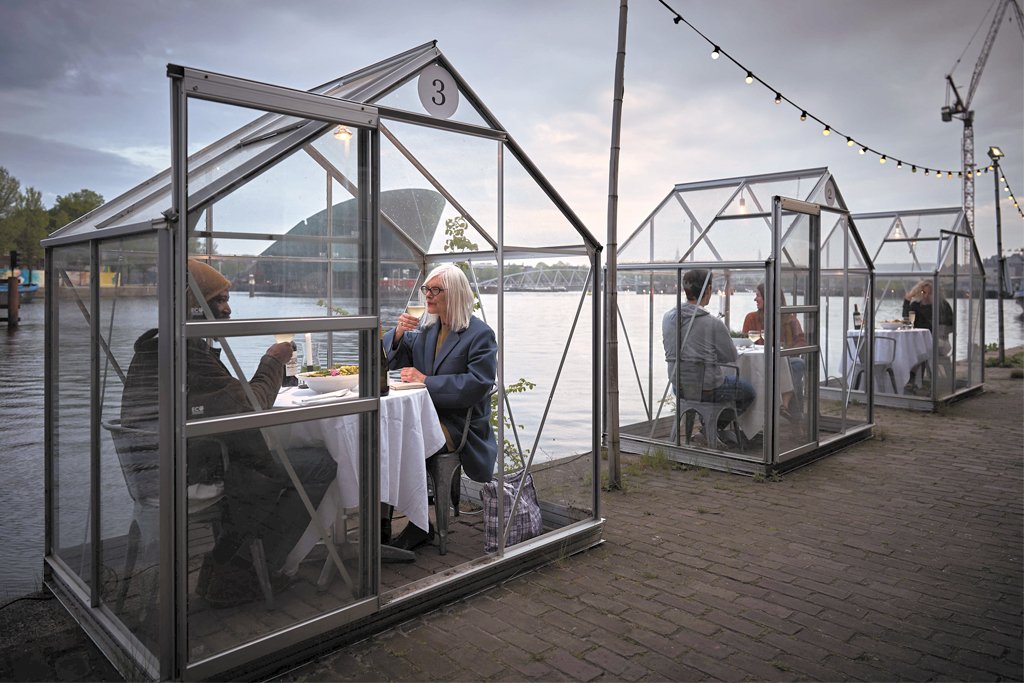
 HEMANT:
 NICKI: This whole technology thing is great, but I do think that people bring people back to restaurants. I’ve noticed through our reopenings, at both locations, that whatever age people are, they want to talk to us. They want to touch base with the people. We get a lot of people that come back two to three times a week because both locations are in fairly residential areas. While I agree that we’re moving toward technology, and it’s great for a lot of reasons, people go to restaurants for an experience. They go to a restaurant to be entertained, to be fed, obviously, as well, but there’s so many elements of a restaurant, and people are such a huge element of it. So I hope we don’t see maître d’s and servers replaced. I really do. I hope that the pandemic doesn’t kill the need for the conviviality that you get when you go to a restaurant. That’s really important to why I’m in this business — because that’s what I love to do.