Home Blog Page 985

Local doctor wins big in area byelection battle

0

Dr. Eric Hoskins, of the Liberal party, prevailed at the Sept. 17 byelection to win the vacant provincial government seat left by former MPP Michael Bryant.

Hoskins won more than 47 per cent of votes cast. He ran against the Progressive Conservative party’s Sue-Ann Levy, a municipal politics columnist for the Toronto Sun, who won more than 28 per cent. Trailing behind was the New Democratic Party candidate, Julian Heller, who won more than 16 per cent of the vote. Hoskins also ran against seven other candidates.

“Many, many thanks to everyone who helped during the campaign,” Hoskins said. “It was a blast. Now it’s time to get to work for St. Paul’s.”

Hoskins, a practising doctor, spent more than 10 years working abroad as a doctor, doing humanitarian work after he finished his medical studies at McMaster and Oxford universities. He then spent time advising Lloyd Axworthy, former minister of foreign affairs with the Chrétien government, on human rights, peacekeeping, child soldiers and Africa.

Hoskins has received the Order of Canada and the United Nations Lester B. Pearson Award

Hoskins is married to Dr. Samantha Nutt and has a four-year-old son, Rhys.

“I want to congratulate Dr. Eric Hoskins on his victory in the byelection in St. Paul’s,” said Premier Dalton McGuinty. “It takes courage to put your name on a ballot and campaign from door to door. And it also requires unswerving dedication to our democratic traditions and a belief in the value of public service.”

Don Mills development divides community

0
donway
donway

North York Community councillors were unable to reach a decision about whether or not a condominium development proposal that would add 1,300 units to the neighbourhood should be built on the site next to the Shops at Don Mills.

The proposal, submitted by Cadillac Fairview, called for a mixed-use development of six buildings with heights ranging from 12 to 26 storeys. The plan also calls for the conversion of a 13-storey office building currently occupying 75 The Donway West as well as the developer’s offer to fund construction of a two-storey community centre.

Following five hours of discussion at a community council meeting, only six of the 11 councillors remained. Those still in attendance were unable to make a recommendation for the proposal.

“The impression I am getting from my constituents is that they believe that they have not been provided with all the facts nor the dramatic impact that this development application will have,” said Coun. Denzil Minnan-Wong. He added that suggested densities in the proposal are similar to those along the subway corridor.

Don Mills residents are divided on the proposal.

“We’re very much in support of it,” said Terry West, president of Don Mills Residents Inc., who said the new centre will serve the changing neighbourhood as more young families move in to the area. He added that his group sent out 1,300 questionnaires about the proposal. Roughly 85 per cent of respondents were in favour, he said.

"It is definitely not an accurate representation of the community," said Simone Gabbay, founder of Don Mills Friends, who said many area residents never received the questionnaire. In addition to traffic and density worries, Gabbay said she is concerned that the conversion of 75 The Donway West will displace health-care providers using the building, impacting area residents.

Pulse of Heart Park beats, thanks to funds

0
heart park
heart park

A recent donation of $200,000 has resuscitated plans for the construction of Heart Park. The funds — negotiated by the city for an approved RioCan development at 1717 Avenue Rd. — will allow for the transformation of the property on Avenue Road, south of Lawrence Avenue. Money raised through neighbourhood efforts will also be used.

“I think it’s a wonderful initiaive that really speaks to a community coming together,” said Coun. Karen Stintz, who added that the new green space will help the parks-deficient area.

Stintz said that the next step is to get the park in the capital budget, to allow for construction to begin next year. The roughly 900-square-metre triangular property was owned by the Toronto Transit Commission from 1936 until 2006 when it was transferred to the city.


Lorne London, the publisher of Post City Magazines, pledged up to $25,000 for redevelopment of the site when he first approached local councillors and the TTC with the idea for the park in 2006. The park’s design — inspired by the structure of an actual heart — will come from local resident Dr. Karen Atkin.

Stintz projects a fall 2010 completion date for the park.

OMB squashes massive Midtown condo project

0
omb
omb

A local community group said they are “delighted” after the Ontario Municipal Board ruled against a development company that proposed a 25-storey building along Duplex Avenue near Yonge Street and Eglinton Avenue.

On Sept. 14, the provincial board issued its decision against Top of the Tree Developments Inc.

It said the proposal to redesignate the area between Helendale and Roselawn avenues “apartment neighbourhoods” from “neighbourhoods,” which would allow for increased density, could detract from a stable, high-functioning neighbourhood.

“It was the right decision, and we want to thank and acknowledge the OMB’s understanding and comprehensive analysis,” said Jordan Applebaum, chair of the Eglinton Park Residents’ Association.

“Clearly we were delighted.”

Applebaum’s group has fought the application since it was first submitted to the city two years ago. After the city turned the proposal down, it was appealed at the provincial level.

“We’re supportive of renewal and investment in the neighbourhood — it’s important to maintain the vitality and appeal of our community,” Applebaum said. “However, this particular development was not the right development for us. It would have creative a massive imbalance, both aesthetically and in density.”

Mark Flowers, the lawyer for Top of the Tree Inc., disagreed.

“We believe that the subject site and the surrounding properties within the proposed official plan amendment area are exceptionally well-suited for residential intensification," said Flowers. "Accordingly, this is obviously not he outcome we were hoping for."

Flowers said his client has not yet decided if they will appeal the decision or submit a revised application for the site. "We are currently reviewing the Board’s decision with our client and will be considering all options that may be available," he said.

My Toronto

0
jesse cook
jesse cook

What do I know about favourite places in Toronto? A reasonable question as so much has been made of my youth, growing up in “exotic” Spain and France, soaking up the music and world culture.

However, the reality is from the age of four, my school years were spent in Hogtown.

I was born in Paris and we did spend our summer vacations in the Aveyron in a stone house once run by nuns. But instead of The Sound of Music, picture large stinging nettles, spiders as big as your hand and no running water. My father did retire to Arles and live next door to a real Gipsy King.

But the majority of my youth was spent freezing alongside Lake Ontario. I grew up in the east end, a little jumble of cottages they used to call “The Beach.” Today developers have reclaimed the name using it for condominiums with cottage-chic facades and names such as Breezes on The Beach.

Despite all the commerce being made by tearing down real cottages and putting up fake ones, The Beaches somehow remains a magical annex to the city. A few more yuppies and yoga studios than when I was a kid. The Goof restaurant kept their “Good Food” sign although they fixed the broken “D”.

Sadly they swapped the linoleum tables and individual jukeboxes for haute cuisine digs with no jukeboxes. But the tradition of fine Chinese-Canadian cuisine, burgers with Szechuan noodles, still has a home. So sure, it’s changed.

But when I walk that old weathered boardwalk from the Water Works to Ashbridges Bay, or watch people rowing by the Balmy Beach Canoe Club it’s like time has stopped there. I am like that portrait of Dorian Gray in the attic. The place hasn’t changed much, but each time I come back, it seems I have.

Jesse Cook’s latest album, The Rumba Foundation, is in stores now (www.jessecook.com).

Patrick McMurray's blog: A surprise about your scallops

0
scallop patrick
scallop patrick

There’s nothing quite like a scallop. The buttery sweetness, the firm texture, the caramelized sear on the outside and just warmed tenderness of the inside… and yet there is something missing.

Here in North America, scallops are shucked and processed on the boat, the adductor muscle of which we all know as the scallop meat itself is severed from the shell, and the rest of the scallop is tossed overboard. The processing afterward creates either wet, dry, or frozen scallop meat that we can get at the fishmongers.

Wet scallops have been dipped in a preserving liquid that plumps them up, and whitens them as "that’s what consumers want" (or so they thought years ago). The resulting meat looks very white and fat when you buy it. However, as soon as it hits the pan, water is released and the flavourless meat tightens up and gets rubbery. Probably the reason that most people get put off of scallops. I hear through the grapevine that this process is being phased out — yippee!

Dry sea scallops have not been touched, just put in a container. They’re either frozen if harvested by a big fisher that goes out to the scallop beds for days on end or brought to shore fresh and shipped within hours of landing. The resulting colour of the scallops ranges between off-white, beige, cream, to light pinks and corals. These scallops are more highly prized by chefs and their customers as that perfect golden sear, and the buttery flavour, comes through to the plate. Lovely and sweet, yet there is still something missing.

When the scallop is shucked in Europe, the shucker is careful to remove the scallop meat AND the roe that is attached to the side of the muscle. The coral-coloured roe is the caviar of the scallop and is tossed overboard here in North America. I can’t seem to get an explanation to this one except that it’s just how it has been done since time began — "no one wants that pink stuff."

Luckily, however, scallops are now being aquacultured on scallop farms in both Nova Scotia, and British Columbia. At Starfish, I am getting a lovely Weathervane Scallop from B.C. and soon the Atlantic sea scallops will come online. They arrive to my back door, whole in the shell, and like oysters they can be enjoyed on the half-shell — alive and kicking. Sometimes, the scallop will dance on the shell, especially when the lemon hits it.

I love to show the scallop on the half, whole, and in-tact if it is small enough. The B.C. scallops come in at 5-6" in diameter, and are so large that I have to break it up into three parts:

The mantle, which is the outer part of the scallop, is very firm, crunchy, salty and meaty like a water chestnut. The adductor muscle (the scallop meat as we all know) is firm, delicate and all butter. The roe is velvety in texture and tastes of unsalted caviar — a sweet finish.

It is a beautiful thing to see when it comes to the plate and, as these scallops are aquacultured, they are softer on the environment than the traditional dragging or dredging methods to get the regular scallops — that’s a longer story though, and best asked for over the Oyster Bar with a glass of Sancere. See you soon, scallops arrive Thursdays.

Shuckingly yours, Paddy

Patrick McMurray is the owner of Starfish Oyster Bed & Grill and The Ceili Cottage. He is also a World Champion Oyster Shucker. Catch his blog weekly at PostCity.com.

Nothing gets between me and my Calvins

0
CALVIN
CALVIN

I’ve always been a fan of Calvin Klein. I was totally taken in by those old Brooke Shields ads from the 1980s. There was nothing sexier at the time. And even now, I like Calvin’s simple aesthetic, their soft cottons, even the headless mannequins they put in their windows.

So, as you can imagine, I sank into a mini-funk when I heard the 150 Bloor St. location was closing. The spot where I’d dropped $54 on what may be the best (if not the least expensive) bit of underwire I’ve ever come across, was to be no more? Bummer. Luckily, as it turns out, Calvin isn’t abandoning us — they’ve just relocated.

The new shop at 110 Bloor St. W., nestled between Gucci and Starbucks (how very Yorkville), is a fine replacement — maybe even an improvement.

According to the marketing campaign, the store’s design concept emphasizes Calvin Klein’s modern aesthetic with lots of light and bright surfaces. I can’t say I disagree. Rows of acrylic rods line the windows — an unusual choice for a window display — but since this store is all about intimates I understand wanting to provide a little privacy.

It’s all very clean, bright and minimal, but feat not, it’s welcoming at the same time. Worth checking out is the new Perfectly Fit Evolution line, promising a line-free smooth look. (I’ve heard it before, but I’ve yet to find a line that lives up to the promise perfectly. Maybe this is it?) The new store carries men’s and ladies stuff and sale merchandise is often 50 per cent off. Oh, and they offer free bra fittings (though that’s not something I partake of because I’m not crazy about letting unknown women get all up in my business).

They also offer environmentally friendly bags ("green" reusables in signature white). And when you buy one, $1 from that purchase goes toward the Cure Foundation — a breast-cancer fund raising initiative. Basically, there are lots of good reasons to go.

Calvin Klein Underwear 110 Bloor Street W. Toronto, ON M5S 2W7 416-413-0411

Wendy Woods' blog: Yoga-inspired gear casual but sexy

0
Cat tilt
Cat tilt

Cat Tilt is a beautiful store for women who are looking for fashionable casual and active wear options. Alison, the owner, focuses on pieces that function well for dancers, yogis, or casual strolls in the park.

I love that the casual clothes at Cat Tilt fit multiple personality styles. Often times when you get into functional clothing, the clothes have a very “sporty” feel. Cat Tilt offers pieces that show off the feminine, sexy, or trendy side of a woman.

For example, my favourite piece was a long white zip sweatshirt with a dramatic hood by Perry Underground. The puff sleeves and ruching around the pocket gave this sweatshirt a very feminine feel.

Looking for something a little trendier? Clothing Brand Experiment is a new line of hoodies that are designed and made in Toronto. Each hoodie is made mostly in neutral fabrics with a touch of neon detailing added, which makes them a great option to update your wardrobe.

I’m always on the look out for a great tank that can be worn underneath anything. Often they are just one plain colour with little personality. The Threads for Thought tank top I saw a Cat Tilt was refreshing with its unexpected lace detail in the back, making it a sexy casual option.

If you’re ready for some unique pieces in your casual wardrobe that stand out from the crowd Cat Tilt is the store for you! Cat Tilt is located at 198 Walnut Avenue – 416.519.5189.

Always on the lookout for Toronto’s best boutiques!

Wendy

As a personal style coach with THE REFINERY, Wendy Woods translates the world of fashion into a personal style that makes her clients shine! Through Wendy’s guidance, her clients discover their own REFINED sense of style and a new found confidence in themselves.

Franco Mirabelli's blog: Toronto-made fashions showcased in N.Y.C.

0
franco NYC
franco NYC

That time of the year again. It’s down to New York City to launch my new collection for Spring-Summer 2010.

Now I love Toronto and I love Canada but in my eyes there are only four true blue fashion capitals — Milan, Paris, London and New York. The rest are what I jokingly consider “regional markets.”

After making fabric selections and designing each garment, we put together our fashion story for next season.

Armed with a set of samples that we prepare for market, I take the team — design assistant Grace Rigato and my wife, also our retail merchandiser, Nancy Mirabelli — down to Manhattan. It’s here where we showcase my vision, my collection, to buyers and fashion retailers from all over the world.

There is so much clothing in the world. So many buyers chase the latest fad or brand to explode on the scene, hoping that it becomes their next meal ticket. As much as I have craved this type of success, I have also wanted design longevity.

That’s why every season is personal and why I must maintain my own philosophy while designing.

With a staff of 35, we’re not the biggest fashion company but we produce every collection right here in Toronto, designing and making beautiful clothing that can compete with other designers and manufacturers from all over the world.

Perhaps it’s my old world background, we came from a place where everyone worked hard and believed in doing their best, no skimping or cutting corners. Maybe that’s why I believe in quality and things that never go out of style. I have never wanted to design disposable fashion but rather clothing that was timeless and remained modern at the same time.

Ciao for now.

With three corporate stores in Toronto, Franco Mirabelli continues to distinguish himself as one of Canada’s strongest fashion talents. Keep up with him by following his weekly blog at PostCity.com or by visiting mirabelli.com.

Liisa Winkler's blog: My secret place to shop in Toronto

0
thrift store
thrift store

Fashion is such a constantly changing market, where last season’s "pinks" turn a hideous hue when compared to this season’s "reds." It’s hard to keep up with what is current and what will leave you looking like Jan Brady.

Away from the trend followers, there is a growing movement of people trying to "green" their lives and their wardrobes.

Being a bit of a "greenaholic" myself, I feel I must share with you a little secret: the store where I do most of my shopping is not found at any mall or in any trendy downtown area.

Value Village, with its rows and rows of sweaters, dresses, shoes and abandoned knick knacks really speaks my language. "Come pick thru my wares and sample my finest no name cardigan," it seems to call to me.

You never know what you might run into in the dress aisle. I should also mention that children’s clothing purchased here is usually in great condition. (I keep my kids in Village fashions 24-7)

I find it an inspiring and refreshing change from the same old trendy shops in my neighbourhood. Clothing purchased here is sure to be original and it’s ALREADY very "last season" so how can you go wrong? Value Village is to me now what the shops of Kensington market used to be 10 years ago. Fun, original, a bit out of the way and a little bit dirty.

Buying used clothing is of course just one way to maintain a "green wardrobe." Buying or (if you have skills with a sewing machine) making repurposed clothing is another. Preloved (881 Queen Street West) is a great shop that has been turning old undesirables into amazing pieces for years. I also love Susan Harris for her one-of-a-kind creations using only recycled materials. I love her patched together cardigans and whimsical dresses.

If you know what you are looking for exactly, someone on ebay or craigslist will often have what you crave at a fraction of the price. Just beware of knockoffs from large quantity sellers.

Anyway you look at it, fashion is a bit of a wasteful industry.  By shopping at vintage stores, buying directly from earth conscious designers, and choosing pieces that are well made and will survive the seasonal turnover of trends you will actually end up injecting a bit more personality and fun into your wardrobe. You will also discover many unique treasures that are sure to live out full and happy lives in your bedroom closet.

Instead of throwing it away:

  • Reconstruct old garments or salvage interesting details (buttons etc.)
  • Use worn out t-shirts as cleaning rags
  • Donate to a second hand shop, charity or a designer who uses old clothing for fabric
  • Try consignment stores for your nicer items, sell on ebay or craigslist
  • Swap clothing with friends
  • Have a yard sale

Liisa Winkler is one of Canada’s biggest supermodels and mother of two beautiful children. Her blog appears bi-monthly at Postcity.com.

The rise of the city's new culinary king

0
hanif
hanif

He is said to have the Midas touch: a guy who can smell the next big thing from a mile away, find it, package it and bring it to market before most realize what’s going on. Not bad for a quiet kid from Flemingdon Park who started his rapidly expanding culinary empire with a little coffee shop on Dundas Street West.

Hanif Harji is the man behind such Toronto hot spots as Kultura, Nyood, Colborne Lane, Doku 15, Blowfish and the recently opened Madras Pantry, but you would never know it from talking to him.

“I am still that broke-ass kid from Flemingdon Park,” he says. “Mine is not a rags-to-riches story. My theory in life is put your head down and work really, really hard. Try to be innovative and think outside the box, partner up with really smart people who add value, and hopefully you have made an impact in the industry and in your bank account.”

So how does a kid who grew up in one of Toronto’s many multicultural neighborhoods end up with a mini-empire?

Harji moved here from Tanzania when he was six. His parents bought a convenience store, and his father worked for the TTC. It was while he was at the University of Toronto that he got it into his head to go into business for himself, so right out of school, he bought his first coffee shop.

“The coffee business was a growing market at the time,” he says. “Then I just fell in love with the hospitality industry and evolved through there, working with really smart people and hotels.”

Harji went from slinging coffee and serving up fast food to owning his own restaurant in 2004, with the sushi and sake bar Blowfish.

“I had been doing some consulting work overseas and working with some really interesting chefs and hotels, and I kind of got homesick and decided I wanted to do it for myself instead of for other people,” Harji explains.

“So I found a really great location on Bathurst Street. Susur had just opened his restaurant there, and it was up and coming. I partnered up with some smart people, a really good chef and came up with this idea to do a really hip Asian concept, and people really took to it.”

And from there, a trend was born. Pan-Asian fusion exploded, as did Harji’s business, which was bolstered by his partnership with chef Roger Mooking, whom Harji had met while Mooking was working the kitchen at Barrio.

“We immediately hit it off. As you know, he is a very charming guy and is very skilled at making people feel comfortable,” says Mooking. “We had a similar sensibility, he seemed to enjoy my food and Barrio, and we went from there. He is one of the smartest people you will ever meet, and I only like to surround myself with the best players in everything I do. He is definitely one of those people.”

Harji’s current locations are some of Toronto’s most popular restaurants — hits with critics and the public, alike.

A go-to place during the Toronto International Film Festival, Kultura has been described as “damn gorgeous” by Joanne Kates and “lots of fun” by James Chatto, which is a testament to Harji’s good taste.

It sits in one of the oldest retail spaces in Toronto, and the look is modern without losing the beauty of the original structure.

“We are very design focused and hate buying out of catalogues, so we try to work with people who can innovate with us and help us bring to life what we envision in our head,” says Harji.

Nyood, the next on Harji’s growing list of funky downtown eateries, started off with a bit more controversy. Harji had partnered up with Claudio Aprile on the restaurant Colborne Lane and had planned to open Bar Crudo in the West Queen West space, before their relationship went sour.

Their partnership dissolved, Aprile stayed at Colborne Lane, and Harji kept the Bar Crudo space already equipped with glass French doors and a huge chandelier made from utility lights and thick black wire.

Following the success of Nyood, Harji’s latest venture is Madras Pantry where you can grab a hand-held dosa and head across the street to Trinity Bellwoods Park.

Just like Nyood and Kultura, Madras is decked out in a design from Commute Homes (819 Queen St. W.), owned by Sara Parisotto and Hamind Samad.

Brightly coloured carnival posters are mounted on the walls, Indian kitchen staples line the shelves, and the menu is scrawled out on a chalkboard behind the counter.

And Harji has no plans to slow down any time soon. Indeed, his most ambitious projects to date are just getting underway.

His company, Scale Restaurant Group, plans on opening a new “concept” in Burlington called Eatalia, a trattoria that will introduce the suburbs to informal Italian eating, and he has managed to get his hands on an old women’s prison in Liberty Village, which is in the very beginning stages.

But none of this is magic, according to Harji.

It is hard work and partnering with the right people. “I have a chef partner named Roger Mooking, who has his own television show named Everyday Exotic,” he says.

“He and I collaborate together and really look at what’s happening globally in the food world that we are passionate about and where we think it’s going. We really focus on the global approach to food, not the local approach to food. We like to see what global trends are happening. We think Spanish trends are hot right now.

“You know that singular genre tied in with Asian could do really well, so we start looking at concepts and testing menu items, trying to get a good feel for what we think will work. And we are all about flavours and ingredients and making food dance on your tongue.”

The duo also offers food and beverage management for hotels and are currently working with a company that owns Elora Mill Inn and the Benmiller Spa and Resort.

“He is a romantic and works well with high-level ideas, and I work well with execution, creativity in my own domain and management,” says Mooking, of the key to their partnership’s success.

“He works the front, and I work the back, and it is the perfect balance for effective restaurant management. I know how kitchen people think, work and feel, and he does the same at the front of house. I do my thing, and he does his. We peek into each other’s worlds, to get bigger-picture things sorted, but we stay focused on our areas of expertise, and I think it works.”

Harji is clearly thankful for those with whom he works closely.

“The reality is that I am very, very fortunate,” Harji explains.

“I have amazing partners, and I’ve had the good fortune of picking some good locations, and I don’t know about the Midas touch but definitely really great partners who have made things great for me.”

He makes it sound so easy.

Patrick McMurray's blog: T.O. diners have wild choice to make

0
Halibutplate1
Halibutplate1

Wild or cultured? That is the question. If you have a choice of fish, do you go only for the wild or does it matter overall? In the end, the human body does not discern that protein molecules from a cultured fish are any different than those from a wild source.

I once had a gent request to eat only wild oysters. "None of that cultured stuff," he said. In the world of the oyster, about 95 per cent of the oysters that reach market have been cultured in some form or another. If an oyster that is farmed spawns off and creates that rogue "wild oyster" outside their pens, the taste and texture are still the same. The shell is the only noticeable difference.

So why worry about your fish? I find that the diners in Toronto like to know where their food is coming from these days. It’s harder to label the location of origin of wild fish because you have to personally know the fisher, their port of call, and how the fish is transported to the table. In addition, wild fish can be wonderfully inconsistent and very seasonal.

Lately, we’ve been receiving a wild ling cod with a tracing tag on the tail. I traced it to Captain Tony of Tofino, B.C., and the fish was caught two days prior. Fantastic — and Capt. Tony was happy that the fish reached Toronto. Still, the trouble with wild fish is that we keep eating the tasty ones to the point of extinction. Cod, Atlantic salmon, and many others are either gone, or close to it.

Meanwhile, cultured fish can be traced down to the day that the fish was harvested, how it was raised, and who drove it to your door. Culturing allows consistency in stock, and in some cases, custom growth (the size and colour of a fish).

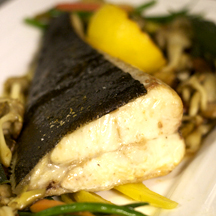
But too much culture in an area can be devastating to the surrounding environment. Closed cell culture tends to be among the softest on the environment as the water that is used for the fish is filtered on the way into the farm and then filtered on the way out. Scotian halibut produces a beautiful halibut that come to us in a five to seven pound size that is just right to roast on the bone — hard to do with the 150 pound wilds.

As a restauranteur, we have the same choices to think about, although I feel that I have more of a responsibility as I serve more fish and therefore have a greater impact on the environment.

I think we have to move towards a balance of both wild and cultured. If we start to use more cultured product, the wild will have a better chance to naturally rebuild their stocks. The culturalists also have to get smarter and more environmentally conscious about their practices to reduce the environmental impact. As the wild fish come into season we can enjoy a variety that is short lived, and therefore special.

In Toronto, we are lucky that we do not have an ocean in front of us because we get a variety of fish from all over the globe. But we don’t even have to go that far. We have some wonderful culturalists right in our own backyard. Jim Giggie of Tottenham, and the trout growers of Manatoulin Island can produce a trout that’s light in colour, clean, grassy in taste, and so fresh that when it hits my door hours later the fish is still in rigor and needs a day before we can cook it properly.

Ask the questions when you next cook a fish supper or sit down at the restaurant. Find out where your fish comes from and make a balanced choice to help the environment.

Shuckingly yours, Patrick

Patrick McMurray is the owner of Starfish Oyster Bed & Grill and The Ceili Cottage. He is also a World Champion Oyster Shucker. Catch his blog weekly at PostCity.com.