
Home Blog Page 836

$200 million in savings in two easy steps

0

It’s true that life can become so ordered that ridiculous things become standard practice and are taken for granted. It happens in marriages and in business, and it also happens in government.

The best defence is often said to be openness, transparency and new ideas. Many people have founded successful marriages on these principles — and successful businesses, too. But governments and other big organizations? “Not bloody likely,” to quote Eliza Doolittle.

Which brings us to the current occupants of City Hall and their quest to balance the city’s budget. Those with the most power at City Hall seem to approach things ideologically, and not with openness, transparency or the consideration of new ideas.

To save money, they hired a big company with little knowledge of city government. It was a fruitless exercise, proposing a general strategy of chopping away indiscriminately at services.

Police chief Bill Blair entered the fray by threatening to cut 1,000 officers, a rough-and-ready, slash-and-burn approach that did nothing to instill confidence in how the police force is managed.

But, as those who pay close and critical attention to the spending of the Toronto Police Service know, a fresh look shows that ridiculous things have become standard practice there, and, if changed, could save considerable sums.

Look at the shifts that police work. Currently, there are three shifts a day: a 10-hour day shift, a 10-hour evening shift and an eight-hour night shift — adding up to 28 hours for every 24-hour period. Other police forces in Canada don’t have overlapping shifts, nor do other city services. Three eight-hour shifts each day would result in no loss in service to the public and would result in savings of 15 per cent of the total police salary of $750 million, or about $100 million a year.

Or look at the standard Toronto practice of two officers in every squad car after dark. It’s been in place since the late 1970s when an arbitrator said it must be done.

There is no evidence that one-officer cars are more dangerous than two-officer cars; in fact, the reverse may be true since single officers don’t take the chances that two do.

The RCMP does not use two-officer cars after dark, nor do the Halifax or Ottawa forces, and the practice in Vancouver and Edmonton is not required. No one has ever suggested that policing is second class in those cities.

Two-officer cars may be useful in some areas, but if we dispensed with two-officer cars in half the neighbourhoods, we would save close to another $100 million. Those are two suggestions for saving money by looking carefully how money is spent and then asking questions.

Sadly, the Toronto Police Services Board and city hall have not been willing to do that, and this particular brand of gravy did not interest Mayor Ford when raised early this year. In June, a few weeks before the Police Services Board was to ratify a new four-year collective agreement with the Toronto Police Association, the board was asked to amend the agreement so that these two ridiculous ideas were not written in stone for another four years.

The members of the board refused to listen and instead agreed that, for the next four years, shifts would guarantee 28 hours work for officers in every 24-hour period and mandatory two-officer cars in Toronto after dark. Which means that savings of about $200 million a year — savings that would not have required any cuts in service to the public — will not be achieved this year.

It’s a sad story about the costs of ridiculous ideas that have become such standard practice that they aren’t noticed by those charged with making good decisions. It’s the cost of local decision making that’s not open, transparent or challenged by new ideas.

Post City Magazines’ columnist John Sewell is a former mayor of Toronto and the author of a number of urban planning books including The Shape of Suburbs.

No longer the next big thing, time is now for indie king

0

When Dan Mangan rolls into Allen’s pub on Danforth Avenue for an afternoon pint, he’s bearded and a little ragged from an early morning appearance on Canada A.M. That’s a good thing. He fits the image of the husky-voiced troubadour whose characteristic growl, insightful lyrics and passionate performances have propelled him to the cusp of stardom. With a new album just released and a massive tour to follow, Mangan seems ready for prime time.

“Hopefully we’ve made kind of a career-defining work,” says Mangan of the new album, Oh Fortune, released on Toronto’s Arts & Crafts label. “I’m feeling really proud of it right now.”

Oh Fortune is Mangan’s third album, and it follows on the heels of his breakout record, Nice, Nice, Very Nice, which, among other things, sat atop the iTunes Canada best-seller list for a whopping six months and garnered the 28-year-old high-profile performances at such prestigious festivals as Glastonbury in England. He’s that good.

And it becomes readily apparent that Mangan isn’t one to crow about his art offhandedly.

This is a guy who set his expectations so low it took him years to quit his job waiting tables at the Keg, and even then, they kept him on the payroll for four months “just in case,” while he toured around the world.

“This business is full of disappointments, so the healthiest thing for me is to have low expectations so everything is a victory and it keeps things exciting and keeps you hopeful,” Mangan explains.

“Getting comfortable is a recipe for self-sabotage.”

Still, Mangan is now selling out the Orpheum Theatre in his hometown of Vancouver and checks into another major venue, Toronto’s Queen Elizabeth Theatre, this month. Bob Dylan plays the Orpheum. Jeff Tweedy and John Hiatt play the QET.

Mangan is no longer the next big thing. He’s just big.

And the songwriter, who spent four years living in Toronto as a child while his mother, a minister in the United Church, worked in the Beach, is quick to heap praise on his band for helping him grow his sound.

“It is great to be in the band I’m in,” says Mangan, who has slowly poached players from Vancouver’s music scene, primarily those involved in experimental jazz. “More than ever, this is a band project, and the guys that help shaped these songs are an integral part.”

The album, says Mangan, despite the big-time label and increased media attention that comes with it, is probably his most creative and least radio-friendly. It will find an audience. It will garner critical acclaim. Whether or not it will make Mangan a mainstream success story remains to be seen.

For example, the album’s most upbeat, fun and radio-friendly track is “Post-War Blues,” a song about post-traumatic stress disorder and the tendency of governments to ignore young soldiers with such illnesses upon their return. It is that type of juxtaposition that Mangan enjoys.

“I think I’ve made a really morose record in a way,” Mangan says with a laugh. “But in a sense it is a bit of a celebration, too, because the titles and themes wind intricately through death and then hopefully back to the gloriousness of understanding that there is a deadline. There is death. And, therefore, that makes life all that more meaningful. If there was no death, we’d be incredibly bored.”

Dan Mangan plays Toronto’s Queen Elizabeth Theatre on Oct. 28 (www.danmanganmusic.com).

Band of the Week: Morning Thieves

0

The Morning Thieves would probably be the first to admit that they’re all about the hooks. It’s rare to find a young band that's enthusiastic about personal connection with their audience without coming off as totally superficial. But that’s this band in a nutshell: performers — entertainers, really — who trade in fun pop but don’t water it down too much. Like Hollerado, they’re just a little more complex than what you’d ordinarily hear on the radio.

Case in point: the Thieves’ new Wrongside EP, specifically its titular track, which for the first half packs in hooks like sardines in a crushed tin box. Drum hooks, guitar hooks and vocal breakdowns (which echo Our Lady Peace back when they were, like, good) trade places. It’s this dedication to density, this musical cutting-of-the-fat (for the most part), that makes them convincing — and, as a matter of fact, they’re also more convincing live than they are recorded.

The Our Lady Peace comparison is doubly apt, because the Thieves seem to embody a little of that band’s Clumsy-era brooding atmosphere. What makes them unique is their understanding that dark music can be fun and accessible. They’re still mastering their craft: Wrongside is not without missteps, but for a first release, it’s an accomplishment, with plenty of promise and some room to grow. Wrongside dropped at The Piston on Oct. 6, and we got lead singer Bryan Fligg on the phone to talk about where the Thieves are at and where they’re headed.

Last time we spoke you guys were busy trying to wrap this thing up — which was a while ago. It sounds great, by the way, but obviously this was an intense process. When did you get it finished?
Well, we finished recording in April and started mixing in May. We took a break over the summer to play some shows — we did the Warrior Dash, which is basically this insane military obstacle course. There were over 21,000 people there, which was amazing. Not all of them were there for the music, of course, but the vibe was still there. We also did a cancer benefit at the Horseshoe. We finished mixing in late August and then mastered it in September at the Wreckhouse. Shortly after that, TIMA (the Toronto Independent Music Awards) wanted “Wrongside” for a promotional video, which was awesome. We also shot a fun sort of summer video for “Holding On” at my family’s cottage.

How have sales been?
Well, we managed to sell 60 copies at our CD release, and 30 packages with a CD and a T-shirt.

That’s pretty damn good for an indie CD release.
Yeah, totally. It was an awesome event; we packed The Piston at $10 apiece, and the energy was incredible. All eyes on us, everybody sweating … the audience was totally involved, and that’s what we strive for. If it feels intimate, if it feels high-energy, then we’ve succeeded. We also signed on with Indie Pool to do distribution, duplication, artwork and radio promotion. It’s really a great tool for indie bands working their way up. Basically you get 250 CDs for $500 — the same price ratio as you’d get with a bigger run, say a thousand CDs — but for a short run. Anyone making their way in the industry should check it out.

How do you feel about the final product?
I love it. It’s got a great consistency to It — it listens like a cohesive product, not like a handful of songs. A lot of that has to do with all of the preproduction we did… we recorded with Tim [Oxford] from the Arkells, and most of the preproduction was done at his place. We’d work, go out and grab a schawarma, come back and work some more. We trimmed a lot of fat. When we started getting sick of each other we’d just burn off the aggression with some N64.

What game?
Goldeneye. Four-player Goldeneye. It really works.

Who do you like in Canadian music right now?
I don’t know, man, it’s hard to say: I just keep hearing about these new bands, and they blow me away. The quality of the material coming out of the Toronto-Hamilton-Newmarket sort-of area is great. I mean, I come from a place musically where I love bands like Wilco, Spoon — but we [the band] really like Canadian music right now: Tokyo Police Club, The Reason, Sweet Thing … and, man, I saw Hollerado at Sound Academy, and it was just great. It wasn’t over the top, it wasn’t cocky: just guys who genuinely love what they do, not forcing it on you but subtly convincing you.

That’s kind of how they struck me with their answers to my interview questions, as well. I see that commonality between your bands, and the Arkells too because of the Springsteen-anthem quality, but you guys are a lot darker than either Hollerado or the Arkells, I feel.
Yeah, we are definitely darker, but… I mean, some of us used to play in a prog-rock band, and we were just all about screwing with your head — but there came a time where we just had to say “f*** it” to that. It has to feel good for the audience, it has to get the audience involved, make them feel like the material is theirs, not exclusively ours.

Morning Thieves are:
Bryan Fligg — Vocals, Guitar, Keys
Stephen Orr — Guitar, FX
Mike Appleton — Bass, Vocals
Christopher Paul Hummel — Drums, Vocals

The LG Fashion Week Diaries: Day Two

0

After a few winks we were back in the swing of things yesterday, with the first show taking place at 1 p.m. Following her somewhat disappointing fall/winter 2011 collection, Amanda Lew Kee was wise to show a more tightly edited collection in the smaller studio space, ignoring the hype that seemed to be her downfall last time around.

The 15-piece collection saw sheer and flowing pieces in taupes and creams being paired with kaleidoscope-like prints of London, New York and, thankfully, Toronto. Our favourite look was the opening one: a sheer printed silk dress-shirt worn with leather-fronted biker shorts and lustrous brogues. While we liked the idea of the closing looks — silk chiffon maxi tube dresses in either a print or solid — the execution was off, with bunching zippers distracting from the line of the fabric.

Joeffer Caoc showed next, with the likes of Liz Cabral and Bernadette Morra spotted in the front row as elevated sporty looks were paraded down the runway; we liked a baby blue tweed sports dress that had a whiff of Chanel, in addition to an orange, fuchsia and grey colour-blocked shift.

Michi and Tosca Delfino both saw ladies wearing lingerie and swimwear looks that left little to the imagination; the Michi gals oozed vicious sex appeal in their sport-meets-S&M pieces (with some models getting into it more than others, much to the delight of passers-by, peering in through the glass windows), while the Tosca ladies were far more sun-kissed, donning bikinis and such that were inspired by, specifically, the Cayman Islands. A one-piece printed with the Toronto skyline was a crowd favourite, and the second Hogtown-inspired print of the night (we’re guessing that the local gal is heading straight to the islands from the city).

We then moved on to the Mercedes-Benz StartUp national final, an initiative that supports new Canuck talent. The finalists were Unttld, Triarchy, Cassie Dee, Travis Taddeo, and Martin Lim; each design team sent select looks down the runway before they were judged and Jessica Stam announced the winning team. Martin Lim snatched up the title, with Danielle Martin and Pao Lim charming the room with their gracious acceptance speech. While their collection of flowing colour-blocked pieces was likely the most commercially viable, we couldn’t help but fall for Unttld’s self-proclaimed contradictory looks. A shredded white dress with metallic beading was stunning in an off-kilter way, and we thought that both the spiky silver jewellery and shoes were highly covetable, if not a wee bit dangerous.

Much to our disappointment, we missed the Chloé Comme Parris show due to timing confusion (though we heard that many were turned away due to overcrowding anyways). We did catch Lovas, with Wesley Badanjak being another designer to reference the island life; this vision featured looks in a mostly subdued palette with pops of coral. We liked a sophisticated coral dress with a black and white belted effect, falling hard for the tousled braids worn by all the models.

Meanwhile, Laura Siegel’s sustainable creations (a.k.a island life round three) had more of a shipwrecked feel, with garments appearing sun-bleached and wave-ravaged. We loved a floor-length macramé dress coupled with a slouchy sand-coloured blazer and tie-dyed scarf in a washed out shade of teal.  

The day ended with Attitude Jay Manuel, which drew a packed house and many a media notable (Anita Clarke, Lisa Tant, Derick Chetty and so on). Before the show began, the patterned runway was briskly unwrapped to reveal, well, a surface that looked suspiciously similar to the one everyone had just walked upon, albeit shinier. Dry ice wafted down the runway as a model emerged in a look that instantly reminded us of Carmen Sandiego: red trench, flowing brown locks, and a tilted fedora.

Yasmin Warsame stomped out next, unfortunately appearing at the moment in time when the no-longer dry ice met the sheen of the runway, resulting in a bit of a tumble that left her laughing on the ground and a lucky front row-er with a hug. Overall the collection was filled with simple and wearable pieces — often in neutrals — that were paired with bi-coloured prints, giving the collection an urban gypsy (or “gypset”) feel. Following a well-heeled bow from Manuel, we were off to rest before day three.

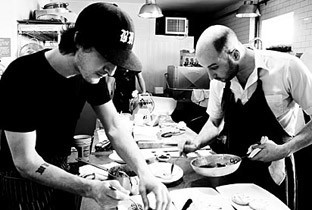
Grant van Gameren and Guy Rawlings join forces at Lucien (the word “awesome” comes to mind)

0

When Grant van Gameren announced that he was leaving The Black Hoof back in August, the news was bittersweet. Sure, it sucked that he was leaving the Hoof, but what was he going to tackle next? The answer is Lucien, Toronto Life reports.

The news is doubly interesting: not only is van Gameren headed there, but Guy Rawlings (ex-Cowbell and Brockton General) is too. They are replacing chef Scot Woods.

Lucien’s owner, Simon Bower, tells Toronto Life that “the restaurant is going in a new direction,” which, in addition to the two highly-regarded chefs, apparently means bigger portions and lower prices.

The chef duo has been in the kitchen since last week, but the new menu is on hold for a few weeks until kinks get worked out. We have a feeling we’re not the only ones eager to give it a taste.

[Toronto Life]

The Breakfast Hub: say goodbye to Maple Leaf Gardens, the boons of accessible parking, Toronto is a humdrum tourist draw

0

Maple Leaf Gardens no more. When Ryerson University uses the historic landmark for its hockey team next year, the arena will be named after a sponsor. (Please, don’t call it the Rogers Gardens.)
[Globe and Mail]

Get out of jail free pass? The blue and white accessible parking permit may as well be. Holders of this permit are able to park almost anywhere, anytime, free of charge.
[Toronto Star]

The cup of mediocrity: Condé Nast Traveler has released its Reader’s Choice Awards, and Toronto’s showing is decidedly blasé.
[Toronto Life]

The Toronto Zoo is hoping to become a part of the planned Rouge Urban National Park.
[Toronto Sun]

Halloweek in Church Wellesley Village will be looking a little less colourful this year. A smaller operating budget means visitors to the festival won’t see any light shows or rooftop DJs.
[Toronto Star]

Toronto Councillor John Filion is hoping to keep Rob Ford on a short leash by limiting his lockout powers.
[Toronto Star]

Toronto’s worst restaurant names

0

When Number Two Restaurant appeared on Spadina a few weeks ago, we wanted to give it the benefit of the doubt. Number Two is “with it,” we thought. By openly admitting its inferiority, it is indulging in that grand hipster ideal known as “irony.” Well, we were wrong. As Now Magazine reports, Number Two has already changed its name. It’s now known as Ivan’s Kitchen Dim Sum Fusion Cuisine.

We’re not sure which name is worse. Actually, we’re torn about whether Ivan’s Kitchen is the worst name or the best name for a dim sum joint. Surprisingly, though, this venue is not the only place in the city that has grappled with an unfortunate moniker. Below, some of Toronto’s worst restaurant names, in no particular order.

  1. Thymeless Bar & Grill. This is just a bad pun all round. As if anyone would expect to encounter any kind of green herb at a reggae bar anyway.
  2. Kom Jug Yuen Restaurant. Yeah, we know. Chinatown is too easy for bad restaurant names. This is the last one, we promise.
  3. Big Chubby Burger. The worst part about this name is that it used to be Craft Fat Burger, which managed to rip off Fatburger and Craft Burger all at the same time. The new name is still pretty bad.
  4. The Spotted Dick. Explanation unnecessary.
  5. Guu. Everybody loves Guu, but it must be said: it’s a terrible name. Brings up images of Nickelodeon and You Can’t do That on Television.
  6. 17 Steps Restaurant & Bar. It’s simply way too far to walk for lunch.
  7.  Fickle. The name of this Vietnamese restaurant is bad enough, but check out the interior. Guaranteed acid flashblacks.
  8. Pizza Pide. Apparently, it’s pronounced “pee-day,” which is bad, but everyone just says “pide,” is in, “I really want to say ‘pie’ right now, but I can’t, because the owners of this restaurant are weird.”

Have a further addition to the list? Please add it to the comments below.

Trending in Theatre: The Normal Heart, Guns & Roses, Name in Vain, Le Dieu du Carnage, Off Bathurst Theatre District Marathon

0

The Normal Heart

Larry Kramer's landmark play about the rise of the AIDS epidemic in New York back in the '80s has been experiencing a resurgence as of late. It was on Broadway earlier this year, and a movie is in the works.
Buddies in Bad Times Theatre, 12 Alexander Street, 416-975-8555. Oct. 14-Nov. 6.  


Guns & Roses

Inspired by real Toronto teens, this original play by Julian DeZotti has a "ripped from the headlines" feel (no sugar-coating here) and an added bonus: a live DJ. How real can you get? Something tells us Axl won't be there, though.
Alumnae Theatre, 70 Berkeley Street, 416-364-4170. Oct. 17-28.


Name in Vain (Decalogue Two)

In this world premiere, an angry monk breaks his vow of silence and the second commandment, throwing his monastic brotherhood into disarray.
Tarragon Theatre, 30 Bridgman Avenue, 416.-531-1827. Oct. 19-30.


Le Dieu du Carnage (God of Carnage)

If you're French or bilingual (or just like the accent), then seeing Yasmina Reza's acclaimed play about bickering parents in its native language will be a special treat (P.S.: there are subtitled viewings for the Anglophones). Oh, and Roman Polanski's got a movie based on the play coming out later this year.
Berkeley Street Theatre, 26 Berkeley Street, 416-534-6604. Oct. 21-Nov. 5.


Off Bathurst Theatre District Marathon

For the third time, Factory Theatre, Tarragon Theatre and Theatre Passe Muraille join forces to present a slew of fabulous theatre (plus dinner) into one jam-packed day. First off is Those Who Can't Do… at 2 p.m., and then it's Rick Miller's Hardsell  at 4 p.m. over at the Factory Theatre. Participants may then enjoy a prix fixe dinner at Diverso by Ferraro 502 before heading over to the last play of the night, In the Next Room or the vibrator play at 8 p.m.
$95 includes all three plays and dinner, Oct. 22.

The LG Fashion Week Diaries: Day One

0

Toronto’s LG Fashion Week got off to a rather slow start. Held in tents at David Pecaut Square instead of out in the boondocks, Monday began with an introductory speech from FDCC head Robin Kay (who spoke of Canada, coolness, and the ways in which Canada is cool) followed by the Holt Renfrew show. Drawing seemingly endless big names — we spotted Jay Manuel, Tommy Ton, Jian Ghomeshi and Suzanne Rogers, to name but a few — the runway was soon filled with garb from some of HR’s top Canuck designers.

Dodging huge letters spelling out H-O-L-T-S (we were expecting a capital disaster, but were fortunately mistaken), models strutted their stuff in select looks from Jeremy Laing, Smythe, Naked & Famous, TwentyCluny, Denis Gagnon, Dennis Merotto, Wings + Horns and Lida Baday. Our favourite looks by far were the ones from Laing, who showed some gorgeous sheer dresses in earthy tones, and a preview for Friday night’s show from Gagnon, who paired dark florals with sneakers — a perfect look for this week.

The other collections had some highlights, but overall fell short of the mark, with many of the looks seeming outdated or overdone (harem pants, exposed zippers). With a tired soundtrack doing little to help, the overall reception was lukewarm: one patron was overheard exclaiming, “I’m officially disenchanted with Fashion Week.”

The second big-ticket event of the night was the Arthur Mendonça show. After being shoved around by so-called ladies in fur, we finally made it into the runway room, working our way past the likes of Jully Black in a floppy mauve hat, Yasmin Warsame (who had what was presumably her daughter in tow), a sparkly Keshia Chanté, a not-so-sparkly Fefe Dobson and Stacey McKenzie, who was dressed in sheer-meets-fur frock, if that makes any sense.

After taking a bit of a leave from fashion following the recession, Mendonça returned to the runway last season, a feat accomplished without losing a step, as witnessed by his many devotees at the show. His inspiration for the spring/summer season was the Liz Taylor version of Cleopatra, spotted in his flowing silhouettes, bold jewellery and use of gold.

Highlights included a gorgeous rust-coloured sheer dress (which caused McKenzie to exclaim “I love that!”); a fuchsia dress with an asymmetrical neckline and teardrop cutout — worn by local style maven Naro Lokuruka — and an illusory jumpsuit look in a black and hot pink floral print.

The surprise of the night was an appearance by it-model Andrej Pejic, a male model known for his stunning androgynous looks. While we felt that the collection wasn’t quite as cohesive as it could have been (it included florals, zebra-print and colour blocking), and the jewellery lacked substance, the cheering at the show’s end left little room for discussion.

One day of peace, love, music and food

0

Nothing seemed to curb the hungry spirits of visitors to Foodstock on Sunday, as they braved spotty skies and fields of mud in a pay-what-you-can celebration of local produce, fresh water and culinary camaraderie.

Some 20,000 foodies and supporters attended the event, hosted on a defiant potato farm in Honeywood, Ontario, to sample a smorgasbord of local bounty prepared by an impressive roster of over 80 Canadian chefs.

Foodstock, presented by the Canadian Chefs’ Congress, was a bid to raise awareness for The Highland Companies’ proposed Melancthon mega-quarry, which would span an area a third the size of downtown Toronto and eviscerate the earth to a greater depth than Niagara Falls. 

The controversial project plans to excavate 2,300 acres of agricultural land north of Orangeville in a bid to access the area’s rich limestone deposits. To facilitate mining, an estimated 600 million litres of water would have to be drained daily, posing a serious threat to the watershed of multiple rivers. 

Michael Stadtländer, president of the Canadian Chefs’ Congress and champion of all things locavore, addressed the Foodstock crowd and called the event a “special day for the relationship between chefs and farmers.” Stadtländer’s celebrated restaurants, Eigensinn Farm and Haisai, are located near the proposed site of the mega-quarry. 

Foodstock’s participating chefs — including many of Toronto’s finest — were rallied by Stadtländer’s culinary call to arms.

“It’s extremely important for us as chefs to preserve where we get our food from. Farmers are so passionate about the land, and we’re passionate about our ingredients,” said Rob Gentile, executive chef of King West’s Buca, who offered bison prosciutto with house-made pecorino fresco on chickpea panella. 

Aaron Joseph Bear Robe, chef and owner of Queen Street’s Keriwa Cafe, apprenticed under Stadtländer. While dishing out fried green tomatoes with corn relish, Bear Robe stressed the importance of recognizing the breadth of impact that the mega-quarry would have on the surrounding area.

Aaron Joseph Bear Robe at his fried green tomato station

“This doesn’t just affect food, but water. It affects future generations. If you take away water, you essentially have nothing,” he said. 

Despite the looming threat of the quarry, visitors happily ate their way through a showcase of rustic gourmet food, scattering throughout the woods and spilling onto the peripheries of potato fields in layers and rubber boots.

All trappings of pretension were left at the gates as Foodstockers patiently weathered rain and long lines and held impromptu picnics on the damp forest floor. Music lovers swayed to performances by Sarah Harmer, Jim Cuddy and members of the Barenaked Ladies.

The ambience was unmistakably autumnal. Mud and leaves squelched underfoot as the red and golden canopy compounded a melange of scintillating smells: wood smoke from the chefs’ cooking fires; wafts of tomato and apple cider-glazed roast pork; braised rabbit with cranberry-hoisin sauce; jerusalem artichoke soup, spicy meatballs and frites fashioned from local potatoes.

Some of Toronto’s most acclaimed chefs, including Anthony Walsh of Canoe, Jamie Kennedy of Jamie Kennedy Kitchens and Brad Long of Cafe Belong cooked for the cause.

The Breakfast Hub: the Bank of Toronto, drug testing at the TTC, Michael Bryant’s new book

0

How to help the city’s financial woes? Councillor Kristyn Wong-Tam and scholar Stephen James Kerr suggest starting a City-run Bank of Toronto.
[National Post]

The TTC considers introducing random drug and alcohol testing for its employees.
[Toronto Sun]

Former Ontario Attorney General Michael Bryant is penning a book about the events surrounding the death of cyclist Darcy Sheppard.
[National Post]

New immigrants are apparently less supportive of immigration than other Canadians. Irony much?
[Toronto Star]

Turns out the hourglass has a little bit of sand left in it as Toronto libraries get a reprieve from cutting hours and services for at least one month.
[Globe and Mail]

Toronto’s Jersey Shore spinoff is a no-go. But what would a future with Lake Shore have been like?

0

Looks like the plug’s been pulled on the Toronto-based hot-mess-of-a-reality-show, Lake Shore, before it even got turned on (no pun intended. Well, maybe a little). The Star reports that the show is a no-go after producers couldn’t secure a network to pick it up. We’re not all that surprised, considering the recent controversy it begat, but we can’t help but wonder what could have been if Lake Shore did make its way into our homes, into our lives.

Below, a vision of Toronto’s future, had Lake Shore actually come to pass.

1. Toronto gets Real-er. Toronto, which hasn’t been home to too many reality shows before, goes reality crazy. Lake Shore takes off, and a slew of other Toronto-based MTV-esque reality shows hits the airwaves, including Cherry Beach, The G.T.A. and The Forest Hills. Toronto wastes hours upon hours watching television.

2. Cast members become big time (D-list) celebrities. Torontonians hang on the edge of their seats as they wonder who is going to be the next The Situation: Joey Violin, Downtown D, or Tommy Hollywood. With Jersey Shore cast members doing everything from pistachio commercials to Dancing with the Stars, turning on the television in Toronto becomes synonymous with seeing Downtown D hawking walnuts. Tommy Hollywood appears on Being Erica as the new love interest.

3. Blatant racism becomes acceptable. Producers continue to insist that the “multi-cultural” Lake Shore is different than the Italian-American Jersey Shore because it focuses on tensions between various cultures. Toronto eats it up. Political correctness becomes a thing of the past, and formerly offensive remarks by city politicians become revered for eternity.

4. The entertainment district gets worse. With Lake Shore relying heavily on nightclubs for its drama, the John and Richmond ‘hood sees a resurgence of glow sticks. Puking on sidewalks becomes even more commonplace. Obnoxious brawls outside bars become Toronto’s favourite pastime.

5. Toronto the good becomes Toronto the bad. The outlandish antics of the Lake Shore crew quickly spreads around the world (or at least the world wide web). Toronto’s reputation for being clean and polite quickly transforms into something more boozy, blingy and bronzed.