


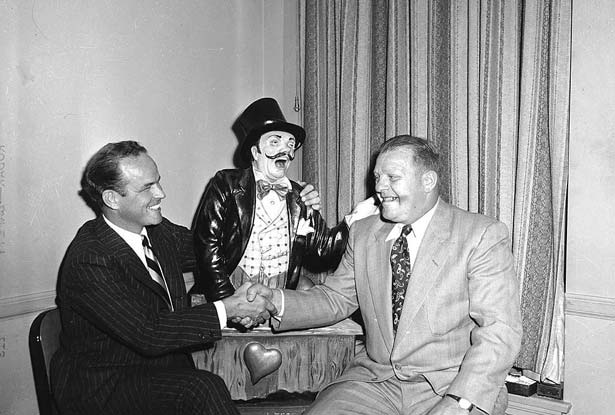
Maybe this guy is rightfully upset over his missing mascot, but if this creepy looking doll went missing, we’d be glad to see him go. (Although that ice cream head is kinda scary.)
Local burger purveyors learn valuable lesson: not even food deserves to be called “half-breed”

Holy Chuck Burgers is known for its twisted humour, but too much obnoxiousness is apparently a bad thing. According to the Toronto Star, a rush of customer complaints has prompted the restaurant to take two burgers off its menu: the Half-Breed and the Dirty Drunken Half-Breed. It seems the names were intended to be taken literally, since the burgers were half beef and half bacon. Unbeknownst to the owners at the time, “half-breed” is also a racial slur.
All of this could have been prevented with a quick consultation of the dictionary. Merriam-Webster clearly says that the term is “often offensive.” Try telling that to Cher.
Review: We’ve Totally (Probably) Got This

The Second City’s latest mainstage offering opens with an ominous voice announcing that “there’s a shit storm coming.” The quote is a riff on the Anne Hathaway line in this summer’s blockbuster, The Dark Knight Rises. In the movie, Hathaway, as Catwoman, foreshadows the film’s chaotic events. Thankfully, We’ve Totally (Probably) Got This is anything but chaotic. However, it does have its own dark moments.
As you probably already know, according to those pesky Mayans, it’s quitting time for Earthlings come Dec. 21. It’s no wonder, then, that The Second City’s last show for 2012 would dance with the devil in the pale moon light. Or maybe that devil is really just a bratty know-it-all kid (Jason DeRosse) who, after making his parents (Alastair Forbes and Stacey McGunnigle) feel like morons, says to them, “Remember, Lucifer was just a fallen angel,” reminding us that a tinge of darkness resides in everyone.
Whatever the case, the pulse of We’ve Totally (Probably) Got This races equal parts electrifying and ice-cold, and it’s in the jolts of “I can’t believe they just went there” where the show really finds its rhythm.
Such bits include the gals (Carly Heffernan, Ashley Comeau and McGunnigle) lamenting the lack of sex appeal found in Canadian women (“Thai boys are sexier than Canadian women”) before transforming into dancing, lisping Brazilians. Another stand-out moment is Nigel Downer going Chuck Norris on a group of pigeons who won’t let him eat his sandwich (particularly for Downer’s innate nimbleness and Bruce Lee-like facial expressions), as is the security guard sketch, where McGunnigle, Forbes and Downer all showcase their masterful agility and matching comedic timing.
A bus sketch that includes the participation of an audience member (in this case, a long-haired and bearded senior, and overall good sport, named John) was also fun, even if it ventured into Karen Klein territory.
But that’s what The Second City does best: it illuminates societal afflictions — however serious or stupid — and turns them on their heads.
Add in the fine direction of Melody A. Johnson and the innate chemistry amongst the ensemble (even if McGunnigle is a new addition to the cast, you wouldn’t know it), and The Second City’s got its most entertaining revue since Dreams Really Do Come True (And Other Lies).
Though I recommend seeing the show sooner rather than later out of pure enthusiasm, the production does run until the end of the year. In fact, the last listed date is Dec. 30, proving that, despite the dark underlining of We’ve Totally (Probably) Got This, the show remains optimistic that the world won’t end on Dec. 21.
As George Carlin once said, “The planet is fine. The people are fucked.”
We’ve Totally (Probably) Got This, The Second City, 51 Mercer Street, 416-343-011. Now – Dec. 30
Finally, chocolate bars and vigour unite as one

Here’s something Toronto doesn’t need more of: caffeine. But it’s getting more of it anyway. Awake, a new chocolate bar from local entrepreneurs Matt Schnarr, Dan Tzotzis and Adam Deremo, provides a solid caffeine kick — about 100 mg of the stuff, which is roughly equivalent to a cup of coffee (a 250mL can of Red Bull, by contrast, has about 80 mg).
But doesn’t chocolate contain caffeine anyway? Apparently, not a whole lot. Which means kids now have a whole new avenue towards chronic hyperactivity. Awake is available for $2.49 at convenience stores and gas stations across the country.
Emmanuelle Chriqui is back on screens this fall

For Emmanuelle Chriqui, former Entourage star and one of the Richmond Hill area’s hottest exports, the future is looking bright.
Returning to the screens this fall in a recurring role on CBS’s crime drama The Mentalist, with several other projects in the works and a bunch of charities to promote, the pace hasn’t let up for Chriqui following the finale of the long-running comedy drama Entourage last year.
“I feel like it’s going to be a busy year,” she says, speaking on the phone from Los Angeles.
Taking a look at Chriqui’s impressive resumé, there’s no reason to think otherwise. Since her big break in the 2000 hit Snow Day, she has racked up credits on shows including The OC and The Borgias.
Now living the star life in Beverly Hills, Chriqui still has deep roots in the GTA.
Chriqui moved to Toronto from Montreal with her parents when she was two years old, first living in North York before moving to the 905 where her family settled just outside Richmond Hill.
For the last 13 years, Chriqui has split her time between New York City and Los Angeles. But she says she still enjoys coming back to Toronto.
“There’s so much that I love about the city,” says Chriqui, who returns often to visit her brother. But, having lived away so long, she says the GTA has changed: “It’s not quite the Toronto I remember.”
Chriqui grew up with big dreams and the desire to be an actress. At the age of seven, she focused all her time and effort on community theatre in her neighbourhood. “There was a kid at my school who asked me to audition for his dad’s play at the Unionville Theatre Company,” she says. “I landed the role of a baby ghost — and I was absolutely hooked after that.”
As a teen, she attended Unionville High School, which specializes in the creative arts, and later joined the Arts York Drama Program.
Though ambitious and clearly talented, Chriqui was also realistic, when it came to her career, realizing that actors just starting out can’t always be choosy about the roles they take.
“I took whatever I was able to get,” she says, though she adds that she steered clear of “trashy stuff.”
Chriqui landed her first big role in 1999 when she appeared in the comedy Detroit Rock City, a story of a failed drummer striving for a second chance at fame. Then, shortly after, came her breakout role in Snow Day, in which she appeared alongside the likes of Chevy Chase. Chriqui describes the experience as the time of her life.
“Being able to shoot on location in Wisconsin and Alberta while bonding with the cast and crew was definitely my foray into big studio movies and the real Hollywood,” she says.
Chriqui, though, is most widely known for playing Sloan McQuewick in the testosterone-laden series Entourage, which ended after eight seasons last year.
“I want people to be talking about my work, not who I’m dating or what club I went to last night.”
Chriqui appeared in all but the first season of the drama, which is loosely based on the life of exec producer Mark Wahlberg and is essentially a Sex and the City for guys.
Originally, Chriqui’s character was scripted for only three episodes in season two, but she made such an impression she stayed around for the remainder of the series.
Sloan, the daughter of a retired movie-industry bigwig, spends most of her time agonizing over her on-again off-again relationship with her fiance (Eric Murphy, played by Kevin Connolly).
Hardly surprisingly, Chriqui says there aren’t many real-life comparisons between her and her onscreen alter ego.
“I wouldn’t compare myself to her,” she says. “I definitely think that Sloan is absolutely grounded. But her lifestyle is the complete opposite of mine.”
Chriqui is known to guard her privacy, liking to limit her public exposure to her time on the red carpet.
“I’m just an insanely private person,” she says. “I want people to be talking about my work and what I’m promoting or the philanthropic causes I’m affiliated with, not who I’m dating or what club I went to last night.”
One thing there are constant rumours about is the possibility of an Entourage movie. Wahlberg has said he wants to make it happen, and there were rumours of a script being developed, but so far, nothing concrete has emerged.
“They say there is a movie in the works, but I honestly have no idea at this point,” Chriqui says. “I hope the rumours are true. It would be amazing.”
Chriqui calls her time on Entourage “one of the most thrilling chapters of my life,” but there’s no let-up in the pace for the star.
Most recently, she has been working alongside Australian actor and director Simon Baker. The two share an onscreen romance in the The Mentalist, the hit series based around a “psychic” consultant for the fictional California Bureau of Investigation.
“It's just a really interesting role for me and like nothing I’ve ever played before,” says Chriqui. “It’s funny, you never know where that very creative satisfying thing really comes from and that’s what this has been for me.”
Of course, it’s not just her acting talent that has garnered attention. With more than a hint of classic Hollywood glamour about her striking dark looks, 34-year-old Chriqui makes frequent appearances on lists of the world’s beautiful women.
In 2010, she took the top spot on Ask Men online magazine’s Most Desirable Women list.
Though she acknowledges the attention, Chriqui is decidedly cool about it.
“It’s a really nice compliment, but I don’t think it really defines anything one way or another,” she says, though she adds that it was “pretty cool” to be number one for a year.
More important, she says, is her charity work, which is one of her main priorities. Among the causes she supports is Raise Hope for Congo, a project Chriqui pioneered that helps to raise awareness for the atrocities that have happened to women and girls in the area.
Alongside this organization, Chriqui has been a spokeswoman for Colon Cancer Canada for several years. Having lost both parents to this disease, she continues to be extremely active for the cause. Chriqui strives to promote early screening, pointing out that colon cancer has a cure rate of 90 percent if detected early.
“It’s a cause that’s very near and dear to my heart,” she says.
Chriqui remains tight-lipped about her plans after The Mentalist, saying only that she has a number of projects on the go, but they are in their early stages.
“There are a lot of irons in the fire right now,” she adds.
Matt Austin Sadowski prepares for his big moment

“Within my family there’s a famous story of me answering ‘Superman!’ when asked what I wanted to be,” explains Thornhill filmmaker Matt Austin Sadowski. “When my mom pointed out that only actors could be superheroes, I said, ‘OK, I’ll be an actor then.’”
A born and bred Thornhiller, Sadowski actually grew up surrounded by the world of film. His father ran a used-video shop in Thornhill, and Sadowski has fond memories of sifting through the bounty of titles. It was here that he found his love for film.
Although he is now known as a director, initially Sadowski pursued his acting dreams. Involved in theatre productions throughout high school, Sadowski would often smooth-talk his way into video projects instead of writing essays. It was at university that an agent helped him nab his first paid acting gig: a Tim Hortons’ commercial.
Though Sadowski has since tucked a roster of characters under his belt, it was his stint as Bridge Carson, the idiosyncratic green Power Ranger, in seasons 13 and 15 of the hit kids’ show that brought his work to a wider — and rather impassioned — audience.
“Bridge was a really misunderstood, weird character,” says Sadowski. “It was really cool to have a fan base of young adults who identified with that.”
Sadowski’s ability to empathize with the misunderstood has been threaded throughout his oeuvre.
Known for exclaiming “Buttery!” while wiggling his fingers, his Ranger’s catchphrase was actually coined by Sadowski himself, who uses it as an alternative to more common utterances.
“The writers decided to incorporate it into the show, never knowing it would take off like it did,” he explains.
The popularity of his character really hit home at Power Morphicon — a convention that draws nerdtastic fans clad head-to-toe in character outfits. “There’d be people literally lining up with sticks of butter for me to sign — or pieces of toast!” he says.
While spandex-clad cast reunions have yet to happen, the greatest part about being a Power Ranger was one that didn’t involve the green suit.
“There is a young kid who, as part of the Make-A-Wish Foundation, made a wish to hang out with me, play video games and eat pizza. That will be for a very long time the coolest thing that happened to me.”
Sadowski’s move from being in front of the camera to behind it was one that came naturally. Around six years ago, he realized that he was growing increasingly obsessed with the overall picture: his ability to focus on the dialogue was being eclipsed by thoughts on lighting, camera angles, music and so on.
As a child rummaging in his father’s video store, Sadowski had found himself particularly drawn to the work of director John Hughes (The Breakfast Club, Home Alone), who was known for his sensitive portrayal of young people.
“Hughes created a genre all by himself,” says Sadowski. “He made teens feel that their lives were important and meant something.”
So, for his first major directorial production, Sadowski chose to go back to his childhood roots and make a film about John Hughes. His documentary Don’t You Forget About Me shows Sadowski and three other filmmakers as they seek out Hughes — the highly influential director who had become a terrific recluse after years as Hollywood’s golden ticket.
“People respected John Hughes and his films. In turn, they seem to respect me as a filmmaker more.”
The doc was thrust into the spotlight following Hughes’ untimely passing and earned critical acclaim.
“People respected Hughes and his films a great deal, but even more after he died. In turn, they seem to respect me as a filmmaker more,” says Sadowski.
The film garnered international attention and propelled Sadowski to a place at the National Screen Institute.
Rather than plowing ahead with some brazen project, he chose to tighten up his filmmaker’s approach, creating a number of shorts instead.
The Butterfly and the Bee — a snapshot of two boxers bouncing around, waiting for their moments to strike — made an impact at the Vancouver Olympics, where it was shown on a Jumbotron in the athletes’ village.
This month, Sadowski will make his debut at TIFF with his latest film, The Tape, which screened at Cannes last May.
The short film stars actor Julian Richings and follows him on an unusual quest to unearth a VHS tape. The film examines the relationship between reality and memory — and where the two collide in the digital age.
“I think that shorter films have more poetry about them,” Sadowski notes. “For this particular story, I just thought it would work as a shorter film. I wanted more experience before I make my big debut opus.”
The idea for The Tape sprang from a long-forgotten event from Sadowski’s childhood. Determined a hazy memory wasn’t a figment of his imagination, he sought out the VHS tape that surely held the proof — but was unable to ever procure it.
Going stir-crazy after another short of his was held up in production, Sadowski dusted off an old script inspired by this experience and called up some filmmaking buddies. They quickly banded together, and the film was shot — from start to finish — in just one day. A couple of weeks later, he received a call for previously unseen shorts, not realizing it was for a Telefilm program bringing Canadian films to Cannes.
“It was a film that was never really supposed to be. It happened out of pure angst. Had everything gone smoothly, I never would have been able to make it.”
Anticipating his film’s TIFF debut, Sadowski also has plans to take in the rest of the short films at the fest.
“I think it’s really important to be invested in who my peers are,” he says.
As for the parties, expect to find him at Festival Music House, a pavilion of sorts that gives Canadian bands the opportunity to play for movie folk.
“I’m a diehard music collector,” says Sadowski. “It’s an event where you can be surrounded by people in the industry, without feeling like it’s schmoozy.”
When he’s not hanging out with the TIFF film stars, Thornhillers might bump into Sadowski at the Octagon. He has also, in his time, racked up the hours at one of his favourite places, the Thornhill Public Library.
So, what’s next for Sadowski?
Currently, he is directing the second season of HBO Canada series The Right Hand, an atypical look at the adult film industry. He calls it a “fish-out-of-water coming-of-age thing” which is set against the backdrop of “this train wreck of a [main] character.”
Next summer, he has plans for a feature film, which he describes as “An Annie Hall–like love story starring Canadian actors.” Could this be that big debut opus he was talking about?
First Draught: Southern Tier IPA

We Canadians can get pretty smug about how our beer compares to what’s made in the US. The problem is that we only have the upper hand, really, when it comes to the mass-market end of the spectrum. Our Blue is a bit less sweet than their Bud, light beer is less forcefully marketed here and old-guy brands that retain a bit of flavour — like Labatt 50 — live on thanks to our marketplace, where the brewers own the retailer.
But when I’ve had the chance to talk to the men and women who have opened small, independent breweries in Ontario, almost all of them credit the craft movement in the US as their inspiration. And the one beer that they most often call out by name is the IPA from Southern Tier Brewing Company.
Southern Tier’s standard IPA has the true amber-gold colour and herbal and citrus aromas that characterize the style. More than with other IPAs, the bitterness from the hops is supported by a toasted cereal sweetness. It reminds me of caramelized grapefruit slices.
Pairing an IPA with Indian food is a bit of an obvious layup. Better to try for the hook shot and set it beside the aromatic, floral-spicy flavours of Thailand or Vietnam, or to use this IPA’s strong-sweet flavours to echo the same in southern barbecue. Be careful with spicy food though; the chemical in hot peppers that creates the hot sensation is alcohol-soluble, so stronger beers like this one (6.5 per cent alcohol) can just spread the burn around instead of cooling things off.
With regular offerings like Muskoka’s Mad Tom, Double Trouble’s Hops & Robbers and seasonals like the Beaver River IPA from Beau’s, Ontario is really starting to run with the competition from the States. This IPA is still worth checking out as one of the beers that set the style.
Southern Tier IPA, $12.75 for a six pack, LCBO #81737
When David isn't busy drinking beer for his articles here, he writes about food and drink for Toronto's online publications including his own site, Food With Legs. For more of his thoughts on beer and life in general follow him on Twitter.
Liane Balaban is back in the spotlight

Most people prepare for their first day at a new job by buying a new shirt or cleaning their shoes. For North York–born actress Liane Balaban it was a stint in front of YouTube learning how to take a dog’s pulse.
Balaban will be hitting screens this fall in the new season of the CW’s demon-fighting series Supernatural, in which she plays the love interest for leading actor Jared Padalecki. In addition to being Padalecki’s character’s squeeze, her character is also a vet.
“I thought at least I’d have something to do with my hands when faced with a canine,” says Balaban, explaining her decision to teach herself animal diagnostic procedures from Internet clips.
To her relief, she found, when she turned up to the set, she wouldn’t need to fall back on her YouTube training — the producers had brought in expert veterinary advisers to show her how it’s done. “They showed me how to hold operating pincers and how to swab a wounded animal,” she says.
Balaban is arriving on the hit drama in its eighth season, and she likens joining such a well-established cast to being “the new kid in school.” But, she says, “Luckily everybody is nice. And happy because they are making a show that really works.”
Born and raised in North York, where she attended Lawrence Park Collegiate, the Genie Award–nominated actress first found fame in 1999 with her charming portrayal of Moonie Pottie in New Waterford Girl.
After a stint studying journalism at Ryerson, Balaban decided to concentrate on acting and has been a regular face on screens large and small since. In addition to a string of guest roles in series like NCIS: Los Angeles and Covert Affairs, Balaban also starred in Last Chance Harvey, acting alongside Dustin Hoffman.
In Supernatural, Balaban will be playing the role of Amelia. Although producers are staying tight-lipped on exactly where her character is headed — even Balaban doesn’t know — it seems that, whereas Padalecki fights the bad guys from the underworld, Balaban might have some inner demons of her own to slay. Her character is described as having a “damaged soul.”
The actress, who previously appeared on sci-fi drama Alphas, is excited to be getting into the fantasy adventure series. Having previously spoken about her passion for women’s issues and the portrayal of women on the screen, Balaban points out that sci-fi and fantasy genres often present “more rich and empowering” female characters.
Being an actress, Balaban has found it impossible to avoid the siren call of L.A. She moved there two years ago and says, “It’s a great city, full of creative people, parks and with lovely weather.” Nobody is ever going to describe Toronto’s climate as lovely, but Balaban will always consider it home and comes back regularly.
Last year, she returned to Toronto to star in the theatre adaptation of Michael Ondaatje’s Divisadero, which marked her stage debut.
When she’s not here working, Balaban likes to take in the North York neighbourhoods where she grew up (“It has changed so much since I lived there,” she says) and her old hangouts, like Mitchell Field swimming pool and Abbotsford Park. She also likes to drive by her old middle school, Willowdale on Senlac Road.
If you’re downtown, you might also spot her in Chinatown as she has a passion for Mother’s Dumplings restaurant.
“It’s the films like Nuit #1 that make TIFF exciting, more than the stars and glamour.”
But Toronto is far from the only place you’re likely to find Balaban. This summer has been a coast-to-coast Canadian journey for the actress, who films Supernatural in Vancouver but also found herself in Newfoundland filming an indie flick.
In fact, when I contact her for this interview, she is sitting in the Two Whales Café in the tiny town of Port Rexton. Clinging to Newfoundland’s Atlantic-facing coast just north of St. John’s, it’s about as far east as you can go in Canada.
Balaban is in that far-flung part of the country filming The Grand Seduction, an English-language remake of the 2003 Quebecois film La grande seduction (also known as Seducing Doctor Lewis).
The film, which is being directed by fellow Torontonian Don McKellar sees Balaban play yet another love interest. (Considering she has a look that’s distinctly reminiscent of Black Swan star Natalie Portman, it’s not hard to see why she gets these roles.)
This time, her leading man is Taylor Kitsch who, having had a tough time at the box office with John Carter and Savages, is taking a break from the big-budget blockbusters to play the role of the doctor. Balaban takes on the role of the local post mistress who catches Kitsch’s eye, though his feelings aren’t necessarily returned — Balaban’s environmentally minded character being more concerned with an oil reprocessing plant that’s opening up in the community.
“It’s a funny, touching script about a community trying to lift their town out of economic disaster,” says Balaban. “That’s a situation many people can relate to right now, with the economy in such a slump and the closing of so many factories in the U.S. What I love most about it is the ensemble aspect, people rallying together for a good cause.”
Though she doesn’t have a film in this year’s TIFF, Balaban says she loves the film fest. Last year she was on the Canadian features jury, judging films like Monsieur Lazar and Nuit #1. “It’s the films like the latter that make TIFF really exciting, I think,” she says, “More so than the stars and glamour, it’s the revelation of new talents.”
Having established herself as an actress in a cutthroat industry, Balaban occasionally speaks at Reel Canada events, a program that screens Canadian films in Canadian high schools. Despite all her TV and movie credits and the stars she has worked with, it’s one of her lesser-known roles that get the school kids interested: Balaban provided the voice of the crazy Lucrezia Borgia in the video game Assassin’s Creed: Brotherhood.
“Doing Assassin’s Creed has given me serious cred with teenaged boys,” she says.
Balaban is also involved in a project that’s aimed squarely at the other half of that high-school audience. Balaban, is one of the creative forces behind Toronto-based website Crankytown.ca. The site, which was founded in 2011, is designed to give teen girls information about their menstrual cycle through short online films.
Balaban is currently working with Toronto-based iThentic video website on a series of comedy shorts for Crankytown, featuring actors such as Jessica Paré (from Mad Men) and Ryan Cartwright (from Alphas).
Whether she’s fighting demons, period pain or economic hardship, the future looks bright for Balaban.
The rise of Rachel Skarsten, Hollywood’s next it girl

Most of us never get a crack at Hollywood, but Rachel Skarsten is already on her second big break. At age 27, almost 10 years after leaving Tinseltown to focus on her academic career, the Bayview native is making a name for herself — both in Los Angeles and back home in Canada. A mundane life was just not in the cards for Skarsten.
Speaking from Toronto, where she’s currently shooting two Canadian television series, Skarsten is articulate and animated as she describes how she fell into acting as a child and then rediscovered it in adulthood.
“I never naturally gravitated toward acting in grade school or high school,” she says, “but now I’m starting to see I’ll probably be an actor forever.”
Like so many child performers, Skarsten’s early career was launched by an unexpected phone call from an agent. Yet there’s a sad twist in her narrative: Skarsten’s story begins with the sudden loss of her father to cancer when she was only nine.
“Losing my father was absolutely devastating, but we all have our crosses to bear,” she says resolutely, before explaining how the family calamity indirectly led to her first acting gig. A televised tribute was planned to honour her father’s work as a psychologist, and Skarsten was asked to sing.
Her TV appearance was followed by the agent’s call — “Your daughter would be great for acting” — and with the choice left up to her, Skarsten opted to head out on her first audition.
“It was for a Honeycombs commercial. I was such a newbie and had no idea what I was doing, but somehow I booked it,” she says.
By her teen years, Skarsten was an accomplished competitive hockey player who happened to have acting credits under her belt such as TV’s Little Men and the feature film Virginia’s Run. Her priorities were clear. “I always had to do acting on the side because it was important to our mom that my brother and I not only complete high school but go on to higher education.”
Despite this effort to remain grounded, Skarsten couldn’t refuse an offer from the WB network for a role in its new show Birds of Prey. “I sent the director an audition tape I had made one day after school,” she recalls, “and the next thing I know, they’re welcoming me to the WB.” Skarsten had officially landed her first major leading role at age 17. But full-time taping in L.A. and full-time school in Toronto were not exactly compatible endeavours. An incredibly hectic time followed, with endless flights between the two cities, on-set tutoring and a measly 13 actual in-the-flesh days at school. Somehow, the work had consumed her life.
“In my mind, acting had just been another extracurricular activity,” she says. “I didn’t realize I had signed an adult contract with adult expectations and adult commitment.”
When Birds of Prey was done taping, Skarsten made her first adult decision. She worried that if she accepted any of her L.A. job offers she would be sucked into the business and never complete the schooling that was such a priority.
“I really did feel like I missed out on high school, and it was very important to me to have the experience of university at an age-appropriate time,” she says. So just like that, she turned her back on acting and headed to Queen’s University to study history and literature.
“I would love to do more films like Two Hands to Mouth. It was so artistically thirst- quenching.”
What does a former child actress do with a B.A.? Get a job, of course. And then another and then another. Back in Toronto and living at her mom’s house, Skarsten cycled through a series of dissatisfying gigs, including a stint as manager of Abercrombie & Fitch in the Eaton Centre.
“I think I was aspiring to become a retail mogul,” she jokes. Somehow that didn’t pan out.
Skarsten was aimless and lost. “I said to my mom, ‘I’m so bored! I don’t know what I’m doing. I need an adventure.’ ” And Skarsten’s mother, in a flash of parental intuition, responded simply, “Why don’t you just go back to L.A.?”
One week later, Skarsten was in her car heading south. This time around, Hollywood was not quite so welcoming. “It had come so easily when I was younger, but in L.A., five years away is like a lifetime,” Skarsten says, recounting the uphill battle she fought to resuscitate her career. “I was living on a cash-in, cash-out basis. I really had to pound the pavement and put myself out there.”
In between auditions and meetings with casting directors, Skarsten even cleaned houses to keep afloat, and she reaped the benefits of her labour. She scored bit parts on shows and in TV movies, getting herself noticed all over again.
Then just this year, she landed a major role in Canadian writer-director Michael DeCarlo’s soon-to-be-released independent movie Two Hands to Mouth, a dark comedy about an exclusive dinner at a restaurant that goes terribly awry, forcing guests to defend themselves and their morally bankrupt lives.
When Skarsten went in to audition for the part of Leah, a lovesick dinner guest, she was taken by DeCarlo’s passion.
“As I was auditioning, Micheal stopped me and then stepped in to take over from the reader to run through the lines with me himself,” Skarsten says. “He pushed me to go much further in my interpretation, and I thought to myself, ‘This is someone I really want to work with.’ Thankfully, he felt the same way.”
The experience of making the movie was accordingly challenging but rewarding. The small ensemble cast spent the entire shoot together, filming the majority of their scenes in one room and staying on the same floor of a Hamilton hotel.
“It was a very intense month, but I came away from it with some dear friendships,” says Skarsten, “and I would love to do more films like Two Hands to Mouth because it was so artistically thirst-quenching.”
After cutting her teeth on that experience, Skarsten is back in Toronto busy with Lost Girls and The L.A. Complex. Unsurprisingly, in both shows she is portraying powerful (if malevolent) women. “Lost Girls’ Fae Tamsin is brash and lacks any social graces but she’s also funny and bold,” Skarsten says.
“On L.A. Complex, Roxanne is manipulating one of the main characters for her own purposes, but she also cares for him, so I have to play her as sincere yet calculating.”
Since both shows tape at the same time, Skarsten has her two hands full jumping between characters and sets, but she still manages to eke out some quiet time at her local bookstore.
Above all, she’s looking forward to the future, having gained an appreciation for her work that she never before felt.
“Even though I was dirt poor when I first returned to LA, I really honed in on my true desire: I realized acting was what I wanted to do. And after working so hard to get here a second time, I feel immensely grateful.”
Time for Cronenberg 2.0

Brandon Cronenberg stopped paying attention to his dad, iconic Canadian film director David Cronenberg, years ago — about the same time the former Republic of Rathnelly resident decided to carry on the family tradition and become a filmmaker himself. When he got into the racket, he knew he’d be put under the microscope, he knew there would be naysayers, and he knew enough to ignore his father’s body of work and concentrate on his own ideas and his own interests. Here’s the catch. The apple doesn’t fall too far from the body-horror tree, and despite his best intentions, there are many striking similarities between his first feature film, Antiviral, and the work of his father. Lucky for us because Antiviral could be the most exciting Canadian film to hit the big screen in 2012.
“Well, I grew up with him,” says Cronenberg, during a recent interview at the offices of Rhombus Media. “So, there is some overlapping of our interests and tastes. But I don’t know, if I obsessed completely over it, it would bomb for sure.”
Antiviral, which makes its Canadian premiere at this month’s Toronto International Film Festival, is memorable and moving whether made by a Cronenberg or anyone else. Stark, chilling and thought-provoking, Antiviral is bolstered by some wonderful performances including the utterly marvellous lead Thomas Landry-Jones alongside local thesps Sarah Gadon and Douglas Smith as well as legendary British actor Malcolm McDowell.
It is set in a world a slight sidestep from our own where obsession with celebrity has gone overboard to such an extent that the buying and selling of celebrity viruses is big business.
The film opens with Douglas Smith’s character heading into the offices of the Lucas Clinic to purchase himself a brand spankin’ new cold sore that once perched lovingly upon the lip of mega-star Hannah Geist (Sarah Gadon). Needles are involved. Full penetration. But as Cronenberg says, “If you're discussing disease as a sex metaphor, there has to be penetration!” Ahem.
The rather disturbing opening sets the stage for a romantic thriller, in a very roundabout sort of way, that results in a dark, satirical portrait of celebrity culture and its ongoing commodification. The premise, says Cronenberg, who had been working on the film since 2004 while a film student at Ryerson University, was inspired by — no surprise here — a nasty virus.
“I went through this sickness, this intense flu, and I was obsessing over it,” says Cronenberg, “the physicality of illness, that there was something in my cells and my body that came from someone else’s. There is a weird intimacy to that connection.” Insert shudder here.
The plot took shape thanks in small part to Sarah Michelle Gellar — everyone’s favourite vampire slayer.
“A friend of mine said he was watching Jimmy Kimmell one night and Sarah Michelle Gellar was on the show,” Cronenberg explains. “She said she was sick and if she sneezed she’d infect the whole audience, and everyone just started cheering.”
Not too surprising coming from a society that has commodified celebrity like no other. Remember that rotten tooth of late Beatle John Lennon that sold for $30K on eBay? So does Cronenberg. Maybe signing up for a needle filled with the Justin Bieber cold sore virus isn’t such a stretch now is it?
Of course, by the end of Antiviral, which Cronenberg describes as a “romantic comedy,” ahem, the obsessive behaviour reaches even greater and profoundly darker heights thanks to the über-creepy performance of Landry-Jones, who portrays Syd March, a salesman turned viral trafficker (it’s a long story).
“If the film didn’t stand up, he’d be crucified.”
“I kind of wanted a character who seemed to be a good window into that world, position themselves as having this sort of distance,” says Cronenberg, of Syd March. “At the end, we figure out he’s motivated by the same obsessive impulses, and I guess I was thinking that celebrity culture is something easy to step back from and find extremely grotesque and make fun of, and I do, but at the same time, we’re sort of defined by the environment and can’t help but be affected by it."
The object of obsession through most of the film is celebrity Hannah Geist, played by Gadon, who has had the rare opportunity of starring in a film for the elder and junior Cronenberg (she was in David Cronenberg’s A Dangerous Method as well as Cosmopolis). She has a unique perspective on the two, as a result.
“Brandon has all the intellect and darkness of his father, yet there is a sensitivity that exists in him in this moment in time,” she says, “a sensitivity that surfaces in his filmmaking. It’s what allowed him to get to the heart of the beautifully twisted but fragile closeness we have with celebrities."
Cronenberg grew up on his dad’s film sets and in the fabled Republic of Rathnelly neighbourhood nestled between the Annex and Casa Loma in Toronto. A self-described “nerd,” he spent his time reading books, playing video games and dreaming of becoming a rock star. His interest in wanting to become a writer, as well as his love of music and visual arts, made filmmaking an easy choice where he could put all three to go use.
And this past spring it all came together for him. In May, the clan Cronenberg was in France where Brandon Cronenberg’s first feature had the rare honour of premiering as an official selection at the Cannes Film Festival alongside his father’s latest, Cosmopolis (with sister Caitlin shooting photos for the New York Times).
This in addition to Antiviral having its Canadian premiere at this month’s Toronto International Film Festival. That’s huge, says producer Niv Fichman.
“It is extremely rare for a first feature to premiere in Cannes as an official selection,” says Fichman.
“And it is probably the first time in their history that a father and son had films the same year.”
But, even if Cronenberg gets a little attention as a result of his dad’s track record as one of the country’s most successful filmmakers, Fichman says, at best, it is a double-edged sword.
For every door that opens, there is an immense amount of pressure to walk through and have your film scrutinized by every two-bit blogger with wireless Internet and a intense need for validation.
“I was expecting a lot of hostility even when I got into films in general,” Cronenberg explains. “I guess because my dad makes film, and I just thought that’s the way people were. I hadn’t gotten that, but actually now I have gotten it … people who haven’t seen the film, who don’t know anything about me, who happen to dismiss me because my dad makes films.
“If the film didn’t stand up, he’d be crucified,” says Fichman, who financed the film through the unique First Time Filmmakers Initiative he set up along with Alliance Films that has also turned out Hobo with a Shotgun and The Boy Who Smells Like Fish, among others.
Fichman saw potential in the young Ryerson University student when he caught Cronenberg’s short film Broken Tulips at the enRoute Film Festival in 2008 — a five-minute gem that would eventually become Antiviral.
“I was very impressed with the film but more impressed with the idea and where it was going to go,” Fichman explains.
Antiviral has its North American premiere at TIFF this month, followed by its theatrical release in October. Check out the creepy trailer at www.youtube.com/watch?v=XIZb50HiBCo.
World-class director Deepa Mehta comes home

You would never expect that a celebrated director, whose work explores such complicated and controversial issues as child widows in colonial India and domestic violence in immigrant families, would find inspiration in the mundane mishaps of Toronto’s mayor, Rob Ford. But in fact, Deepa Mehta claims that our fair city and all its colourful inhabitants provide a bottomless well of ideas for characters and stories she pours into her films.
“A lot of people have landed in Toronto by way of other places,” Mehta says in explaining what makes our city particularly interesting. “That makes for a lot of good stories to tell. It is very alive and has a strong appreciation for good food, art, culture, movies — all the things I love. And Mayor Ford — hard one to beat for amusement,” she jokes from India, where she spends the balance of her time, when not at her Annex home in Toronto.
Her attention to detail and interest in the nuances of everyday relationships led her very naturally to working with acclaimed author Salman Rushdie on her latest film, Midnight’s Children, premiering at the Toronto International Film Festival this month. Like Mehta, Rushdie’s work often deals with post-colonial topics, drawing from history and real-life experiences, which he then twists into magic, surrealist tales. Midnight’s Children, his second novel, was published in 1981 and an instant success, catapulting the Indian-British writer to the top of the literary A-list.
Over the past three decades, he was approached several times about turning the book into a film, and more than once it was attempted — but ultimately, for one reason or another, it failed to get made.
And even though Mehta became the first successful filmmaker to take on this complex book as a subject, it took her several years to even conceive of the project.
“I read Midnight’s Children in the winter of 1982 in Delhi,” she says. “I remember distinctly talking about the wonder of it all with a friend — specifically about the cinematic nature of the writing. But the thought of filming it never crossed my mind. I think I was too much in awe of the novel to even think about an adaptation.”
Fast-forward 26 years, and Mehta and Rushdie are sitting across from each other in a Toronto restaurant discussing this very idea. It was as simple as Mehta feeling suddenly and inexplicably prompted to ask who owned the rights to the book. “To this day, I don’t know what made me ask about Midnight’s Children,” she says. “But I did.”
When Rushdie explained that he, in fact, still owned the rights, Mehta didn’t hesitate in asking him next if she could option it. He immediately replied yes. “It was that simple,” Mehta says.
Since then, Mehta and Rushdie have enjoyed a very close working relationship, collaborating on everything from creating the script to casting the actors — Rushdie even provides voice-over narration in the film, which traces the lives of two babies switched at birth in a Bombay hospital at the hour India proclaimed its independence from Britain. What follows is the chronicle of a nation struggling to redefine itself, told through the intertwining lives of children who possess special powers by virtue of being born near the hour of India’s own rebirth.
“Toronto has a strong appreciation for food, art, culture, movies — all the things I love.”
The story deals with some controversial aspects of India’s history — subject matter which Mehta, who was born in Punjab and studied in Delhi before moving to Canada in 1973, has never shied away from. Her 2005 film Water, for which she received an Oscar nomination for Best Foreign Language Film, explores the lives of five widows living at an ashram in Varanasi, the oldest city in India. Filming was interrupted by violent protestors who went so far as to burn the set, throwing pieces of it into the Ganges River, angry that her film would portray their cultural history in a negative light. In the end, the cast and crew relocated to Sri Lanka where the film was ultimately completed.
Almost a decade earlier, Mehta similarly faced backlash for Fire, the first film in her Elements trilogy, which Water concludes. One of the first mainstream films to deal openly with homosexuality in India, Fire itself came under fire after its release and theatres in Mumbai were stormed by protestors.
But in both cases, the films also got people talking, and that is ultimately what Mehta hopes to achieve when she sets out to create a film: “Often my goal is to reveal what is not being said,” she explains. Perhaps, for that very reason, she remains undeterred by the harsh criticism she faced.
“I have realized the importance of letting the product speak for itself. I can only concern myself with one thing at a time and, most often, that is making the best possible film. Sometimes that means changing locations or having to work a little bit harder.”
Unlike Water, Midnight’s Children was shot in more than 60 locations. “The film was a massive undertaking,” Mehta admits. But now that it’s wrapped up and about to make its debut, she describes the experience as her proudest accomplishment to date — more than her Oscar nomination, her Genie Award (for 2002’s Bollywood/Hollywood) and even the success of her company Hamilton-Mehta Productions, co-founded with her husband, producer David Hamilton, in 1996.
“I can only hope that it is received with the same love I put into it,” says Mehta. “I hope that the audience is pulled into another world and swept into the narrative of love, family, war and death for the two-and-a-bit hours they sit in the dark.”
Back home in Toronto for the festival, she says she’s looking forward to reconnecting with the actors and crew to celebrate this huge accomplishment. No doubt, she’ll also spend some much-needed downtime with family and friends at her favourite neighbourhood haunts, the Host restaurant in Yorkville and Middle-Eastern eatery 93 Harbord. But true to form, it won’t be long before her work takes her to another exciting locale. Next up: the south of France, where she is directing a film called Matisse, about the painter and his muse. “Though it’s lovely in its own right, I’m not sure Toronto has the right look for that,” she jokes. “But I love shooting in Toronto — doing Bollywood/Hollywood here was great fun. I certainly hope to be making another film here in the future.”
Perhaps a biopic of Rob Ford?
Patrick J. Adams is the small screen’s man of the hour
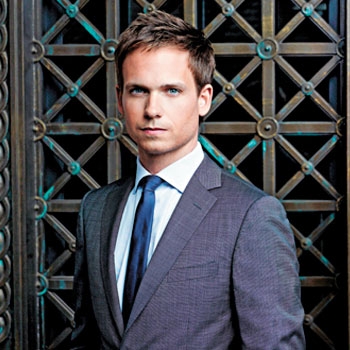
Patrick J. Adams is one of those actors you’d never heard of until one day you suddenly started noticing him everywhere: those impossibly bright blue eyes staring down at you from seemingly every billboard in the city, his chiseled face flashing across your TV screen, his character Mike Ross coming up as the topic of water-cooler conversation as your co-workers discuss last night’s episode of Suits (which airs on Bravo in Canada), the runaway hit TV series that’s catapulted him to fame.
You’ve probably even found yourself Googling him, eager to find out more about the up-and-coming heartthrob and his gorgeous celebrity girlfriend, Troian Bellisario (sorry, ladies).
What you might be surprised to discover is that the self-proclaimed movie nerd got his start right here in Toronto.
These days the multi-talented 31-year-old is TV’s man of the hour. And it’s no coincidence that Adams is raking in accolades for his work at the same rate as he’s accumulating Twitter followers and diehard fans. He is and always has been driven to make it big.
Adams spent his teen years enthralled with film and acting — passions that dragged him uptown on a daily basis.
“Northern Secondary School had this incredible, world-class theatre program,” Adams says of his chosen high school, “and when I saw it at work, I thought, ‘If acting is really what I want to do with my life, there’s no better high school than this one.’ ” Not many teens are so goal-oriented as to sacrifice an extra hour of sleep every morning, but Adams was able to think long-term, and his commute from the Beaches paid off.
“In that class, I saw the real power of film, television and theatre in action for the first time. All the typical high school barriers shattered when you walked into the drama studio, and it didn’t matter who you were or where you were from. Suddenly everybody could be part of the conversation.”
For Adams, drama was already serious business. It follows suit that, when his mom told him he had to get a job, he could only conceive of working at the now-defunct York movie theatre at Yonge and Eglinton. There, he was completely in his element, enjoying sneak-preview screenings, taking home movie posters and nerding it up with other budding film buffs.
“I had to seek out my own sense of confidence to attain the things I’d wanted for so long.”
Yet for all his movie mania, Adams headed off to the University of Southern California, not to study film but to study theatre. Again, this was strategic, long-term planning on his part.
“I sensed early on that the actors that seem to go a little deeper and understand the craft on a different level were those who started in theatre,” says Adams. Here again, there was a sacrifice involved in his decision: not a naturally assertive person, he was devoting himself to at least four more years of battling stage fright. “You can’t really hide when you’re on a stage, which I appreciate even though it terrifies me most of the time,” Adams says.
Armed with his degree and his determination, Adams settled in L.A. and quickly learned that, despite his diligent preparation, movie stardom was not going to just fall into his lap.
“When you get out of school, you realize that about 99 per cent of the acting jobs in the industry are in television,” he explains.
Drawn as he was to movies, he wasn’t burning to be on TV, but business was business, so Adams turned his attention to the acting medium he’d spent the least time with, watching recommended TV shows, decoding the strengths of the format and coming to appreciate its uniqueness. Within a matter of weeks, he was also landing gigs.
Soon he was popping up with small parts on the likes of Friday Night Lights, Lost and Pretty Little Liars, and as the list of credits to his name grew longer, his friends dubbed him the “professional guest star.”
While this tenuous position stretched on a little longer than he might have liked, Adams took full advantage of the time to experiment and grow as a television actor. “Unless you’re a real natural in front of the camera, you’ve got a lot to learn,” he says. “That time taught me a lot about how to handle myself on the set and how to do what I love to do in front of the camera.”
Then in 2010, after a rough year of false starts (and even being fired from a role on an ill-fated NBC series), Adams got the opportunity to show he was the real deal: in a starring role as a fraud.
On the runaway hit Suits, Adams’ character, Mike Ross, is a brilliant con man gifted with photographic memory who bumbles his way into a position as an associate at a top Manhattan law firm. Only thing is, he has no law degree.
Today, Adams says he understood the character instantly. “I don’t necessarily connect to Ross’s genius, which for me is the acting part,” he says wryly, “but what I do connect to is the emotional core of the guy. When we meet him, we can tell he’s never had the necessary faith in himself to do the great things he’s capable of.” Admittedly, Adams is describing both Ross and himself, men whose first step to success was accessing their own inner strength.
“I really related to Ross because I had come to a place in my own life where I had to seek out my own sense of confidence to attain the things I’d wanted for so long,” says Adams. Photographic memory and fraud aside, he and his character are a perfectly matched pair.
That fact has not been lost on viewers of Suits. Though the show has only been on for two seasons, it’s been an instant success, racking up high ratings both in the U.S. and Canada. And Adams himself has already been nominated for a Screen Actors Guild Award for best actor in a drama series.
And in Toronto (where Suits is filmed) and L.A. (where Adams spends the balance of his time), fans frequently stop the affable actor in the street to tell him they’re rooting for Ross. You can’t help but also root for Adams, who’s back on his home turf doing the work he loves and — true to form — making the requisite sacrifices.
“The shooting schedule is so all-encompassing that most of the time I don’t even know what city I’m in,” Adams says. “But in the little downtime I’ve had, it’s been excellent to reconnect to Toronto and learn it as an adult. I’ve been figuring out the neighbourhoods, finding amazing food and reconnecting with my friends from high school. Sadly I only have a very, very small window of time. I can usually only grab an afternoon to go sit in Trinity Bellwoods before I’m back on set again.”
If his run on Suits is any indication of things to come, Adams is going to have to get used to the frenzied pace. Given the foresight and determination demonstrated in his career thus far, there’s no doubt this is only the beginning of a meteoric rise to the top of the A-list.
