
Home Blog Page 697

The host with the most

0

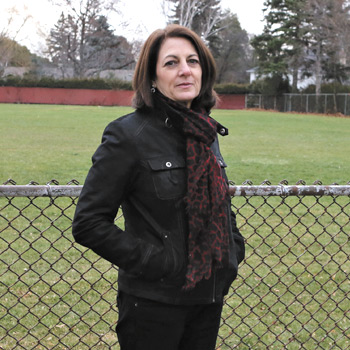
The keen sense of planning and organization that television host Anna Wallner demonstrates in her W network TV shows may have developed during her high school years. The Toronto native carefully managed her workload to graduate a year early and earn the Ontario Scholar distinction for her high marks.

“I had no idea what I was going to do, but I don’t remember feeling any pressure to decide at the time,” says Wallner, who attended Don Mills Collegiate Institute. “I felt like my teachers and parents were really good about encouraging me to take subjects that interested me.”

Shortly after graduating, the Toronto native moved across the country to attend the University of British Columbia and then packed her bags once more to head all the way east to Halifax for her master’s degree in journalism.

Wallner initially wanted to be a war correspondent and was a reporter for Global News in Vancouver in 1994. But eventually her interests shifted course and she launched the Shopping Bags, Anna & Kristina’s Grocery Bag and Anna & Kristina’s Beauty Call shows with her long-time friend and co-host, Kristina Matistic.

“It’s funny, when I see myself on TV, I see my mother,” says Wallner. “My mother was a caterer [when I was] growing up, so she was definitely my earliest influence in terms of trying new things. She could take the simplest thing and make it fancy, and I remember being so impressed by that.”

Although she has settled down in Vancouver, Wallner flies to Toronto several times a year to visit her mother and other family members, many of who still live in the Bayview neighbourhood.

“I love [it there]. A lot of cool people came from [the area],” says Wallner. “I think it was an amazing place, growing up, and I feel very fortunate.”

But flights back to Toronto may be fewer now that Wallner and her co-host, Matistic, are preparing to launch a new television series that will take them to exotic places around the world.

“I can’t say what it is, but it’s certainly high drama,” says Wallner, who has also been busy revamping the television duo’s website into an online lifestyle magazine. “It’s a spinoff of our cooking show. It focuses on food, but so much more than food. It takes us right out of our element in every way.”

Sending your child to camp helps

0

A mother called me. Her son is 15. Has friends but not many. Doesn’t get together much with them. Sits on the computer all weekend. Kind of like me at that age only I was reading those antiques called books, and my mother’s most common form of address to me was: “Can’t you ever get your nose out of a book?”

This mother was distraught, as I’m sure my mother was. The worry is that the socially awkward, lazy teenager will never get it together. He/she is not going to be on the hockey team, let alone captain it. He/she is neither popular nor athletic, and the parents desperately want one (or both) of those for their child.

As parents, we all want that. We can’t help it. Wanting our child to be a certain way seems to be in our parental DNA.

And that’s the real reason for summer camp. It’s for us, the parents, as much as for the kids.

I include myself in this group. It’s almost as if we love our children too deeply and too passionately to let them be who they are. As I said to the mom on the phone: “Is he doing all right in school?… Is he doing drugs?… Drinking? Being more than normally hostile for his age? Staying out all night?” Her answer was no to all questions.

So I told her to back off and let him be. But that is perhaps an unattainable goal. And that, precisely, is why kids in general and adolescents especially, need and love camp. Camp is the antidote to parental attempts to control our childrens’ lives. We think they love camp because of activities or friends, but we’re wrong. They love it because we’re not there.

And that is the great value of summer camp — more needed now than for any previous generation of children because we, their parents, are more control obsessed than they need us to be, and they need time off from our craziness. Why are we like that? For one, we belong to the first generation of professional parents. We have blogs, speech makers, parenting and school consultants and a section in the Kindle bookstore with 32,172 titles!

All these experts are telling us how to do it … perfectly. Which is, of course, impossible and makes us simultaneously well-informed and overcontrolling, thanks to the illusion of possible parenting perfection.

Our anxiety about the world is the second reason for being control freaks. Is the world a scarier place than the one we grew up in? Is there more abuse, more bullying? Are there more attacks on children? Nobody knows the answer to those questions but for sure we have more information on those perils because we’re parenting in the instant info age — which raises our anxiety level, which in turn raises our desire for control.

The problem of information is the third reason for our difficulty. We know too much, and our appetite for info about our kids is insatiable. This is not helpful. Our addiction to info about them does not make their lives better — or ours. It likely has the opposite effect on both us and them. Take the story of the bicycle.

My young adult daughter rides her bike everywhere, including in the winter. When she comes home for dinner, I experience anxiety about her riding her bike back downtown, and I make her call me when she arrives. She says I’m silly because the other six nights of the week I neither know her whereabouts nor require a phone call when she gets home. She’s right. In this case (and in too many others) my knowledge does not make her safer.

At summer camp, kids get to cut the umbilical cord. They love and miss us because we are not there to annoy them by trying to control them. When kids go to camp and parents cede control to other adults who let them be who they are, kids become resourceful and independent. They grow confidence in their independence, which is hard to grow when somebody is always on your case.

This is the great gift of camp.

First Draught: a flavourful winter ale from Granville Island Brewing

0

What distinguishes a craft beer from a large-scale beer? As the market share slides toward newer, smaller brewers, and the older, behemoth competitors find new ways to keep customers, that question becomes more relevant. Big beer companies are resorting to a number of tactics to stay in the game, including starting their own microbreweries or buying existing ones.

Vancouver’s Granville Island Brewing has been owned by Molson Coors since 2009. Once under a macrobrewery’s branded umbrella, it can be difficult to objectively separate noteworthy flavour from crafty marketing, but Granville Island’s Lions Winter Ale — which has a well-deserved, devoted following — stands out as a remarkable, flavourful exception.

Out of the can and into a pint glass, the colour is clear ruby and brown. The aroma leans on sweet, dark fruit with hints of Christmas spices like cloves and cinnamon. On first sip, flavours that remind me of milk chocolate and licorice allsorts continue the Christmas candy theme. Compared to the taste and aroma, the carbonation, body, and head of the Lions Winter Ale are just average.

A wide distribution network is one of a macrobrewery’s greatest advantages. In this case, Molson Coors devoted the resources to the LCBO’s product approval process to get the Lions Winter Ale listed here. That means Ontarians no longer need to depend on six packs smuggled back from B.C. by friends visiting family for the holidays.

Granville Island Lions Winter Ale, $2.85 for a 473 mL can, LCBO #321877

In addition to covering beer, new restaurants and food trucks for Post City, David writes about food and drink for several Toronto publications including Spotlight Toronto and his own site, Food With Legs. For more of his thoughts on food, beer and life in general, follow him on Twitter.

Rapid transit plans upset local residents

0

A bus lane route planned to stretch along Highway 7 from Markham to Vaughan is alarming some residents near Bathurst and Centre Streets.

Along some parts of this planned route, York Region Viva bus rapid transit’s rapidway project will create bus-only lanes and stations to speed bus service and eventually connect the area’s future subway extensions. A segment of the route will run along Highway 7 from Yonge Street, detour down Bathurst and Centre and end at Bowes Road. It will have 7.6 kilometres of bus-only lanes and four bus stations.

According to Viva, no traffic lanes will be lost. Existing lanes will be shifted to the side, and two new lanes will be constructed in the centre. Where no bus-only lanes exist, buses will merge with regular traffic.

Gila Martow, president of the Beverely Glen Ratepayers Association located near Bathurst and Centre, has initiated a campaign to fight the expansion. Martow said bus lanes would not ease congestion heading north and south, unlike a subway. She and other residents would prefer if the rapidway did not detour through the area.

“We will be closed in by bus lanes, wall-to-wall cars and pollution.”

“It’ll kill the character of our neighbourhood,” said Martow, noting the rapidway could continue on Highway 7 instead. “All of the sudden we will be closed in by centre-only bus lanes, wall-to-wall cars and pollution.”

The local councillor at Bathurst Street and Centre Street, Alan Shefman, said the area has the highest population density in York Region, necessitating rapid transit for future residents. He believes the rapidway will strengthen the city of Vaughan’s weak transportation links from east to west by laying the groundwork for a GTA-wide transit network.

“You build the first step and then you have the capacity to build further steps of sophistication” such as subways, said Coun. Shefman. “What York Region is doing is starting to build the network that we need.”

Coun. Shefman said he also thinks the rapidway could help rehabilitate Centre Street’s “ugly, rundown and unwalkable” streetscape. The rapidway’s two-year construction is scheduled to start in 2015.

Rob Ford’s $10 million dance with democracy

0

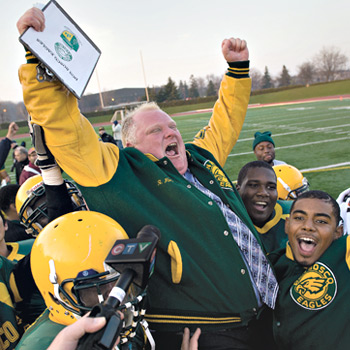
One of the surprising things about Mayor Rob Ford is that he forces us to confront some of the basic questions about our ideas of government and public life. When a politician promises to get rid of the gravy at city hall but then finds there isn’t any to cut and must cut programs instead, does that mean his mandate has disappeared?

What can a politician demand of the public service? That it meet his personal needs — which may involve personal pastimes, such as coaching football — by providing staff help or transportation, or by accepting time commitments interfering with public duties? That it meet the needs of the business of which he is a part owner?

And what does democracy mean? Mayor Rob Ford says if the appeal court confirms the ruling that he breached the Municipal Conflict of Interest Act and must be removed from office, he wants city council to either reappoint him or hold a byelection in which he will be a candidate. He says this is what democracy is all about: he was elected by Torontonians and democracy means they must vote again on who should be mayor.

That’s a thin interpretation of democracy. Sure, elections play a part in democracy even if there is a suspicion that the terms of the contest were violated (Mayor Ford is still awaiting the result of the investigation about whether his financial arrangements during the 2010 election infringed the terms of the Municipal Elections Act). But there’s a lot more to democracy than elections.

“A byelection would cost about $10 million.”

Democracy also implies that public decisions are made after an intelligent and full public debate about the options available. Mayor Ford does not perform well on this aspect of democracy. He is not given to discussion or debate. Sometimes he has voted on items without saying a word or offering any explanation of why he is doing what he is doing. 

Democracy also implies civility and respect for those with different opinions; that’s what creates a wide expanse of common ground upon which public policy can be hammered out. Mayor Ford has not served us well here, either. On too many occasions he has been belligerent with the public, with public servants and with elected officials. He chastises (and often demeans) those with different opinions, and that’s not helpful for democracy.

A respect for the law is also a part of democracy. As we know from the trial about his conflict of interest, he has made a point of refusing to be briefed on the law. One often gets the sense he feels above it.

A sense of the public good is also required for the practise of democracy, but it’s hard to sort out what Mayor Ford thinks of such a strange notion as the public good. Too often he seems to get his personal wishes and desires entangled in public business. There’s no clear picture of what the public good means for the man.

Mayor Ford is clearly bent on holding on to office and will even go through another election if that’s what must be done, but I don’t buy his arguments that it’s an election that ensures democracy is present. That’s just one of several important characteristics and maybe a lot less important than many think.

If the court upholds the decision to remove him from office, a byelection would cost about $10 million. A cost that would be incurred entirely because of Mayor Ford’s actions. I would argue it is money that should not be spent, particularly given the cuts to social and other programs city hall claims it must make to balance a budget.

Better for city council to appoint someone to the post, someone who can give us the other aspects of democracy: informed and intelligent debate, civility and respect, respect for the law, a sense of the public good.  That kind of person would serve us better than would the possibility of electing someone like Rob Ford who has shown he doesn’t share these values.

FYI: Last month I wrote about fracked gas in Ontario. I have since learned that eco-friendly gas is also available through Bullfrog Power.

Post City Magazines’ columnist John Sewell is a former mayor of Toronto and the author of a number of urban planning books, including The Shape of Suburbs.  

Homes slated for former TDSB site

0

Talks of the Toronto District School Board (TDSB) selling off excess land have become commonplace, but one neighbourhood is already having to say goodbye to green space and hello to new homes.

In January of 2011, the Sorbara Group purchased 2.4 acres of land on Fairmeadow Avenue formerly belonging to the TDSB. The land was once the home of Fairmeadow Public School, which is no longer open. The building now serves as the headquarters of the Toronto Public School Principals’ Association, and some of the severed land includes park space regularly used by the public.

Now Fairmeadow Avenue, which lies southeast of Highway 401 and Yonge Street, will be home to 11 new single-family detached homes — seven of which will be placed on a newly constructed cul-de-sac.

Sorbara Group is requesting variances for the properties, which doesn’t sit well with all residents.

“When you lose green space, you never get it back.”

Their request to have rear-yard setbacks reduced by two metres is particularly troublesome. Currently, the bylaw requires a setback of 9.5 metres.

“They initially asked for 7.5 metres,” said Cindy Weiner, president of the St. Andrew’s Ratepayers Association. “That’s a big difference, especially for the people living on Lord Seaton [Road]. Their properties back onto Fairmeadow. Weiner said that the biggest issue for most residents was a loss of parkland and green space.

Councillor Jaye Robinson said that, though these deliberations are tame compared to most development battles, the loss of green space is an unfortunate sign of the times. “It’s just a shame that we’re losing green space,” she said. “When you lose green space, you never get it back.”

She said, however, that the Sorbara Group agreed to pay for the relocation of goal posts regularly used by neighbourhood residents.

“We did fund the removal of the goal posts,” said Moira Morris, director of marketing and sales for the Sorbara Group, adding, “The residents are very co-operative.”

If you build it, they will come

0

Taras Grescoe is hooked on Paris. Who isn’t though, right? But what makes Grescoe such a fan isn’t the Louvre or even a healthy dose of croque-monsieurs. It is the impressive transit system, growing cycling infrastructure and the fact that even though the legendary Metro is a feat unto itself, the city is still expanding its system. 

Toronto should take note.

In his award-winning 2012 book, Straphanger: Saving Our Cities and Ourselves from the Automobile, Grescoe surveys a sampling of cities around the world: some better (Montreal), some worse (Phoenix) and some off the charts (Shanghai), as well as offers a special serving of reverence for that rare, pedestrian-friendly wonderland of Paris, France.

“Most of Europe and Asia have a long history of catering to transit. Shanghai, for example, has built an entire subway system, and it now has the world’s largest in only 18 years,” says Grescoe.

“European cities, you know, are famous for making car-free life a possibility for most of their citizens. Most mega-cities seem to realize transit is the only thing to keep them moving in the future. North America is a bit more problematic.”

Some are getting it right, most notably New York City, Chicago, Montreal, Vancouver and even Los Angeles. Even Toronto is expanding its system with a massive investment in light rail transit; though, Grescoe refers to both the Queen and King streetcars as “special challenges.”

Amen to that.

But, the bottom line is that even the current expansion isn’t enough.

What is really needed, according to Grescoe, is a national transit strategy as the precursor to steady funding for cities that is earmarked specifically for transit.

“There is a big change happening,” Grescoe explains. “There is a real urban revival.”

And, if Toronto doesn’t get its transit issues under control, the city risks missing out on the benefits that could come its way.

Grescoe was born in Toronto. His parents were journalists who met at the Globe and Mail. His family moved to Burlington and then to the West Coast where his parents helped found Vancouver magazine.

After completing his undergraduate degree at the University of British Columbia, Grescoe started his writing career at the local Georgia Straight newspaper.

After a sojourn in Paris in the ’90s (hence the love), Grescoe settled in Canada’s most European city — Montreal, where he lives, car-free, with his wife and young child.

Straphanger, which recently won the Quebec Writers’ Federation Literary Award and was a finalist for the Hilary Weston Writers’ Trust Prize for Nonfiction, is Grescoe’s fifth non-fiction title and the follow-up to the award-winning Bottomfeeder, about the global seafood industry.

For more information, go to www.tarasgrescoe.com.

Special educator funds life-changing scholarship

0

Merle Langbord Levine has been working as an educator since 1959. But it wasn’t until the late ’60s that she entered the field of special education — and she hasn’t left the field since then. In 1995, she opened the Merle L. Levine Academy in North York. The school specializes in teaching children with learning disabilities and attention deficit disorder.

“There’s no magic,” says Levine of her methods. “It’s just really delving in and looking at what the child needs and breaking it down.

She credits a dedicated staff for the school’s success. “I’ve got staff that have been with me 26 years,” she says. “They love it. They can go to the boards. They could be principals by now, some of them … but they want to stay in this environment.”

She also funded the Langbord Family Scholarship, a bursary that makes it easier for children with exceptionalities to attend specialized schools such as her own. She regularly organizes educational events related to learning disabilities, including an upcoming seminar with Rick Lavoie on helping children with learning disabilities find social success.

The seminar is scheduled for Feb. 1 at the Toronto Reference Library.

Educator honoured with prestigious award

0

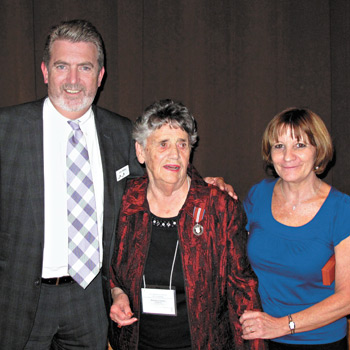
85-year-old Florence Carter of Leaside was awarded the Queen’s Diamond Jubilee Medal on Nov. 2, 2012 from the Canadian National Institute for the Blind (CNIB) for her many achievements in the field of education for the blind. The Diamond Jubilee Medal exists to honour the outstanding contributions and achievements of Canadians. 60,000 Canadians were recognized with the medal in 2012, celebrating the Queen’s Diamond Jubilee year.

When Carter was younger, she dreamt of becoming a teacher. After she lost her vision at the age of 16, she thought that she would have to give up that dream — until she received training from the CNIB and went on to work as a rehabilitation teacher for the blind and partially blind.

Though she retired in the early ‘90s, she continued to volunteer with the CNIB and worked at Mohawk College with aspiring rehabilitation teachers. She also co-authored the first Canadian Braille textbook.

“I didn’t intentionally start out to make a name for myself or anything,” says Carter. “I just loved teaching.… I think sometimes a blind person learning from a blind person is a good experience.”

Monkey business

0

Darwin, the monkey who famously roamed around a local IKEA last month, has brought into question the issue of exotic pet ownership in Toronto. The incident has left many people asking whether the confiscated primate should be reunited with his owner or kept in a sanctuary. We spoke to Dr. Karen Ward, senior veterinarian with the Toronto Humane Society and UC Davis–ASPCA fellow, about this and other hot topics in the animal kingdom. 

Why is it a bad idea to own an exotic pet?
There are a number of different reasons — public health is high on the list. Primates especially carry a number of infectious diseases, such as hepatitis, measles, rabies and tuberculosis, as well as emerging diseases, that place humans at risk. Because primates are so close to us genetically, there’s a lot more that can be swapped back and forth.

Bites are also a huge concern with primates.

Another issue is that people can’t generally attend to all the needs of these animals in a home setting. When they’re young, you can enjoy animals such as primates as pets, but once they reach maturity, their behaviour changes quite significantly. They can become quite aggressive.

How do people even get a hold of exotic pets in Toronto?
Well, certainly it’s not something that’s done by legal means. I’m not really tapped into it, but it must be something that’s done behind closed doors.

Is Darwin better off at the sanctuary, or are there psychological concerns about separation from his human mother figure?
I don’t think a person in a house can provide appropriately for a primate’s needs. He can’t express a normal array of behaviours in that environment. They’re not an animal that lives alone. They should ideally be in a group with the same species.  

In general, how much do we need to worry about our pets’ psychology?
Well, if they’re not experiencing good mental health and well being, you’ll have behavioural issues.

Are certain pets known to be more sensitive than others?
Of course, they’re all different in their own way. Cats can be more upset with routine changes, whereas dogs are pretty happy as long as you’re with them. But in general, both cats and dogs are very well-adjusted to living with us.

Are you a cat person or a dog person?
I am both, but I guess my heart is a little bit more with the dogs.

Are there any specific concerns for urban-dwelling pets that Toronto residents should be aware of?
The most common emergency we deal with is trauma. If your animal goes outdoors, they’re exposed to risks like getting hit by a car or balcony falls.

What’s your opinion on the city’s shark fin ban and its repeal by the Ontario court?
I’m personally against using shark fins in soup. I think it’s horrifying, the way it’s done. It’s an atrocious way to treat animals. I think people lose sight of the fact that we all fit within the ecosystem, and all the different species have a role to play. The more we exploit these resources, be them animal resources or plant resources or mineral, the further and further out of whack things get.

What are your thoughts on the zoo’s elephants and the most recent decision to send them to California?
I think zoos play an interesting role, and they’re now having to redefine the role they play in society, focusing more on conservation and education than people being able to go and look at animals from the other side of an enclosure.

I do think it’s incredibly difficult to house species that don’t normally belong in our climate up here, especially very large species. It’s one thing with small animals, when you can build enclosures and reproduce environmental conditions that they normally live under, but it’s very different for these large mammals. And these are animals that are very social and very smart, and it can be difficult to give them enough stimulation and enrichment so that they can live healthy and balanced lives.

So, yes, I think they need to be housed in the most humane and appropriate fashion, where all their needs can be addressed and attended to — and certainly there are concerns as to whether that can be met up here.

Tireless champion recognized for efforts

0

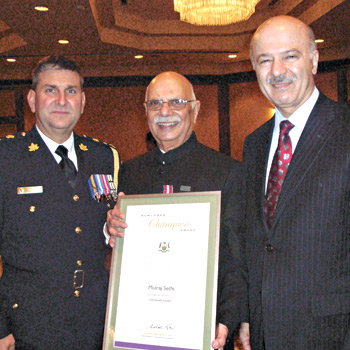
A Richmond Hill man has been awarded the Ontario Ministry of Citizenship and Immigration Newcomer Champion Award on top of two other awards he received earlier last year, all for his tireless work to better the lives of seniors.

Mul Raj Sethi received the Queen’s Diamond Jubilee Medal, which honours significant contributions to Canada as well as the York Region Citizen of Character Award, for making York a desirable place to live, work, play and learn. Having turned 80 years old recently hasn’t slowed down Sethi, who founded York Region Indian Seniors Club in 2006 to help immigrant seniors maintain their social, physical, mental and spiritual health.

Today, Sethi’s club boasts more than 150 members from around Richmond Hill, Markham and Vaughan. Though the club hosts social activities, such as fun casino outings, it also provides important services such as bereavement counselling, financing information seminars and end-of-life planning. Sethi hopes to continue raising the profile of his non-profit organization in the new year: “As long as my health allows me to carry on, I will continue serving the seniors,” said Sethi. “That’s my passion.”

Wacky new Canadian game show tame by modern standards

0

­All the talk at the recent Canadian Comedy Awards revolved around the new remake of the game show Match Game on the Comedy Channel. Most of the talk wasn’t pleasant, at least by those who weren’t booked on the series.

“It isn’t even a comedy show!” I heard one wag sniff, which seemed a little harsh. I doubt anyone would tune into the show for the suspense of seeing who might win or to learn anything about cold fusion. It’s mainly for the laughs, like most game shows of its type.

If you remember, Match Game was a successful American game show, often hosted by Gene Rayburn, that had various runs between the years 1963 and 1982 and even later remakes right up into the ’90s.

It was a groundbreaker, allowing double entendre answers from a celebrity panel, which led to other, smuttier shows like The Newlywed Game and The Dating Game.

It’s the job of the celebrity panelists to match the missing word of the sentence the contestants are given — barring that, to come up with something outrageously funny.

So why, I kept hearing, was the Comedy Network doing a remake of an American game show with wafer-thin relevance in the midst of a Canadian comedy explosion of stand-up, sketch and improv? And why was it the only show being funded and produced this year?

Part of the answer must be that a similar French version, running on V channel in Quebec, has been a big hit since 2010. Every network wants a hit, especially a network with new corporate owners: Bell Media. And it isn’t as if hipper shows produced under the old regime, like Hotbox or Picnicface, had strong ratings.

You can understand the frustration of the comedy community, though. Match Game isn’t going to create stars or show the world of comedy the genius of Canadian innovation. This isn’t SCTV by a long shot.

The retro-futuristic look of the show is pleasing to the eye. The host, Darrin Rose, is suave and engaging and wears beautifully cut suits. One of the regular panelists, Seán Cullen, always manages to squeeze in an extra joke or two. The other celebrities are sometimes strangely obscure, but I was pleased to see Janeane Garofalo on one episode, Tom Green on another.

Unfortunately, they aren’t given much to do. There are so many panelists that there just isn’t much time for anyone to register properly with the audience. Plus, the light smuttiness of their answers seems way out of date in a Howard Stern/Louis C.K. world.

But the real issue may be whether a game show can ever be truly funny.

I remember back in the ’80s when a prominent comedian friend of mine expressed his outrage that he had been offered, of all things, a game show to host — a lowly game show! But I reminded him of when one of the greatest comedians of all time hosted a game show and was brilliant at it.

The show was You Bet Your Life, and the comedian was Groucho Marx.

Canada has a bit of a tradition of indigenous game shows. A lot of them were serious and news-oriented, but there was also Party Game — a silly charades show that everyone seemed to loathe that featured minor Canadian celebrities. It ran for 11 years.

Match Game needs to turn it up if it wants to make its mark.

Post City Magazines’ humour columnist, Mark Breslin, is the founder of Yuk Yuk’s comedy clubs and the author of several books, including Control Freaked.