

Home Blog Page 664

The Music Issue: Rufus Wainwright

0


For flamboyant musician Rufus Wainwright, Toronto’s Luminato Festival is becoming a byword for “tribute concert.” During the 2012 festival, he performed at a concert in honour of his mother, folk singer Kate McGarrigle, who died from cancer three years ago.

This summer he will be on stage at Massey Hall with four other musicians to mark the 70th birthday of Canadian jazz folk legend Joni Mitchell. One more Luminato tribute, and it’ll officially be a trend.

The eclectic two-night tribute will see Wainwright share the stage with Herbie Hancock, Kathleen Edwards, Cold Specks and others. Mitchell herself is scheduled to make an appearance, but, as Wainwright points out, “She’s one of the great figures of the music world and can certainly do whatever she wants.”

Musicians queue up to claim Mitchell’s influence on their work, with everyone from Björk to Taylor Swift sprinkling themselves with the musical fairy dust, but Wainwright’s relationship with her is more ambiguous. Being the scion of another Canadian folk musician, Wainwright says he rarely heard Mitchell’s music on the stereo as a child — that was his mother’s territory and she had “conflicted feelings” toward the “Both Sides Now” singer.

“She really admired her, but on the other hand, she was quite jealous of her,” says Wainwright, who admits his mother was a “crushed by life” type of musician envious of Mitchell’s independent spirit.

But it’ll be his own envy that Wainwright will be trying to keep in check this month. Having lived much of his life in the spotlight since launching his musical career two decades ago, Wainwright acknowledges that playing second fiddle to his husband during the Luminato festivities doesn’t come naturally.

“I find myself struggling at times with the reversal of fortunes,” he says, adding that he’s used to being the “centrepiece.” “But it is good for me,” he continues. “It’s very representative of marriage. You have to give each other their special time.”

The Luminato festival will also be one of the relatively rare moments when Wainwright and Jörn Weisbrodt are in Toronto together. Although the couple recently rented a house in the Annex, their work schedules mean they have little time to enjoy the neighbourhood’s artsy vibe.

Last spring, Wainwright released Out of the Game, his seventh studio album, which impressed critics and peaked at number 11 on the Canadian Albums Chart. Since then, he has been touring relentlessly while Weisbrodt is also frequently out of town trying to track down artists to bring to Luminato.

“I’ve been there a couple of months in total, a few days here, a week there,” says Wainwright of Toronto. “Jörn has to travel a lot, too, so we often end up meeting in these very glamorous places — thanks, Toronto.”

Emphasizing that he has lived in Montreal, London, New York and Los Angeles, the singer also says that, now that he is nearly 40, what he likes about his place in Toronto is the peace and quiet.

“I’m attracted to the bucolic ideal,” he says, waxing lyrical about his love of the serene neighbourhood, playing his piano and quietly sipping a coffee.    

Wainwright admits he’ll never be able to kick back and relax in Toronto for long, not least because he has an infant daughter, Viva. Now two years old, she lives in L.A. with her mother, Leonard Cohen’s daughter, Lorca. For Wainwright, fatherhood has created a rich seam to mine in his songwriting.

“I wrote a lot of songs about my daughter right off the bat, even one before she was born,” he says.

But fatherhood has also created some changing life perspectives.

“It broadens my life. It’s immensely relieving to realize she doesn’t care how good my songs are or how good my shows are; it just matters that I’m there and that I am around.”

Chef Matt Blondin leaves Momofuku Daishō

0

Last week we reported that chef Patrick Kriss had parted ways with Acadia, and now chef Matt Blondin — also ex-Acadia — has announced that he is no longer affiliated with Momofuku Daishō. That means two of Toronto’s most talented chefs are now apparently free agents.

Sue Chan, a publicist for Momofuku, confirmed the departure.

“Matt Blondin has left Momofuku to explore new opportunities and endeavors,” she wrote in an email. “He was an integral part of the opening team at Momofuku Toronto. He will be missed.”

Chan says that Momofuku Toronto’s executive chef, Sam Gelman, along with Shōtō’s chef de cuisine, Mitchell Bates, will oversee Daishō and Shōtō. Meanwhile, Paula Navarrete, who was part of Noodle Bar Toronto’s opening team, has been promoted to sous chef at Daishō.

No word yet on where Blondin is headed next.

Foraging in the Don Valley: less wacko than it sounds

0

For those who aren’t familiar with the Don Valley, it’s easy to think of the place as a hobo-riddled wasteland, vaguely forest-like, where the wildlife — if it can be called that — subsists off the rampant urban refuse. Which is probably why, when I told people that I was going to forage for food there, a common response was, “Ugh.”

But I now know that the Don Valley is a perfectly viable place to harvest wild edibles. In some areas, the Don River is clear more than it is brown, and I even saw a totally non-mythical creature known as a “deer” out there.

Over the weekend I took part in an introductory Don Valley foraging tour, along with around 30 others, hosted by The Culinary Adventure Company. Scott Savoie, a chef and co-founder of the tour group — which hosts a number of food-related tours throughout the city — organized the excursion. Savoie has worked as a private chef for several interesting characters, including Jeff Foxworthy, and he also knows how to open a bottle of champagne with a sabre, which officially makes him the kind of guy you want to have around.

Our guide was Grant Bouchard, an avid forager and a member of the Mycological Society of Toronto. Bouchard knows of several lucrative foraging spots in the city, and he decided to share one of them with us. Generally, foragers aren’t so willing to divulge their good spots, but Bouchard says that if people want to forage, he might as well show them how to do it sustainably.


Grant Bouchard, foraging guide, finds a morel just off the Don Valley trail and cuts it open to
reveal the hollow interior

During the spring, the Don Valley is rife with fiddleheads (edible baby ferns), ramps (wild leeks), morels (extremely tasty mushrooms) and other snacks. This particular tour was bit too late in the season for fiddleheads, but morels were still game.

I had never partaken in a mushroom hunt before, but had wanted to for a long time for the simple fact that mushrooms are fascinating. It’s difficult to overstate their greatness. They have names like black trumpet, dryad’s saddle and devil’s cigar, all of which are way better than my name. If you want to take an intergalactic spiritual journey, certain mushrooms can help you accomplish that. If you mess with mushrooms, they can kill you. And in case you missed it, mushrooms are some of the best-tasting organisms on this planet.

Savoie and Bouchard escorted our group to the site of an old, decaying apple orchard somewhere in the Don Valley. Participants were asked not to disclose the precise location in order to prevent overharvesting, which, Bouchard says, is a serious problem: recently, he came across a fern patch that was decimated by overeager fiddlehead foragers.

Morels enjoy old apple trees; they also like oak trees and, rather inconveniently, poison ivy. They are also one of the first signs of rejuvenation after a forest fire (if you’re jonesing for morels, go to High Park after a controlled burn). Morels are some of the best mushrooms for novice foragers because they are so easy to identify. They do have one toxic doppelganger — known as the false morel — but those are also easy to identify because they aren’t hollow inside, like real morels, and they are decidedly uglier.  

Sustainable foraging, it turns out, isn’t so complicated. Bouchard’s tips consist of the following: don’t take more than a third of what you find, and, if possible, don’t disturb root systems (if the foraged item is a mushroom, don’t pull out the whole thing — cut off the tasty part and leave the base).

En route to the old orchard, we made a few stops to learn about different kinds of mushrooms that grow in the Don Valley. We learned about the edible hen of the woods, and we learned about the inedible dead man’s fingers, which look like the digits of some undead creature digging its way out of the grave. We learned about dryad’s saddle, which grow out of logs and are edible, preferably when they’re young and tender. I ended up stumbling across a beautiful patch of these, and I cut off a sizeable cap to take home. It smelled like watermelon.


A patch of dryad’s saddle and a harvested cap

That was to be my best find of the day. After reaching Bouchard’s preferred morel site and scouring it, I didn’t find a single morel. Others were successful: one couple found around 15 of them. I had heard that mushroom hunts are meditative, and I got that for a few minutes, being out in the woods and all. Then I got anxious. Nobody wants to be that guy that didn’t find a single morel.

I’ll probably head back to the Don Valley to try my luck again before morel season is over. After my first forage, though, I had to be content with my sole specimen of dryad’s saddle. I took it home, chopped it up and sautéed it with some butter and a bit of brandy. Added salt and pepper, and grated some Parmesan on top. Certain portions were too fibrous, but the outer edges were soft, with a mild woody taste. Verdict: I’d eat dryad’s saddle again.


Sautéed dryad’s saddle

The Culinary Adventure Company is hosting another Don Valley forage in October, where the sought-after items could include mushrooms such as hen of the woods, oyster mushrooms and bear’s head tooth (which tastes like crabmeat, I hear).

In the meantime, morels are common in scattered pockets of the Don Valley, and now would be a good time to seek them out: if there’s one thing they like, it’s moisture.

The Culinary Adventure Company, 647-955-8357

The Music Issue: Dallas Green

0

After having heard the gorgeous, melancholic songs of Dallas Green, one might assume the mopey rocker who performs under the moniker City and Colour is some sort of pale-skinned, plaid-shirted waif who is scared of his own shadow.

Nothing could be further from the truth … except maybe an increasing appreciation for plaid to go with his move to a more folkie and less furious style of music, as he leaves his days in post-hardcore scream team Alexisonfire behind.

The colourfully tattooed North Toronto resident’s stunning new album, The Hurry and the Harm, is out June 4, but today we begin with baseball. Green is worried about Toronto Blue Jays pitcher J. P. Happ who was beaned by a line drive in a baseball game the night before, fracturing his skull (he’ll be OK, FYI), which naturally leads into how he almost got into a fight at a recent Blue Jays game. No wilting rose here.

“We live in a hockey town, and a lot of guys bring that hockey mentality,” Green explains. “But I’m too emotionally invested in the Blue Jays and the Raptors. So, I’m personally at fault. I see people behaving badly, or booing, and it really pisses me off. As a true fan, you don’t boo your team. You just don’t.”

Catching a game at Rogers Centre, or hoofing it down the street to The Burger’s Priest near his North Toronto home are just two of his indulgences he shares with his wife, etalk’s Leah Miller.

And, although the Blue Jays may have started off the season in a slump, Green has been on a critical and commercial tear since his first solo release as City and Colour, Sometimes, back in 2005, followed by Bring Me Your Love in 2008 and the Juno Award–winning Little Hell out in 2011.

But things have changed. His new album is the first since his band Alexisonfire called it quits; the safety net is gone and the pressure is on.

“If I can continue to make records that I love, that’s success.”

Following on the heels of Little Hell, Green officially left Alexisonfire, getting the sizable monkey off his back. It wasn’t long before he started writing new songs. A lot of them. So much so, in fact, that he was ready to get back to the studio in record time.

“I just had the songs,” he says. “I started to notice, when I was finishing them, that many were about that idea and what I was going through when I was trying to make the decision to leave the band. The idea of searching for something else.”

Nowhere is Green’s feelings on the matter on display in more obvious fashion than the song “Of Space and Time,” a lush track that illustrates, in dramatic fashion, a person lost, struggling to find his or her place in the world. It is haunting. And this idea of the artist turning inward to his art in order to make sense of the world is one Green has been pondering since coming across the poetic works of American writer Wendell Berry. Berry is a modern-day Thoreau with a keen interest in “the land.”

“For me, I turn to music, to my songs and to writing. I realized that was what I needed to do, to dig deeper. And it just inspired me to write again.”

Green travelled to music mecca Nashville and Blackbird Studio to work on the new record. Producer Alex Scott hand-selected a crew for Green to work with  that included Jack Lawrence on bass (The Raconteurs, The Dead Weather), Bo Koster on keys (My Morning Jacket) and both Matt Chamberlain (Pearl Jam, Fiona Apple) and James Gadson (Bill Withers) on drums.

“The approach was definitely different. It’s the first time I’ve ever made a record with people I’d never met before,” says Green. “Alex has all the faith in me that I don’t have in myself.”

Green is far more critical of himself than most, but even he admits his new album is his best work to date. And, in the end, it is the work, the art, that really matters.

“If I can continue to make records that I love … that’s success,” he says. “I’m not looking for numbers or trophies or top 10 lists, I’m looking for the ability to continue doing this because I don’t know how to do anything else.”

Drink This: Marben’s Soft ‘n’ Sloe

0

Wellington Street’s Marben is aiming to stay ahead of the curve. Earlier this month, the downtown eatery relaunched with a decor facelift and a menu revamp.

A new cocktail program put together by Dan Gütter, Marben’s general manager and beverage director, includes decadent picks like the Soft ‘n’ Sloe ($15). Two gins (No. 3 and Hayman’s Sloe) are paired with Edmond Briottet rose liqueur, rhubarb done three ways (a puree, a syrup and a juice), and Dillon’s lemon bitters.

The beverage is finished with a lavender-lemon foam that’s whipped up out of lemon juice, lavender bitters, egg white and maple syrup. Served in a rocks glass over ice, this fancy tipple captures the essence of spring.

Marben, 488 Wellington St. W., 416-979-1990

For more must-try Toronto cocktails, check out our Pinterest page


Table Talk: Joanne Kates reviews Bar Isabel

0

If Grant van Gameren were a one-trick pony, you would not be reading this column. Because he would have opened son of The Black Hoof, and why bother with that? After Grant, who was its founding chef, left the Hoof in 2011, he ate his way around Europe, finding most felicity in the tapas of Spain.

The food of Spain is adored for its sharp flavours and fealty to fresh ingredients. No wonder Grant fell in love. Everybody thinks he’s just a snazzy salami guy, but we who fell under his spell at the Hoof recall spectacular flavour and graceful garnishes.

To open Bar Isabel, he assembled quite the team. He scooped chef Brandon Olsen from the Hoof, for front-of-the-house, added the suave Guy Rawlings (ex-Lucien) and partnered with Max Rimaldi (Enoteca Sociale, Pizzeria Libretto).

I’m pretty sure that about 25 years ago I reviewed a mediocre Italian restaurant called Regina where Isabel sits. And that it was dark, with a bar at the front, served soggy spaghetti and had dark wooden arches and fake Tiffany lamps in the dining room. Which it does today. Are we seeing the bones of the old Regina? Not exactly a great look.

But they’re playing great music, from classic rock to New Orleans jazz; the servers are affable and educated; and the food is: Grant! Via Spain. It’s a flamenco on the taste buds.

One could drink wine, but why bother when there are bourbon confections that go down like a wet dream. The house signature cocktail is the Isabel Fashioned — bourbon with Grant’s bacon-infused sugar. For a palate teaser he offers pickled piquillo and jalapeno peppers with white anchovies and house-fried corn chips. Being Grant, he pickled the peppers himself and they’re vinegary heaven.

Also divine is chicken escabeche, crispy wings in vinegar sauce, sweet ’n’ sour with allspice. Or octopus, chorizo and peppers, the octopus grilled, citrusy potatoes, house-made juicy chorizo and stewed sweet peppers. Grant makes magic without meat, roasting acorn squash with brown butter–inflected yogurt and pomegranate seeds. Is he influenced by London-based Middle Eastern chef and cookbook author Yotam Ottolenghi?

Chef allowed himself one shout-out to his Hoof days: tongue! A pile of shaved tongue sits between slices of toasted brioche. Grant brined the tongue by piercing it repeatedly with a syringe — for light pickling — and cooked it sous vide for 30 hours. If something as downscale as tongue can become haute cuisine, this is it.

But you must order the whole fish sea bream ceviche. The method is dazzling: Chef takes apart the fish, ceviche’s the chunks and puts it back together to resemble a whole fish, with cilantro, mint, avocado and frizzled leeks.

For dessert the gateau basque is mind-blowing, sugary vanilla cake, superbly moist, with a creamy heart. When the waiter pours sherried cream on top, it’s enough to imagine yourself eating tapas in Barcelona, doing after-work bonhomie with a gentle alcoholic buzz and snacks that dance a jig on the taste buds.

Bar Isabel, 797 College St., $55 Dinner for two before tax and tip

Joanne Kates trained at the Ecole Cordon Bleu de Cuisine in Paris. She has written articles for numerous publications, including the New York Times, Maclean’s and Chatelaine, and she was the Globe and Mail’s restaurant critic for 38 years.

T.O.’s best butcher shop sausages

0

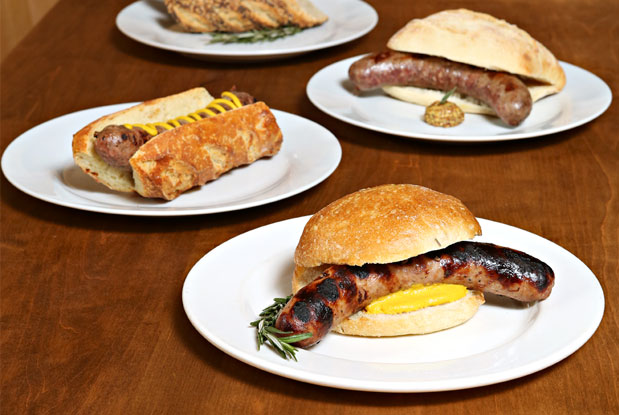
Grant van Gameren — chef-owner of the buzzy new Bar Isabel — tastes the offerings from the city’s top butcher shops and artisanal meat purveyors.

WINNER
Bruno’s Fine Foods, 1560 Yonge St.
Honey garlic, $6.99/lb

This pick ticks all chef’s boxes: salt level, quality of seasoning and moisture level. Immediately taken with the look of the sausage, upon biting into it, van Gameren declares it to be perfectly seasoned. “It’s super juicy and has a unique flavour.” It was love at first bite.

Runner-up
Olliffe, 1097 Yonge St.
Toulouse, $10/LB

“For whatever reason, it really took well to the grill — every ounce of it is golden.” Van Gameren commends the sausage on its juiciness and the seasoning. “I’m really happy with this one.” It was a close second. 

Simply divine
Sanagan’s, 206 Baldwin St.
Pork with nutmeg, $6.99/LB

“This one’s got a nice robust flavour for a very simple sausage. Van Gameren notes that texturally it’s well-made, but he points out that it’s a little on the dry side.

Rustic appeal
Whitehouse Meats, 1523 Bayview Ave.
Mild Italian, $5.99/LB

Van Gameren notes that this is the most artisanal-looking one. Although there is too much wine and salt for his liking, he really enjoys the fennel. “It’s inspired by an Italian recipe. It’s definitely got those flavours going on.”

Fantastic fennel
Cumbrae’s, 1636 Bayview Ave.
Italian, $7.99/lb

“This one has a nice fennel aroma to it, which I love,” van Gameren says. Pointing out that he’d prefer a bit more salt, he notes that it grilled up well but lost too many juices due to a lower fat content.

Sweet surprise
The Healthy Butcher, 298 Eglinton Ave. W.
Beef/pork with jalapeno & cheese, $12.99/lb 

Van Gameren instantly likes the juiciness of the sausage and comments on the vegetable nuances, which are a great touch. Personally he likes his sausages savoury, but this one is a little bit on the sweeter side. Unfortunately, it was the only sausage that split open while grilling.

A+ technique 
Stuart Carroll Quality Meats, 7509 Yonge St.
Tomato basil, $4.99/lb

“There’s good technique to this one and it has a really nice salt level.” Van Gameren would have preferred if fresher spices were used.


Lessons from a Dragon: a profile of Arlene Dickinson

0

Author. Entrepreneur. Mother. Dragon. These are just a handful of the many hats worn by Arlene Dickinson, the self-made multi-millionaire who went from living hand-to-mouth while raising four children to becoming one of Canada’s most influential women in business.

Most of us first got to know the savvy, silver-streaked redhead during the second season of the CBC’s hit reality show Dragons’ Den, where she joined an otherwise all-male panel of highly opinionated financial heavyweights, such as fire-breather Kevin O’Leary. Audiences and panellists alike quickly learned that Dickinson — sharp, confident and with a keen eye for “the next big thing” — would hold her own just fine.

Six seasons later, she remains the sole woman on the panel, something she says is indicative of the number of female senior executives in Canada — a depressing 17 per cent.

“I hope that the show is a reminder of this stark reality,” she tells me over the phone from the Toronto office of her marketing firm, Venture Communications. “I imagine at some point we will change [the makeup of the panel] on the show, and that it will be a reflection of a change that’s happening in the marketplace.”

Dickinson is optimistic about the future of women in business — but adamant that action is needed in order to see them rise to the top.

“As our workplace becomes more than half female, it’s very important that we give women opportunities to thrive and shine in business. We have to diversify our boards. [Women] think differently, we approach problems differently. It’s not right or wrong; it’s different. And it’s crucial to have that other perspective at the table,” she says.

As for what fans of Dragons’ Den can expect in the near future, Dickinson sounds excited as she tells me that the deals being made this year are bigger and better than ever.

“I’m seeing a lot of ideas that are incredibly smart and bang on trend.” Her ability to identify these trends is uncanny, perhaps even among the other Dragons.

Many of the companies Dickinson invested in during recent seasons are already thriving. OMG’s Candy, the company that entrepreneurs Chris Emery and Larry Finnson pitched the Dragons in season six, is flying off the shelves of almost all major grocers and drug stores in Canada. Another of Dickinson’s season-six investments, Ontario’s beloved Balzac’s Coffee Roasters, is similarly spreading like wildfire, with two new locations in downtown Toronto alone.

“You have to stop judging yourself by other people’s standards.”

The secret to their success? According to Dickinson, it’s a combination of factors: “Great entrepreneurs with a proven track record, a great product and a space in the market that previously had a void.”

Season eight will begin airing in the fall, but the Dragons are in the middle of filming now — just one of the many tasks Dickinson juggles on a daily basis. In addition to her role on the Den and her position as CEO of Venture, she is also in the midst of writing her second book. Unlike her first, the 2011 best-seller Persuasion, which focused on her own life lessons, the as-yet unnamed book will be based on interviews with other successful entrepreneurs from across the country.

“It’s really about the entrepreneur’s life, how the personal and professional become so intertwined. There’s no balance!” She laughs, but her words are genuine, rooted in her own experience. When she started Venture, Dickinson was raising four children as a single mother, trying to make ends meet without even drawing a salary from the nascent business for two years.

“I think that we learn so much from other people’s stories,” she says. “[Writing the book,] I’ve been able to hear from others first-hand what their journey was like and what they learned.”

This idea of gleaning valuable tips from others’ experiences is also the basis of yet another project Dickinson has in development: YouInc.com, an online community for entrepreneurs to connect, share their stories and find resources and support. The website already boasts thousands of members, and an affiliated e-zine will be launched next month.

With all this on the go, it’s hard to imagine that Dickinson ever finds time to relax. “I’m really good at compartmentalizing!” she tells me. But even Mother’s Day will be a busy time for her — she’ll spend that week jetting across the country to visit her children and three grandkids, some of whom live in Toronto, others in Calgary.

Canada’s Western economic hub is where Dickinson grew up and still spends about half the year. She credits Calgary’s “entrepreneurial spirit” for helping her get her start in the business world during the late ’80s.

“There weren’t the same kinds of obstacles and barriers to starting a business,” she says. “It was a young city that needed a lot of services and organizations to grow.”

In the beginning, starting Venture was simply another attempt at putting food on the table, but within 10 years, Dickinson had taken sole ownership of the company, growing it from a local marketing firm to one of the biggest in Canada.

Today, putting food on the table remains one of her primary concerns — no longer for her own family, but for thousands of less-advantaged kids across the country.

Dickinson is the national spokesperson for Breakfast Clubs of Canada. True to her nature, she considers it a wise investment for our country’s economic future: “I think it’s very important to feed the future generation and make sure they’re able to pay attention in class rather than worrying if they’re going to get to eat that day.” One of her most recent fundraisers drew in more than $3 million for the foundation.

Still baffled by how she can successfully balance all these different commitments, I ask Dickinson what advice she has to offer to other working mothers. What it comes down to, it seems, is forging your own path — something Dickinson has done all her life.

“Bring your family along with you on the journey,” she says. “Don’t feel like you’re somehow shortchanging them. They’re going to have a different experience than other kids do, but it’s not necessarily a lesser experience. You have to stop judging yourself by other people’s standards. Let go of the guilt and embrace the messiness of what you’re doing.”

Peace, love and a little bit of free literature

0

Bill Wrigley’s miniature library is perched outside his home on a white post, like a large mailbox. It has two shelves filled with books and a single swinging door. Instructions on the top say “Take a book — Return a book.”

Wrigley’s library, at 304 Lee Ave. in the Beach, is part of a growing international community of take-a-book-leave-a-book libraries called Little Free Library.

The movement began in Wisconsin in 2009. It has since spread, putting more than 3,000 libraries similar to Wrigley’s all over the world, including far-flung countries such as the Republic of the Congo, Pakistan and India.

People can design their own boxes however they want or order them online, but as Wrigley says, “The concept is the same: people come around and they take a book. If they finish it, they bring it back. If they don’t bring it back, maybe they bring a different book back, and it’s like a rotating library.”

Every time someone walks past Wrigley’s house, the library is different and new. Wrigley’s library is a hit — like many across Toronto and the country.

“The interesting thing is the kids just love it. They come around in cars from who knows where with their parents and they pick up books. They’re very, very popular,” he says.

Wrigley advocates on behalf of Little Free Library in Toronto. He oversaw the creation of 10 in his own neighborhood, 25 in Toronto and more than 40 in the GTA.

He says Little Free Libraries have benefits that set them apart from city libraries.

“The beautiful thing is it’s open 24 hours a day, it’s open seven days a week, you don’t have to have a library card, and you don’t get fined if you bring your book back late.”

Wrigley has more than 250 extra books in his basement to keep the library stocked. He says once a book is in the library, “it no longer belongs to [him], it belongs to the people who live in Toronto.

To find a Little Free Library near you, check this map

Hadley’s goes up in smoke

0

Brunch on College Street is about to take a hit. After three years, popular barbecue joint Hadley’s is closing its doors. A letter posted in the restaurant’s window indicates that there were issues with the lease renewal. Hadley’s will continue to operate according to its regular business hours until June 28, after which it will close for good.


Q&A: Michael Cera on Orangeville, Super Dave Osborne and the new season of Arrested Development

0


Michael Cera has managed to elevate acting like a dork into an art form. There are few people who do it with such panache. And, what got the geek chic ball rolling was his appearance in the TV show Arrested Development.

The show was unceremoniously cancelled in 2006, sparking a North America-wide outcry from loyal fans. But Cera went on to further success in films such as Scott Pilgrim vs. the World and Juno (opposite fellow Canadian Ellen Page). Cera gets back to his roots with the Netflix premiere of Arrested Development. Cera spoke with us during a recent visit to Toronto.

There had been so many reports coming out since the show ended. Did you feel any added pressure to deliver for all the cult fans out there?
I imagine, hypothetically, the concept was really daunting for Mitch [creator Mitchell Hurwitz]. But he’s such a wonderful writer: once he got his hands into it, it took on a life of its own. I think it’s really high quality, and I like it a lot.… People will react to it how they react to it, but I’m pretty sure it’s really good.

What are some of your favourite hangouts when you’re back in town, and do you get to spend much time in Toronto?
I like Saving Grace, the breakfast place. I was there the other day. I guess I’ve been here for about a month. I don’t look too far ahead, but I’d like to spend more time here. I love being here.

Does the area change much in between visits?
Well, [my parents] live out near Orangeville; that doesn’t change. Tanfastic is still there, and, I mean, that’s the greatest name for a tanning place.

Where is the show picking up from?
Everyone gets caught up from where the series ended, and then the story starts in present day and moves forward from there. The series has so many storylines happening, every character has multiple storylines going on, and they intersect in different ways. On top of all that, it is really funny and silly and bizarre.

I know there are a lot of cameos as part of this season. Was there anyone you were particularly excited to work with?
I would have loved to work with Super Dave again; he’s the funniest guy in the world. But mostly I was just excited about getting to work with Will Arnett, David, Tony and Jason again, and just being around them again. 

Was the experience positive enough that you’d consider an Arrested Development movie?
I’d be game for a movie if it happens. Ya, that’d be great. I think the series, story-wise, cues up the movie nicely. I’d also be game to do another season. It would work well episodically. I do think it should continue. There are a few things nicely set up.


Ecks and the City: putting a new spin on an old exercise

0

One simply cannot do a private hooping session outside without drawing attention, even on a quiet afternoon. As I am hooping in my front yard, with my personal hooping trainer, people honk horns as they drive by, an elderly woman with her caregiver smiles and stops to take in the scene, and a mother pushing a stroller asks what we’re doing.

“We’re hooping,” I call out. “Want to join?”

What Mandy Harvey, my personal hooper trainer, and I are doing is the latest trend in exercise. Although, it barely seems like exercise because it is so much fun. “That’s why, in the hooping world, this is often called ‘exercise in disguise,’ ” says Harvey, who runs Sugar Hoops. Harvey started hooping 13 years ago when she was a DJ at a music festival in Nova Scotia. “I saw some girls hooping,” she says. “And I had to try it. I bought a hoop and I never looked back.”

These days, Harvey not only makes a living teaching hooping, but she can barely keep up with the demand. In addition to going to private homes, she runs hooping classes across the city, and, starting this month, weekly hooping classes in parks. (A private lesson starts at $75 an hour. Group classes in studios start at $15.)

“There is now a global community of hoopers,” she explains. “I hoop every day and look online every day because there is always a new move or trick to learn. I talk to hoopers in Australia, Berlin and the U.K. There are hoopers all over the world.”

And, of course, there are hoopers in Toronto. Recently, Harvey was hired to do a surprise bachelorette party that ordered custom-made hoops to match their dresses.

“Once you develop a rhythm for hooping, you can really let go.”

When I talk to Harvey on the phone to book our “training session,” I tell her that I’m not sure if I can hoop.

“Don’t worry,” she tells me. “I’ll get you hooping in less than two minutes.”

And … she does. The trick — who knew? — is not to move your hips side to side, but rather to use your core to move back and forth, with the hoop spinning right below your belly button. Within two minutes, I’m hooping like a champion. Ten minutes in, I’m completely out of breath.

“Hooping promotes movement, and you’re not thinking about fitness and having to go to the gym. And everyone smiles when they see a hoop. You get to see a side of yourself that you’ve never seen or haven’t seen since you were a child,” Harvey says.

Harvey, whose love for hooping is infectious, has lost 30 pounds over the past two years by hooping.

“I have had regulars who have lost 65 pounds over two years just by hooping. I’ve even had boyfriends of my clients come to me and say, ‘Wow, my girlfriend’s body is looking amazing. She can’t stop doing this!’ ” she says.

So many women, Harvey says, are dropping pounds while hooping without even realizing it. This is definitely “exercise in disguise.” My hands are up in the air and I’m doing lunges while hooping. For the next two days following my session, I can definitely feel that my abs have gotten a workout, and it feels as if I had done a hundred sit-ups.

People from every career — from doctors to teachers — join Harvey’s classes in Christie Pits (which start in June) and in Withrow Park (which start in May). “There are so many friendships that come out of it, too,” she says. “People want to show each other new tricks they have learned.”

As a novice hooper, I start with a larger hoop (42 inches). As I get better, I move onto using a smaller hoop (34 inches). Harvey shows off tricks, like spinning around while hooping and twirling the hoop around her wrists and fingers.

Inside my house, she takes out a ring of paint samples (like she’s a decorator) and shows me the 50 different colours she offers for custom-made hoops. I order one, letting my daughter pick out the sparkly green, pink and silver colours for me. The hoops are not like the plastic Hula Hoops we used as kids. These are serious hoops that can be folded up and kept in a yoga bag. Brilliant.

“Once you develop a rhythm for hooping, you can really let go,” Harvey says. There is a lot you can do once you learn to hoop. For example, you can watch television, or take in the thousands of hooping tutorials on the Internet. She says that eventually I’ll be able to dance to my favourite tunes while hooping. “It’s really addictive,” she says. “People are always looking for something fun.”

I can’t disagree. I will pick up my own hoop on Monday and I can’t wait. I feel younger than I have in years.