

Home Blog Page 983

Joey Shulman

0
joey
joey

DR. JOEY SHULMAN, nutrition powerhouse, mom and best-selling author, calls herself a city girl. (She once lived in a tiny loft at Yonge and St. Clair.)

But these days the author of the popular weight-loss book The Last 15 and the new book Healthy Sin Foods finds herself spending more and more time in Thornhill — and she’s loving every minute.

Fed up with an hour-long drive from her home in the 905 to her former downtown office, Shulman moved her weight-loss clinic to Thornhill two years ago. Now she drives just seven minutes from home to her clinic on Yonge north of Steeles.

As an author, registered nutritionist and speaker, Shulman is a household name when it comes to healthy eating. But it wasn’t always that way. “It takes 10 years to be an overnight success,”she says, sipping an organic coffee (no sweetener) at a local café.

Shulman is well versed in the art of juggling. In addition to running the Shulman Weight Loss Clinic, she’s also the head nutritionist for Sweetpea Baby Food, a spokesperson for Genuine Health supplements and head nutritional consultant for Stonemill Bakehouse. The popular speaker, who has given workshops at companies such as Nike and Cadbury, frequently speaks about nutrition and health at conferences and trade shows, including upcoming events like the Whole Life Expo.

Somehow this busy mom also finds the time to appear on various radio and TV shows, such as Breakfast Television, and be a contributor to popular websites NaturallySavvy.com, Homemakers.com and Alive Magazine. It’s a lot to juggle.

But the busier Shulman gets, the happier she is. “I feel very blessed,” she says. Nutrition was Shulman’s first love — at 11 years old, she read books on the science of food — but when she grew up, she veered toward other careers. At 17, she worked briefly as a model. “It wasn’t my thing,”says the now 38-yearold. With her long legs, luminous skin and perfectly shaped hazel eyes, Shulman could still be mistaken for a model.

After graduating from Concordia University with a degree in psychology, Shulman studied at the Canadian Memorial Chiropractic College in Toronto. Two years after opening her chiropractic practice, Shulman decided to switch professions. “I wanted to write books on nutrition and … practise nutrition full-time,” she says.

The next two years were a blur as Shulman worked as a chiropractor while studying at the Canadian School of Natural Nutrition. In 2002, she began working in nutrition full-time.

Not many people can say their knowledge of dairy-free foods led to marriage. But in Shulman’s case, her first love, nutrition, helped her find the love of her life.While listening to the radio, Shulman heard a voice on CFRB talking about dairy-free options.

Shulman called the show to comment. Host Randy Taylor invited Shulman to the studio for an on-air interview. That resulted in five years of twice a month on-air discussions about nutrition. Not only that, Shulman married Taylor.

Taylor, a former caterer who Shulman calls “the best chef I know,” helped Shulman develop the recipes in each of her books, including Healthy Sin Foods, which arrives in bookstores this month.

The inspiration for Healthy Sin Foods came partly from Shulman’s clients. “I have so many people at my clinic who say things like, ‘Joey, I don’t want to have tasteless tofu.’ There is that misnomer out there that you have to eat bland, lacklustre food in order to be healthy. And that’s absolutely not true.” Nutritious foods — those that help people feel energized, lose weight, prevent disease and eliminate cravings — can be delicious, Shulman says. And she wrote the book to prove it.

Some of the book’s recipes sound downright decadent, like the crumbled goat cheese, apple and pear salad or the chocolate raspberry brownie bites. But all the recipes have been tweaked to be made healthy.

(For proof, read the nutritional information beside the recipes.) Hence, the book’s subtitle: Decadence Without the Guilt. Even the most sinful-sounding recipes contain what Shulman calls superfoods. A superfood, Shulman explains, must meet three criteria. It must have a low glycemic index rating, which means it won’t cause blood sugar to fluctuate and it won’t cause the body to store excess fat. It will keep a person’s energy and weight stable.

A superfood must also be high in antioxidants, which help prevent disease. And it must be antiinflammatory, which can help achy joints. Apples, apricots and chickpeas are among the 50 superfoods Shulman describes. Dark chocolate, goat cheese and cinnamon also qualify. Over 100 mouth-watering recipes in the book incorporate superfoods, so readers learn how to add these über-nutritious foods to their meals.

A rating system explains how often each recipe should be enjoyed. Three strawberries means eat any time. Two means enjoy once a week. One means save for an occasional treat.

Even people devoted to healthy eating want to cheat a bit — and a little cheating is OK, Shulman says. She provides strategies to ensure people don’t go overboard.

“Have a hardboiled egg before you go to your party, so you don’t walk in famished,” she says. Shulman’s goal, both at her clinic and in her books, is to encourage longlasting change.

She wants to help people lose weight and keep it off for life. And she wants people to keep eating tasty, nutritious meals long after they’ve finished reading her latest book.

That’s why Healthy Sin Foods isn’t just a cookbook.While the back half is packed with recipes, the front half explains how different foods interact with the body.

Shulman provides what she calls the “behind-the-scenes stuff ” because she believes if people understand how various foods impact their body they will make wiser choices such as avoiding processed, packaged foods.

“We’re more than we eat for breakfast and for lunch. You are more than your bagel or, hopefully, your whole grain bread,” Shulman says. “But making those small choices can really improve how you feel and how you function on a daily basis at any age, whether you’re a CEO or a stay-athome mom.”

Turning Wonderbread into soufflé bread puffs

0
susur shang
susur shang

Recently I was invited to appear on the CBS Early Show in New York City, and asked to create an “audience-friendly” recipe. Not a typical request.

The night before the show, I put on my thinking cap, and the idea of Wonderbread just popped into my head. It’s such an American standard!

I came up with a recipe for soufflé bread puffs with Chop Chop Chicken (which we serve at Shang), wrapped in lettuce with almonds and fresh vegetables. It can be adapted for vegetarians if you leave out the chicken.

I had to get up really early to get to the show, but it was fascinating to be on the set while the other stories were being reported — watching TV in the making.

While I was in New York, I also participated in the Wine and Food Festival, working the Dim Sum & Disco brunch with my good friend and fellow chef Ming Tsai.

We both really enjoyed the event for the change of pace. The brunch had a much more relaxed feel than an evening event, with families and kids everywhere.

For chefs, it’s a gift to finish up during the daytime, enjoy a glass of champagne and go home to rest before working that night. And it’s always a pleasure to cook alongside Ming Tsai, because he’s sure to create something amazing. This time, he made a fantastic dim sum Foie Gras and Maitake Shumai– which, I’ve got to emphasize, is NOT audience-friendly to make!

Chef Susur Lee maintains two successful restaurants in downtown Toronto – LEE and MADELINE’S — and now has a restaurant in New York (Shang) and Washington (Zentan).

Jully Black

0
jully black
jully black

THE ORBIT ROOM is a hole in the wall on College Street, and on the small stage, backed by a five-piece band, stands Richmond Hill’s Jully Black, wearing brown motorcycle boots, a denim miniskirt over black tights, a fitted beige jacket and a smile from ear to ear.

The music is loud, thumping, a sound Black calls “durban rock,” rock ’n’ roll urban dance tunes. The group runs through several blistering numbers from The Black Book, the 31-year-old’s third album, and then Black hugs all the musicians and takes a momentary breather at the classic old bar.

“I’m ready to celebrate life, love and opportunity,” she says, as she catches her breath on a recent Friday afternoon. “You know, the first record was dedicated to my mother, and my last record was dedicated to my sister who passed, but I’m now at a point where it’s not the victim’s story. This record is a jubilee, a celebration, it’s triumphant — a little bit of oomph to start your day.”

Black has spent her days making music since her mother moved the family from Jamaica to the Jane and Finch neighbourhood where she was born.

Instantly, Black was marked as a talent, and she was signed by a record label in 1998 and recording songs with Kardinal Offishall by the time she was 18. For a girl at the centre of a small world in a rough neighbourhood, Black thought she was on her way to fortune and fame.

“I would assume that she learned a music industry truth that is very real, but not very glorified: that the overnight success story you often hear or dream about is seldom a reality,”says Rez Digital, an influential DJ at Toronto’s New Flow 93.5 FM.

Black’s label went out of business before her first album was released. After starting off as a teenage sensation, she was cast aside and spent the next years eating Mr. Noodles and playing small shows for uninterested crowds.

“I’d say Jully lived the story where you learn that if you pay your dues, sacrifice, study the ins and outs along the way and work your ass off it can lead to incredible success,” Rez Digital says. “Jully’s story isn’t about her being different; it’s about her simply being the best.”

The way Black looks back on her story, she sees the rapid emergence and subsequent disappearance of her music career as an inevitable path. One that she also sees intricately tied to Richmond Hill.

“I finally had bragging rights in the ’hood and then … my mom moved our family to Richmond Hill,” says Black, who not only had to say goodbye to her friends, but also her music career.

Black attended Seneca College, where she studied law enforcement, but all the while she continued to sing.

She says adjusting to life in Richmond Hill wasn’t easy. But there seemed to be a lesson attached to everything that she did. She continued to make music and, eventually, settled into her new home.

“I didn’t want to go, are you kidding me?” Black says, with a laugh. “Yonge and 16th? I’d never gone past Steeles! But my attitude changed. I made my first friend, and she’s still my best friend.We’d go to Victory Gym and be the only two black girls.

I realized, in the inner city, sometimes you get too comfortable. Richmond Hill became symbolic: ‘What do you really want to do?’”W hat Black wanted to do was to continue to make her soul-shaking music, which eventually was released as the album This is Me, in 2005. It had been six years since Black worked her last day job. And the album was nominated for the 2006 Juno Soul Recording of the Year.

“I knew it was the right thing for her to do because I knew she enjoyed singing and did it well,” says Black’s mom, a mother of nine, who, like her youngest daughter, still lives in Richmond Hill. “That made me put my faith in her and encourage her to keep going and never give up. I told her if she puts her trust in God she will surely get everything her heart desires.”

Once Black had a chance to get her music out, accolades followed her from city to city and show to show. She recorded with Missy Elliot and Destiny’s Child and, with so much momentum behind her, released Revival in 2008, which contained the number one single “Seven Day Fool.”

“It’s not a bad thing to be an underdog. When it seems like things are too perfect, what is there to strive for?” she says. “I feel like an underdog in our country, and that’s where I want to be. I’ve won a Juno and realize that’s not a golden ticket. There is no golden ticket! If you jump in your car, tell me where you can go without making a turn? You’ll run into your neighbour’s house, even if you don’t live in Richmond Hill.”

The day at the Orbit Room is organized chaos, and Black is seemingly doing a thousand things at once. She tapes a commercial to promote her upcoming appearance at the Vancouver Olympics and then hops back onstage to play “Running,” the first single from her latest disc.

The album represents Black’s influences, everything from Michael Jackson to David Bowie, Cyndi Lauper to Madonna, Prince and Peter Tosh. “We didn’t have black radio where I was growing up, we had radio,” she says. “I’d hear Phil Collins, Run- DMC,Bob Marley and Kenny Rogers. It’s the language I speak. That’s what I grew up listening to.”

Young Pete is the producer of Black’s new album, and he says that while she’s a perfectionist in the studio her long road to the top has given her a serenity when it comes to dealing with fame.

“Nothing has come easy for Jully, but what’s amazing is that she said, ‘Fine, if no one’s behind me, I’ll just go my own way,’” the Atlanta-based producer says.

“You can hear endurance and passion in her singing. She’s real, and that’s what makes people love her so much.” On the small stage, Black is smiling as she directs the two guitarists who help her round out her new durban rock sound.

The Black Book is an album that Black says celebrates the twists and turns that have made up her life. When the band is finished, she’s laughing. She then asks everyone to run through it again.

“As young as I am, with no children and no ties, my music is my baby and I owe it everything,” the Richmond Hill resident says.

“It’s not money, it’s not fame, it’s your significance that matters. I feel significant to me, that’s why I’m successful. I hope people like The Black Book because it’s me: everything that I’ve been through and everything that I am.”

Clark Johnson

0
clark johnson
clark johnson

CLARK JOHNSON APPEARS unaware of the effect he’s having on most everyone else in the room. We’re in between takes, and the 30 or so crew members on the set of Cra$h and Burn are rearranging the set, tinkering with panels and dials, fixing collars and all the while flashing furtive glances at the famous gent presently arriving at the punchline of a joke with cast members who’ve pulled their chairs in close.

Finally, we’re ready to roll. Johnson rises from his cubicle and takes his mark amid the potted plants, water cooler and filing cabinets that decorate this Mississauga office. At Action! a brunette in a pencil skirt swishes past, eyes fixed on an armful of documents. Johnson and his co-star drop into dialogue. Halfway through, however, something’s amiss. The director, dissatisfied, yanks off his headphones. Cut!

This, the business of filming a TV show, can be a long and laborious process where one 30-second scene can consume hours and multiple takes. Efficiency is therefore the law of the land. But where cast and crew are nervously fussing over the next take, Johnson is drumming vigorously on the top of a filing cabinet. Clearly, the sudden stop-and-go of the set is nothing new to Johnson.

“I touched my tie, and there’s a mic in there,” he explains a few moments later. “The camera could be just off, a cable could be hanging.You know, little stuff can make you go again.”

He would certainly know. Over his decades in the business, Johnson has directed big-budget shows and movies and some of Hollywood’s biggest stars — Colin Farrell and Samuel L. Jackson, in 2003’s S.W.A.T., and Michael Douglas, Kiefer Sutherland and Eva Longoria in 2006’s The Sentinel.

Before that, he was on the long-running series Homicide: Life on the Street as Det. Meldrick Lewis. But Johnson is perhaps best known for his work on HBO’s The Wire, a gutsy cop drama that earned critical acclaim for its honest portrayal of the trenchant social ills facing American urban society today, from the drug trade and smuggling, crooked politics, a crumbling education system and a news media dangerously reliant on advertising dollars.

Johnson directed the first three episodes as well as the series finale and, in season five, played wise and weary newspaper editor Augustus “Gus” Haynes, which made him a vital part of what Slate editor Jacob Weisberg called “the best TV show ever broadcast in America.”

High praise, but not a far cry from how Johnson feels about the show himself. “That’s one of the things I’m most proud of, that show,” he says.

Today, Johnson is in front of the camera — no directing this time — as Walker Hearn, a cop turned insurance fraud investigator who plumbs the seedy depths of the insurance game alongside his partner and lead character Jimmy Burn, played by Luke Kirby. The Showcase series, produced by Paul Gross, premieres on Nov. 18 at 9 p.m. on channel 39.

A typical plot might see an insurance company refusing to pay out to “the little old lady whose house burned down because she was wearing [something as inconsequential as] a plaid shirt,” Johnson says.

Hearn and Burn set out to right the various wrongs, a job that’s not unlike those of the TV cops of Johnson’s past. “OK, I’m listening to what you’re saying, but I’m trying to pick up on what you’re thinking. That’s fun,” he says of his character’s mindset.

A series about insurance fraud set in an office may not scream surefire hit, but that’s not how Johnson sees it.“You look at these cubicles out here and how predictable it seems, but in the world of insurance fraud, people are gaming all the time, so it’s more like the cop and robbers stories we’re used to,” he says.

Plus, the two female leads (Toronto’s Caroline Cave and Vancouver’s Leela Savasta) are “profoundly sexy,” he adds.

Johnson grew up on Heath Street and lives nearby today, not far from his siblings, jazz singers Molly and Taborah and social worker Ron (“the only grown-up in the family,” he says). When asked, though, Johnson says he’s “from” Philadelphia, which is where he was born and lived until age six when the family picked up and headed to Canada.

Nevertheless, while Johnson’s various directing and acting gigs take him all across the world — as you’re reading this, he’s in South Africa directing Halle Berry in a shark thriller called Dark Tide — Avenue and Dupont is where Johnson hangs his various hats.

“I call it ‘my place upstate’ because I’ve got two pine trees and a deck in the back, and that place is really mellow.With the hustle and bustle of Manhattan, I come to Toronto and I’ve got my little country retreat.” He takes his work to Caffe Doria, when he needs to get out of the house, and he plays golf with the butchers from Olliffe.

The area wasn’t always quite so posh, Johnson remembers. “It’s really yupped up now, but it was pretty much a middle-class neighbourhood when we got there,” he says.

The Johnson kids were a talented bunch from a young age. Ed Mirvish cast them in his productions along with another talented troupe of child actors, Cynthia, Jennifer and Loretta Dale. “I think they did Gypsy while we were doing Finian’s Rainbow,” says Johnson. “We kind of grew up in the wings of the Royal Alex.”

After university at Concordia and in the States and a stab at pro football, Johnson took a job as a driver on the set of an action movie called The Last Chase, starring Lee Majors. Bit roles and special effects work followed. The work was regular but never high profile.

Finally, in 1985, Johnson scored a regular part on Night Heat from 1985 to 1988. That led to Homicide: Life on the Street from 1993 to 1999.

Eventually, Johnson found himself behind the camera, directing five episodes of Homicide. From there, oneoff directing spots on some of TV’s biggest shows fell into place: The West Wing, NYPD Blue, Third Watch, The Shield.

Then, in the summer of 2001, David Simon, co-writer and co-producer of Homicide, approached Johnson to direct the pilot of a new show he had dreamed up called The Wire. Johnson was an easy choice to direct the show’s pilot.

“Clark is hilarious. He has one of the more refined senses of humour in the business. He is a master of the practical joke, albeit not as much as I am,” says Simon. “He keeps the crew loose. Listen, it’s a hard job. It’s a fun job, but it’s also 12, 14 hours a day, and five days a week.… He knows everyone’s name, he’s into everyone’s shit. He’s making everyone loose and comfortable when by rights no one should want to stay there that long.”

Since getting this scene right on the set of Cra$h and Burn is the only thing keeping cast and crew from their lunch break, the same sentiment could apply today.

At the moment, the director is huddled with Johnson’s co-star, giving instructions on how to tweak things. Little do they know that Johnson has snuck up behind them and is eavesdropping on the private conversation.

When the director finally notices, the crew erupts in laughter and Johnson scurries back to his mark. The master of the practical joke has struck again, and whether anyone realizes it or not, the mood in the room has noticeably relaxed.

The next take, perhaps not coincidentally, is a keeper.

Peter Mansbridge

0
p mansbridge
p mansbridge

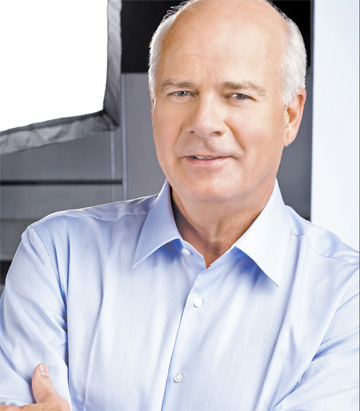
FOR OVER 20 years, Peter Mansbridge has tucked the nation in at night as host of The National, leaving us safe in the knowledge that while everything may not be right in the world at least he’s trying to figure out why.

And now, with The National having just undergone a top-to-bottom makeover, viewers will be seeing a different side of Mansbridge — or at least a different angle.The re-branding of CBC Newsworld as CBC News Network (or CBC NN, for short) sees Mansbridge delivering the news standing, not seated behind his desk as we’ve come to know him. But that’s not all that’s afoot.

“It’ll look different. The set’s different, the music’s different,” says Mansbridge. “But you don’t change the way you go about doing the news. I mean, the news is the news. We still focus on the stuff that we think is the most important news of the day. And we put it in context, lay it out and let people make up their own minds.” Canadians are a relatively adaptive people, but in changing the format, the CBC is playing with fire, something Mansbridge is fully aware of.

“One time when we changed the music, we got a flood of letters from people saying stuff like, ‘This is outrageous! My dog won’t go to sleep any more — it always went to sleep when it heard the theme to The National.’We’re going, ‘What do we do about that?’”he says with a laugh.“They may find the change a little jarring.” Being the most trusted face in news is a big responsibility, especially for someone who technically didn’t even finish high school.

“That was 1966. I didn’t get my senior matriculation,” says Mansbridge. “I’d probably still be there trying to get my Grade 13. I’d mentally checked out of school.”

Mansbridge gives the impression that underneath the perfectly tailored suit and behind the steady voice there still lies the curious, brave and rugged journalist who found his calling after setting out for a life of adventure while still in his teens.

“So I joined the navy. I went out west and was in the navy until 1967,” he explains. “It was a way of furthering my education but doing it in a more adventurous way. It didn’t work out, but I had a lot of really good times there.”

Not ready to return home after his service, Mansbridge travelled to the Manitoba outpost of Churchill to work for an airline as a jack of all trades. He refuelled airplanes, announced flights and loaded baggage in minus-60- degree weather.

“One day I was announcing a flight in the terminal. A guy heard me. He was from the CBC, and he offered me a job there,” Mansbridge says. “I mean, this was back in the ’60s, and they couldn’t get people to go up there.”

Mansbridge began by working the late shift as a DJ. He admits he wasn’t very good at it, but it built his confidence to the point where he could be a radio broadcaster.

“I had never thought of it as a career.

At the time, they didn’t have a newscast, so I started one,” he says. It was a natural fit, and he thrived. “I think it was because of the upbringing that I had. We sat around the dinner table, and we would discuss issues,” he says. “And we would listen to radio broadcasts. I was born in England and grew up in Southeast Asia, and we would listen to the BBC at first. That’s how we learned about the world around us.”

Mansbridge made a name for himself, gradually moving south to Saskatchewan, transitioning to television and establishing himself as a correspondent for The National.

It was while at The National that Mansbridge met the man who would shape his career, Knowlton Nash. “He was like a mentor to all of us,” Mansbridge says. “When he was anchoring the program, he’d been there for 15 years, and he’d been a foreign correspondent, then a manager, then an anchor.”

By this time, Nash was nearing the end of his esteemed career and knew he would soon cede his post as anchor. There were many promising young broadcasters to choose from, but Nash wanted Mansbridge to take over for him, something he made quite clear.

“At that time, I’d received a great job offer from the States,” says Mansbridge. “The offer was from CBS. It was their morning show. He basically didn’t want me to go. He said, ‘Look, I’m about to retire. Just wait six months and it’s yours.’”

Now, over 20 years later, Mansbridge is the face of The National, as much a presence at the CBC as Nash ever was. So who does he want to take over for him?

“I’m very lucky at our network, and we have a half a dozen people at least,” he says. “If something happened to me tomorrow, they could easily step into that role. I have my favourites, but I won’t be the one who gets to pick.”

Whoever the CBC chooses will have a big desk to fill and not just when it comes to reporting.

Some months ago, Mansbridge sat down with a famously smart man, President Barack Obama, then only a few weeks into his presidency. The interview was a major coup for CBC and a moment Mansbridge recalls vividly.

“I can remember the way he walked into the room where we were doing the interview. He was still on the high and the excitement of becoming the alleged most powerful person in the world,” says Mansbridge. “But he knew then that it wasn’t always going to be like that.”

Obama’s approval numbers tumbled steadily through the summer as he got caught up in a health care debate that appeared to re-energize what had been a divided American right wing. “I don’t think people should underestimate him, just like they shouldn’t overestimate him. It’s going to be an interesting four years,” says Mansbridge.

As for our own national politics, Mansbridge says that, as a journalist, his fingers are crossed that we’ll see an election soon, even though that sentiment may contrast sharply with the popular mood of the electorate.

“These are exciting nights, especially for television, they really are. But I travel the country a lot, and I see how little people are interested in an election right now. Whether they support this government or not, they just feel there are more important things for politicians on Parliament Hill to be doing right now than running around on another campaign. But that mood can change in a heartbeat.”

Whatever the case, Canadians can be sure Mansbridge will be on the case. While he and his wife, actress Cynthia Dale, spend most of their time in idyllic Stratford, the two also enjoy time in their charming Midtown piedà- terre, putting Mansbridge minutes from the CBC headquarters.

Which means that Canadians — and their pets — can rest assured that while sets and theme music may change Mansbridge will be around for a good while to come.

Sonja Smits

0
sonja cover
sonja cover

FOR SONJA SMITS, the Canadian icon who we’ve been watching on television for almost three decades (Street Legal, Traders and The Eleventh Hour), starring in the edgy play That Face this month means a return to her roots, and she couldn’t be happier about it.

“I started in theatre, you know. That was my first love. I went to theatre school, and that’s where I first started — onstage,” she says. “What I like most about theatre is the process. I love the rehearsal process. I love the fact that you have a month, in this case, to work almost essentially with the other actors and the director on how you want to do it and playing with that.”

It’s a warm autumn day, and Smits is on the patio at Caffe Doria, looking just as she does onscreen but softer, more feminine and younger. A chunky beaded necklace rests against her neck, and she is sporting sassy spectator pumps that are unexpected and daring.

It’s no wonder she’s being stared at. But Smits lives in the ’hood, so maybe it’s just neighbour curiosity rather than celebrity gawking.

Smits, her husband Seaton McLean, the former head of film production for Alliance Atlantis, and their son and daughter have lived in Rosedale in the same house for the last 17 years or so. That puts her close to her favourite restaurants and shops — here at Doria for coffee, Pastis for casual dinners and seafood at Pisces.

The very picture of domestic bliss, you might say. But in That Face, Smits is far from your typical housewife. The award-winning play, currently on now at the Berkeley Theatre on Berkeley Street, sees Smits playing the pillpopping alcoholic mother of an uppercrust family.

“It’s a fun character,” says Smits. “They’re a very eloquent family, the kids are in private school, they have all of this. From the outside, things probably look pretty good. But it really says to me about what happens when children end up parenting parents.” A bit dark, perhaps, for a woman who’s known for PG-rated CBC drama — but that’s half the fun, she says.

“It was interesting. When I read it for the first time, I thought, ‘This is awful, and then I’d start laughing, and I’d think, ‘Oh my God, I’m laughing. But this is so awful — but I’m laughing.’”

Written by award-winning English playwright Polly Stenham when she was just 19 years old, That Face offers an edgy and real — often uncomfortably so — look at a wealthy family, whose various dysfunctions and vices are laid bare when their daughter is expelled from private school.

When the play’s director, Kelly Thornton, came upon That Face she sent it to Smits immediately. “She said, ‘This part has fangs,’”recalls Thornton. “It’s an amazing, amazing role. Sadly, there are fewer and fewer roles for women. Sonja is shining in it.”

Of Smits’ various roles on stage and on screen, it’s Street Legal we remember best. The one-hour CBC legal drama ran from 1987 to 1994 with repeats running into this year. Smits played Carrington “Carrie” Barr alongside Canadian actors Eric Peterson and C. David Johnson. In its last six seasons, it regularly drew about a million viewers and a devoted following. When the show was airing, says Smits, “people would shout out my character’s name, which was cute.”

So how did a girl from an Ottawa Valley dairy farm end up on a hit television series? Smits came to Toronto to attend theatre school at Ryerson. After two years, she took a summer theatre job in Quebec City where director Ken Livingston invited her to join his new company in London, Ont., Centre Stage.

When CBC casting directors saw the show, they asked her to audition for a CBC movie, Tyler, for the part of a farm girl.

“I arrived for the audition very nicely dressed in a skirt and heels. Most of the other actresses were dressed in pigtails and gingham. When I was called back for the final audition, they pleaded with me to wear something more ‘farm girlish.’ I said, ‘This is how a farm girl would dress for an important meeting, but if you really want, I’ll wear jeans.’ I got the role.”

Since then, Smits has been a regular on stages across the country, including the Tarragon, Toronto Free Theatre and the Canadian Stage Company, starring in The Graduate, George P. Walker’s Nothing Sacred and Judith Thompson’s Perfect Pie.

She interspersed those roles with film and television work: alongside Deborah Harry in David Cronenberg’s 1983 film Videodrome, was in a television biopic about Judy Garland and been in big screen films such as Owning Mahowny, How to Deal and A Different Loyalty, starring Sharon Stone.

Back then, acting was the most important thing to her. Now, she says, she has other interests and waits for the right role to come along.

“I want to do [roles] because I’ll get something out of it, because I think acting is like a precious thing — I don’t want to waste it. I’ll do something else. I’ll read a book,” she says.

She was elected president of the board of directors at Harbourfront this past June (the first professional artist to be named president) after being a member for several years. She supports the Parkdale Women’s Shelter, the Redwood. And then there are her kids and family.

“There’s a lot of just my own life — my kids, my family. There’s a lot of other things that I can do that I’m interested in,” says Smits.

Like starting a vineyard in Prince Edward County, for example.

The country girl moves back to the country? It wasn’t planned that way. “It wasn’t until we’d already bought the land, put some vines in and started worrying about the weather that I realized, ‘Oh, I’ve come full circle.’”

Smits and her husband bought the land about 10 years ago.

But back then, they were among the handful of vineyards in the area. Now they are one of about 50. Wine from their estate wine, Closson Chase, is available through the LCBO Vintages this month.

“When I first started out, people would say,‘It’s Canadian and it’s good?’ So the level has gone up, and the expectation has gone up too. And it’s nice to be a part of that growth, and that’s a cultural thing, too, which I didn’t even think of that. So I’m still in the cultural industry, but now it’s wine.”

And despite having recently bought a farm about eight kilometres away from the vineyard, Smits is not ready to give up city life entirely. Thank goodness. Then who would the neighbours spy on?

Why would anyone want to be mayor of Toronto?

0
mayor images
mayor images

THE 2010 MUNICIPAL election has become more exciting with David Miller’s announcement that he will not seek re-election.

Before, it looked like the next election would consist of candidates with high name recognition competing to replace him.

Each challenging candidate would expound on why Mr. Miller needed to be defeated and what was wrong with the direction in which Toronto was heading. Now the dynamic will be very different.

Already, with 13 months to go before voting day, there is heightened interest and competitors are coming out of the woodwork.

There is greater willingness and increased chance in the minds of those who would wish to be mayor when the incumbent factor is removed. It usually results in a larger slate, which is a great way to build excitement and participation.

"It’s a long, vigorous campaign, and one cannot peak or burn out too early."

Any individual who actually registers to run in the election shows commitment and courage. Campaigning to win requires energy, a supportive team and money. Some wait for the right time, when they stand the best chance of success, and others go for it despite the odds — because circumstances compel them.

There are questions that each candidate should ask himself or herself: Am I able to provide leadership? Do I understand what the priorities are? Am I prepared to commit the time, energy and money to win this election? Can I attract a team who can raise the funds for a credible campaign?

I believe that the early bird gets the worm. It’s important to organize your support and strategy well in advance. A good offence is the best defence.

By expressing your intentions early, it effectively reduces the number of competitors. Fundraising can be more difficult if like-minded candidates are tapping the same circles. Positive name recognition is an asset. Previous scandals, baggage and poor judgment can seriously jeopardize the outcome.

Campaign workers usually volunteer their time. In a mayoralty bid, certain key roles that demand full-time hours and expertise are often paid positions.

These include a campaign manager and chairs of policy and fundraising, canvassing and signs.

Office managers, a scheduler, a CFO and a driver are vital. It’s extremely important to have an advisory group whose guidance can be provided to steer the campaign and keep it on message.

The first week of January is the time to register. At this point the campaign officially begins, and one can legally begin to fundraise.

The fundraising goal should be $1.3 to $1.5 million, which allows you to buy media, to mount a professional attempt to reach voters. The easiest way to accumulate these funds would be if in a well-connected group each member committed to raising a portion of this. The maximum donation of a private individual is $2,500. It’s important to hold well-publicized events to build momentum. The Internet has added a new dimension to campaigning.

Barack Obama enjoyed a high number of small donations from grassroots supporters through it.

A mayoralty candidate needs to be strategic about time. It’s a long, vigorous campaign, and one cannot peak or burn out too early.

A typical day begins with interviews, visits to organized events and many types of speaking venues. Earned media is a free bonus and can be used to broadcast the message. The schedule needs to be flexible because it will change.

Personal time needs to be protected for family, exercise and rest. It’s an exhilarating experience to compete for the prize of leading Toronto. Ideas and advice will be offered, but in the end, it’s the candidate’s own sense of judgment or lack of it that will prevail. The 2010 election should focus on who can win the trust and confidence of voters and can work urgently on positive solutions to move Toronto forward.

Post City Magazines’ political columnist, Jane Pitfield, was a Toronto city councillor for eight years. She is now involved in several volunteer projects.

In search of the wizards of Oz

0
libretto
libretto

THE OSSINGTON STRIP is a culinary melting pot that has exploded in popularity, drawing some of the city’s finest young chefs to the area, including Tom Thai and Paul Boehmer. But how to separate the bistros from the booze cans? Herewith, a guide to nine of the best culinary destinations to help plan your trip.

Böhmer goes back to basics

93 Ossington Ave., phone number TBA

Esteemed local chef Paul Boehmer follows his nomadic impulse and helms yet another restaurant, this time in a 5,000- square-foot former garage.

Boehmer is known for transforming whatever he touches to edible gold — from falloff- the-bone ribs at the late Cluck, Grunt & Low to posh nosh at Rosewater Supper Club, Scaramouche and others.

And foodies have been holding their garlicky breath ever since the venture was announced last spring.

While Böhmer is slated to open within the next month, at press time the restaurant was still in renovation mode.

Boehmer has already been blessed with luck as the last liquor licence recipient before a oneyear moratorium on the barheavy half-kilometre stretch between Queen and Dundas, and we don’t expect the seasoned chef’s good fortune to end there.

Classic Canadiana fare, such as Ontario pickerel and caribou; promises of reasonable prices ($10 to $20 for appetizers, $20 to $30 for mains); local art and photography; and a rustic 100- seat space filled with furniture designed by the funky, reclaimed wood–happy Brothers Dressler twins are sure to keep the place packed and profitable.

During the day, bread, preserves and vinegars will be sold, cheering up disgruntled locals who bemoan the parity of daytime hangouts in the buzzy ’hood.

Oh, and don’t scoff at the classy new umlaut in the eponymous restaurant’s name: it’s Boehmer’s original surname (his father traded the dots for an “e” upon arriving in Canada) and is simply another sign of this epicurean icon getting down to his roots.

Corinna’s Delux edition

92 Ossington Ave., 416-537-0134

Skinny waiters with five o’clock shadows serve up chef-owner Corinna Mozo’s delectable Franco-Cuban fare in a cool, modern space decked out with recycled fluorescent tube lighting fixtures and alphabet-themed art.

The massive Cubano sandwich is stuffed with molasses-cured pork, ham, watercress, melted Gruyère and lemony aïoli and comes sided with Mozo’s famous frites, for extra heart-palpitating pleasure.

Gooey made-to-order chocolate chip cookies arrive with an organic glass of milk and inspire nostalgia for bygone childhoods and simple delights. Leslie Feist and her Broken Social Scene friends have been known to pull up a chair.

Pizzeria Libretto true liberation

221 Ossington Ave., 416-532-8000

The vibe at this no-reservations Neopolitan pizza joint is almost as hot as it’s 900-degree woodburning oven.

Aim for an unconventional arrival time (think 6 p.m. on a Tuesday) or slip the hostess your cell number and grab a tequila cocktail at nearby Reposado to avoid spending hours in line. Entrance hassles are soon forgotten with a couple glasses of $4 wine and Libretto’s trademark blistered pie.

The margherita D.O.P. pleases traditionalists with its restrained minimalism (tomato, basil and Ontario fiore di latte mozzarella are the sole toppings) while the white duck confit and bosc pear number tantalizes more adventurous palates. Reclaimed wood tables fit in with the Bullfrog-powered restaurant’s green approach.

Tom Thai’s cuisine is very Foxley

207 Ossington Ave., 416-534-8520

Foodies were initially disappointed when they learned that revered chef Tom Thai wouldn’t be concocting his famous avant-garde sushi at Foxley.

Once they tucked into the resto’s exquisite fare, however, patrons (including down-to-earth screen sirens Sandra Oh and Rachel McAdams) were instantly converted to his small-in-size yet big-in-flavour modern pan-Asian tapas. Standout dishes include sticky side ribs with caramelized shallot glaze and sea bream ceviche with yuzu and shiso leaf.

Exposed brick walls, mod light fixtures and attentive staff would make this the perfect date spot — if only they accepted reservations.

State of the Union

72 Ossington Ave., 416-850-0093

Union was worth the wait. After a beleaguered year of delays and red tape that foodies followed on chef Teo Paul’s blog for Toronto Life, the locavore restaurant was greeted with accolades for its Parisian-inspired food (many ingredients sourced from his family’s Collingwood farm), not to mention the casually glam digs, punctuated by a horseshoe bar and 35-foot vine mural by Barbara Klunder.

Patrons speak reverently about the truffle fonduto, a poached egg, ground truffle and toast concoction; the chèvrespiked sweet pea lasagna; and the bread pudding.

Burger Shoppe shines

210 Ossington Ave., 416-850-1919

True to its name, this handsome wood-panelled restaurant offers 12 different kinds of burgers as well as yummy sides like hand-cut fries and chorizo-topped poutine.

BQM boasts that their beef patties contain higher levels of omega-3s than conventional beef products — maybe that’s why they’re so juicy and delicious. Get local with the Ossington, a portabello mushroom, mozzarella and balsamic reduction–dressed affair.

The Dakota for bluegrass brunch

249 Ossington Ave., 416-850-4579

Most nights, mustachioed indie kids and their vintage-clad girlfriends sling whisky sours in boot-shaped glasses, chow down requisite pub grub, and get down to the live bluesy rock bands.

On weekends, however, hipsters rub flannel elbows with families that invade the barn-boarded space for an all-you-can-eat bluegrass brunch featuring freshly squeezed juice, coffee, scrambled eggs, home fries, bacon, pancakes and acoustic tunes.

Watusi swings

110 Ossington Ave., 416-533-1800

Watusi departs from the Ossington decor standards, eschewing understated exposed brick and reclaimed wood for retro eye-popping neon and lava lamp swank. The food proves just as playful.

Tuck into won ton nachos, a fun take on Tex-Mex that’s dressed up with sweet chili beef, avocado salsa and roasted red peppers, or the crispy chickpea fries.

Save room for the lime-spiked avocado and chocolate mousse for dessert.

Golden Turtle is pho-real

125 Ossington Ave., 416-531-1601

What this decidedly plain Vietnamese restaurant lacks in decor it makes up for in flavour and affordability, making it ripe for celebrity chef sightings (Guy Rubino, Claudio Aprile and Susur Lee are devotees). And for good reason: the unpretentiously named pho #1 is arguably the best in the city.

Rare beef cooks in a complex broth that’s topped with fresh basil and bean sprouts. Vermicelli noodles (a.k.a. bun) arrive with all sorts of tasty topping combos, from deep-fried spring rolls and grilled pork to beef and pineapple. Lingering is not encouraged.

Get your motor running

0
erica roncon 2
erica roncon 2

1st PLACE – START YOUR ENGINES

On Erica: Armani, $1,095 On Teresa: Mackage, $580

Back in the day, they donned leather as on-air hosts. Now, Teresa’s a PR manager for TVO and Erica’s the dynamo behind the Yummy Mummy Club, but both of them still know how to work the biker babe look. Erica loves her pick because it’s versatile. “I’d never take it off,” she says. Teresa likes hers because it’s “fitted, flattering and unique.”

Where to get it: Andrew’s Bayview Village 2901 Bayview Ave. 416-225-0049 

BIKER BABE

Belstaff Leatherblouson Approx. $1,600
Ride in style with this jacket by the company that practically invented high-performance chopper gear.
Where to get it:
www.belstaff.com

VERY VESPA

Nygard quilted jacket, $96.60
Not the hard-core type? Not to worry. This jacket works at the office or on the weekend.
Where to get it:The Bay, Centerpoint Mall 6500 Yonge St., 416-226-4202

PATENT POWER

Adore, purple patent jacket $249
Scoot over to style in this shiny number that goes from day to night in a flash.
Where to get it: Tzatz 2512 1/2 Yonge St., 416-481-0311


CARAMEL CLASSIC

Doma leather jacket, $725
Head out on the highway in this three-season staple in a beautiful colour.
Where to get it:Holt Renfrew Bloor 50 Bloor St. W., 416-922-2333


Using your noodle

0
grano owner
grano owner

1ST PLACE
MACARONI MAGIC!

TERRA RESTAURANT, 8199 Yonge St., 905-731-6161
Terra’s gourmet take on this quintessential comfort food elicits multiple “Mmmms” from the affable owner of Grano. Martella praises the presence of apple-smoked cheddar, lobster and mini-elbow pasta, but overall it’s the “Canadian northern flavour” that seals the deal. The only downside? With its nifty cast-iron casserole dish, “it would be hard to take to school in a lunch pail,” he says. Price: $19 plus tax

2ND PLACE

 
Oliver & Bonacini Cafe Grill ,2901 Bayview Ave.
“Adults, kids — from two to 100 — could eat this,” raves Martella. Peas and chicken add to nuanced taste, but overall punch is perhaps a bit muted. Price: $14.25 plus tax

THIRD PLACE


Weezie’s, 354 King St. E.
Martella praises the “classic cafeteria” presentation, tasty slab bacon cubes and gentle asiago and Parmesan cheeses. The overall effort receives a B on its final report. Price: $14 plus tax

FOURTH PLACE


Carens Wine & Cheese Bar , 158 Cumberland St.
Hot peppers make Martella tear up: “It needs alcohol, if not a fire department,” he gasps. Loses points for slightly “commercial” taste. Price: $16 plus tax

FIFTH PLACE


Tundra, 145 Richmond St. W.
The most attractive dish, but the lobster here seems better suited to a tossed pasta, where it can be better “exulted,” says Martella. Price: $12 plus tax2

Liisa Winkler's blog: TOMS brings shoes to T.O. and to kids in need

0
toms shoes
toms shoes

About a year ago, I was staying at a hotel on the lower east side of Manhattan.

After finishing work slightly late, I was absolutely starving and wandering the streets looking for that perfect little restaurant in which to park myself for a feed and perhaps some people watching.

Nothing really pulled at my salivary glands and so I wandered into an old faithful… Whole Foods. I have had many healthy and delicious meals here and felt that I ought to give this new location, at Bowery and Chrystie, an investigation.

This is where I found them. The "ethical, earth friendly section" on the second floor. (Nowhere near the food section which is where I should have been headed with the growls and grumbles from my tummy becoming loud enough now to elicit concerned looks from my fellow shoppers- I guess sometimes shopping trumps hunger.)

TOMS shoes makes really cool shoes. Cool because they are simple in their rugged design and can thus be worn with almost anything. Cool because they are made by a man who wants to help people and actually donates one pair of shoes for every pair that he sells! Blake Mycoskie started TOMS to help kids in Argentina who had no shoes and could not go to school. By walking barefoot, feet are prone to cuts which then become infected and cause disease and pain. Since starting his company, he has given away over 150,000 pairs and plans to give another 300,000 by then end of this year. He now does his "shoe drop offs" all over the world.

The shoes I found were not my size. But I bought them anyways. The whole idea of "One to One" (which is the company’s motto) appealed to me so much and the shoes were a perfect alternative to the usual flip flops of summer that I had been flopping around in. The light canvas shoe can be worn from spring to fall. The insole is actually inspired by a flip flop (but with more support). I put them right on and flopped down to the food section to quell the monster in my belly.

But now they are here. They have made their way to Toronto and have arrived in a rainbow of colors, styles and, yes, sizes as well! I love the charcoal and the tan canvas. My daughter looooves her red sparkly pair. I plan to keep my family in TOMS for as long as is practical. I love that they now make adorable and stylish kid sizes as well!! I know it’s a bit early, but why not pick up a pair for everyone on your Christmas gift list this year? I plan to give at least a few pairs to the feet of a few lucky friends.

TOMS is sold in Toronto at:

  • Get Outside – 3456 Yonge Street
  • Sporting Life
  • Heel Boy – 682 Queen St.
  • Lileo – 55 Mill St.
  • Pre-Loved – 24 Ryerson Ave
  • Canopy Blue – 2582 Yonge St.
  • Cat Tilt – 1-198 Walnut Ave.

Go to the Toms shoes website for more information on the cause and a very inspirational video.

Liisa Winkler is one of Canada’s biggest supermodels and mother of two beautiful children. Her blog appears bi-monthly at Postcity.com.

Patrick McMurray's blog: Oyster shucking in full view

0
shucker bar
shucker bar

In 90 per cent of restaurants around the world, oyster shuckers are left at the back door to shuck and clean dishes in between orders.

As an oyster shucker in Toronto, I’m a bit biased to bar dining as that is how we work — up front in full view of the customer. I would rather be in no other place.

I often tell diners to either book a spot at the bar or just pop by and see what’s happening.

A spot at the bar means you’ll be right In the middle of the action, watching the evening’s events unfold in front of your eyes. At the bar, it’s more of theatre for the palate than dining on food.

Drinks are poured, menus are read and recommendations are made by the service staff. After choosing your supper for the evening, sit back with your companion and watch the deft hands and skilled crew do their job. It’ll no doubt feel like they are just cooking for you… a special event indeed.

You will also be privy to specials that are being tried out, taste tests, and special attention. Go regularly to the bar, and you become one of the crew.

The best pro is that you can almost always sit when you want at the bar. Torontonians live by the 7-7:30 p.m. reservation, making it the hardest time to acquire. The bar however is seldom reserved so pop in and eat when you want.

Shuckingly yours, Paddy

Patrick McMurray is the owner of Starfish Oyster Bed & Grill and The Ceili Cottage. He is also a World Champion Oyster Shucker. Catch his blog weekly at PostCity.com.