
Home Blog Page 972

Just who should run this town, anyway?

0

THE MESSAGE IS clear: the status quo at city hall is not good enough and is contributing to holding the city back.Never in the city’s history has the decision making and control been in the hands of so few.

Public consultation has been rushed and token.The time has come to return the “power to the people.”

The new mayor can set the tone and ensure the priorities are set by the residents of Toronto. Big vision ideas are always an asset, but now more than ever we need a mayor who we like and trust.

At this point, it looks like there will be four main contenders: John Tory (undeclared), George Smitherman (declared), Joe Pantalone (strongly interested) and Rocco Rossi (declared).The first is a Conservative, the second a Liberal, the third an NDP and the last a Liberal.

Joe Pantalone will attract the NDP vote as well as some of the union vote. There is a significant Italian community who may also support the deputy mayor.

Pantalone supported the Front Street Extension and the straightening of the Dufferin Jog.

There has been a history of promises made to developers who have built condos in Pantalone’s ward, assuring the Gardiner Expressway will be removed.

Some businesses have had challenges opening as he maintains tight control of restaurants and bars in his ward. He is the city tree advocate and has led the way, planting thousands of trees to increase the city canopy and greening. He is a seasoned veteran as a member of the former Metro Council as well as 12 years on the mega-city council. His main focus is downtown.

Pantalone has worked well with Mel Lastman and the current mayor and has been successful gaining plum positions of influence. He can be a bully with a temper to get necessary support to further the agenda.

But I believe that Mayor Miller will step down soon and announce a climate change position. He may call upon Mr. Pantalone with the support of council to finish the term. Pantalone may then not be able to enter the mayoral race, as an appointed mayor.

John Tory is currently hosting Live Drive on Newstalk 1010. He is able to discuss all of the daily issues, and it provides an effective forum for listening and developing a pulse for the thoughts of many. It enables him to take a stand on issues. His answers are becoming more definite and concise. He is attracting some Liberal support.

George Smitherman has more than 1,000 friends on his mayoralty Facebook, which indicates momentum. He has a reputation for getting things done but also for impatience and temper when things do not go his way.

He had city hall experience with former mayor Barbara Hall prior to amalgamation. He has been accustomed to a powerful portfolio and supportive bureaucracy.There would appear to be some burnt bridges with former colleagues, but Smitherman also has a loyal following. He declared his intentions and zeroed in on “jobs.”He missed the vote on HST by stepping down but had to account for 70 per cent of the eHealth boondoggle while he was Minister of Health. Others have stepped down, but he has been silent.

A recent poll indicated 47 per cent support for Tory and 21 per cent for Smitherman. Up to this point, Pantalone has not been polled. Miller has endorsed him which could be the kiss of death — if the majority of the voters want “change” rather than “more of the same.” Rocco Rossi was John Tory’s campaign manager in 2003.

He most recently has been the national director of the federal Liberal party and successfully fundraised to put the party back into the black. He will attract support from the business community. He is a bit of a showboat but is generally positive and gregarious.

Toronto needs a “mayor for all people” who will lead with urgency committed to bridge building with the province, the feds, the 905 and the school boards.

 

Tender truce between rival anchors ends in a tie-d knot

0

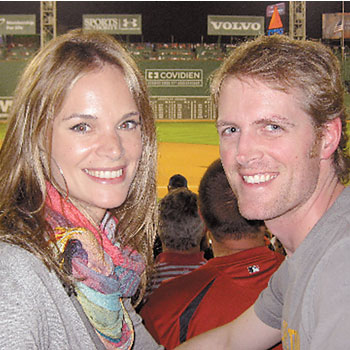
Whoever said that it’s wrong to flirt with the other team wasn’t taking this Toronto couple into account. As Jennifer Hedger and husband Sean McCormick gear up to be on-site hosts for the Vancouver 2010 Olympics (for their respective television stations of course), the sports team discuss what happened when their off-the-field romance went into overtime.

How they met
Our mutual friend Dan O’Toole (SportsCentre anchor) was getting married out of town, and while he was friends with both Sean and me, the two of us had never met. I showed up and tried to convince myself that Sean really wasn’t all that good-looking because I had been told, incorrectly, that he was there with a date. Halfway through the evening, when Sean revealed that he too, was at the wedding solo, I went in for the kill.

The first date
After observing the 48-hour rule (48 hours between last contact and calling), I called Jen, and we went to dinner to Julie’s Cuban Restaurant on Dovercourt and then for drinks at the Drake.

What happened?
Rather than ordering the Caesar salad and chicken fingers I was craving, I tried something on the menu to impress her, and I think it worked. Little did I know that Jen’s a passionate foodie, not to mention the best cook on the planet!

The courtship
When Sean and I met, he was a reporter and I was hosting the two a.m. SportsCentre, so we were keeping very odd hours. I would go by his place after work, around three a.m., and we’d watch TV and do all the things that you would normally do in the early evening but in the middle of the night.

The proposal
We already had a trip planned to the Mayan Riviera, and it seemed like the perfect opportunity to pop the question. After dinner very early on in the trip, I surprised Jen with a photo album. In every photo I was in front of a different Vegas landmark holding a different letter, eventually spelling, “Jennifer Hedger will you marry me?” We didn’t call anyone to share the news until we got home. Thank the sweet baby Jesus she said yes, or that would have been the longest week of my life.

The wedding
We got married on Jan. 12, 2006, at the same resort in Playa del Carmen where we got engaged, with family and friends, and we had an amazing week. After that we honeymooned in Brazil.

Their lives today
We’re both sports broadcasters, so we both basically eat and sleep sports. We like to take one sports holiday a year, either to New York to see a Yankees game or a road trip to Boston to see a game at Fenway. Our other passion is music. We love to travel, and we make an excuse to go to places we may not otherwise go, to see our favourite bands abroad. This summer we went to Dublin to see U2 — standing on the floor together surrounded by 90,000 people was definitely one of the most unbelievable moments of our life together so far.

Secret Success
We genuinely like each other. We make each other a priority and appreciate each other. It isn’t all wine and roses, but we laugh, a lot.  I guess that’s the biggest thing: we make each other laugh.

Eternal summer?

0

 A child heading to camp this summer might just spend more time dealing with megabytes than bug bites. As registrations fill up for summer 2010, we plot the top 10 changes to summer camps over the last decade.

1. Online registration
The cabins may be in the woods, but registration is on par with modern technology. Parents can forget requesting brochures and faxing in forms — nowadays, almost every camp lets you plan your child’s summer with a click.

2. Safety concerns
In recent years the words “summer camp” and “safety” have become synonymous.
“We’ve implemented procedures where we check and double-check our equipment,” says Robyn Hochglaube, director of Camp Green Acres day camp. “We also ask every camper to wear a hair net under their helmet to prevent spreading lice.”

3. More experienced staff
Camps have become much more rigorous about their staff’s qualifications. Michael Silverman of the Richmond Hill Country Club Day Camp explains: “In the past, a counsellor’s responsibilities ran the gamut. Now we hire leaders who have some experience in the field they are teaching about.”

4. More specialization
Will singing around a campfire help Tommy get into college? These days, parents want their children to acquire concrete tools for the future. “Summer camp used to be about independence and social interaction,” says Hochglaube, “Nowadays it’s ‘How is your golf swing? How is your swim badge?’”

5. Environmental awareness
Since camp is a child’s most direct channel to the bush, it seems only natural that the industry is going green. Whether it’s eliminating the use of disposable cups or installing solar panels on the dining hall, camps these days are doing what they can for the earth.

6. Healthier, more tailored meals 
“We’re instilling the values of healthy, active living, which we didn’t really think about that much for kids 10 years ago,” says Lynda Fishman of Adventure Valley day camp.  Camps are also much better equipped to manage dietary restrictions like vegetarianism or severe allergies.

7. Nature deprivation
“We’re getting a lot of kids who have never been in natural surroundings, so it takes a little bit longer for them to adapt to the camp scene,” says Dave Graham, director of Camp Kandalore. “We have to be much more gradual in how we show kids our canoe trip stuff. They deal in cement more than they do in grass and trees.”

8. More communication
Whereas a stamped envelope used to be the main means of communication with Mom and Dad, many campers can now zip their parents an e-mail. And it’s not just the kids. Parents are also more prone to communicating with camp staff, curious to know what their child has been up to.

9. Increased cost
The experience may be rustic, but the price tag is four star. Like everything else, camp is more expensive now than it was in the ’90s, with higher food and gas costs, as well as more stringent employee standards, helping to drive the prices up.

10. The rise of tech camp
Children’s Technology Workshop president Darryl Reiter, whose camp has gone from about five locations to 100 over the past 10 years, says that, while tech camps are not new, their curriculums are constantly being updated. “In 2000, they might have been looking for rudimentary skills. Now what kids learn is how to be creative about the technology, making movies, music and video games. And only those camps who understand how to make a compelling program can stay in the business.”

Melt your hunger at The Grilled Cheese

0

This tiny two-tiered Kensington eatery makes a great date venue for me and my four-year-old son, a wiggly and high-energy kid who devours anything that can be dunked in ketchup.

As the name suggests, owner Rob Youill’s endeavor focuses on just one kind of grub, but his fare of fancy — grillies — is done up right, rounded out by just two selections of daily soup.

Opening three months ago, The Grilled Cheese follows on the heels of the burger-resto trend, whose success is due in part to society’s addiction to eating out combined with economy-forced pinched pockets. Nothing on the menu here tops a ten bill, and although Youill doesn’t source the highest-end cheeses or breads (he’s firmly planted in rough-around-the-edges Kensington Market, after all), his grilling skills are clearly capable.

We are the first customers of the day, which gives us choice of any of the mismatched wood-topped tables and chairs and plywood banquettes. Wood is definitely a decorative theme — walls, shelves, floor, funky stairs partition made of rustic wooden odds and ends assembled in a modern horizontal pattern — this here is a durable, kid-proof environment.

A wall of windows looks out onto Nassau Street, and despite its dire draftiness, it makes for ideal market madness people-watching as we wait and wait — quite patiently, I might add, especially for my preschooler — for our baskets of food to arrive.

A blackboard menu over the matchbox open kitchen lists ten variations, each available on white, whole-wheat or light rye. From The Hamlet with swiss, cheddar, ham, red onion and tomato to the Grilled Motzy with fiore di latte, basil pesto and sun-dried tomatoes, there’s something for every grillie guru.

Provolone and orange cheddar melt together in The Classic ($6) to form a gooey middle layer that, for the first few bites, creates long, stretchy strings of cheese between mouth and sandwich — much to the delight of my son. A perfect slathering of butter and expert grilling give the whole-wheat slices a lovely, crispy exterior. This is a substantial portion for anyone, but somehow my strong, silent type of a son gets through the whole thing (and manages to put a serious dent in the bottle of Heinz).

The Beast ($10) seems a boorish moniker for such a triumph of a sandwich. Generous portions each of bacon, jalapeno jack, cheddar, turkey, grilled onion and tomato weighted down between rye slices during grilling form a divinely dense assembly that can be easily manhandled and scoffed — even by pudgy digits.

All sandwiches are served in red plastic baskets laid with red-and-white checkered paper alongside a small fistful of Lays chips and Bick’s dill pickle slices — a strange corporate accompaniment considering the mass of visually striking mason jars of all things homemade and pickled that line the west wall of shelves (for decoration only).

Two house-made soups are the only other menu offering and provide a bit of winter warmth. Today, chunky potato leak and thick tomato soups simmer on the stove.

Youill seems master of keeping the formula simple and the costs down. He alone takes orders, cooks and serves sandwiches and soup. There are no fancy ketchups, no expensive dairy-free cheeses, no interesting beverages, no Interac or credit cards here to complicate the procedure.

One step at the front door is manageable by stroller, but stairs to the basement washrooms prove a hurdle.

66 1/2 Nassau Street

647.347.7062

Kelly Jones is a freelance writer and editor of articles, reviews, websites, novels and board games. She teaches Food Writing at George Brown College.

Billboard tax to generate $10 million annually

0

Community groups and councillors alike are applauding a recently approved city-wide billboard bylaw and tax. Passed by a 29 to 12 vote, the new tax is expected to generate roughly $10 million annually on outdoor advertising in the city.

“It was fantastic,” said Rami Tabello, founder of IllegalSigns.ca, regarding the recent decision. “It was exactly what we wanted.”

For several years, Tabello has worked to address illegal billboards within the city. In addition to making the installation of new billboards more difficult, the bylaw also calls for dramatically increased fines for illegal signs, Tabello said.

“It regulates signs much better than we’ve been able to do up to now,” agreed Coun. John Filion, who voted in favour of the bylaw. “As importantly, it gives us the money and the regulations to enforce the bylaw.”

The issue is one that effects more than just downtown neighbourhoods. “We have a huge number of illegal signs in the ward, including many in Willowdale,” Filion said. “Even though they are blatantly illegal, we haven’t been able to go in and remove them.”

In addition to fewer billboards in the ward, Filion said the new bylaw will provide new power to dealing with illegal billboards and those responsible for them. “This new bylaw will much more clearly identify the ones that are illegal and get rid of them.” Not everyone is thrilled with the decision, however. “We were extremely disappointed,” said Rosanne Caron, president of the Out-of-Home Marketing Association of Canada, a lobby group for the advertising industry, of the decision.

Caron said the tax put forth by city staff is 21 per cent higher than the industry’s annual profit of roughly $8.6 million. “It’s going to cripple our industry,” she said. “From our standpoint, the tax is unfair and it’s punitive and threatens the survival of an industry that contributes to Toronto’s economy.”

As to where revenue from the new tax should go, opinions are split. “It’d be nice for it to go to public art, as sort of an offset to what billboards do,” Tabello said. Filion said he wanted to see the money first go to enforcement of the new bylaw and secondly to ward beautification projects.

Redevelopment study for local public school

0

AN ACCOMODATION REVIEW committee (ARC) is underway as a prerequisite to redeveloping Davisville Junior Public School, and depending on the recommendations, the school could develop in much the same way as North Toronto Collegiate Institute did, but the Toronto District School Board said the school could also close.

Daryl Sage, board director of strategy and planning, said there is a “possibility” the school could be closed and combined with another school within the ARC area or, if necessary, undergo redevelopment by partitioning a piece of the land.
 

“It’s possible that the school could be relocated to another site,” Sage said, or if the school remains on the site, it would be redeveloped to encompass the attendance boundaries of some other school.
 

Currently the school is undercapacity, sitting at 51 per cent, but numbers are expected to jump to 94 per cent capacity by 2018 once early learning is factored in and the French immersion attracts more students. Redeveloping could mean adding on grades 7 and 8 and bringing in students from another school within the ARC area, which includes schools from Oriole Parkway to Bayview Avenue, up to John Fisher Junior Public School and as far south as Davisville Junior Public School and Hodgson Senior Public School.
 

Selling the property, which could be valued at $10 to $12 million according to a local realtor, would help to offset the TDSB budget deficit, which is what Coun. Michael Walker believes the board is trying to do.
 

“This isn’t one of those critical sites that has to be looked at to be sold off because we have too many schools and too few kids,” Walker said.
School board trustee Josh Matlow said before the board moves forward with a redevelopment project it would need approval from the school and local community groups for referral to the board for consideration.
The next public meeting is Jan. 17, North Toronto Collegiate Institute.

Residential use now on back burner at former CAMH facility

0

THE CENTRE FOR Addiction and Mental Health (CAMH) is in talks with a mental health and addiction clinic, based out of Guelph, to occupy CAMH’s vacant Brentcliffe Road site.
 

Kathleen Wynne, MPP Don Valley West, said it was made clear at a recent community meeting that residential use is not welcome for the site because of already overcrowded schools, traffic congestion and wanting to maintain access to the ravine through the vacant land.
 

“The CAMH board and leadership have worked very hard to find institutional use,” Wynne said, of the efforts made to accommodate the local community’s request.
 

The Brentcliffe Road building has been vacant since April 2008 when CAMH relocated its services to its Queen Street West and Ossington Avenue site.
 

They are trying to work out a deal with Homewood Health Centre to utilize some or all of the space. But Susan Pigott, spokesperson for CAMH, said they have yet to reach a deal regarding whether or not it will share the facility and run services from the site as well.
T

he centre also hopes to lease the other approximately six acres of the nine-acre property for institutional use on a long-term basis.
“The ideal tenant would be somebody who puts it to an institutional use, such as a long-term care facility or a retirement home,” Pigott said. But they haven’t found anyone yet.
“What we were trying to do with the Brentcliffe building was to have a short-term, I think it was a five- to 10-year lease,” she said.

Dunlap debate heats up with development plan

0

Recently released PLans for the David Dunlap Observatory site have residents up in arms.

“After over two years of fighting to save this place, it’s obvious that absolutely nothing we’ve said made an impact,” said Karen Cilevitz of the David Dunlap Observatory Defenders.

The three proposed planning scenarios created by consulting company planning Alliance place “community pods,” composed of houses and townhomes, on various areas of the site. The plans also call for the construction of interior residential roads and pedestrian pathways. None of the three options would keep the site development-free.

Cilevitz said that the three proposals are contrary to an “overwhelming consensus” voiced by residents and others at public consultations to keep the site undeveloped. “What the town has shown, with the publication of their planning report, is that they have zero respect and understanding for what their residents want,” she said.

The site proposals are the latest in recent events that have outraged both residents and councillors, including the recent removal of a number of trees from the site by owner Metrus Developments. Coun. Godwin Chan said that he understands the anger of residents over the proposals.

“I recognize the discontent,” he said. “Maybe there should be a concept that has [no development]. It’s a very sensitive issue.” Brenda Hogg, deputy mayor of Richmond Hill, said that for the site to remain undeveloped would require either provincial and federal government intervention or a UNESCO World Heritage List designation, something town staff has been investigating.

“Even with this blow dealt by the town toward its residents, we will still continue to fight for the protection of the site,” Cilevitz said. Town staff will present the preferred scenario at a Jan. 18 meeting.

Home Depot store to be appealed by city

0

The City of Toronto will be asking for permission to appeal a decision from the Ontario Municipal Board that would allow a Home Depot store to be built on lands zoned for employment purposes only.

“It is the city’s position that it is a conversion from an employment use to a retail use,” said Andrew Biggart, a lawyer who is contracted by the city. “And the city wants to protect its employment land.”
 

Citing the growth plan for the greater Golden Horseshoe, retail is defined as a non-employment use, Biggart said.
 

The now-vacant lot on the northwest corner of York Mills Road and Lesmill Road is also subject to a second development proposal that would primarily be used for a 15-storey all-suites hotel with retail stores, restaurants and professional and medical offices.
The developer is also seeking permission for a wide range of other uses, such as an adult education school, artist studio and various other facilities.
 

But Coun. Dennis Minnan-Wong said the developer seems to want to use it for a seniors’ home and is using the term “long-term hotel for seniors.”
 

“A seniors’ home is an inappropriate use of that property, in my view,” Minnan-Wong said.
But he said he has a different view on the Home Depot proposal because employment in retail is preferable to no jobs at all.
“That particular property, there hasn’t been much interest in anybody purchasing it and using it,” Minnan-Wong said.
City council has yet to approve the zoning for the hotel or the additional outlets.
 

It has already denied rezoning for the Home Depot, after which the case went to the OMB.
 

The OMB granted approval for the plan amendment, but the city sought review from the board chair.
“The board, after examining the decision, ordered a new hearing,” Biggart said, but the outcome was the same.
Now, the city has filed a notice of application for leave to appeal to the divisional court.
 

If approved, Biggart will argue an appeal before the divisional court panel, and it is expected that by early spring a decision will be made.
Tiziana Baccega, spokesperson for Home Depot, said they are looking for a positive outcome for themselves and for Home Depot because “we would love to have the lands zoned to build there.”
The plan also includes a parking garage.

York Region to back Buttonville Airport?

0

Recent talks between Buttonville Airport’s president and York Region could keep the airstrip operational through regional support.

In April, the airport lost $1.6 million in annual funding from Greater Toronto Airport Authority (GTAA). Lloyd Russell, commissioner of finance for York Region, said the region’s previous funding agreement, worth roughly $330,000 annually, was tied to the GTAA agreement.

“Quite frankly, the amount of money we’re talking about was pretty small to support a $96 million economic generator,” said Toronto Airways president Derek Sifton of the family-owned airport.

With development plans for the site, the money will keep the airport open while the region transitions air traffic to an alternative facility, Sifton said. The Town of Markham recently passed a resolution asking that the region restore funding to the airport.

There was some concern over using tax dollars to fund the privately owned airport, Russell said. “At the same time, I’d say there was a reasonable amount of recognition of the value to the region,” he said.

Russell said that the formation of a subcommittee to examine the matter would likely be the next step.

Organized crime plagues Leaside

0

PAULA KING THOUGHT locking her car doors would be sufficient to prevent auto theft.
But King and five others, the most recent victims of organized car theft in Leaside, learned that nothing is safe.
 

“It’s not some kid hot-wiring your car.… They had a list of what cars they needed and they figured out where they were,” King said.
Toronto police Sgt. Det. Dan Nealon said there hasn’t been any major organized car thefts in the area since the six Toyota Highlanders were taken overnight.
 

But, he said, “how they are stealing them has yet to be determined,” adding Toyota Canada is doing their own investigation in conjunction with police.
 

Using a steering lock could prevent these types of car thefts because, although they haven’t ruled out tow trucks, their use seems unlikely.
“I wonder what the next car is on the list that they need because they can take them,” King said.

Thornhill drivers win dubious distinction

0

When it comes to driving accidents, the community of Thornhill is the province’s worst according to a recently released study. Allstate Insurance’s “Ontario Safe Driving Study” ranked communities and regions by examining the frequency of car collisions.

The study spans a three-year period form 2006 to 2009, calculating the number of collisions per 100 cars in communities across the province. Thornhill’s rate of 6.6 claims per 100 cars was the highest among the 49 mentioned communities. Neighbours to the north in Richmond Hill fared little better, finishing five spots behind Thornhill, with a rate of 5.9 claims per 100 cars.

“[The study] shows that communities in the Greater Toronto Area have collision rates more than twice as high as some other Ontario communities,” said Tony Irwin, manager of external affairs at Allstate.

Comparatively, communities with similar populations to Thornhill, such as Chatham and and Thunder Bay had much lower rates at 3.4 and 3.7 respectively. For one local councillor, the report did not carry a lot of weight.

“I don’t think there’s any fair comparison,” said Coun. Alan Shefman. “This is a large, urban municipality with a commuting population.”

“The reality is I drive here every day, and I don’t feel any less safe in Thornhill than I do anywhere else,” he added. Shefman said that he receives a lot of feedback from residents regarding traffic concerns in the community.

He said the feedback usually falls into one of two categories: traffic volume on major arteries and poor driving on residential streets. Coun. Sandra Yeung Racco echoed Coun. Shefman on the volume of resident feedback related to driving concerns. “I can tell you the traffic issue seems to be the biggest issue,” Yeung Racco said.

Yeung Racco agreed with Shefman that a comparison of Thornhill with other communities is problematic. “They don’t have as much of the industry,” she said. She added that the report was prepared by an insurance company using accident claims reports and not a traffic engineering study. The remedy for the area’s vehicular problems lies in alternative transit options, not more roadways, Shefman said. “The real resolution is rapid transit that is easily accessible,” he said.