Home Blog Page 967

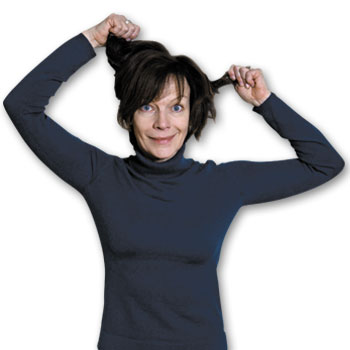
Linda Frum

0

THE SENATE CHAMBER, located at the east end of the Centre Block, the main building on Parliament Hill beneath the Peace Tower, is the most imposing and magisterial room in all of Canada. It’s clothed in red, which lends it the nickname the Red Chamber, is adorned with gold leaf and polished oak. Dominating the room are two thrones, one comically smaller than the other, as though borrowed from the set of The Friendly Giant.

The upper house wears its pretensions loudly and proudly, in startling contrast to the more modest — and green-hued — House of Commons located at the opposite end of the Centre Block. It’s where the Queen addresses the country, where the Governor General delivers the throne speech and where royal assent is given to bills destined to become law.

The pomp and circumstance of the nation’s capital — not to mention the backroom machinations of federal politics — is some distance from the Bayview–York Mills area of Toronto where Linda Frum Sokolowski grew up.Yet, when she took her place as a member of the Senate last year, she found the experience strangely familiar.

“You feel like a schoolkid, like you’re back in high school and everything is foreign and strange and a little scary, and you wonder who you’re sitting beside,” she says with a shake of her head and a deep, genuine laugh.

Frum is seated in the living room of the home she shares with her husband, Argonauts co-owner and real estate developer Howard Sokolowski, and her three children. The home, like Frum herself, is bright and stylish and tastefully decked out in taupes and creams and cinnamons, with the occasional slash of grey and black.

Even her dog, a russet-coloured cavapoo named Raffy, is perfectly coordinated with his surroundings.

“I’m so sorry,” Frum says for the third or fourth time as she tries — unsuccessfully and much to my amusement — to convince Raffy that I’m not there solely to scratch him behind the ears.

It’s clear that Frum, an author, Gemini Award–winning documentary filmmaker and former columnist with the National Post and Maclean’s magazine, is less comfortable on the dangerous end of an interview. “I still haven’t gotten used to answering questions,” she says with a pained expression.

As a politician and one appointed by the prime minister, reporters suddenly have free rein to rummage through Frum’s closets looking for skeletal remains. Not that Frum’s life is an open book, just something resembling it.

Frum says she was a “nerdy bookworm” growing up who spent more time at the library than she ever did at the mall or partying with friends.

“There’s nothing my children enjoy hearing more about than what a complete loser I was,” she says. “I spent a lot of time at home and didn’t really hang out a lot. Of course, back then there weren’t many places to hang out. The Swiss Chalet, maybe, that’s about it.”

Her father, Murray Frum, was a dentist and real estate developer, while her mother, Barbara, was a highly respected broadcast journalist who hosted As It Happens on CBC Radio in the ’70s and The Journal on CBC TV in the ’80s.

“I had a pretty strong sense at the time that her work mattered and that she mattered to people,” Frum says of her mother.

Naturally, people assume that Frum was inspired to become a journalist by her mother, who died of leukemia in 1992.Frum even wrote a book, Barbara Frum: A Daughter’s Memoir, published four years later, in which she wrote in loving detail about their relationship and how she would often seek out her mother’s sage advice. But she says that it was actually her big brother, David, a journalist, pundit and political shark, who pushed her toward a career in journalism.

Frum was attending McGill University in Montreal when she despaired at the strong liberal leanings of the campus newspaper.

At her brother’s urging, she resolved to “speak out against this political stranglehold” by starting her own newspaper.

“It was a political impulse more than a journalistic impulse, a response to the singular monolithic discourse on campus. But I wouldn’t have taken a single step if it hadn’t been for David.”

When Frum speaks of her brother, it’s with equal parts affection and hero worship, and she laughs when I mention his notoriety. After all, while writing speeches for President George W. Bush, he coined the term “axis of evil.”

“I know him as someone who is wise and generous and sweet and principled and who inspires me,” she says. “And yes, he is all of the things that you’ve said, as well, infamous, notorious, but his public image is changing, too.”

When I point out that, considering his role in the Bush administration, his image could only soften, she laughs again and shakes her head.

“He’s one of those intellectuals whose opinions will never be so solid as to be impervious to new evidence. He has an extremely supple and rigorous mind. And I would say the same about the prime minister. Stephen has a tremendous intellectual capacity and strikes me as someone who’s completely obsessed with policy and what is happening in the world. He’s an egghead, and he’s a very thoughtful man.”

Just as politics drew Frum into journalism, journalism has returned her to politics. Of course, one wonders why Stephen Harper would choose Frum, a journalist (a profession considered the Enemy by many politicians) for a Senate seat.

“There’s been a very interesting evolution in the Jewish community away from the Liberal Party and toward the Conservative Party, and I’d like to think I played a small role in that process and that the prime minister is aware of that process,” says Frum, a former chair of the women’s division of the United Jewish Appeal and past board member of the Canada Israel Committee.

Every political appointment comes with more than its share of criticism.

Frum even found herself being not-sogently ribbed by her former employer, Maclean’s. The magazine’s 2009 political yearbook issue dubbed her “head cheerleader,”stating that she was “relatively qualified” for the job. And the overall sentiment regarding Senate appointments could be summed up when the article stated that she had been given a “taskless thanks.”

Frum admits that it stung a little, especially coming from former colleagues. She also recognizes that it’s indicative of a wider misunderstanding of the Senate’s role in federal politics. “It’s not necessarily a powerful job but it’s an important job. We review legislation to make sure the intention of the law is as written,” she says.

“You want to do the right amount of safeguarding but don’t ever want to overstep your authority because you’re not an elected representative of the people.”

Of course, sometimes the job can be just as dull and boring as it sounds. “It is like high school,” she says, returning to her earlier analogy.

“You’re not always interested in every single subject — if you’re a Latin person, you’re not necessarily interested in geography.You can’t be an expert on all subjects or all the legislation.”


Michael Lambert

0

OLYMPIC SNOWBOARDING hopeful Michael Lambert took a bit of a gentle ribbing from his teammates during a recent phone interview from Switzerland.

“Jasey [ Jay Anderson] is here, and he’s really giving it to me about the attention that I’m getting,” he says and laughs. “He’s calling me a rock star. He could just be jealous.”

But Anderson, Canada’s top men’s slalom snowboarder, may just have reason to be envious in the coming weeks. Local boy Lambert, star of Over the Bolts, an MTV reality series chronicling the lives of the country’s top snowboarders as they vie for 18 spots on the Olympic team, is Toronto’s best hope for bringing home snowboarding gold in Vancouver, especially after claiming gold at a major race in Nendaz, Switzerland, in January.

Overall, Lambert has put up stellar placement numbers on the FIS Snowboard World Cup Tour’s parallel giant slalom category as the 2010 Games inch nearer and nearer.

But none of it would be possible, he notes, without the strong connection to his Village friends, family and coaching staff who have supported him over the years.

A particularly special moment came for Lambert last December when he carried the Olympic torch through Hamilton. “My mom was really proud of me that day,” he says. But at the moment, Lambert is focused solely on one goal: Vancouver.

“I’m excited to go because I want to represent the people who believed in me and helped me to get there,” says Lambert, 23. “People like my mother, my sponsors, my coaches. The last couple of years weren’t amazing for me, and they believed in me and fought for me to no end. I’m excited to race well for those people, the ones who helped me truly get there.”

Lambert spent the greater part of his childhood around Lower Forest Hill — calling Austin Terrace, near Casa Loma, home up until a recent move — the oldest of three children born to athletic parents.

He regularly works out at the University of Toronto and continues to have his hand in quite a few sporty activities.

During his time off, you can find him hanging around Yorkville, in particular Sushi Inn and MBCo. (Montreal Bread Company), two of his preferred places to grab a bite.

As a student of Royal St. George’s College, he played on the rugby and soccer teams. “I definitely wasn’t the star,” Lambert says of his tenure as a footballer, though he says the sports he loves most were never associated with school.

His summer pastime, sailing, often finds him out on Lake Ontario. Lambert calls it a good way to stay in shape and a refreshing break from intense, hard-working winters on snowy hilltops.

Though for Lambert, these pursuits match neither the prowess nor the passion he has for tearing it up on the slopes. His first brush with the sport came at the Caledon Ski Club when, at the tender age of two, pint-sized Lambert was put on skis and towed downhill.

Developing a need for speed and a damn-the-torpedoes style, Lambert gave his worried dad reason to slow his son down but, in the end, ended up only speeding him up.

“I was a reckless skier, apparently,” says Lambert. “You know, when you see someone going down the hill and you’re just waiting for them to crash, to explode? I was definitely one of those kids. So my dad gave me a snowboard to slow me down a bit. He [had] had enough of me being reckless. That’s actually how I got into snowboarding. I didn’t so much as ask for it as it was presented to me.”

It was arguably an exercise in futility on the father’s part. The pastime became the beginning of a budding career in 1998 when Lambert took part in a snowboarding championship series at Caledon.

“I got my first exposure to actual racing then,” he said. “There were three kids in my age category, and I won, but for me it was just about going fast again, you know?”Lambert started doing provincial tours every other weekend, then moved on to races in Quebec, then Colorado. “I think a lot of this stuff, you don’t really know how it happens. I was doing it because it was fun. You don’t plan for it to be your job, but when you do well, you have coaches around and opportunities start to spring up,” he says.

Following his graduation from Royal St. George’s, Lambert went full-time on the board, training 220 days a year at various Canadian locales.

The key to victory isn’t so much physical as it is mental, he says. One might memorize a hill to familiarize oneself with the unexpected, but it does little good when weather conditions change over the course of a 10-run day.

Focusing in the midst of such changing conditions can be difficult.

And indeed, concentration problems combined with a tendency to overthink have hampered Lambert in the past. Meditation and scripting his every move up until he comes out of the gate have helped address those issues, he says, and adding the use of one-word mantras centres his focus during his runs.

“I’ll keep repeating ‘Attack, attack’ in my head,” he says. “And if I need to speed it up or if someone gets in front of me, I repeat, ‘Believe, believe.’ Everyone’s got their own system, and I find this is the one that works for me.”

So far, the training appears to be paying off. January’s win, plus a second-place finish behind Jasey Jay Anderson (currently ranked number one in the world) at a race in Telluride, Colorado, means Lambert is hitting his stride at just the right time.

Lambert, however, doesn’t sweat the pressure of the Games bearing down.

“I want to perform my best, obviously,” he says. “I hope I’m not heartbroken. It’s a dangerous thing to do, to make a link between performance and happiness. It’s a very bad place to be, and unfortunately a lot of people think that way, and they think that it’s OK to think that way. It’s no way to live your life, that if you don’t do well you don’t deserve to be happy. And not thinking like that has been bringing me some great results, knowing that life is bigger than the race, bigger than the medal. At the same time, I’m not a flaky racer. I can put it together when I need to. But I’m going to be happy no matter what happens.”


Sheila McCarthy

0

MIDTOWN’S SHEILA McCarthy knew she wanted to be an actor by age 10. “I played the Wicked Witch of the West in The Wizard of Oz.And I killed. I knocked it right out of the park,” she says laughing.

The winner of two Gemini Awards, two Genie Awards, two Dora Awards and a starring cast member on CBC’s Little Mosque on the Prairie is on the phone at her daughter’s volleyball game, on a break from filming.

Shortly, however, McCarthy will be back at work promoting Year of the Carnivore, a film in which she co-stars and that was written and directed by another CBC notable, Sook-Yin Lee.

For McCarthy, who has acted in major Hollywood films, including Confessions of a Teenage Drama Queen, the decision to appear in a small, independent film such as Year of the Carnivore is an interesting one.

McCarthy joined the project because she wanted to work with Lee.When the two met on Lee’s CBC radio show,“We really gelled,” McCarthy says. Plus, after so many seasons of Little Mosque,“it was refreshing and wonderful to be able to jump into another project.”

Like some of Lee’s other cinematic forays, Year of the Carnivore is both racy and moving. The film, which has been described as “a bittersweet comedy,” follows Sammy Smalls, a 21-year-old who works as a store detective catching shoplifters, who her boss then beats up.

Sammy feels guilty about her role in the mess but needs the money and doesn’t want to move home to her neurotic parents.

In the meantime, she falls for a musician, but when the two become more than friends, the experience is less than ecstatic. The musician suggests they date others to gain more sexual experience. In response, Sammy engages the shoplifters to teach her everything they know about sex. Edgy? Absolutely. How this experience changes her and whether she and the musician find their way back to each other — that’s up to theatre-goers to discern.

McCarthy brought her daughter to the Toronto International Film Festival premiere in September and found herself a bit red-faced during some of the more explicit scenes.

“What our [on-screen] daughter goes through is a real coming-of-age tale in that sort of Juno-esque kind of way.

Sook-Yin Lee likes to push the envelope,” she says.

When McCarthy was asked to address the audience after the show, she seized the opportunity to confront her embarrassment.“Clearly my work as a mother is done,” she remembers saying to huge laughter. “Oh. Dear. God.”

In the film, McCarthy plays Sammy’s mother, and Kids in the Hall veteran Kevin McDonald plays her father.

“We’re Sammy’s rather straitlaced but eccentric parents who, I think, parenting rarely occurs to,” McCarthy says.

Shot in Vancouver in November and December ’08,the film “was a short little experience but was really fun,” she says.

She loved acting alongside McDonald. “It was a marriage made in heaven,” she says. As a director, Lee was “very thorough, very intuitive and strong.” The admiration goes both ways. Lee has been a McCarthy fan since watching the classic Canadian film I’ve Heard the Mermaids Singing, in which McCarthy stars.

In that film, “she’s very funny but also … sweet. She’s just got this beautiful energy to her,” says Lee.

While Mrs. Smalls is a very different character from McCarthy’s in I’ve Heard the Mermaids Singing, Lee could tell McCarthy was suited for the role. She wanted an actor “who could bring humanity to this completely flawed character and make me love them — and that’s what Sheila can bring.…She’s able to make me feel something in my heart, with humour and authenticity.”

Those same qualities characterize McCarthy’s role on Little Mosque. It’s one of the first sitcoms to focus on Muslim families. McCarthy’s character, Sarah, is a convert to Islam.

At first, “Sarah was sort of a straight man in the show and kind of the window of the non-Muslim world into the Muslim world. Over the years, she’s grown and gotten warmer and funnier,” McCarthy says.

People of all ages and ethnicities chat with McCarthy about the show, which airs in 60 countries. “When I talk to my mother’s friends in the bridge club, they no longer talk about it in terms of Muslim and Anglican. They just talk about, ‘Oh, that husband of yours.’”

Midtown’s Debra McGrath, who plays Sarah’s boss,Mayor Popowicz,says McCarthy “has a spirit and an energy unlike anybody else.” In scenes together, “we really feed off each other.”

McCarthy says her close friendship with McGrath is one of the great benefits of Little Mosque — along with security as an actor. “I’m the luckiest person in the world to be doing this show,” the 53-year-old says.

With some plays, “you do show after show for months and months. With films, you are there for a week and then you’re gone.” With TV, you do something new every day but with the same family. “That is a wonderful combination.”

Little Mosque has just been picked up for its fifth season, and the show has “really come of age,” she says.With her penchant for quirky film roles, look for her on the big screen, too. She’s also cowritten a screenplay, St. Lucy’s War, that has drawn interest from a major Canadian network.

As for returning to theatre,McCarthy says the prospect is terrifying. “When I sit in the theatre now, I go, ‘Good Lord, how did I ever do it?’”

McCarthy has had an on-off relationship with Toronto over the years

In 2000, she moved here with her husband, well-known classical Shakespearean actor Peter Donaldson (who stars in this month’s And So It Goes by George F.Walker at the Factory Theatre), and their two daughters.

McCarthy was starring in Ross Petty’s Peter Pan, and the family bought a house in Midtown.

With their older daughter now away at university and the youngest about to finish high school, the couple is once again considering settling full-time in Toronto.“I have refallen in love with the city,” McCarthy says.

With their busy schedules and the constant back and forth between Toronto and Stratford, McCarthy’s hoping she and Donaldson find some time to relax and unwind this Valentine’s Day.

“If we’re in the same city, we’ll try to have dinner together and eat lots of chocolate,” she says.

While McCarthy’s affection for Toronto may ebb and flow, her passion for acting (not to mention her husband) is a constant. McCarthy’s prevalence in film,TV and theatre means, even if you don’t watch Little Mosque, her face — with those big blue eyes — is instantly familiar.

But don’t be surprised if the multitalented actor turns up onstage. There are playwrights she’s itching to work with. “But I must do it soon or I never will. I’m in a cocoon on the TV set, and it’s very safe.”


King of campfire ska pulls it all together

0

Toronto native Chris Murray flies under the radar, and that is just wrong.

The former frontman of Canadian ska band King Apparatus has been living in Los Angeles for a dozen years, developing his unique musical sound and living the life of an itinerant ska musician travelling the globe, playing and recording with some of the biggest names in the genre. Recently, Murray released his grand opus, Yard Sale, a stunning culmination of his last 15+ years in music.

For Yard Sale, Murray went to the vaults to dig up some rare gems from days of yore. Twenty tracks that made the album were recorded in 19 different sessions, but despite the immense challenge, the results are impressive.

"In the end, I’m really proud of Yard Sale, the musical unity and diversity, and how it tells the story of my life in music, a life I have been very lucky to live," he says.

Yard Sale has highs and lows, but the package is a stellar effort, and includes some tracks that make you wonder why Murray isn’t more well known than he is. Highlights include the opening jump-beat masterpiece "Everything’ll Be Alright," which is so addictive and so utterly fun. A remastered King Apparatus tune "Strong Physical Urge," and the aggressive "F-train," with its throbbing bass line and gritty lyrics add to the groovy mix.

Back in the early ’90s, Toronto’s Chris Murray fronted pioneering Canadian ska outfit King Apparatus. Fuelled by a frenetic live show, and two solid albums (King Apparatus and Marbles), the band managed to carve out a niche. The band split, and Murray headed for Venice Beach and began recording a unique hybrid of folk and ska (recorded in lo-fi on equipment such as a Walkman) that was dubbed "campfire ska."

"I love my career and I’m very lucky and thankful to be able to make a living doing what I love," says Murray. "But it’s a non-stop hustle to make ends meet, to hustle work and to be out on the road as much as I am."

Go to chrismurray.net for more information, or unstrictlyroots.com to buy the album.


Acclaimed chef gets her groove back

0

Chef Lynn Crawford rubs the dirt away from the eye-catching tattoos on the palms of her hands — a square labyrinth on the left, a Hindu labyrinth on the right.

They’re getting a bit faded, but the message is strong and clear. For Crawford, life is a journey in the pursuit of happiness.

And that journey is leading the talented chef and TV star back to Toronto to open Ruby Watch Co., her new 70-seat restaurant in Leslieville.

For the past 24 years, she has plied her trade in hotel kitchens, rising to the top of her game as executive chef for the Four Seasons Hotel in Toronto and then New York, back in 2006, as well as starring in the popular Food Network TV show Restaurant Makeover, and competing in Iron Chef (she lost to Bobby Flay).

But, after working her ass off for more than two decades, Crawford lost her mojo. At the Four Seasons she was surrounded by the finest of ingredients, and the most talented chefs, but she rarely got to do what she loves: cooking for people. Overseeing five restaurants with multi-million dollar budgets and huge staffs, holding budget meetings, visioning, administrating, and ordering hundreds of turkeys for the Christmas holidays will do that to you.

She knew the ride was coming to an end more than two years ago when she started plotting an escape route. “I’ve been planning for a while,” says Crawford, when we meet at her new construction-site-cum-restaurant, surrounded by a work crew made up largely of family and friends. “I had no clue where or when, only that there would be a next chapter eventually.”

As it turns out, there wasn’t a next chapter, there were two. First came the offer of a new Food Network TV show called Pitchin’ In, which premiered last month. “Pitchin’ In was this incredible new chapter of my life; it was just an unbelievable experience,” says Crawford.

The premise is simple: the highfalutin chef would travel North America to seek out the farmers, growers, fisherman and foragers — the same people that provide the bounty for her high-priced New York City plates. In episode one, she works on a pig farm in Georgia where she encounters a number of colourful local characters, including the stern patriarch of the clan who isn’t too impressed by the city slicker trying to mess with his hogs. Mayhem ensues.

But, at the end of the day, Crawford repays the favour by taking the local ingredients and turning them into a gourmet feast in the farm fields. It is funny and touching, and it seems to have done wonders for Crawford. The show’s subtitle easily could have been, How Chef Lynn Got Her Groove Back.

“I get put in these situations, and maybe I’m the brunt of the joke, but so be it,” says Crawford. “It has just given me so much, such a gift.” In reconnecting with the “bounty of the land,” Crawford rekindled her passion for food and for preparing beautiful meals for people.

Chapter two: the journey home. When Rodney Bowers, a local chef and restaurateur (who worked under Crawford at the Four Seasons in Toronto) put the Citizen on the market, Crawford, along with business partner and restaurant designer Cherie Stinson (of Yabu Pushelberg fame) and Stinson’s husband Joey Skeir, decided to jump in with both feet.

As we tour the space she took over just a week ago, Crawford is clearly comfortable in her surroundings. This is her baby.

“People think it is going to be this five-star place, but it’s not,” Crawford explains. “Five-star service, yes. Five-star cuisine, yes. But we want it to be comfortable.” Not surprisingly, the new restaurant will focus on local ingredients and cooking with the seasons. Crawford is already making connections with local farmers.

“What we want to do is get back to the farms, back to the land where beautiful food comes from,” she says. Joining Crawford in the kitchen is former protege and Truffles chef Lora Kirk, who was also working in New York, with the Gordon Ramsay Group among others.

“She’s exceptionally talented,” says Crawford, with Kirk standing a few feet away casually surveying the ongoing renovations. “I find it hard to talk about you when you’re standing right beside me,” she continues, laughing.

Talent aside, lately Kirk has been busy laying kitchen tile, grouting (she says she has the pictures to prove it) and cleaning exhaust hoods an inch thick with grease. The restaurant is being completely gutted and gussied up from stem to stern for the expected March opening.

Ruby Watch Co. (named after finding a massive 13-foot sign at a vintage store in the Junction) will feature a Stinson design that will see the front facade pushed out to the street, taking over the awkward front patio of the Citizen.

Inside, expect plenty of reclaimed wood, an old barn door at the rear of the restaurant (A gift from Yabu Pushelberg.), a horseshoe bar and a butcher block station that links the open kitchen to the dining room. This is key, says Crawford.

“We take so much joy and pleasure from seeing that immediate reaction when people are eating,” says Crawford. “Nobody knows the blood, sweat and tears it takes to get something beautiful and real to the plate and to produce the beautiful food for chefs. We want to celebrate that.”

There has been a torrent of online chatter surrounding Chef Lynn’s return to town. And, if buzz is any indicator, it seems Toronto diners are as revved up about Crawford’s return as she is.

“I’m so flattered and very grateful,” says Crawford. “All I want to do is cook. I am high as a kite when I’m cooking.”

Ruby Watch Co. is located at 730 Queen St. E.

A marriage of method & madness

0

THE MISSUS

MARTHA BURNS

Q: What has it been like to have George as director?

George’s direction is like his writing: surprising, original, unpredictable and full of heart.

Q: Tell us about your character.

Gwen is someone who has had a lovely comfortable life and all of a sudden doesn’t have it any more. She loves her family.

Q: What’s something we don’t know about Martha Burns?

I hope that there is a lot that you don’t know about me, but here’s one fact you may not know. I have very small feet.

Q: What did you think the first time you saw your hubby, Paul Gross?

Wow, does he ever have small feet!

THE PLAYWRIGHT

GEORGE F. WALKER

Q: This is your first new play in a decade. What prompted the return to the stage?

The play just came to me. It was a surprise that I had one in me.

Q: If you could have dinner with any playwright, who would it be and what would be your conversation starter?

Samuel Beckett. And I’d begin by asking him, “Why bother?”

Q: If you could prorogue anything in your life right now, what would it be?

Memory loss.


THE SHRINK

JERRY FRANKEN

Q: Tell us about your character.

He is aware of life’s problems and still enjoys it.

Q: What’s your favourite theatre-lingo term, what does it mean, and why do you love it?

“Thank you! You’re finished.” It’s a type of contradiction I enjoy.

Q: What’s your secret technique for memorizing your lines?

Rehearsal and hard work.

Q: What’s the best movie you’ve seen this month (and why)?

Dr. Zhivago — the idea of revolution fascinates me.


THE HUSBAND

PETER DONALDSON

Q: When a cellphone goes off during a show, what goes through your head?

Damn, I thought I turned that thing off.

Q: What are you and wife Sheila [McCarthy]’s Valentine’s Day plans?

Everyday is Valentine’s Day for Sheila and me.

Q: When theatre-goers leave the auditorium after seeing this play, they’ll exclaim …

“Thank God that Donaldson character finally shut up.”


THE DAUGHTER
 

JENNY YOUNG

Q: What has it been like sharing the stage with these actors?

Intimidating, but they too have their process of fumbling through the work. They’re kind, generous and wonderful to watch.

Q: What’s the challenge to your role? She is schizophrenic.

She hears voices and is paranoid. So figuring out what’s real … but not a caricature of a sick mental health patient. She has ugly moments that I don’t want to shy away from.


This Latin jazz star’s fave ’hood is truly the Pits!

0

I RECOGNIZE AMANDA Martinez’s hair immediately. Natural and bouncy, much like her personality, I can spot it a mile away as she strides toward the Linux Caffe at the corner of Christie and Harbord.

Slow jazz lingers in the air of the coffee shop as the gorgeous Latin musician enters the front door. We find immediate common ground in our love of baked goods and warm drinks on an ugly winter’s day.

“This place has such delicious food,” she says as she waves to the owner, who knows her as a dedicated regular. “Delicious and dangerous.”

With latte and cider in hand, we begin to discuss Martinez’s connection to the Toronto quarter that lies west of Clinton, on Bloor Street. Most famous for its slope-sided 21-acre park, the area has played host to Martinez for half a decade.

“It’s a really warm community of people,”she says.“I think that’s what I love most about it.”

She pauses for a moment and smiles. “Plus, I first met my husband Drew living in this area.”

Hearing about the couple’s coffee rendezvous turned late-night dinner turned marriage leads me to ask Martinez to weigh in on the art of the first date. I figure as the voice and brains behind an acclaimed Latin album entitled Amor, she’s qualified to give her two cents.

“You’ve got to start out at a place like this one,” she says of Linux. “The best thing about a coffee date is that you never know when you’re going to click with someone. If you go for a coffee, there’s no commitment, you can leave when you want.”

Coincidentally, it’s time for us to leave the café but certainly not for lack of connection. Like two old friends we set out in the slush to excavate the city’s most charished chasm.

Heading north toward our first destination we pass by Clinton’s, a black-bricked Toronto tavern tradition that stands large and proud on the corner of Bloor and Clinton.

“I always bump into people when I’m there., it’s a really great place to go after work, after a long day,” she says. “Of course they have great music; my husband [who plays bass guitar] has performed there. I always hear great new bands there.”

A few paces west bring us to the busy intersection of Christie and Bloor, where we duck into boutique store Top Half, the narrow walls of which are delicately lined with hip scarves, funky jewellery and comfy cardigans.

“I love going to little boutiques where there’s not tons and tons of stuff,” says Martinez.

A few steps further down the road brings us to a bleak grey building with foggy windows. We step into Wong’s Garden Centre and the reality of winter melts away.We’re faced with a veritable greenhouse of plants and flowers from the familiar to the exotic.

I love flowers,” she says. “I like them best when they’re unexpected, for no reason at all. “I find they can really help to lift a mood, especially during the winter.”

Agreeing to engage in one more spiritlifting winter activity, we cross the road and head into the area’s famous park for a short skate on the Christie Pits rink.

As we weave along the pathway toward the ice, Martinez speaks fondly of the surrounding scenery.

“My husband Drew took me skating here, and it was the first time in years. It was very romantic.”

En route, she points to the left and to the right, citing Tacos El Asador and Mexitaco Taqueria as her two favourite places to grab Latin American comfort food.

“The taco place is like my kitchen,” says Martinez.

“It was the first place I went when I moved. I walked in and told them that this is the place that I would come all the time, and they kind of rolled their eyes. But I became their best customer!”

When I look over at Martinez, she’s already lacing up her skates. Within seconds she hits the ice like a pro and even manages to strikes a few flamenco poses.

I can’t help but think that this moment of playful relaxation couldn’t come at a better time for the singer, whose schedule is jammed with performances and preparations for her upcoming world tour in promotion of Amor.

But here in Christie Pits, she takes a moment to appreciate the past and let the future be.

“It was such a nice chapter of my life,” she says looking out into the park. And somehow I can tell that no matter where she goes, she’ll always come back to it.


Get your arepa-tite going at Queen W. cafe

0

Craving something different than the usual pub grub, slice of ’za, or submarine sandwich in the Queen and Spadina neighbourhood? You’re in luck.

Arepa turns out South American specialties in casual but decidedly funky, unpretentious digs. And although it’s not exactly set up for Bugaboos and babes with Bjorns, preschoolers and kinder kids will find the space welcoming and the menu manageable. 

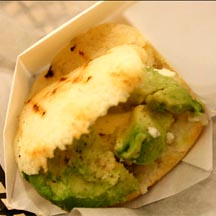
Arepas are a kind of bread made from corn, thicker than tortillas and with a consistency not unlike dense English muffins. Popular with Venezuelans and Columbians, they’re often sliced and stuffed, like a sandwich, with any manner of fillings. Twelve set assemblies line the menu here.

Recommended by the server/cashier, the roasted pork and onion selection ($6.50) brings an arepa filled with succulent swine slices and sweet, yielding caramelized onions. Despite the juiciness of the fillings, on the whole, it’s a teeny bit dry; a few smears of freshly smushed avocado spread from the small silver ramekin does the trick.  

Pickled octopus arepa ($7), otherwise known as the pulpo, sates seafood lovers with its generous, toothsome filling of diced octopus tentacles and mantles, well marinated in citrus and coriander and tumbling out from between the halves of arepa. Our only quip is that the octopus could have self-pickled a while longer for a more tender consistency. 

The daintiest serving of uber-fresh grated coleslaw of carrot, onion, celery and cabbage—refreshing and flavourful—accompanies both. 

Those looking for something more than just a sandwich opt for one of three platters. Pabellon Caraqueño ($10.50) steals the show, with a prettily plated assembly of greaseless fried plantain, basic grilled arepa, soft, cooked black beans (and I mean black!) under a grating of queso blanco, a molded puck of white rice, and the most palate-pleasing serving of savoury and sweet pulled flank steak meat stewed in tomatoes and spices. The cheese is somewhat dry, having been grated much earlier, and the rice is not a hot as it should be, but despite these shortcomings, we are thrilled with the dish. 

The most likely favourite for little ’uns comes in the form of tequeños: freshly baked, airy pastry tubes wrapped around melting white cheese. Avocado dip accompanies the four thumb-sized pieces, but a simple side of salsa cruda (homemade salsa) would have proved a better partner.

High ceilings, blond wood tables, a wall of windows and well-placed lighting make this a bright, open, happy place, while exposed brick walls and original tin ceiling add authenticity. Rows of bright yellow packages of harina decorate one sizeable shelf, their colour echoing the sunny yellow walls in other places. Chefs prepare arepas behind a glass counter as ordered, successfully distracting short attention spans while they wait for orders.  

Mill Street organic beer tempts ale quaffers. And interesting, healthy and freshly prepared juices, like mango and cantaloupe-melon, make good choices to their pint-sized partners—but at a price ($4.50). A glass of lemonade (just $2), a perfect balance of raw sugar cane and fresh lemon juice and topped with mint leaf, promises to be a regular’s favourite. 

Stroller accessible, but bathrooms downstairs. No high chairs. 

Arepa Café, 490 Queen St. West, 416.362.4111

Kelly Jones is a freelance writer and editor of articles, reviews, websites, novels and board games. She teaches Food Writing at George Brown College.

Second meeting slated for ‘food belt’ proposal

0

A second meeting to discuss a controversial plan to establish a Markham “food belt” will take place later this month.

“It is a vision for the future of agriculture, not just in Markham or our region, but in Canada,” said Coun. Erin Shapero. “I think there’s no more important debate than this.”

The joint proposal put forth by Shapero and fellow Thornhill councillor Valerie Burke calls for 16 per cent of Markham’s total lands, roughly 2,000 hectares, to be preserved for agricultural purposes. The land is classified as Class 1 farmland, the best in Canada.

“You can’t get it back,” said Coun. Burke. “It took thousands of years for the soil to develop. We have to look at the big picture. This is about our survival, for heaven’s sake.”

The Town of Markham is currently preparing to revise its official plan to accommodate population growth mandated by the provincial Places to Grow Act and looking into various intensification plans.

“In survey after survey, Markham residents have said do not continue the cycle of sprawl onto farmlands in our north,” Shapero said.

Others, however, are skeptical about the response residents will have to the plan. They argue the proposal will mean that 100 per cent of future growth would come through intensification of existing residential areas.

“I have a hard time believing that the existing ratepayers are in for 100 per cent intensification,” said Stephen Dupuis, head of the Building Industry and Land Development Association, which represents 1,300 companies. He said that the creation of the farm belt could create what was recently dubbed an “apartment belt” in a local advertisement. Shapero dismissed the ad.

“It is fear mongering that you’re hearing from the development community,” she said. “The fact is, they’ve been building cookie-cutter, single-family housing for years and years, and they don’t want to change.” The meeting is scheduled for Feb. 16.

Forest Hill resident to bid on Canwest dailies

0

FORMER SENATOR JERRY Grafstein, a long-time Forest Hill resident, is filing a bid, along with two long-time media professionals, to buy three of Canwest’s daily newspapers.

“There is an urban legend that the future of newspapers is dim. I don’t believe that. That is a view that the glass is half empty. I don’t believe that. I think the glass is half full,” Grafstein said.
 

He is one of the founders of Citytv, and has had a lengthy career in public affairs and law. Grafstein said he will be filing a bid to purchase the Montreal Gazette, the Ottawa Citizen and the National Post with a consortium of colleagues.

Raymond Heard (a media consultant with major corporate clients, a former White House correspondent and managing editor of the Montreal Star and head of Global News) and Beryl Wajsman (editor of Quebec’s largest English language weekly and producer and host of a Montreal radio news magazine program) will be bidding with Grafstein.
 

The vitality of the ownership is based on local direction, Grafstein said.
“You should know the communities you serve,” he said, “as opposed to having distant corporate ownership.”
“We intend to dig deeper roots into each of the communities,” he said.

Book Excerpt: To Hellholes and Back

0

Introduction: The Four Horsemen of My Apocalypse

I thought Americans were supposed to be stupid about these things. Ignorant of foreign cultures. Disinterested in international affairs. This, I’ve always figured, was particularly true of Africa—Americans presumably have trouble distinguishing between the Kalahari, Sahara, and Luxor on Las Vegas Boulevard. Jay Leno hits the streets to prove what a bunch of insular jackasses we are, and even someone like me, who’s never once laughed at that condescending bit, has to admit he’s got a pretty deep reservoir of stars-and-stripes stupidity to trawl.

Which is why it surprises me that when I begin e-mailing friends and family about my upcoming trip to the Democratic Republic of the Congo, I receive in reply a storm of dire and frighteningly specific warnings. Americans, at least my Americans, appear to be quite impressively informed.

From buddy Dave Malley: "The current Atlantic Monthly has a thing about a British biologist who died in the Congo after contracting an illness from monkey feces. Thought you might want to know."

From sister Amy: "You’re aware there’s a civil war going on there, right?"

From Glasser in Japan, a man hardened to life’s inequities first as a foot soldier in Vietnam, then as a jewelry salesman in South Central Los Angeles: "The Congo, and you may quote me, is Hell. Only without the interesting people. Pay for a week at the nearest rifle club. Train on an M16 or AK-47. Takes a monkey about two days on either one to begin shooting like Clint Eastwood. Your M16 tends to jam up if you don’t keep it clean, but AK ammo weighs a ton, something to think about when you’re humping through a croc-infested swamp with your mortally wounded local guide slung over one shoulder. But don’t even think about bringing guns into the country. They’re cheaper at the Kinshasa 7-Elevens."

From cousin Michelle, intrepid sufferer of Peace Corps and invasive-parasite abuse: "Do you know about guinea worms? They bore into your skin, then burst and release larvae and infecting cyclops, better known as ‘water fleas.’ If the worm is wrapped around a tendon or so deep that it’s not possible to extract it surgically, you have to wait until ‘normal emergence’ occurs. This means waiting for the worm to burrow out on its own. When I was in Senegal I saw a woman with multiple worms in her leg, breast, and vagina."

From Dr. Bahr, a man I’d claim as my personal physician had I not personally witnessed his collegiate heyday. "In lieu of your latest effort to impress I don’t know exactly who with your carefree spirit of misadventure, I’m pasting some information from the State Department’s Web site: ‘The Department of State again warns U.S. citizens against travel to the Democratic Republic of the Congo (DRC). Armed groups and demobilized Congolese troops in parts of the country, including Eastern Congo, are known to pillage, carjack, and steal vehicles, kill extra-judicially, rape, kidnap, and carry out military or paramilitary operations. Travelers are frequently detained and questioned by poorly disciplined security forces at numerous roadblocks throughout the country. Public Health concerns also pose a hazard to U.S. citizen travelers for outbreaks of deadly viruses and other diseases which can occur without warning and many times are not rapidly reported by local health authorities. During the months of August–October, lab confirmed cases of Ebola were found in the Luebo area of Kasai Occidental Province.’ "

Perhaps because he wastes more on- the-job Internet time than anyone who doesn’t have an addiction to fantasy football or two girls, one cup, my infamous Asia expat buddy Shanghai Bob began slamming me with daily e-mail warnings featuring links to archived New York Times stories bearing headlines such as "Rape Epidemic Raises Trauma of Congo War" and "African Crucible: Cast as Witches, Then Cast Out." The latter story dealt with a contagion of Congolese and Angolan children who were being persecuted as witches. One concerned father reportedly injected battery acid into his twelve-year-old son’s stomach in an effort to encourage the boy’s evil spirits to find a new home. Later, Bob would keep me informed of proceedings concerning a roundup of Congolese sorcerers accused of shrinking men’s penises with special curses.

When I told him I couldn’t possibly keep up with his force-feeding regimen of Dark Continent fearmongering, Shanghai Bob wrote me a note that summed up, if in less urbane terms, the prevailing attitude of everyone from my mother to my dental hygienist. (Even the relentlessly chipper Tete from Togo exclaimed, "Africa, it’s all bribes!" while scraping my plaque.)

"I’m not trying to scare you, fuck with you, or be a wiseass in any way," Shanghai Bob declared, drawing upon his complete reservoir of personal empathy. "But I think you may want to be kept informed about these things as your trip nears. As Father O’Flaherty always counseled us, there’s no shame in pulling out, even at the last minute."

This is the problem with having a lot of educated, liberal friends. Every one of them has an encyclopedic knowledge of injustices and outrages around the world—Congo, East Timor, charter schools—and jump at any chance they get to tell you how bad everything is out there.

More disconcertingly, my friends seemed to be right. Or at least consistent with expert opinion. A few weeks before going public with my plans for a Congo holiday, I’d sought the advice of a highly regarded BBC documentary filmmaker named Sam Kiley, himself on his way back to the Congo to shoot more footage in the North Kivu region, the place where that aforementioned civil war was raging.

I had no interest in being an eyewitness to war, but North Kivu had caught my attention for its mountain gorillas and position at the center of Africa’s Great Lakes region. As a friend of a friend, I thought Kiley might be a good guy to tag along with for my first trip to Africa. He immediately rejected my plea to join his expedition, then did his best to discourage me from going it alone. From a twenty-minute phone conversation, here are a few of the more memorable moments:

"Congo’s not the end of the world, but it’s bloody close. As deep bongo as it can be."

"You can get eaten in the Congo."

"You mean by animals?"

"No, by humans. Try to stay off the menu, mate."

"You’re kidding, of course."

"No, I’m quite fakking serious."

"Congo is very advanced fakking horror. Think Marlon Brando in the final scene of Apocalypse Now and then take some acid and you’re close to it. I’m properly not kidding."*

"All Eastern Congo is a front line. A full-on war is going on."

"It’s not at all rare to come across eight- and ten- and twelve-year-old boys with AK-47s using someone else’s intestines to set up a roadblock."

I wanted to go to Africa because I didn’t want to go to Africa. And I didn’t want to go to Africa for many excellent reasons. Malaria. Cholera. Bilharzia. Yellow fever. Genocide. AIDS. War. Famine. Rebel attack. River blindness. Lions, hyenas, and other wild animals that occasionally maul and kill even dedicated pacifists. Eighteen hours in the coach cabin of an airplane. The aforementioned worms that nest in human sex organs. National dishes such as "foufou" that cousin Michelle reported on from her latest posting in western Africa as "gelatinous balls of yam or cassava with a thin sauce on top, often slimy okra."

All of which made me want to go. Not counting the eighteen hours.

Allow me to explain. While I’m admittedly a person who cowers instinctively from tests of individual resolve, I am at the same time strangely attracted to them. Like walking a little too far out onto a ledge or agreeing to speak at Rotary Club luncheons (where my little act goes down about as well as a hair in your throat), I often do things that I absolutely know I shouldn’t. The Thompson coat of arms is, after all, a man being handed a beer while someone else twists his arm.

But beyond being an admitted contrarian— and, yes, part of the reason I’d chosen the Congo was because almost no one else would— I believe there’s value in doing things the mind cautions against. Two episodes from my adolescent years come to mind. One winter, I agreed to play the part of the little drummer boy in a local Mormon Christmas pageant. (Juneau was small and apparently there were no Mormons in town who could keep 4/4 time.) Several years later, I took mushrooms with my reprobate friend Roger Sinclair and attended a midnight showing of An American Werewolf in London. Trusted advisers had counseled me against becoming involved with either mushrooms or Mormons, and upon making the decision to enter into both of these strange worlds, I was instantly consumed with anxiety and regret. Nevertheless, I plowed through both experiences, found one only slightly more bizarre than the other, and both, once the scarifying events were behind me, at least partially rewarding.

Challenging one’s assumptions doesn’t necessarily mean refuting them. I became neither a Latter Day Saint nor addicted to psilocybin. Sometimes it’s just as valuable to reaffirm your belief system as it is to disprove it.

The larger point is that one should never let one’s own moral compass go unchecked for long. The world changes too fast. The worst thing is to become stagnant. Comfort is the enemy of creativity. Or, if you prefer your searching personal philosophy from Saul Bellow (who will appear again shortly in the unexpected role of traveler’s aid in Africa), "Trouble, like physical pain, makes us actively aware that we are living."

We’ve done a lot to eliminate trouble and physical pain in this country. Like yours, my life is and largely has been too easy. I wouldn’t have said or believed this at twenty-five, an age at which I believed high school geometry, female rejection, mean bosses, Ronald Raygun, and the inexplicable hot-rotation popularity of Duran Duran counted as legit personal traumas. In retrospect, I see that I’ve had far too little to complain about. Aside from the fourteen thousand exposures to "New Moon on Monday" and "The Reflex."

We’ve become soft. Like Jell-O. You. Me. Everyone. America. Americans. Too fragile to breath in someone else’s cigarette smoke, ride a bike without a helmet, or play Texas hold ’em without a pair of wraparound sunglasses. We’re turning into a nation of fearful twats, obsessed with supposedly tragic childhoods, lousy parents, career disappointments, social outrages, political grudges, and long lists of personal grievances that until recently were collectively known as the human fucking condition.

Our edges have been beaten away by trophies handed out just for showing up; schools that no longer make kids memorize multiplication tables; doctors who pass out brain meds like Skittles; and therapists who indulge the public’s every impulse to whine and wallow in self-obsession. The pussification of America, promoted by corporate empires with an interest in keeping the nation locked in a state of suspended me-me- me childhood, is especially insulting to anyone with a memory that stretches back to a time when comic books and superheroes were cultural mainstays only for those under twelve years old and our national leaders didn’t use words like "bad guys" to describe criminals, misfits, and every third unlikable foreigner.

Years ago in the Philippines, I hired a small catamaran to take me a few miles offshore to Hundred Islands National Park. The first mate was the captain’s son. Eight years old. The kid ran around hauling jugs of fuel, dragging anchor chains, rigging fishing gear, and tying half hitches and bowlines like Vasco da Gama. I have no doubt that boy is running his own charter operation today; and that if his apprenticeship had taken place in the United States, social workers would have seized him from the abusive father before he’d had time to learn port from starboard.

If I sound angry it’s because I’m no less culturally flabby than anyone else. My problem is that I can’t afford to be. For travel writers, maintaining an intrepid reputation is vital in the never-ending quest for more work, and my biggest professional secret is an ugly one: much of the world scares me. Or worries me. Or, at the very least, repels me for no better reason than the extreme physical and social discomfort I’m certain a visit will require. There aren’t supposed to be limits on "adventure travel," but until now I’ve privately kept a list of not-for-me destinations where beyond disease, crime, filth, intestinal viruses, and the possibility of rectal bleeding, I’m equally turned off by prejudices against pushy locals, monstrously bad food, paralyzing constipation, and hotel beds with only one pillow (I require two, minimum).

For several years I’ve been appearing periodically on a Canadian radio program hosted by an amiable iconoclast named Andrew Krystal. Like many others, Krystal reads my dispatches from places like Saipan and Kursk and assumes the best/worst of me. This has led him on occasion to introduce me to the "Krystal Nation" as "Indiana Jones’s long-lost son." My limp protests to these pronouncements are meant to project an appealing, boyish humility—"Heh-heh, not really, Andy, but I’ll admit that brush with the locals in Pago Pago was a close one." In fact, they mask the stuttering false modesty of a semifraud.

International competence is the stock in trade I’ve sold to editors and publishers for years, but like anyone else I’m given to wondering how one does manage to traverse the Congo, one of the largest countries in Africa, when it barely has a functioning government or infrastructure? More worrisome than my own wherewithal is the competence of others. Don’t stories of airplanes crashing in remote jungles, tourist-laden buses plunging down ravines, and overloaded ferries sinking to the bottom of oceans come all too frequently from the more "exotic" parts of the world? Is it really wise to travel overland in places where car horns double as brake pedals?

And these are just the obvious concerns. Upon reflection, Africa proves to be the mere tip of a blade of personal paranoia that widens like a bloody cleaver on a butcher’s block. Beyond the continent of Robert Mugabe and Idi Amin are dozens of places I’ve heretofore avoided even more assiduously than Dave Matthews albums.

I can probably be pardoned for not getting around to Yak Heritage Days in northern Mongolia or autumn leaf peeping in New Hampshire, but for a guy who’s spent years passing himself off as a well-rounded traveler, three other locations stand out as the most shameful holes in an otherwise respectable resume. You wouldn’t think that a man in my position could have managed to avoid not only Africa but also give the slip to India, Mexico City, and, perhaps most astonishing of all, Walt Disney World. Yet year after year I have. And happily.

Not only have I been to none of these traveler touchstones, I’ve diligently avoided them, and for mostly lame reasons. My fear of AIDS, for instance, is dwarfed by my fear of standing in line in the Florida sun next to rotund people from New Jersey and Texas who steadfastly refuse to discipline their little Jacobs, Justins, and Caitlins while they run off their Adderall highs in Frontierland.

And food. Being a picky eater is another of my more emasculating confessions. Few pretrip worries weigh on me like the prospect of being the haole guest of honor at some native banquet presented with a steaming bowl of goat ovaries and baked kittens while a klatch of locals watch in anticipation to see if I merely love the national cuisine, or really love it! Or, worse, figuring out what exactly the discerning palate falls back on in countries where chipotle flavoring has yet to make significant inroads.

But this unholy quartet of locations doesn’t merely signify my personal hellhounds. Each of them, and for different reasons, are places many Americans spend their lives turning their backs on. Presumably for good reason. Of the dozens of people I’ve known who have survived India, for instance, not one, not one, has returned without some horror story involving a no-holds-barred bout with a gastrointestinal ailment that rendered them half-blind for days on a damp cot in some reeking backwater "hotel" praying for a merciful and speedy death.

"It’s practically a given that a visiting gut is going to go south at some point on a trip to India." This is the lead sentence of the story that introduced me to India’s most widespread reprisal to tourists, a piece in Escape magazine by a writer named Andrea Gappell whose Indian stomach cramps were so painful that she made an emergency visit to a doctor in Agra. The doctor informed her that her appendix was about to burst. After emergency surgery and eight days tethered to an IV drip—"Rows of Indian patients stared at me as they lay flat on sheetless mattresses in the dingy ward"—Gappell was released from the makeshift clinic, only to be informed by locals that the doctor who’d operated on her was notorious for running the old "Your appendix is about to burst; we must operate at once!" scam on panicked travelers felled by severe food poisoning.

Colorful anecdotes like this one are a big reason I’ve never applied for an Indian visa, despite being a big fan of any dish, movie, or stripper with "masala" in the name. No one wants to spend half his vacation laid out in Bangalore. Yet why go to India and not eat the food? Easier just to stay home.

Aside from being a digestively explosive travel destination (though Condé Nast Traveler runs stories about India all the time, so how bad can it be?), India is even more intimidating as a political and economic entity. The value of its stock market doubled in the mid-2000s. In 2007, the Economic Times reported an annual 14 percent rise in Indian manufacturing, the largest national growth on the planet. The country’s stable, well-regulated banks largely escaped the global financial crisis of 2008–2009. Business-Week and The Economist routinely refer to India as a tech giant and predict the balance of power in the world’s economy shifting from the United States to China and India in the coming decade.

On a pragmatic level, it’s true that I’m worried mostly about myself, but it does seem to me that now is an opportune time to get a close-in look at the challenges we as a nation are up against in the years to come: new diseases; new rivals; new enemies; entitlement seekers pouring across our borders; armies of hypermotivated, tech-savvy workers battling an anachronistic American labor pool whose most potent job-market skill is the self- esteem acquired in "fun" classrooms and on sports fields where everyone’s a star and no one keeps score; an international up- from-the-gutter work ethic that trounces "follow your dreams" with "suck it up, get used to a little disappointment, and find a goddamned job that doesn’t play to your dumb ambition to program video games and produce hip-hop records." If, as it certainly feels, the world is closing in around us, it seems worth the trouble to have a look at who and what is on the way.

All this is alarming enough and I haven’t even factored in America’s diminishing reputation abroad. During the week I began planning my daunting year of travel, the reigning Miss USA, a Tennessee stunner named Rachel Smith, was actually booed in a packed theater in Mexico City. Lustily. Not lustfully.

I don’t care what side of the political divide you rattle your saber on or what you think of the wondrous Obama ascension, a moment like this demonstrates far more than any flag burning, effigy bashing, or orchestrated protest just how far America has plummeted in the world standings of likable countries (at the moment fighting for last place with North Korea). When one of the quantifiably hottest women out of a population of three hundred million from a country known for flashy displays of its most lurid perversions can parade her perfectly hard, twenty- two-year-old, multiethnic, beauty- queen, bikini- wrapped body in front of an arena filled with partying Mexicans and get booed, you can’t help wondering what kind of reception you’re going to get when you accidentally wander into the barrio at two in the morning with your head spinning with tequila and Los Lobos lyrics.

If you pay attention to media drumbeats, of course, you already know that testy pageant crowds are the least of Mexico travelers’ concerns. The latest orgy of yanqui panic, fueled by more of those totally reliable State Department travel warnings and a blanket recommendation from university presidents around the country advising students to avoid Mexico during spring breaks, feels less like sober assessment and more like a concentrated effort to paint our next-door neighbor as a terrorist narco-state. Current conventional wisdom is that Mexico doesn’t simply present the United States with a drug and illegal alien problem, but with a genuine security threat. From Face the Nation’s dyspeptic Bob Schieffer to Rolling Stone magazine— there’s actually less of a difference between the two than you’d imagine, these days—there’s been a tremendous effort to lump the land of margaritas and mariachi in with the likes of Iran, Pakistan, and Al-Qaeda.

Written by Guy Lawson, the Rolling Stone feature kicked off with an account of a violent drug raid in Mexico City carried out by a hundred federal agents wearing ski masks and armed with assault rifles. It claimed: "The real front in the War on Drugs is not in cities like Tijuana and Ciudad Juárez, or in the Sierra Madres, where drug kingpins hide out, but in the corridors of power in Mexico City." Typically, efforts to scare Americans away from Mexico have focused on crime around the U.S.- Mexico border. Now Lawson and plenty of others would have us believe that extreme toxicity also runs wild in the capital. And maybe it does.

"Extreme tourism" means different things to different travelers. It’s often associated with billionaire space tourists and bombastic cable TV hosts who pit themselves, alone and ill-equipped, against the Tasmanian wilderness (save for whatever supplies are required to keep union television crews powered, fed, rested, and safe). For those who would complain that some of the places covered in this book might not meet a strict definition of "extreme," I maintain that anything that gets the traveler out of his or her comfort zone, or forces them to challenge their belief system, fits a fluid criterion.

To some, extreme travel might suggest living in a grass hut in Borneo for six weeks, but if you’re the sort of person who enjoys spending time in grass huts, what’s so extreme about that? No question, prowling the Russian steppe for wolf meat and potato vodka takes a certain amount of admirable grit. Far more frightening to me, though, is the prospect of exploring the comely mermaid fantasy of Ariel’s Grotto inside the walls of a twenty-sixsquare-mile temple of consumerism dedicated to celebrating synthetic American culture at its overcrowded, fake-dreams, corndog-and-cotton-candy-inhaling worst, pushing a CEO-manufactured, ultraconformist mass "fantasy" presented fait accompli to American children. If it turns out there’s more horror to shrink from in Disney World than in Africa, I for one won’t be all that surprised.

While standing resolutely behind my newfound willingness to face down extreme challenges, I don’t want to create unrealistic expectations. This isn’t a book about dangling from the end of a rope off a nine-hundred-foot rock face along the south ridge of K2. You’ll not find me dodging bullets and IEDs as I creep with my aide-de-camp Kareem over the border from Pakistan to Afghanistan.

I don’t sleep well in the best of circumstances. I’m in reasonably good cardiovascular condition, but I have the arm strength of a man half my weight. I’m leery of heights. I’m not interested in solidifying my reputation as a wisecracking bon vivant by dying young (relatively) and leaving a good-looking (relatively) corpse. You can make your own fairly accurate assumptions about the mettle of a guy who includes Orlando on his primary list of scary places.

But if there’s one lesson I’ve prized from my years of travel it’s this: no place is ever as bad as they tell you it’s going to be. Government bureaucrats are more concerned with covering their asses by issuing ludicrous "warnings" than with disseminating accurate situation reports. And our "news media"—if you want to call information largely regurgitated from self-interested corporate and government sources "news"—operates pretty much like your one crazy drunk friend, the guy who has a hysterical public reaction to even the smallest events, exaggerates all of his stories, and gets in a tizzy over every opinion whether he agrees with it or not.

I don’t have to be reminded that the world collective is united in its dread of the Congo; that power vomiting on legless beggars is the national sport of India; that Mexico City is a sweltering hole of pollution, disease, cardboard shanties, and homicidal drug syndicates; and that I’ve got some personal issues to work through regarding Florida in general and Disney World in particular. It’s just that for every warning I’ve ever gotten not to do something, someone has always been around to hand me a beer and twist my arm. And, of course, take my money for the privilege of showing me places and things that, while not always pleasant, usually end up leading to some surprising and enlightening discoveries.

* I love idiomatic British-English. Deep fakking bongo. Properly not kidding. Discussions with people who talk like this always make me feel about ten IQ points smarter. I easily would have been one of the hillbilly rustics suckered in by the Duke and King in Huck Finn.

From the Book TO HELLHOLES AND BACK:  bribes, lies, and the art of extreme tourism  by Chuck Thompson. Copyright © 2009 by Chuck Thompson. Reprinted by arrangement with Holt Paperbacks, an imprint of Henry Holt and Company LLC.


Travelling to the extreme

0

Armed with a bag of Sunkist candy and a wallet full of bribe money, author Chuck Thompson waded through one of the most feared destinations of earth for his latest book, To Hellholes and Back.

But another destination offers an equal amount of fear, though not for one’s personal safety — Disney World.

His mission was simple: travel to some of the darkest, dirtiest and most dangerous locations on the planet including the Congo, Mexico City, India and the aforementioned Happiest Place on Earth and make a vacation of it.

Book Excerpt: To Hellholes and Back

“Essentially, the theme of the book is dealing with places and locations that have acquired very negative reputations by a large number of travellers, with myself included,” Thompson explains. “I’ve been in travel writing a long time, but I’ve never really seen a good treatment on the topic of fear and paranoia in travel.”

For Thompson, “extreme tourism” is a fluid term that means different things to different people, but the common denominator is getting people out of their comfort zones.

“Comfort is the enemy of creativity,” says Thompson. “It is usually good to break out of your normal environs … why not?”

Take the Congo, for example. Thompson went to a country best known as the scary place in the Joseph Conrad novel Heart of Darkness expecting little more than an AIDS-riddled, wartorn country with parasitic creatures that like to burrow in human orifices to lay eggs.

And he found, well, all that, but also that there was much more.

“There was a bucketful of problems, for sure, but the people were really friendly and fun, and there was a lot of humour and a lot of life,” Thompson explains. “And it is beautiful.”

And Mexico City offered even more. Thompson says that although the city is usually thought of as a kidnapping-in-waiting-style vacation retreat, he enjoyed himself so much that he went again on his own dime and is planning another trip this spring.

“The biggest danger down there is gaining 10 pounds from all the taco snarfing,” says Thompson.

Thompson, who lives in Portland, Oregon, got his start travel writing for an American Airlines’ inflight magazine before graduating to publications such as Maxim, Outside and Men’s Journal. He was also the first editor-in-chief of Travelocity magazine. His last book, Smile When You’re Lying, was a 35-country romp disguised as a critique of trashy travel writing.

Thompson reads from Hellholes at Harbourfront Centre on Feb. 17 (www.readings.org).