Home Blog Page 942

Diamonds (and gold) are a girl’s best friend in the Village

0

Remembering the address of Studio1098 shouldn’t be hard: the new jewellery store is located at 1098 Yonge St. “We really liked that the location was in a neighbourhood,” says Tamara Kronis, a certified gemologist who opened the store with Kathryn Dieroff. The owners are trained goldsmiths who both do custom work (1098 Yonge St., 416-944-1098).


Susan Dyer’s two daughters may have grown up, but she still loves bringing a smile to a child’s face. Which is why last month the family opened up Advice from a Caterpillar, a children’s shop named after a chapter in Lewis Carroll’s Alice in Wonderland. The store carries furniture, fashion, toys, collectibles and books (8 Price St., 416-960-2223).


Some fathers buy cars for their children, others open up jewellery stores. Celebrating 30 years in business, L.J. & Diamonds started because daughter Grace Auyeung had a passion for jewellery, and her father helped her open the shop as a means to pursue her dreams. Now her sister Emily Auyeung is at the helm of the business (the Holt Renfrew Centre, 416-385-1647).


Revival Couture is out of the closet and now open. The inspiration came from owner Christine Hadden’s years as a personal shopper sifting through old designer clothes in clients’ closets. When Hadden asked Donna Nesrallah to co-run a designer consignment shop with her, Nesrallah said she couldn’t resist (363 Eglinton Ave. W., 416-480-0003).


Ha Long Bay Bistro is the latest Village restaurant to combine a love of food and family. Owner Lynn Hoang opened the Vietnamese bistro after studying to be a chef. “She loves food and travelled across Vietnam,” says manager and sister Teresa Hoang (525 Eglinton Ave. W., 416-487-4851).


Local author makes the New Yorker top 20 list

0

The Village’s David Bezmozgis said, as a Canadian, he is doubly surprised at being named one of the most promising authors of his generation in the New Yorker’s latest issue.

“I didn’t realize they were going to open it up to Canadians,” said Bezmozgis. “It says something about Canadian writing and where it is on the world stage.”

The last time the magazine published its Summer Fiction “20 under 40” list (top authors under the age of 40), it included Pulitzer Prize–winning writers Junot Diaz and Michael Chabon, among some of the other most accomplished authors of today.

Bezmozgis is quickly living up to that tall order. He has already published short stories in the New Yorker and has just moved from his Humewood Park home to take a fellowship with the New York Public Library where he will be working on his new novel, The Betrayers. However, he says his new tiny dwelling in Brooklyn will never compare with home.

“Cedarvale Park is where I jog. I’ll miss St. Clair, I’ll miss my street, I’ll miss going to my barber,” he said.


Teacher donates $10,000 prize to local school

0

Those who know Danny Pivnick probably weren’t surprised when the 50-year-old local recently donated a $10,000 scholarship to Toronto’s contentious Africentric school. After all, as a teacher in countries such as China and Guatemala, a tour guide in Thailand and a volunteer at Meals on Wheels and Out of the Cold, Pivnick has spent nearly a lifetime putting himself in others’ shoes.

“Part of it is I’m a little bit selfish,” says Pivnick. “I’m just trying to understand others and the world a little better.”

Pivnick’s interest in community started young, under the influence of his father — a local politician and the last reeve of Forest Hill before the the 1960s amalgamation with Toronto. “He had a big social conscience,” says Pivnick.

The interest continued after he graduated from what is now Forest Hill Collegiate and entered York University for a bachelor’s degree in sociology. “We used to joke that the only thing you could do with a sociology degree was open a sociology store,” he says.

Unsure of what to do with his degree, Pivnick did what any reasonable young man in his 20s would do: he set out for a five-month trip across Asia. While he was there he met some people who were teaching English in Japan. After returning home, Pivnick tried out a few jobs, but eventually decided to move to Japan and became a teacher.

“I was 30 years old. I could’ve had a family, done real estate.… It was a tough decision,” he says. Throughout his 30s, Pivnick explored the global community, teaching and learning to speak several languages. “Just to be that minority is interesting … an eye-opening experience,” says Pivnick.

After teaching in China in 2001, Pivnick decided to return to Toronto, where he taught at Bayview’s Crestwood School before becoming an ESL teacher at Seneca College.

“Now I no longer have to travel; they come here,” says Pivnick.

Back at home, Pivnick also reconnected with his old buddy James Pasternak, a school trustee for the Jane and Finch area. The trustee encouraged Pivnick to help set up extracurricular music, arts, tutoring and sports programs in schools such as Oakdale Park Middle School and Beverley Heights Middle School.

Pivnick also volunteers outside of the school system. Last month, he took a trip to Africa where he spent three weeks volunteering at a Kenyan orphanage.

“The kids were so appreciative of everything. It inspires me now to think about it,” says Pivnick. The experience reaffirmed for him how easy it can be to volunteer, an opportunity he advises everyone to take.

In regards to the Africentric school, Pivnick says the scholarship donation was just a gesture he wanted to make.

“If someone chooses to go there and it triggers an interest to learn and read, then that is one small step,” he says. “It was a controversial school.… I wanted to celebrate success.”


Mochrie leads protest against broadcaster

0

Local resident Colin Mochrie was at the helm of a spirited ACTRA rally last month that insisted Canadian broadcaster Global Television pay more attention to homegrown talent and shows.

“Our Canadian broadcasters are sort of dropping the ball,” said Mochrie. “They spend 10 times as much money on foreign programming as they do on Canadian programming.”

The protest took place outside of Yorkville’s Hazelton Hotel while inside Global was announcing its fall show lineup. For the season, Global has dedicated a record $846 million toward foreign programming while dropping funding for Canadian shows by 3.3 per cent. According to Mochrie, the opposite situation should be happening.

“It would be great if they put some money into producing Canadian shows, telling Canadian stories that are written by Canadian writers and performed by Canadian actors,” said Mochrie.

For Mochrie, there is no shortage of talent in Toronto to produce quality Canadian programming.

“You can go to Fringe, go to the theatre and be amazed by the talent we have just in the city alone,” he said.

Community has its way with new condominium

0

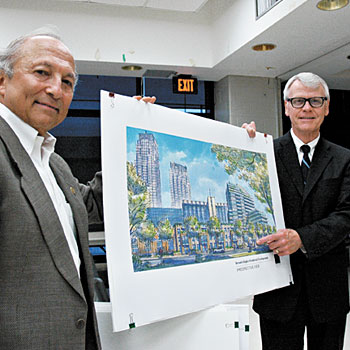
It seems the only privately owned land up for development in the Yonge Street and Eglinton Avenue area is about to become a condo and townhouse complex, and neighbours are OK with it.

“It’s been a great project for me to finish off on,” said Walker, who will soon be retiring from council. “It’s been a wonderful process.”

The Duplex Avenue and Berwick Avenue site sits one block away from Yonge Street and Eglinton Avenue. Walker said the community was involved in developing the 17-storey condominium and three-storey townhouse site from day one when in 2004 the city began a study called the Yonge-Eglinton Centre Focused Review. The review outlined guidelines for future developers, to ensure a proper transition from the nearby residential areas to the high-rise growth areas at the intersection.

Michael Visser, a member of the Oriole Park Association, said the review happened because locals really pushed the city to work collaboratively. Terry Mills, a local planner and activist, said the push was a response to the controversial Minto Midtown development.

When the 20 houses on the Berwick Avenue and Duplex Avenue land were bought by Adrin Cherrytree in 2006, architecture firm Page + Steele Architects developed a plan that complied with the review guidelines. Community meetings were held to get public feedback, and according to city planner Tim Burkholder, plans then went through about three revisions.

During a meeting this June, the final project updates were given, including the proposal of an additional road. However, attendees still voiced concerns about traffic as well as vermin living in the empty houses that a bylaw dictates cannot yet be demolished. “Why do we have to wait?” asked local Joe Miranda. “There are skunks, raccoons, and the houses have been degrading.”

According to Walker, the fact that vermin were the biggest concern is a sign of success. Final site plans went to the city for approval on June 22.


North Yorker opens up world-class facility

0

Jonathon power, twice the top-ranked squash player in the world, is building a state-of-the-art training facility that is set to open in Downsview Park this September.

Power’s National Squash Academy has him returning to the former site of the military base he lived on as a teen, where his father established courts that went when the base did. Since he left the professional circuit, he has worked with his dad, running training camps in Canada and the United States.

Now with his own facility, he hopes to grow the sport here, in his hometown. Sharing the sport that has given him so many opportunities is important to him. “I’m trying to bring that to other kids and other people and just trying to get the level of Canadian squash back up there on the world stage,” Power said.

The academy will feature 10 squash courts, including the only permanent four-wall, glass show court in all of Canada and the only four-wall, glass doubles court in existence.

“It’s going to be such …. an incredible facility that will be open to everybody, but at the same time, it will be a centre of excellence,” said Power’s dad, John. “These young guys have great dreams.”

Major Sheppard & Yonge development wins approval

0

City council has now approved plans for a landmark condo building on Yonge Street, one block south of Sheppard Avenue, but not without strings attached. The Emerald Park design, which features two towers, 30 and 40 storeys, atop a four-level base, called for substantial amendments to the official plan and the site’s zoning, to accommodate its size.

Council gave the 565-unit building, which will dedicate the first three floors to commercial uses, the green light on a list of conditions. Out of the arrangement, the community will see a new building for Lansing United Church, a community centre and a child care facility. The developer must also create a pedestrian tunnel that links to the transit terminal.

Coun. John Filion put forward a motion that hiked the public art contribution included in the terms from $250,000 to 0.5 per cent of the project’s value, which amounts roughly to $750,000. If the developer decided not to proceed with the flair design for the building, this would be increased to one per cent. Coun. Filion characterized the community’s feedback as mixed.

“People are concerned about the overdevelopment in the area and the amount of traffic it generates,” he said. But he indicated that overall people like the look of the design and the benefits that are tied to it.

Kevin Beattie, president of the West Lansing Homeowners Association, described the plans as reasonably positive, provided that they go ahead as approved. He said that, from his understanding, the conditions won’t allow the developer to do anything but this. “We’re fairly pleased,” Beattie said. “At this point, we’re still waiting to see that the developer actually does proceed — given the approvals that have been granted — with the application."

Neighbourhood school to stay open pending final vote

0

While some fear for the future of Davisville Public School, recommendations made by a school committee indicate the school will remain open for years.

“Anyone who looks at the data can see that we don’t have a declining student enrollment, we have an overcapacity challenge,” said Josh Matlow, local school trustee. “The reality is that the school will never be closed.”

Davisville Public School is one of four school locations in the area subject to a lengthy evaluation by an accommodation review committee (ARC). The recommendations for Davisville school have called for the school to stay open.

According to Rob McCready, a father of two Davisville students who has participated in the review process, the committee looked at all options, but closing the school did not make sense. A growing French immersion program is continuing to attract more students to the school, and the number of students attending the English program has also increased. At Eglinton Public School, Hodgson Public School and Maurice Cody Public School, student attendance follows the same trend. 

Recommendations also included keeping the Deaf Hard of Hearing program at Davisville and transferring over the Spectrum Alternative School (currently housed at Eglinton Public School).

“This is a case of what makes the best sense educationally and financially,” said McCready.

On May 18, Davisville Public School staff had the chance to vote on the recommendations, and the vote was unanimously in favour. However, at a meeting on May 31, school trustees held a vote and the result was a three to three tie.

“There are claims that the staff didn’t give enough information,” said McCready.

Matlow said he spoke with those colleagues recently and is confident about the final vote taking place June 23.

Others are not as confident.

Chris Sellors, former executive assistant to Coun. Michael Walker, said he has followed the review process and that the trustee vote carries heavy implications regarding the future and value of the Davisville land. Following the final vote on the school, the Toronto District School Board will conduct a redevelopment study that will consider selling off school land. 

Matlow said, even if the school does come to that point, a memorandum of understanding would have to be signed by the local residential community before any deals move forward.


Suzuki weighs in on BP disaster

0

The explosion on BP’s  Deepwater Horizon platform in the Gulf of Mexico and subsequent uncontrolled release of millions of litres of oil a day is a monumental disaster. But why are we surprised?

Over the years, numerous major spills have occurred on land, from drilling platforms at sea, and after collisions and breakups of ships.
A blow-out at the offshore Ekofisk Bravo platform in 1977 released about 30 million litres into the North Sea in 1977, and the Amoco Cadiz dumped 260 million litres off France in 1978.

Closer to home, in 1988, the Odyssey dumped 159 million litres off St. John’s, Newfoundland. And in 1989, the Exxon Valdez spilled over 40 million litres into the pristine waters of Prince William Sound off the Alaska coast.

Today, tens of thousands of wells operate on land and at sea, massive supertankers move huge quantities across oceans, and pipelines and trucks transport oil over land. Stuff happens: earthquakes, accidents, storms, tides, icebergs, and of course, human error.

What can we learn from the disaster in the Gulf of Mexico? First, there’s no such thing as a “foolproof” technology because, as the computer Hal in the movie 2001: A Space Odyssey knew, the biggest threat to a mission is a fallible, imperfect human being. We should also learn that relying so heavily on non-renewable fossil fuels for most of our energy needs carries numerous risks, from devastating spills to catastrophic climate change.

Human beings are fallible, and in B.C., our coast is marked by numerous rocks and reefs. That’s why coastal First Nations are unanimous in their opposition to the proposed Enbridge pipeline to transport oil from the Alberta tar sands to the west coast where it would be loaded onto ships.

The possibility of a tanker accident is too great a risk to their communities and fishing grounds.
Supertankers are huge, up to 300 metres in length, and can haul enough energy to fuel a small city. It takes three kilometres and 14 minutes for such a vessel going at full speed to stop and reverse direction.

Corporations don’t focus enough on prevention nor do they consider victims of their accidents a high priority. The Exxon Valdez spill led to litigation by several citizens’ groups, including fishers, tour guides, and First Nations. The courts awarded money, but the company appealed numerous decisions. During almost two decades of stalling, Exxon continued to earn record profits.

Supertanker accidents and the gulf spill reveal how little attention is paid to prevention. We have to plan in exquisite detail for any exigency, not play fast and loose with our claims of having everything under control. And we really must start shifting from fossil fuels to cleaner renewable energy sources.

We can all do our part as well by conserving energy and by reducing our reliance on cars. Here in Canada, we can let our leaders know we’re counting on them to make sure our oceans and coastlines are protected from these catastrophes.

The ‘new sushi’ hits the neighbourhood

0

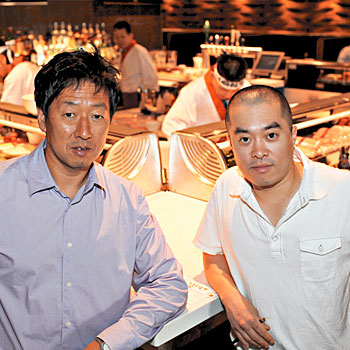
Sushi Moto is not your mom’s sushi place. “The concept we designed was about modernization of the sushi genre,” says David Kim, the mixologist at the sake and wine bar. The place has an extensive wine selection, including several vintages not available at the LCBO. A speciality drink is the saketini — a three-ounce sake-based martini (4901 Yonge St., 416-224-0741).


Celebrating 25 years in business, Trapper’s Restaurant is about as Canadian as its menu. “We are a Canadian company, with a little fusion inside,” says owner Vishal Ramsuchit, who offers mainly Canadian fare such as Muskoka trout and P.E.I. mussels. He says a lot of the ingredients used are local and come from Ontario (3479 Yonge St., 416-482-6211).


When DeBoer’s first opened its doors, Anne de Boer was following in the footsteps of his Dutch father, who sold home furnishings town to town by ship. Today, DeBoer’s has been anchored in Canada for 60 years. “People know the store; we’ve been here for years and years,” says Peter Van Der Herberg, manager for 35 years (5051 Yonge St., 416-226-3730).


While Behnaz Safari has lived in the Willowdale community for years, she has always worked elsewhere. A hairdresser, she decided enough was enough. The result is Tulips Hair Salon and Spa — her very own shop. “I wanted to work for myself,” says Safari, who offers a wash, cut, style and massage at $30 for women and $20 for men (175 Willowdale Ave., 416-225-2555).


While there are no doggies in the window, Dog Care Wonderland, the latest canine shop to hit Yonge Street, offers everything else. Dog lovers can find plenty of toys, treats and leashes for Spot or Buddy. Manager Alex Wang also says that there is a grooming service (5496 Yonge St., 416-546-0687).


What to do when questionable pals appear

0

When I was a young(ish) mother, I once complained to a psychologist about my son having an undesirable friend. This kid was trouble: Extremely impulsive, quick to anger, and I didn’t find him kind.

The psychologist came as close as shrinks ever come to giving me hell.
She said I was to desist immediately from trying to control my son’s friendships because it would backfire in all kinds of ways.
In this case, because he liked this totally unsuitable friend, I would, she said, “drive him into his arms” if I spoke negatively about the friend.

She also said that even with kids he didn’t like or who weren’t nice to him, if I tried to keep them away from him, it would be bad because I would then be telegraphing to my son that I didn’t have faith in his ability to cope with adversity.

Am I the only mom who’s a control freak? I think not. We obviously only want the best for our kids, and we worry when there are yucky kids in their world.

But instead of micro-managing for perfection in their world, if we teach them to manage adversity, we’ve given them a “lifelong learnable.”
Kids who might be labeled “bad” or “undesirable” tend to be the irritating kids. This is the kid with poor social skills, maybe a learning disability and/or ADD/ADHD. Maybe this kid is physically very awkward or, for whatever reason, is not socially attractive.

We all know who these kids are. Some of them are our kids. We also dislike the kids with poor anger management skills, who lose their temper and then feel sorry afterwards.

Genuine and chronic cruelty is different from poor anger management: Kids who repeatedly behave cruelly are bullying, and as adults we bear responsibility for stopping bullying. Most kid misbehaviour is not bullying.

But as parents we tend to want misbehaving kids weeded out of any group our child belongs to. And that’s the problem!
What do we communicate (between the lines) to our children if we complain, to the camp director, the school principal, the hockey coach, the other parents, about the annoying or difficult child in the group?

The message is that perfection is 1) attainable and 2) desirable. The message is that life is controllable and ought to be controlled. The message is that our child isn’t (and doesn’t have to learn to be) tolerant of differences and resourceful. The message is that our child doesn’t have to learn how to get along with irritating or difficult people or to speak up and advocate for him/herself.

Bullying is NEVER okay, but before we assume that someone is a bully, we do need to give them a fair chance — and during that time there may be an opportunity for our kids to practice speaking up, getting help from a grown-up, and advocating for themselves. What fantastic life skills to learn when you’re young!

Think about the irritating kids: The attitude that we have (and exhibit, whether we want to or not) towards difficult or less functional kids, is so important.  As we are fond of saying (ad nauseam) to camp staff: They know what we show.

Which means that when we try to get our kids into cabins or classrooms or sports teams without that challenging child, we’re messaging loud and clear.

And then how will our kids ever learn to live with differences? How will they do at university, at work, in their own families, when all is not smooth sailing interpersonally?

Childhood is a laboratory for life. It’s their opportunity to learn to celebrate and be okay with differences.

Your child will never have the “perfect” classroom or cabin or friendship group — or family! — but instead the growth that comes from learning patience and tolerance, from accepting people who are different, from learning to speak up and ask for help when someone isn’t respectful, from gaining the resilience and resourcefulness that grow from learning to cope with these experiences.

That’s better than perfection, because it’s real life.

 

Mom and theatre maven

0

“You get what you get and you don’t get upset,” says Racheal McCaig and laughs as she relates her husband’s family motto. 

And certainly McCaig has little to be upset about. As the successful manager of an impressive theatre career and a loving mother of two, McCaig has a schedule that would have most working moms throwing their hands up in the air rather than picking up a pen.

But it’s that unlimited enthusiasm that has led McCaig to co-write (along with husband Brett), produce and perform a number of hit plays including the anxiously awaited musical Bosco & Jones, premiering this month at the Toronto Fringe Festival. 

“To me, true balance is achieved when it all works out,” she says.  And with a work life full of evenings, weekends and long hours, the kids have always been  her number one priority. 

“We felt that if we were having them we’d take care of them ourselves. We don’t have daycare — it’s just the two of us.”
Certainly the children might be credited with inspiring their biggest success, the former Fringe darling and soon-to-be-a-feature-film Nursery School Musical.

“Besides writing this play, based on some of our real experiences, I also shifted my work habits when the kids came along.” 
Currently in rehearsals for Bosco & Jones, McCaig says that her kids are comfortable with their lifestyle and with seeing artists come and go at all hours.

“For them it’s just a part of life, they’ve always been around it. We joke that we live in Full House: The Musical.”

And while most families  find it challenging getting together for a family meal, McCaig says they manage to eat almost every meal together. 

She grew up in a household where Dad managed to get home for dinner almost every night. Not an easy feat when you consider that her Dad is high-profile Toronto retailer Harry Rosen, who is there for his grandkids as well and still offers up some parental advice.

“He’s a good granddad. He stepped in when I was working too hard and got sick. He said, ‘Racheal, don’t be a martyr.’”
In addition to an already hectic schedule, McCaig is a successful photographer. But does this multi-talented, together woman ever suffer from mom guilt?

“Oh, of course. Is there any mother on the planet who doesn’t?  The first time it kicked in was when I was watching my daughter play at being me. “Look! Mommy’s at the computer, and you can’t interrupt her.” If that’s life imitating art I need to back off.”
But with three new plays in development and Bosco & Jones set to hit the stage, backing off doesn’t seem to be on the schedule.

“It’s an hour of your time, with a beer tent,” she says of her Fringe show. “What more do you want?”

Certainly that’s nothing to get upset about.