
Home Blog Page 635

Chuck Hughes hits up Toronto to hang out with kids (BTW, he’s also eyeing Baldwin Village for his potential new restaurant)

0

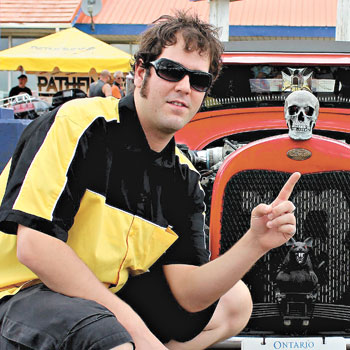
Food Network hunk Chuck Hughes swung by Wychwood Barns yesterday to teach an excited group of whippersnappers how to make pumpkin-pear soup. The kids, participants in The Stop’s after-school program, were bouncing with excitement, so when Hughes opened the floor up for questions, he was inundated:

“What’s your favourite colour?” (Pink.)“What’s your favourite thing to eat?” (Crab.) “You said oysters before!” (I lied.) “What’s your favourite thing to cook?” (Pancakes.) “What colour is your vomit?” (Did you just ask me what colour my vomit is!?)

Hughes has teamed up with luxury cookware manufacturer Le Creuset to raise money for Community Food Centres Canada (CFCC), which has embarked on an ambitious plan to open 15 nationwide centres modelled on Toronto’s The Stop. Le Creuset, which is furnishing all 15 centres with cookware, is amping up its support for the CFCC through the sale of gift sets (which come with three multi-coloured mini-cocottes, along with five Chuck Hughes recipes). All profits from the $80 gift sets will be donated to the CFCC.

The jazzed group of ankle-biters could not have cared less about enamelled cast iron cookware. They were more excited to show off their knife skills for the tattooed celeb chef, who had the most skilled of the group cutting pears brunoise. Even kids understand the importance of a pretty garnish; one particular perfectionist was standing at her station long after her fellow cooks had trooped off to watch Hughes man the wood-fired ovens.

Hughes told us that his girlfriend is pregnant with their first child (they’ll open an envelope that discloses the child’s sex at Christmas). And after hanging out with Hughes and a gaggle of kiddies, we expect he’ll be an excellent pop. He was responsible, jumping from group to group, making sure that the older kids didn’t lose a finger and that the youngest of the crew felt involved (they got to gut gourds and peel garlic).

But, we doubt he’ll be a helicopter parent — he did gift a group of older boys a completely burnt pumpkin to play with. And, of course, the boys insisted they all had to try the crispy, blackened gourd, much to their puckering, face-shaking chagrin.

Hughes also told us that he’s once again contemplating a Toronto restaurant, but it’s space dependent. He’s fallen in love with a Baldwin Village spot, and should lease negotiations fall through, no Hughes for us. (At least not in the immediate future.)

Chef Tip: keep your cutting board in place

0

A cutting board that slides around with every knife stroke can be obnoxious as well as hazardous. To remedy the situation, chef Carl Heinrich of Richmond Station simply runs a dish towel under the tap, wrings out the excess water and slips the damp towel under his cutting board. The friction from the wet towel keeps the cutting board from moving, which could save you (and your fingers) from a trip to the emergency room.

Every week, we reveal a quick kitchen tip from a Toronto chef to help make cooking at home a little bit easier. Chef Tip appears on Wednesdays.

Hey Toronto, what’s up with all the progress?

0

Toronto is a vibrant, progressive city, and it’s changing every single day. New tourist attractions like the Ripley’s Aquarium are popping up. Bold, architecturally interesting developments like the Mirvish+Gehry towers are being proposed. And new, innovative urban solutions to the city’s retail and residential needs are seemingly unveiled every day.

It needs to stop.

Indeed, the time has come, with our eyes so squarely focused on the future, to ask if we are losing sight of our past. That’s why I’ve founded the Committee to Keep Everything the Same Forever (CKESF).

Sure, the CKESF understands that the population of Toronto is rapidly expanding, and that the city’s infrastructure must be updated to accommodate the growth. But we’d like to counter by pointing out that hey, old buildings look prettier.

In the name of “progress,” the city is losing its character — and for what? Just so people can actually live and work here? It’s disgusting.

Well, the CKESF won’t stand for it. Why build more condos, we ask, when clearly the city’s massive annual influx of new immigrants could live in fashionable, historic lofts? Why build Walmarts and supermarkets when there are so many overpriced boutiques around? Are our values so out of whack that we’d force people to live in some newly built, clean and safe condo — close to a convenient shopping centre — just because people can actually afford to live there?

Where are our priorities?

Some might argue that there simply isn’t room for all of us if we keep designating so much downtown real estate as heritage. Well, those of us who cherish Toronto’s cultural landscape are more than willing to make a little more room in our own homes, and you should too. Bunk up, buddy. We’re not going to tear down a crumbling theatre just so you can have a bed to yourself. Victor Garber once trod those boards!

Others argue about the cost of maintaining all that heritage. Those in favour of “progress” say it’s a heavy burden to ask property owners to maintain historic buildings and, financially speaking, it doesn’t seem feasible for the city to bear the brunt of the upkeep. But to those people I ask, how can you put a dollar sign on the joy people get when they walk by a historic building and say, “Hmm, that’s neat?”

Furthermore, we believe that old buildings actually hold up pretty well. One of the founding principles of the CKESF is, “They don’t make ’em like they used to.” Spacing recently uncovered a catch basin grate from 1888, for example, and it’s still working just fine, thank you very much.

Finally, while we know it’s a lot of work, CKESF is here to explain that it’s going to be worth the sacrifice. If we can just look past the desire to have efficient, functioning, safe, appropriate and modern real estate downtown and instead embrace borderline hysteric nostalgia, we’ll all be able to share in simpler joys, like walking past a student learning centre featuring a two-story high neon monument to an outdated technology (fingers crossed!). We’ll all relish the pleasure of explaining to our children what a record is, and then get the pleasure of hearing them say “Oh. Can we go now?”

And who, I ask, can turn that down?

Indeed, for a perfect example of Toronto’s ability to ignore sound economic planning, expert-backed studies, public safety and common sense all in the name of keeping everything the same forever, one needn’t look any further than the city’s transit system, a shining beacon of all the nostalgic wistfulness to which the CKESF aspires.

If we can get by on a transit system designed to meet the city’s needs from 20 years ago, why can’t we do the same with our real estate?

When he’s not forming committees to preserve Toronto’s heritage, Ben Johnson writes about beer on Ben’s Beer Blog. You can follow him on Twitter: @Ben_T_Johnson.

Drink This: the Mideastro II

0


Mideastro’s Yorkville location is about to blow out the candles on its second birthday. There, chef Benny Cohen turns out eats such as shrimp falafel and saffron-infused fish tagine, drawing influences from the Mediterranean and Middle Eastern regions.

In honour of the birthday, bartender Ilanit Kamenetsky has put together a special drink available at both Mideastro locations throughout October. The celebratory ’tail starts off with some muddled chili and lime, which is then shaken with limoncello over ice. After being strained, the goods are topped with Italian vino Brachetto d’Acqui and a splash of bitter orange Aperol.

Served in a flute, the elegant bevvy is finished with a sliced chili pepper, making for a drink that’s slightly bitter with a hint of a bite.

Mideastro, 27 Yorkville Ave., 416-477-2427

Karolyne Ellacott is a features editor at Post City Magazines. She pedals around town in heels, eating sandwiches and drinking cocktails. She writes about that, and about about other stuff too. She is also on Twitter.

For more must-try Toronto cocktails, check out our Pinterest page


Theatre Review: Venus In Fur

0

David Ives’ 2010 play Venus in Fur is a wicked comedy based on the 1870 erotic novel Venus in Furs by Austrian writer Leopold von Sacher-Masoch — from whose name is derived the word “masochist.” But there’s nothing masochistic about watching Canadian Stage’s new production, which opened last week at the Bluma Appel Theatre.

Casting Rick Miller in a Tony-nominated script that is America’s “most produced play” of 2013–14, the Canadian Stage couldn’t go far wrong, and it didn’t go far wrong. In Venus in Fur, Rick Miller — best known for his international solo hits (MacHomer, Bigger Than Jesus) — plays Thomas, a playwright/director who is struggling to find an actress capable of playing the sophisticated Wanda in his adaptation of Sacher-Masoch’s novel.

At the day’s end, amidst thunder and lighting, Vanda storms in; loud-mouthed, low-class and all “whatever!” — seemingly the least suitable of the three dozen actresses he has rejected so far. Dominating the role of Vanda is National Theatre School grad Carly Street, whose career has been prolific on both sides of the border. Last year Street made her Broadway debut in the Tony-Award winning production of Clybourne Park (America’s second most produced play of this season).

Venus in Fur is a sex-charged gender politics comedy bridging the 19th and 21st centuries. It’s like Oleanna meets Pygmalion meets Dan Savage meets bell hooks. In this highly self-reflexive play, Thomas wrestles with the importance of ideal casting, and indeed the hairpin turns that Ives’ script demands of the actors would quickly derail inferior performers.

Rick Miller, a polyglot who has performed his solo shows in a few languages, effortlessly switches between a number of accents. Street, too, volleys back and forth from one accent and persona to another. Both actors get the most out of the comedy and the drama, and they’re not shy about sex, but nothing is overdone. All three elements are in balance as Miller and Street, under the direction of the ubiquitous Jennifer Tarver, negotiate the treacherous dynamics within and between the two characters, and their 19th century alter-egos, like Olympic figure skaters in fetish-wear.

The play is self-consciously situated in an unadorned theatre space, and the 90-minute play is one continuous scene. Costume changes are done as part of the action, and lighting changes (except the lightning) occur only when a character hits a light switch. There is a gothic feeling to the lighting (Michael Walton), set and, of course, the costumes Vanda and Thomas put on to portray characters from the novel upon which the play and the play-within-a-play are based (Debra Hanson, set and costume designer).

There are subtleties in the presentation, such as the inconspicuous way in which Vanda winds up in the director’s chair, usurping the throne as if by accident, but the dialogue tends not to be subtle. A utility pole featured prominently on the stage is, to even a chaste and unimaginative observer, a phallic symbol. But at one point the crass actress snorts, “What’s this, a phallic symbol?”

Despite Thomas’s disdain, Vanda browbeats him into letting her audition. She flatters his writing and insists he read all of his parts without skipping ahead to hers. She pushes him: “C’mon! Get into it!” Gradually she starts directing him, coaxing him to use an accent. “Something continental?” he offers. “Ooh, ‘continental’!” she coos in admiration of his intellect. He doesn’t catch on that she’s playing dumb, even as she increasingly shows herself to be capable, persuasive and powerful.

Ives’ script, which Roman Polanski has just adapted to the screen, shows how much the themes that Sacher-Masoch wrote about nearly two centuries ago are still relevant today. Vanda, speaking as Wanda, says, “In our society, a woman’s only power is through men.” She goes on to consider how things will be different in a new day when women are able to express their authentic selves and find their own power.

With Sinead O’Connor currently schooling Miley Cyrus on the do’s and don’ts of girl power, is this journey not yet at an end? Let’s see what sort of scripts are getting Tony nominations in 2070.

So it’s relevant, but is it entertaining? Well, at the close of the performance, the opening night audience members leaped to their feet like their seats had caught on fire.

Venus in Fur, Bluma Appel Theatre, Sept. 29 – Oct. 27

Evan Andrew Mackay is a Toronto playwright and humorist who writes about culture and social justice.

One in eight species of birds is in danger of disappearing

0

We can’t live without birds. Beyond being fascinating and beautiful, they play a crucial role in keeping the world habitable for all life, including people. They disperse seeds, pollinate plants, control insects, provide food and are indicators of the overall health of ecosystems.

So we should be concerned about the findings of the report “State of the World’s Birds: Indicators for Our Changing World”: one in eight — or 1,313 — species of Earth’s birds is in danger of disappearing.

“The status of the world’s birds is deteriorating, with species slipping ever faster towards extinction,” notes the assessment by BirdLife International, a global partnership of conservation organizations.

This represents rapid acceleration of a troubling trend: 151 bird species are believed to have gone extinct since 1500. But the study, released at BirdLife International’s 2013 Congress in Ottawa, offers hope: “An annual investment of US$4 billion, used wisely, could improve the status of all known threatened species and virtually halt human-driven extinctions. A further US$76 billion could effectively protect and manage all known sites of global conservation significance. These sums are insignificant in comparison with both the size of the global economy (roughly US$70 trillion per year) and an estimate of the total value of ecosystem services delivered by nature each year (US$22–US$74 trillion).”

Many threatened birds are common species, including turtle doves, meadowlarks, barn swallows and purple martins. In Canada, insectivores, grassland birds and Arctic shorebirds have been declining rapidly since 1970, all because of human activity. But conservation efforts, including regulating pesticides such as DDT, have helped some raptor and waterfowl populations bounce back. Sadly, we’re to blame for the current plight of birds.

The report shows industrial-scale agriculture, logging and invasive species are the gravest immediate dangers. It also concludes climate change is an “emerging and increasingly serious threat to species” and “often exacerbates existing threats.” Among other problems, a warming planet changes migration and nesting schedules, hindering birds’ ability to find insects to eat.

One solution for safeguarding bird populations is to ensure habitats critical to their survival — known as important bird areas, or IBAs — are protected, through legislation if necessary. That doesn’t mean shutting out human activity, just managing these areas in ways that allow birds to survive and thrive. As the report shows, investing in conservation comes with benefits beyond helping birds. The more than 12,000 IBAs identified worldwide offer valuable ecosystem services, such as regulating climate and air quality, purifying water and preventing floods, maintaining genetic diversity, providing food and medicines and creating recreation and tourism opportunities.

Plummeting bird populations reflect the state of the global environment — but it’s not too late to do something. As Leon Bennun, BirdLife’s director of science, information and policy, says, “Effective nature conservation is affordable and it works. It’s time to make it happen.

The result will be a world that is in every way wealthier and healthier — and that remains diverse and beautiful, too.”

David Suzuki is the host of the CBC’s The Nature of Things and author of more than 30 books on ecology.

Faceoff: should kids be allowed to use cellphones in the classroom?

0


Yes:

Andy Walker, former TV host, and co-author of Super You, andywalker.com

Imagine a world where children are disconnected from the magic that is the Internet. It happens in some communities. Even in our own backyard. Not all children have the privilege however. That’s why I founded Little Geeks, a foundation to bring connected technology to underprivileged children.

Compare those to the children who have a persistent connection to the Internet: at home, at school, in their pocket. Who does better in the world? Who has a brighter future?

The connected children do. It’s clear.  The Internet connects humans to massive amounts of human knowledge; to the libraries of the world; and to a communications tool that allows them to connect to anyone on the planet.

So should children have cellphones in the classroom? Yes. Of course. Now “cellphone” requires a definition. Because today’s cellphones are not just phones. They are connected computers. So you don’t want the “phone” part of the device to ring in the middle of math class or for the child to receive texts, or Instagrams or any distracting communication that unfocuses them from the lesson at hand. But putting a powerfully connected computer into the hands of every student is a revolution in the making. It makes the child superhuman relative to their counterparts from a previous generation.

My first child will be born in February of next year. And I will do everything in my power to equip them with technology at every turn of their life, including in the classroom.

It comes with a caveat though: These advantages will come with a healthy dose of technology etiquette.  I think that’s the concern people have when they think about “cellphones in the classroom”. The revolution won’t do well without a few good manners along the way.

No:

Dr. Magda Havas, Associate Professor, Trent University, magdahavas.com

As a university professor I forbid students using their cell phones in my classroom as this prevents them from providing their full attention to the lesson.  Talking to neighbours during a lecture and/or using your cell phone for texting or browsing the internet or even having your cell phone ring during a class can disrupt other students as well as the teacher and is a sign of disrespect.

Using a cell phone in a school setting has another disadvantage.  Cell phones emit microwave radiation and even low levels of this type of radiation can be harmful to the body.  Radiation is emitted even when you are not using your phone unless you have it in airplane mode with the Wi-Fi turned off.

Every time you use your cell phone you are activating a signal that goes from antenna to antenna until the person you are calling is reached.  Consequently many people are exposed to the radiation you are generating.  The closer you are to the source of this radiation (cell phone and/or antenna on a tower or building) the greater your exposure.  So having cell phone antennas on or within 500 meters from a school is a bad idea.

Low levels of microwave radiation (at levels well below federal guidelines) can contribute to brain tumors (associated with holding a mobile phone next to your head), breast cancer (if you keep the phone in your bra), and deformed sperm (if you keep the phone in your pant pocket).  If this radiation affects female egg cells then we may be contributing to reproductive problems that can last generations.  Not surprisingly the International Agency for Research on Cancer (IARC) classified this radiation in 2011 as being “possible carcinogenic.”

Some students already have difficulty paying attention and don’t need yet another distraction and no one in the classroom should be exposed to this radiation while learning. 

Concert Review: Nine Inch Nails at the ACC

0


To fully appreciate Friday night’s Nine Inch Nails show at the Air Canada Centre is to understand the band’s recent tumultuousness and to recognize how much effort when into the cheekily titled Tension 2013 tour.

The tour title is a tongue-in-cheek reference to the inner turmoil that has existed within NIN since 2009, when Trent Reznor announced that the band would be going on a touring hiatus. NIN returned to live shows in early 2013, only to see recent band additions Eric Avery (Jane’s Addiction) and Adrian Belew (King Crimson) drop out shortly after the launch of the tour. The revamped lineup, which includes Alessandro Cortini, Josh Eustis, Robin Finck, Lisa Fischer, Sharlotte Gibson, Pino Palladino and Ilan Rubin, only began touring recently.

All of this made Friday night’s show seem more uncertain, exciting and fresh than you’d typically see of a band with 25 years experience under its belt. Credit the ensemble group, then, because they could have been a disastrous assemblage of ill-fitting pieces, but instead they united with surprising chemistry.

Reznor was Reznor, anchoring the group with his raw, powerful vocals and commanding stage presence. But it was the supporting parts that lent a refreshing buzz to the proceedings, infusing the works of NIN with new sound and an overall different feel from their pre-hiatus shows in Toronto (it had been five years since NIN’s last ACC performance).

Most eye-opening among the new additions were backup vocalists Fischer and Gibson, who added a feminine component to what had previously been a Y chromosome-oriented act. Their contributions were particularly evident during “Copy of A,” “Into the Void” and “In This Twilight.”

The new bassist, Palladino, who has amassed an impressive touring resumé alongside acts like The Who (he famously replaced John Entwistle), Adele and John Mayer, bolstered NIN with his versatile musical skills, adapting quickly to the band’s trademark changes in tone and rhythm. Palladino navigated seamlessly through the rough terrain of a deliberately jumpy set list, offering a heavy, violent sound to angry tracks like “March of the Pigs” and “Terrible Lies,” and then more of an ethereal, soothing sound to the creepy “Came Back Haunted.” Beyond the stewardship of an in-control Reznor, it was the veteran bassist who served as the glue that kept the eight-piece band in sync.

The inner machinations of NIN’s new lineup proved to be sufficiently fascinating as to steal the spotlight away from an otherwise mesmerizing stage show, which was a smoky, shimmering and futuristic spectacle. During “Disappointed,” 3D laser patterns cloaked the stage for an eye-popping visual effect that made all eight band members nearly invisible. “Hand That Feeds” went deeper, establishing an illusionary effect that made it impossible to distinguish the band members from their light reflections.

All in all, a refreshed Reznor — backed by some more-than-able musical talent — was quite a sight to behold.

Wanted: this Japanese-style baseball T-shirt from Shared

0


Baseball season may be over for the Toronto Blue Jays, and yes, they may have finished last in their division, but Toronto fans are fiercely loyal and determined to support their favourite underdogs until the day they die, even if it rarely amounts to anything.

Well, now you can show your undying loyalty in style. Thanks to the Drake General Store’s in-house label, Shared, you can support the Jays and still look like the interesting and unique individual that you are.

Shared’s take on the Japanese baseball T is pretty cool. The iconic Blue Jays logo is surrounded by Japanese characters and is printed in a faded, inside-out style, which lends an otherwise basic T-shirt some necessary quirk. As an added bonus, the shirt is also made from super soft supima cotton, making it as cozy as it is cool.

Shared is designed and manufactured in Canada, and its designs make cheeky references to our heritage without being overly kitschy. You can find the entire line exclusively at the Drake General Store. The line includes the aforementioned Japanese baseball T-shirt, as well as past collaborations with the Toronto Public Library and Hudson’s Bay Company.

$42. Available at Drake General Store, 1144 Queen St. W., 416-531-5042 ext. 101

Rock club king

0

He’s a rebel. Back at Sir Sandford Fleming Academy, Fine was known as the guy with the motorcycle, and today he is the owner and operator of two popular Queen West hangouts — the Bovine Sex Club, and Rock Lobster Food Co.

About Bovine, he stresses that it isn’t a sex club but a mere rock ’n’ roll club. The downtown institution has been around for 23 years and has attracted some of the hottest acts in the music business.

Fine was born to Canadian parents in New York but grew up in Toronto’s Bathurst and Glencairn area. In high school he struggled with making it to classes in time but excelled in math. Geography was another high point in Fine’s high school career.

That’s where he met one of his favourite teachers, Dr. Lloyd, who taught geography. Dr. Lloyd, treated Fine with respect.

“He treated me like an adult in private when I was helping him prepare films and audiovisual presentations,” Fine says of him, “I was his tech assistant. Classy guy.”

Fine’s favourite memory in high school was slyly manipulating the system to graduate Grade 13 at the end of Grade 12. He technically did not graduate from Grade 12.

Fine was also able to leave classes several times a week early with teachers’ permission to go work at a restaurant or pub.

“I think it was a unique situation for both parties to deal with,” Fine says. “I doubt that would fly today.”

Part of the reason might be because school culture has changed dramatically.

“Technology and the Internet have changed the way teenagers learn, work and socialize,” Fine says. “It’s certainly a challenge for the students, teachers and their parents.”

Though Fine earned a few degrees from the University of Toronto and Windsor and was a partner in many local businesses, he never really left the hospitality industry, which he entered in his high school days.

He plans to keep up with his career and enjoys its perks.

“Owning the Bovine Club for 23 years has developed a worldwide network of culturally like-minded friends, musicians, filmmakers and film producers,” Fine says. “The club is a small but influential player in the music and film business.”

Melody maven

0

“Remember, remember the fifth of November…” Matt Groopie jokes over the phone channeling V, the protagonist of the 2005 action film V for Vendetta. The fifth of November happens to be Matt Groopie’s birthday, and it was a fitting day for him to enter the world. Like the Guy Fawkes–inspired, mask-wearing V, Groopie aims to save those from tyranny, only this kind of tyranny is the wasteland that is modern music.

Groopie now is in three bands: the King Beez, the Matt Groopie Blues Band and Matt Groopie and the Bandits. He has been in bands since his high school days. Vintage was his first, running for around two years, and gave Groopie his first experience with being in a band. With them he played for crowds upwards of 400 people.

“We only did a few gigs, but that was the first real taste of ‘I can do this,’ ” Groopie says.

When that band ended, he started hard rock punk band the Groopies, nearly immediately, while he was in high school, and with them Groopie toured Ontario and Quebec, made it onto the radio and played for many benefit concerts raising thousands.

“We were more about the community in that band. It wasn’t like, ‘Oh we were going to be famous and rich,’ we just wanted to help the community and show support for causes,” Groopie says.

Although the Groopies started while he was in high school, the group opened for big punk bands like Real Mackenzies, SNFU and ’70s British band the Vibrators. It was a dream come true for Groopie who had wanted a career in music since Grade 4, but this may have not happened due to his elementary school trying to stifle his creativity with pharmaceutical drugs.

“The school was telling my parents to put me on Ritalin because I was a creative kid,” Groopie says. “My parents said, ‘I’m not putting my kid on Ritalin.’ [Then] they bought me a drum set, and it was the best thing they ever did for me.”

Despite his passion for music, he didn’t do well in school arts because he always wanted to do his own thing. By the time he reached high school, he’d nearly failed his high school music class, leaving the class with a 51 per cent grade.

Regardless of that class, Groopie’s music was appreciated by nearly all of the rest of his high school. He won the award for most likely to be a rock star at his prom.

Looks like they were right.

"I think that music is a great thing." Groopie says. "Every kid should be given a pile of instruments when he is little and see which one he likes playing."

Too Close to Call: Uncle John’s Candy Shack vs. The Candy Bar

0


This month, we pit mom and pop shop Uncle John’s Candy Shack against new kid on the block The Candy Bar in a battle of the bonbons. Who knows their tricks from their treats? You choose.

Uncle John’s Candy Shack

vs.

The Candy Bar

John and Dina (not pictured) Vanden Beek, 1982. Owner and year opened:
 
Paola Giavedoni, 2013.
Because it's fun for all ages and it makes people feel good to remember when we were all small. What inspired you to open a candy shop? My neighbourhod was lacking a friendly shop that combined world-sourced candy and international and local chocolate bars.
Candy a kid was gum in OPC hockey or baseball card packs. Also, penny candy in a bag from the corner store — in those days, only the corner store had candy First memory of eating candy? Frequent vistis to Crystal's Corner Variety, in Hamilton, on the way to grade school, live fondly in my memory. Mackintosh's Toffee and penny candy ruled the day.
Altogether, we've got 300 different kinds of candies. How many types of candy in your store? We have over 200 pick-and-mix varieties — both local and imported — and over 50 varieties of chocolate bars.
Lollipops with insects inside. Most exotic candy you ever tasted? Hand-wrapped coconut caramels.
Nowadays, we find that there's more and more hot candy around — it's sweet, sour and spicy. How has candy changed over the years? Options are plentiful today for conscious consumers: natural, organic, fair trade, vegan, gluten-free, raw…
We try to get candy for Halloween that nobody else has included. Doing anything special for Halloween? We'll have spooky fun on Halloween. There will be treats for costume-clad customers, young and old.  

Our favourite is "The Candy Man," by Sammy Davis Jr.


635 Mt. Pleasant Rd.

Favourite candy-based song? 

"The Candy Man," by Sammy Davis Jr. is a winner!


849 College St.