Introducing Streets of Toronto’s new advice columnist, ET Canada’s Sangita Patel! Have a question about your relationship? Trying to figure out how to “have it all”? Submit your anonymous question here and Sangita may choose it for her first column.
With almost 20 years of marriage under her belt, a successful career getting the scoop on your favourite celebrities as an entertainment reporter, over a decade of motherhood and a penchant for fitness, Sangita does it all. Now, she’s giving our readers the chance to turn to her for advice every month. Please provide as much context for your question as necessary.
Amal - Leeds 156 (c) Lizzie Coombes (c) The Walk Productions.jpeg
Summer in the city is around the corner, and with it comes an explosion of incredible events that will keep you entertained throughout June. Enjoy all the fun, art, music, and culture, with these five can’t-miss festivals in Toronto next month.
Immerse yourself in the vibrant Luminato Festival in Toronto, a captivating celebration of arts and culture. Known as an “arts festival that knows no bounds,” this multidisciplinary and diverse event brings together talented artists, performers, and thinkers from around the world to showcase their creativity and push the limits of artistic expression. Plan to be captivated by a remarkable lineup of theatre, dance, and opera. This year’s festival will feature two world premieres, offering a fresh and innovative perspective. Prepare to also be enchanted by a seldom seen opera presented in a whole new light, and be ready for the revival of a seminal dance work that will leave you in awe. You won’t want to miss highights like Scott Joplin’s Treemonisha, Dragon’s Tale, and Aalaapi. The festival runs from June 7 to June 18.
Get ready to rock and roll at the North by Northeast (NXNE) Festival! From June 13 to 18, Toronto’s live music venues are set to erupt with incredible performances, delivering a feast of fresh and exciting sounds. With over 20 venues participating, immerse yourself in a vibrant atmosphere where great new music takes center stage. This year’s lineup includes performances from local, national, and international artists, like AJA, Qemist, Neon Bloom, Nature TV, and more. But it’s not just about the music: it’s a full-on sensory experience with mouth-watering food trucks, fun art installations, and a buzzing atmosphere that’ll have you embracing all the good vibes.
Get ready for the Toronto Jazz Festival, a musical carnival that celebrates the soulful sounds of jazz. From intimate clubs to bustling outdoor stages, this festival brings together talented musicians and enthusiasts for an unforgettable experience. Get lost in the smooth melodies and improvisations performed by world-class artists, including Ashanti, Jully Black, Herbie Hancock, Melody Gardot, and more. Join the celebration, savour delicious bites from food vendors, and connect with fellow music lovers in a city transformed by jazzy rhythms and melodies. The festival runs from June 23 to July 2.
Get ready to dive headfirst into the ultimate music extravaganza: Canadian Music Week (CMW). This festival is the place to be if you want to experience the hottest acts, discover new talent, and surround yourself with vibrant music scene. A playground for music enthusiasts, over 1,000 artists take the stage across multiple venues, ensuring there’s never a dull moment. From rock to hip-hop, from pop to indie, you’ll find a genre to suit every taste. Not only do you get to jam out to your favorite bands, but CMW is also a hub for industry professionals, letting. You network and learn from the best in the biz. But it’s not just about the music—it’s a full-blown music conference too. Expect insightful panels, workshops, and keynote speeches from industry leaders, providing you with invaluable knowledge and inspiration. The festival runs from June 5 to June 10, with the conference running from June 8 to June 10.
June marks Pride month in the city and you can unleash your rainbow spirit at Pride Toronto Festival, the biggest celebration of love, diversity, and acceptance. Get ready for a whirlwind of events, from the iconic Pride Parade with dazzling floats and dance moves, to incredible concerts featuring talented LGBTQ+ artists and allies like Lights, Sasha Colby, Saucy Santana, and Rêve. Join in on dance parties, film screenings, drag shows, and more. While events will be hosted across the city all month-long, the festival runs from June 23 to June 25, with the annual Pride Parade moving through the downtown core on June 25.
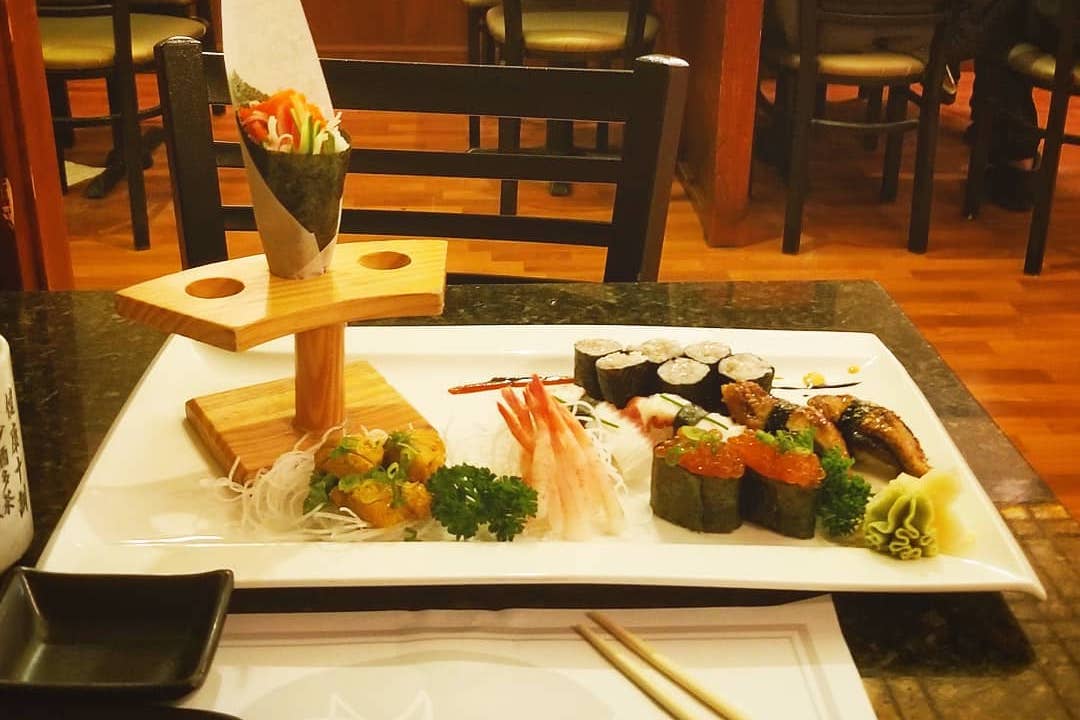
Sushi has never gone out of style here in Toronto, and, with the sheer volume of Japanese restaurants popping up across the city, it likely never will. But it’s not just any sushi that diners are lined up for this spring: hand rolls are having their long overdue moment in the spotlight. Once reserved for only high-end sushi masters and omakase dining, now these rolls have become one of the most popular items on the sushi menu.
Temaki gets its name because unlike maki, these rolls are meant to be picked up with your hands and bitten into. So leave the chopsticks at home when you try out these must-have hand rolls across the city!
The temaki at Torch are so tightly packed and smoothly rolled, you wouldn’t think they were done by hand. Though the spicy salmon is a beloved customer favourite, the hand roll highlight on this menu goes to the lobster roll—one of the chunkiest you’ll find at this price point. 507 Church St.
To-Ne Sushi
@foodbacca/Instagram
Whatever kind of roll you want most, To-Ne Sushi probably has it up at an affordable price. The classic spicy tuna hand roll is one of the most talked about at this joint, though they also serve up some interesting twists on rolls, like the Crunch hand roll, a California roll rolled in tempura bits. 414 Queen St W.
Omai
With a wrap to separate the negi from the rice, even the takeaway hand rolls at downtown sushi joint Omai are as fresh as if you’re dining in house. With tastes and are prices this good, you don’t have to pick just one hand roll—but if you do, the bluefin tuna is a customer favourite. 3 Baldwin St.
Kinoya
It might be one of the more low-key and underrated sushi bars, but Kinoya offers one of the largest selections of hand rolls the city has to offer. Everyone’s had a California roll and a negitoro, but Kinoya’s snow crab and Hamachi rolls are harder to come by. And who knows, you might even see a celebrity while there! 293 King St. W.
Nami Japanese Restaurant
One of Toronto’s highest rated Japanese restaurants also happens to be one of the oldest. Though Nami Japanese Restaurant serves up the hand rolls at a higher cost ($19 for a negi-toro compared to closer to $10 at other locations), it’s worth it for the traditional Japanese atmosphere you get when dining inside. 55 Adelaide St. E.
Spanning from Vancouver’s Aburi Restaurant, Miku is Toronto’s source for flamed-seared sushi. On the take-out menu, hand roll options include everything from cucumber avocado to spicy salmon and spicy tuna, but the most sought-after is the classic negi-toro hand roll. The green onion and fatty tuna combination might be on every sushi menu, but it’s a classic for a reason! 105-10 Bay St.
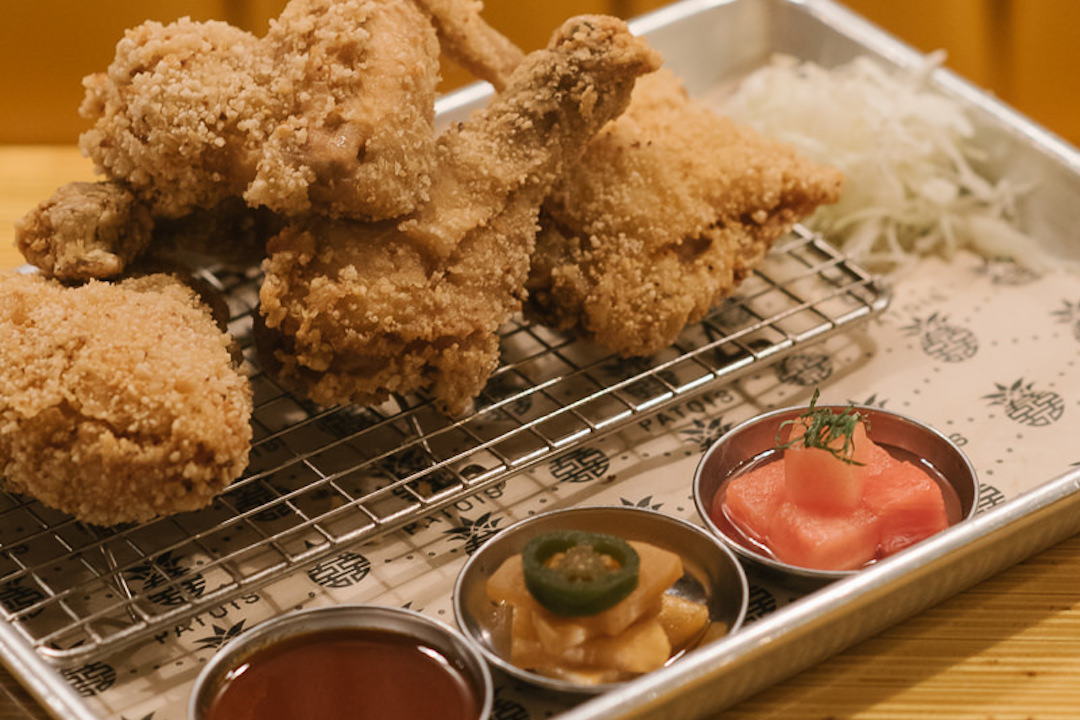
The chef: Chef Craig Wong’s Jamaican-Chinese heritage brings spice and crackle to fried chicken.
The app: Patois uses Skip the Dishes — Skip for short. Skip is somewhat less user-friendly than Ritual. They give less info about your order, and it’s a little harder to interpret. Ritual gave timelines earlier in the delivery process. For people like me who get anxious about when dinner’s coming, Skip is meh.
The chicken: This bird, called O.G., is cock of the walk. Two legs and two thighs in the Double O.G. Fried Chicken order. Way way less batter than Grateful Chicken, greasier (in an OK way), more seasoning, better batter. Pretty light. Chicken flavour: same great, juicy fun.
The coleslaw: No vinegar bite, all creamy, blah and bland.
The kale salad: This extravaganza is the big win. They send the creamy seedy mustard dressing separately to prevent terminal sog; it’s ultra tasty, as is the carnival of a salad with kale, clementines, raw beet and carrot shreds for crunch and savour.
On the crispy side: So-called crispy brussels sprouts aren’t. At all. They’ve been aggressively browned, but have gone flaccid, thanks to sitting for too long in creamy dressing. Not much flavour to it. Pickled yellow daikon, radishes, bean sprouts, sesame seeds, daikon shreds and slightly soggy spinach don’t help.
The sauces: Garlic sauce is creamy and plays nicely with the crispy chicken. Bonus points for sweetened sriracha and also scorching fermented pineapple and scotch bonnet sauce — not for the faint of heart.
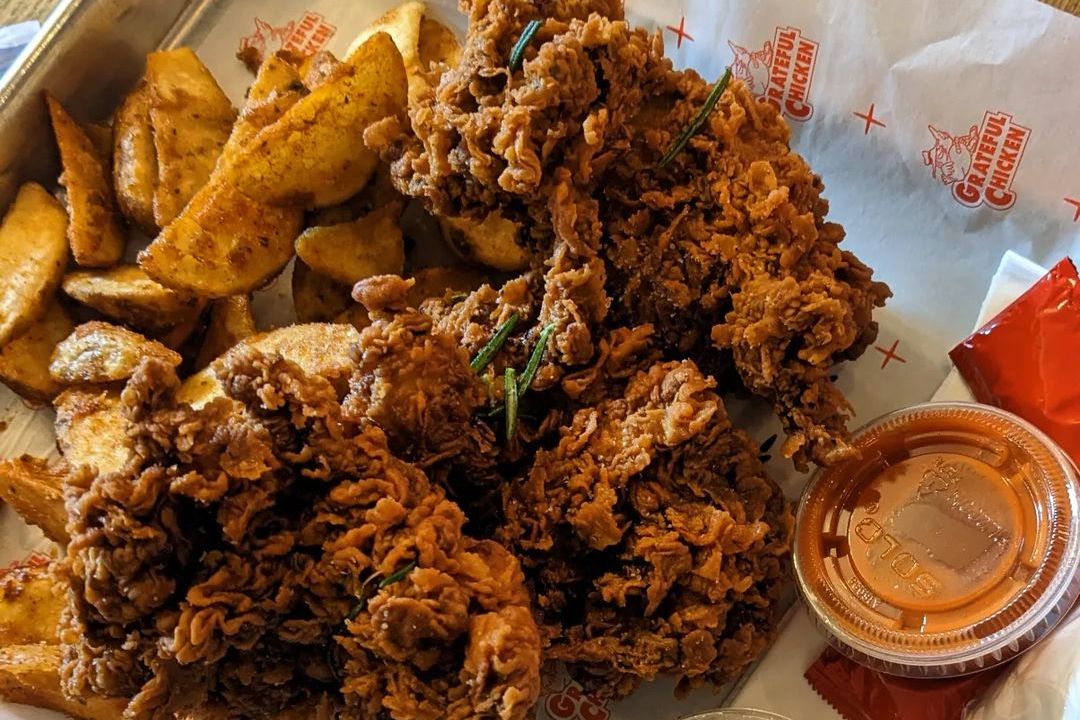
The chef: Celeb chef Brandon Olsen has a snazzy pedigree a mile long, as founding chef of Le Melon, La Banane and Brando’s Fried Chicken, and as the former star chef at Bar Isabel and the Black Hoof. Isabel is where he debuted the fried chicken.
The app: We’re grateful for Ritual, which makes skipping the dishes easier. We like the idiot-proof app, and we like the frequent order updates even better.
The chicken: Stoners on the midnight prowl adore the cornflake-like thick coat on this chicken, but it’s so thick it obscures the bird. Perhaps that’s the point. I know my way around a chicken but can’t figure out if I’m eating breast, leg or thigh. The cornflake-like batter is super crunchy and ungreasy, but between it and the chicken is yet another layer — doughy gooey and bread-like.
The coleslaw: Has no taste, no vinegar bite. Strictly cabbage, all white. Bland.
The kale salad: Kale Caesar has a pleasant although too subtle dressing, which should not have been applied before sending it. Kale went soggy. Feh.
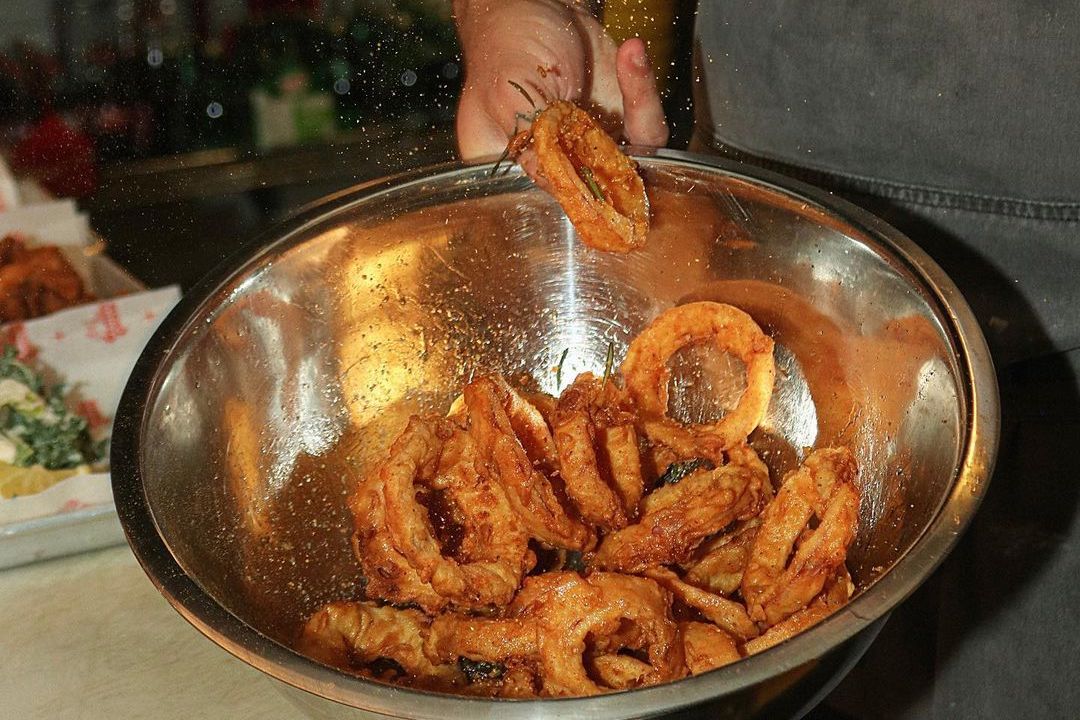
On the crispy side: Buttermilk onion rings resemble a slice of onion with a loaf of bread on it. Badly indelicate. Can’t taste the onion.
@bethearamos/Instagram
The sauces: Chicken comes with Frank’s Red Hot Sauce & buttermilk dressing, both very yummy. We add their garlic sauce. Also very good, just the right amount of bite.
111 Richmond St. W., inside Chef’s Hall, chefshall.com
Just a few weeks ago and without warning, Smith, the beloved three-level restaurant in Toronto’s Gay Village known for its chic interior and Instagrammable brunch, announced via social media that it had served its final huevos rancheros and strawberry cheesecake pancakes — much to the dismay of its loyal patrons.
“Farewell,” began the post on Smith’s Instagram. “It has been a pleasure to have served you on Church Street for 15 years from Straight, to Smith from late night parties, DJs, dinner soirees, to prides, breakfasts of Benedict and brisket this beloved house has been witness to many hook ups and hot dates but as such, in life, all good things must come to an end.”
Co-owned by Renda Abdo and Nadya Mancini, the abrupt closure comes just months after it was announced that another of the pair’s restaurants — popular Yorkville eatery Wish — would be closing after 22 years in business.
While long-time Smith customers will still be able to get their brunch fix at Smith’s sister restaurant, 7 West, sadly, this is not the case for a slew of other popular Toronto eateries, which have quietly closed over the last few months, leaving diners in the cold.
In January, long-time Junction Triangle restaurant Farmhouse Tavern suddenly closed without notifying customers. In 2020, the popular eatery spent more than $10 thousand winterizing their patio which included adding a barn.
Just a few months ago, the owners of world-renowned Chinese restaurant Lai Wah Heen, decided not to renew their lease after serving elevated dim sum to suits and tourists alike for close to three decades. When we reached out for comment, we were told that they were unsure if they would be reopening in a different location.
Not even the acclaim of Michelin recognition is enough to keep Toronto’ s buzziest eateries afloat.
Earlier this year, Babel a live-fire restaurant in North York owned by Oliver and Bonacini Hospitality announced via Instagram that they had closed — three days after their last service.
“Gutted to be honest — massive efforts from great people. Sad to see it go dark,” wrote one customer.
“I’ve never been more disappointed about a restaurant closing. This was our go-to spot for the last few years. The food was amazing!” commented another.
While the restaurant cited the “many twists and turns of the pandemic” as their reason for closing, some on social media were quick to point out that others reasons might be at play.
Others, like Portuguese chicken stalwart, The Rooster, which shut down for “temporary” renovations following a fire in 2021, remain closed two years later.
So just why are so many well-known restaurants in the city closing up shop without giving their loyal customers a heads up? Take a walk down any of Toronto’s streets and you’ll find a number of boarded-up windows, while more often than not, customers are likely to experience deleted social media accounts, disconnected phone lines, expired websites and owners who are almost impossible to get a hold of.
Regardless of the reasons, the Toronto dining scene continues to move forward, with a dozen hyped restaurant opening for every quiet closing. But for some customers, the closures have been difficult to bear.
“It’s hard enough when your favourite restaurant closes, but to not even find out until it’s been out of business for weeks or in some cases, months is even worse,” said Jennifer Dobrovnik, a patron of Smith’s. “When you’ve been a customer for such a long time, you almost feel personally offended that you weren’t notified beforehand,” she said.
If you’re proudly single and tired of pitying looks from strangers when you do anything alone—or if you sometimes just wish you were single and need an escape from the kids, roommates, or spouses— then you’ll love Toronto’s newest restaurant that caters to parties of one. As the city’s first solitary dining restaurant, Yunnan Noodle Shack is proving that sometimes it’s kinda cool to ride solo.
Husband-and-wife owners Andy Su and Jane Yu opened Yunnan Noodle Shack last week at 43 Baldwin Street. Everything about the restaurant, from its concept to the menu and even its name was inspired by Su’s hometown of Kunming in China’s southwestern province of Yunnan.
With over a decade of experience in the food and beverage industry, Su always knew he wanted to introduce his hometown culture to the people of Toronto. The items that dominate the menu most are dishes from Kunming: the rice noodles, which, Su says, are a common “fast-food” type of meal popular anytime of day; and the chilli peppers that are actually picked directly from the mountains of Yunnan and Kuaizhou.
But it wasn’t until a few years ago on a trip back to Yunnan that Su gained inspiration for the new venue while dining alone. “I was very impressed by the solitary dining concept, because I felt very comfortable sitting there eating my ramen.”
Su feels that too often people are distracted when they are dining with others and are being told how to feel about it, rather than allowing themselves to taste and appreciate the full capacity of the meal through their own interpretations, which, he says, is all about how you feel on a given day.
“When you eat alone, you can start to feel yourself,” he explains. “We encourage customers to explore by themselves. No matter the good, no matter the bad. We’re here to be guide, we’re in the background, we’re the tools. The food is also the tools. We just want you to get into the position to have a conversation with yourself and then to finish that journey and whether it’s thirty minutes, forty minutes—that moment is just for you, not anybody else.”
To enter Yunnan, guests walk through a curtain with Chinese characters meaning “it’s our first time meeting.” On the other side, wooden panels separate the spacious booths which each solo diners get to themselves. Beside a call button, in the booth diners will find five pairs of chopsticks, each engraved with the character Fú which means good fortune. Why five sets of chopsticks? Each one represents the five Chinese elements of the universe—gold, water, fire, soil, wood—which are the fundamentals of everything.
“We want our customers to have everything.”the co-owner explains, “like happiness and fortune.”
Su says he and Yu are currently working on developing blind boxes to place on each booth. The boxes will include an experience guide to explain some of the symbolism and characters found throughout the restaurant. “Everything is designed for a purpose.”
@eatseatsandmoreeats/Instagram
There is also a phone stand on the table, which is intended to be used as a place for customers to set aside their phones so they can enjoy the meal without distractions. “We want the customers to use their time to explore more things by themselves, instead of just looking at their phones,” says Su.
But, Su admits, the apparatus hasn’t always been used exactly as he had hoped quite yet, as he’s noticed diners propping up their devices to allow them to watch videos as they dine. Su, however, is optimistic that this will change once guests are more familiar with the concept of solo dining.
And it’s likely Torontonians will become more familiar with solitary dining. Back in 2019, OpenTable released data showing that solo reservations in Canada were on the rise, having grown by 75 per cent over the previous two years, with Toronto having the highest rate of growth in the country. And one can only assume that in the years since, COVID restrictions and isolations only encouraged individuals to get even more comfortable with solo activities—including dining.
Though Yunnan is currently the only restaurant in the city that exclusively serves solo diners, there are lots of other places that make great places for enjoying your own company. The wide chairs at Queen Street West’s Ikkousha Ramen Chicken—because, obviously, you can never have enough ramen—ensure you have enough space to yourself while you read the infographics that hang on the wall above you. Another favourite for solo diners is La Banane, a contemporary French restaurant whose marble-countered bar allows diners to watch the chefs as the prepare from the raw bar in front.
Yunnan Noodle Shack is currently open seven days a week from 11:30 a.m. until 3 p.m. and 5 p.m. until 9 p.m.
The Trekking Group, parent company of Treetop Trekking, a renowned outdoor adventure attraction, is preparing for the launch of uplå, an exciting aerial forest attraction in Stouffville. Anticipated to open its doors on June 23, uplå promises visitors a thrilling experience combining adventurous activities with a nature-inspired setting.
Following the success of its first location in Mont Saint Grégoire, Quebec, which welcomed over 100,000 guests in 2022, Treetop Trekking is eager to introduce this unique concept to Ontario. Developed and produced by The Trekking Group, uplå offers an extraordinary suspended world where visitors can enjoy a playful experience high up in the treetops, navigating through a network of nets.
“We wanted to create an exceptional outdoor recreation option that allows people to connect with nature in a fun and eco-friendly way,” explained Jean-François Couture, chief marketing officer at The Trekking Group. “Despite receiving interest from companies across North America, we decided to stay true to our roots and bring uplå to Ontario, driven by our passion for nature and providing accessible experiences for all.”
Nine interconnected trampolines in the treetops
The Stouffville uplå park will feature an impressive mega-trampoline boasting nine interconnected jumping surfaces. With pathways, slides, vertical tunnels, and a spiral entrance, the attraction will offer a diverse range of exhilarating activities for visitors to enjoy. The Trekking Group has carefully designed uplå to blend seamlessly with the natural surroundings, situated on a Toronto Regional Conservation Authority (TRCA) property.
Jean-François Couture emphasized the potential of uplå to provide individuals with an unforgettable adventure and an opportunity to disconnect from screens and daily stress, while reconnecting with nature in a unique and exciting way.
The development plan for uplå is designed to be modular, with additional features to be announced and incorporated throughout its first year of operation. Pre-sales for uplå will begin on May 15 ahead of the public opening.
A new football team at Western Technical-Commercial School in Toronto is making history as the first all-girls tackle football team in the city. The team is part of a movement in Ontario to make tackle football a real option for women and girls in the province.
On Thursday, Western Tech’s team joined three other teams from across the province for a series of scrimmages as part of provincial organization Football Ontario’s launch of a the Ontario Women’s Football League (OWFL), the first tackle football league for women in the province.
Before the launch of an Ontario U18 women’s tackle football team last year, Emily Todd, director of development and administration with Football Ontario, said girls who wanted to play tackle football in Ontario had no choice but to join the existing boys’ teams at their schools or men’s leagues.
“The first U18 team was a roster of 20 girls from across the province, and they competed at a national tournament in Regina against other provinces,” Todd said. “From there, we saw a need to have girls-only tackle football — a lot of the athletes on that team had only ever played with boys on co-ed teams. It’s great for girls getting into the sport; they’re able to play with other girls, establish new friendships and connections and grow together.”
Right now, Western Tech is the only Toronto District School Board school with a girls tackle football team, but hopefully as more students become interested, enough schools will start their own teams to make it an official high school sport for girls.
Now, the OWFL is launching with an inaugural jamboree on Saturday at York University, where 10 teams will be participating — three U16 and seven U19. The season begins next weekend and runs until playoffs in June.
“]
For Marny Sharpen, co-chair of the OWFL and and chair of the Ontario Summer Football League (OSFL), this new league is a dream come true. “For someone who, when I was in high school and tried to sign up for football, was told that I couldn’t and girls aren’t allowed to play, that’s something that really stuck with me for a long time. Two of my sons played football, I was always on the sidelines — president of one of the clubs, a team manager, always involved,” she said. “So to see where I was back in the ’80s, to now be a part of this, I couldn’t be more proud.”
Sharpen hopes that the league this year is successful enough that it brings about the launch of girls football teams to more regions across the province. At the OSFL, Sharpen said there were quite a few girls playing co-ed tackle football. “That’s kind of what’s got us going with this, and Football Ontario has made huge strides when it comes to tackle football for girls,” she said.
The league plans on expanding into lower age groups as more interest is generated. “This means an awful lot for me,” Sharpen said. “I want this to be successful for girls who felt like I did way back then. Football is an amazing sport — there’s a spot on the team for every kind of person.”
The last year was a a busy and exciting one for the Toronto food scene, in which we saw electric openings that ranged from highbrow to low, including modest local joints and grand, attention-grabbing eateries.
To highlight the standout newcomers, we asked Michelin-recognized chef Eric Chong, recently awarded a Bib Gourmand for R&D — a perfect representation of high-end modern Canadian Chinese cuisine — to tell us what he thought was the best new addition to the city’s dining scene. Read on to find out which exciting spot he selected.
Chef Chong’s pick: Chantecler
“The food is even better than I remember,” he recently told us. “The brioche à tête was sensational, and the French onion soup was the best I’ve ever had.”
Chantecler
Beloved bistro Chantecler returned this year with a new location and the same soul-warming French cuisine that made it a Parkdale neighbourhood favourite. Opened in 2012, the original Chantecler was decimated by a fire in 2019. A pop-up, a pandemic and a butcher shop later, and Chantecler reopened in spring 2023 in its new Bloorcourt home. Fans of the OG Chantecler will be delighted to see the return of menu mainstays, such as the top sirloin steak tartare served with house-made sourdough. New dishes channel the restaurant’s core ethos of French fare executed with unex- pected twists and local ingredients. Like the first iteration, the second coming of Chantecler also aims to appeal to diners with a variety of budgets. The restaurant’s namesake, a type of heritage chicken, is served as a duo of crispy pan roasted breast and thigh stuffed with mushroom duxelles. Nods to the Parkdale location can also be found in the decor, which incorporates a wood arch motif as well as some lighting and bar stools from the first restaurant. With its tin ceiling and hints of exposed brick, the vibes are as timeless and inviting as ever in the new space. A large patio overlooking Christie Pits Park is in the works for the warmer months. 798 Bloor St. W.
In Personal Injury Law, it’s not uncommon for more than one party to share some degree of responsibility in an accident. Whether you’re looking at a slip and fall or a motor vehicle accident, there is always the possibility of something called contributory negligence. Joshua Himel, a Partner at Diamond and Diamond Lawyers, discusses what contributory negligence is and further identifies how it can apply to different types of accidents.
What is Contributory Negligence?
Contributory negligence “is the extent to which you are personally responsible for causing the damages that you’ve suffered, whether as a result of being partially liable for the accident itself, or for failing to mitigate the damages that you sustained,” says Joshua Himel.
Being a very broad term, contributory negligence can actually be applied to all different kinds of personal injury cases. Common situations that lead to contributory negligence can include (but are not limited to):
Slip and Falls:
Failure to recognize your surroundings (ie. wearing flip flops or other forms of improper footwear in the winter, and slipping on ice)
Actively being on your phone and not paying attention to what is happening around you
Failure to wear prescription eyewear when it’s necessary
Carrying something that obstructs your vision
Motor Vehicle Accidents:
Speeding
Distracted Driving (ie. texting and driving)
Slamming on your brakes unexpectedly
Driving your vehicle even though you know that there’s something wrong with it
Are you entitled to SABS if you are found to have been contributorily negligent?
SABS, or the Statutory Accident Benefits Schedule is a form of no-fault coverage in Ontario that is designed to help individuals receive immediate assistance after an accident. “Since SABS is a form of no-fault coverage, this means that any individual, even if they have been found to be contributorily negligent, qualifies for SABS,” says Joshua Himel.
Is it worth contacting a lawyer if you contributed to your own accident?
“When in doubt, it’s always worth it to speak with a lawyer. A lawyer will be able to assess your case and help determine whether or not it makes sense to pursue a claim,” says Himel.
In personal injury law, it all comes down to a range of percentages that determine the extent to which you were at fault. Diamond and Diamond is Canada’s Largest Personal Injury Law Firm and has the experience needed to help you navigate your personal injury claim. Contact the firm today at 1-800-567-HURT to schedule a free consultation – you have nothing to lose and everything to gain!
About Jeremy Diamond
Jeremy Diamond is a lawyer and member of both Ontario and Florida Bars. Jeremy practices in the area of Plaintiff personal injury litigation. Click here to learn more about Jeremy Diamond.
I never thought I’d be someone to participate in Dry January — especially because I don’t even like drinking much anymore. But I have another vice — I love clothes. I love buying clothes; I love looking at clothes; I love reading about clothes (I am a subscriber to invite-only fashion newsletter Opulent Tips). What were once merely frequent but fiscally harmless purchases from Urban Outfitters sale racks now manifest themselves as less frequent but far more significant designer purchases. I got my first adult credit card so I could buy a custom Bode Senior Cords jacket in New York City. When both my passport and wallet were stolen in Barcelona, I somehow found a way to still buy a pair of Prada loafers I’d been coveting for months (they let me input my replacement credit card info, and my sales rep Ellaria emailed me for holidays and my birthday). I convinced myself to buy a recycled cashmere turtleneck from Dai because it is “sustainable” and allegedly a staple piece I needed in my wardrobe (I was right).
Don’t get me wrong: I do not regret a single one of these purchases. But in a cold turkey attempt to curb my spending habits, I determined not to spend a single Canadian dollar on clothing for all of January, something which proved to be extremely difficult but very necessary. I spent my evenings unwinding by scrolling through the SSENSE sale, adding items like Jacquemus sunglasses and House of Dagmar trousers to my wish list. I craved everything, including a bejewelled Collina Strada water bottle— it’s camp! It was agony.
And then suddenly, it was Feb. 1. I didn’t want to buy a single thing. The impulsive urges had faded and I’d gained a newfound limit to how far my wallet would stretch. Maybe it was Dry January. Or maybe it was the fact that inflation had increased significantly over the past year, and everything was more expensive, so buying a pair of Saint Laurent sunglasses seemed like an unwise financial decision. If I’m shelling out more money for tampons and Advil, gas or groceries, splurging on something that is, to some, frivolous is not only ill-advised but vapid and imprudent. I have rent to pay! I am anemic! These things cost money. Do our fashion purchases and trends indicate periods of economic turbulence? Or is it not as simple as tracking the height of hemlines to tell us whether a recession is here?
Iris Simpson, the co-founder of Hello, Couture! Design, said the answer to that has changed over the years. Simpson began working at at Eaton’s part-time as a student and has built a storied career in the fashion industry, including as the board director at the Fashion History Museum of Canada.
“Fashion is in an era of disruption; the old adage that hemlines fall and rise with the economy no longer holds the same weight it once held,” she said. (Evidence: Miu Miu FW22 mini-skirts.) “With the speed of trends and silhouettes falling in and out of style it’s caused many not to consider trends at all. It’s more about building an aesthetic that represents one’s authentic self. Aesthetics is what represents the lifestyle many women would like to emulate.”
Simpson is referring to the hemline index, the now-debunked theory that skirts are shorter during times of economic prosperity and are longer when the economy is suffering. But she points to another economic indicator in fashion that holds far more meaning. “The lipstick index, however, does hold weight. A small purchase of a lipstick is still a sign of an affordable indulgence during an economic downturn. Other beauty products such as nail polish and face creams can also substitute a lipstick purchase,” Simpson said.
With lipstick sales still soaring, it seems consumers are dealing with the economic downturn by indulging in more of these types of less expensive but still luxurious purchases. As it seems like every celebrity has launched a skincare or makeup brand, the demand from consumers is obviously there. While living through times like these — a global pandemic, erosion of democracy, etc. — one would imagine that buying a new shade of lipstick or trying out a new moisturizer not only feel like a luxury, but allow us to maintain the illusion of control.
While Simpson said fashion trends aren’t as strongly influenced by the economy anymore, that may be because of the new era of fashion we’re in — one of micro-trends and a capitalistic tendency to buy, buy, buy.
Iris Simpson said the constant evolution of fashion trends has changed our consumption habits. Photo: @irisknowsbest/Instagram
“Fashion has to constantly change to keep consumers wanting to buy. New trends give them a reason to keep buying and this is very evident during economic struggles,” Simpson shared. “Fast fashion and luxury fashion has had a huge impact on consumers as a result of economic growth. Both these sectors have sustained huge growth over the last decade.”
Perhaps the fact that we live half our lives online has contributed to this growth. There’s a sort of class anxiety that emerges when you’re confronted with images of expensively-dressed people on a daily, if not hourly, basis. In the past, without the Internet, we weren’t fed a steady diet of what it’s like to live outside our own social milieu. These days, I can’t help but compare myself to the slew of influencers that populate my explore page, toting their gifted bags and borrowed clothing.
That being said, while fast and luxury fashion have seen major development, consumers’ priorities have also shifted. “Consumers are also becoming much more conscious of the environment,” Simpson said, “resulting in major growth in sustainable fashion and locally produced goods from more diverse companies.”
There’s distinct intention behind some consumers’ purchases. They recognize that actions, such as deciding where their money goes, makes a difference. That’s part of the reason I bought that Dai sweater back in the fall. Sure, it’s a little pricier than what I’d normally pay for a knit turtleneck, but then again, what if what my conception of what I’d normally pay is wrong? What if in buying cheaply made, cheaply bought clothing, I’m simply feeding into corporate greed that contributes to the oppression of underpaid workers overseas and pollutes the environment with interminable waste? If one has the purchasing power to buy less and spend a little more to buy a sweater or a pair of jeans or a jacket that will last them for a decade rather than a handful of washes, I fear we have a responsibility to exercise our wallets in such a way. As Simpson said, what we chose to wear should reflect “one’s authentic self.” Our choice in clothing is inherently political. We need to ask ourselves who we want to be.
Toronto’s top tattoo artists have done a lot of body art — but none as special as the ones for their clients’ mothers. We asked them to share the details of their most memorable mom tattoo experiences, from a twist on a traditional heart for a client’s two moms to matching ones in honour of the artist’s own mom, done on his sisters.
CONNOR, TBC TATTOO PARLOUR
“I did a pair for my sisters. I was able to do a little butterfly and a rose with the mother banner. My mom doesn’t know about them yet; she’s been away for a few days, so this might be the first time she sees them!” @con____artist
BILLIE, PRIVATE STUDIO
“I posted a traditional mom heart on my account, and I had someone message me and say they wanted to change the ‘mom’ to ‘moms’ because they have two moms. They dedicated that tattoo to not only their moms, but moms everywhere, so it’s the ultimate mom tattoo.” @sandboytats
CORI, PRIVATE STUDIO
“A friend’s mom had passed away when she was three years old, and she got this one and placed it so it was sort of beside her heart. It was a really nice way to commemorate this not present female figure in her life.” @crab_m3at_
KRYS, TRU TATTOO SHOP
“One of the most common mom tattoos that I’ve done is getting something in your mom’s or grandmother’s handwriting. For grandmas, it’s pretty popular after they’ve passed away — cute little notes that say their name.” @krys.ink
VICTORIA, TBC TATTOO PARLOUR
“One of our regular clients here came in and she wanted to get her mom’s name tattooed in script on her face above her eyebrow. Sadly, her mom passed away, but I was happy I could do that memorial tattoo for her.” @victoria.rod
GERMAN, PASSAGE TATTOO
“The client was a first generation Latino from California who migrated to Toronto, and he wanted a tattoo for his mom. In the banner is the word “Ama,” a Latin nickname for mother. Latin culture is more matriarchal; our family revolves around our strong mother figures.” @germanshible
















 Jeremy Diamond is a lawyer and member of both Ontario and Florida Bars. Jeremy practices in the area of Plaintiff personal injury litigation. Click here to learn more about


